Tag: recycling

  • Rage against the greenwashing machine

    Rage against the greenwashing machine

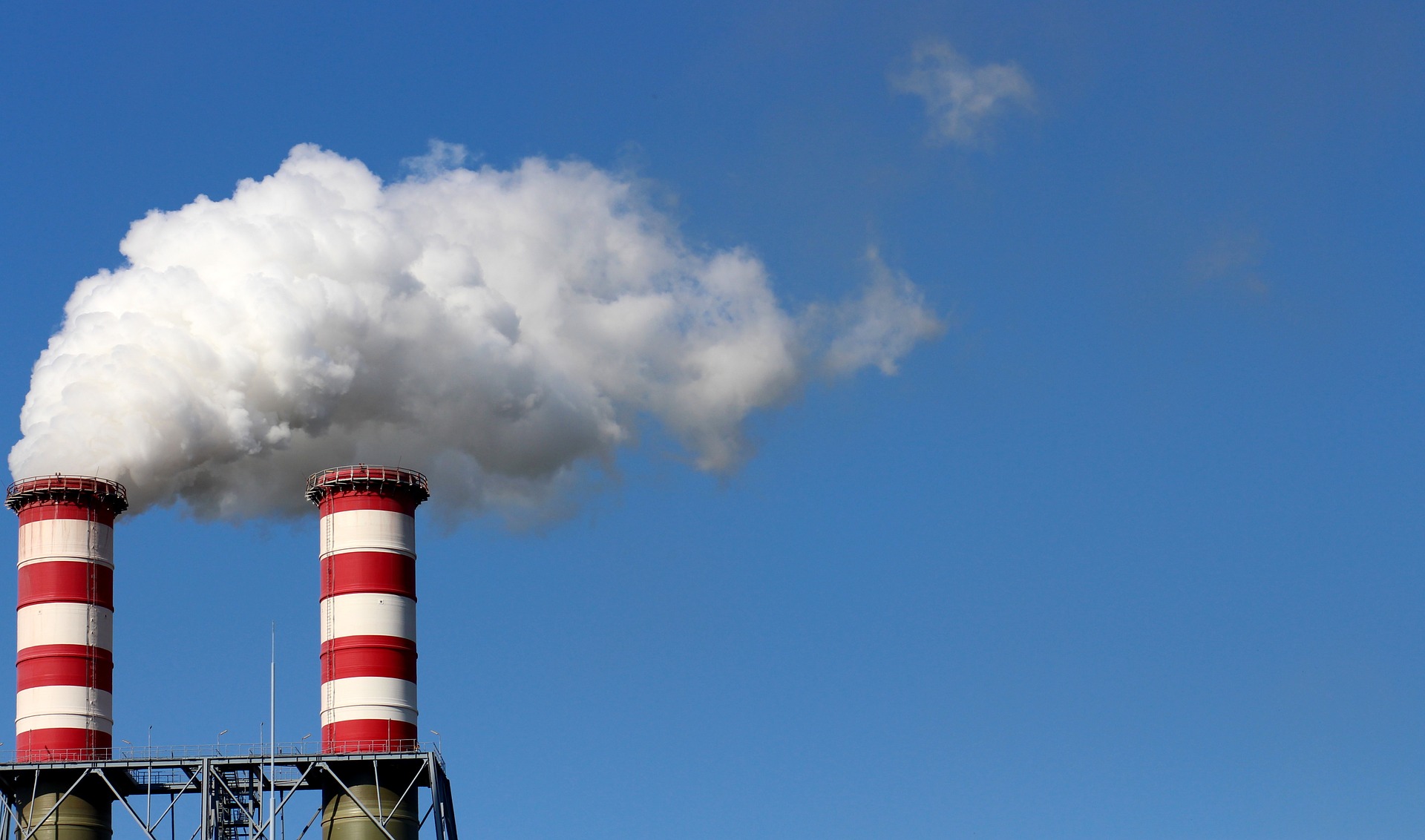
    Smoking up the atmosphere: just 100 companies are responsible for 71% of the world’s emissions. Photo via Wikimedia Commons

    As a child during the late 1990s, I was surrounded by reminders of my personal duty of care to our planet. 

    My boyhood hero Barney the Dinosaur relentlessly implored me to never let the water run, just as Captain Planet had for my older brother. 

    Although I was somewhat unsure of what a compost bin was, I made sure to lecture my parents as to the virtues it would bring to our household.

    Despite constant assurance that my lifestyle habits could change the world, I always felt that underlying sense of futility common amongst those born around Fukuyama’s end of history.

    This ambient dread was perhaps exacerbated by a sense of contradiction – the Celtic Tiger culture of my formative years celebrated reckless excess and unfettered corporate growth while we were personally made hyper-aware of our individual responsibilities to the earth. 

    As I grew older, I began to feel that these unexplained anxieties had been anything but irrational – according to a much cited and hotly debated 2017 study, just 100 companies are responsible for 71% of emissions.

    While it is undeniably important to remember that our individual actions can make a change, I was immediately struck by the dissonance of how little attention had been given to the perspective that climate change is primarily driven by corporations. 

    “On an international level, fossil fuel companies seem to be particularly assiduous greenwashers”

    Caroline Whyte

    This perspective had been kept out of my consciousness, in part, through the corporate strategy of greenwashing – the marketing ploy through which the companies who are disproportionately responsible for burning up our planet attempt to present themselves as saviors of mother nature.

    “I’d say there are two kinds of corporate greenwashers, intentional and unintentional,” says Caroline Whyte of the Foundation for the Economics of Sustainability, or Feasta.

    “Intentional greenwashers aim to make money off naive consumers who are concerned about the environment and are befuddled by clever marketing. These greenwashers seem not to believe that there’s an environmental crisis at all – or if there is, that it somehow won’t affect them and so they can just make a few superficial gestures to placate the public and then continue on as before,” says Whyte.

    “The unintentional greenwashers are different because they genuinely wish to improve their businesses’ environmental impact. The problem is that they believe that ‘green’ GDP growth is possible in the aggregate, so they don’t see any need for systemic change, either within their own organisations or in the wider economy,” she continues.

    Whyte believes that the motivation for companies to greenwash stems from a mandate to maximise profits for shareholders, as well as financial constraints which make it impossible for corporations to truly put the environment first. 

    “Corporations have more of an impact than individuals for sure, because of their formidable political lobbying power, their ownership of the mainstream media and their ability to hire expensive lawyers to fight legal challenges to the damage they do,” Whyte says. 

    Here in Ireland, many of us were made aware of greenwashing after Ryanair declared themselves “Europe’s lowest fares, lowest carbon emissions airline” just five months after their inclusion on the EU top 10 carbon emitters list – and they are far from the only Irish company to employ misleading marketing campaigns. 

    Ryanair is just one of many companies using Greenwashing tactics. Photo from Ryanair’s Media Centre

    “The Origin Green programme in Ireland is a clear example. It’s run by Bord Bia, but many Irish agricultural companies are participants,” says Whyte. 

    “Bord Bia has a conflict of interest because it’s simultaneously generating metrics to try and show how sustainable Irish agriculture is, and also acting as a marketer for Irish products abroad.

    “Bord Bia publishes figures showing that the amount of emissions generated per litre of milk produced in Ireland has gone down – while failing to mention that overall production of milk has increased dramatically over the past decade, so that aggregate emissions are growing relentlessly.

    Bord Bia has been contacted for comment on this but The City is yet to receive a response.

    “On an international level, fossil fuel companies seem to be particularly assiduous greenwashers,” says Whyte.

    “Intentional greenwashers aim to make money off naive consumers who are concerned about the environment and are befuddled by clever marketing”

    Whyte

    In Whyte’s view, the corporate orientation towards shareholder profit as well as the greenwashing campaigns which justify these environmentally harmful business models need to be ended if we are to move towards a sustainable future. 

    “To end greenwashing there needs to be a reorientation of international trade law and corporate law in favour of stability and resilience rather than aggregate productivity growth, along with a massive recalibration of debts, the setting of hard limits on the supply of raw materials whose use breaches planetary boundaries, such as fossil fuels, and a shift in the overall focus of the economy away from increasing consumption and towards well-being.

    “Companies can of course also set internal targets for becoming more sustainable in. But that doesn’t have as much effect on broader economic dynamics or on their own general orientation, and so it’s the weakest action of the three – although it gets the most attention right now.”

    The European Parliament have taken steps to address greenwashing through the introduction of the EU taxonomy for sustainable activities in order to define and categorise which economic activities can genuinely be categorised as sustainable.

    The full list of sustainable activities is set to be completed in December of this year.

  • Bread 41: meeting the knead for sustainability

    Bread 41: meeting the knead for sustainability

    By Jade Carpenter and Paula Bowden

    Located at 41 Pearse Street, Bread 41 is a cafe and bakery striving for sustainability. From their commitment to no single use cups on Mondays, to the ingredients and produce in their kitchen, sustainability is always a priority.

    Thecity.ie spoke to owner Eoin Cluskey about going green and future plans for the business.

  • The life of a coffee cup: are compostable lids really compostable?

    The life of a coffee cup: are compostable lids really compostable?

    By Luke Toomey and Sian Abraham long

    Even the savviest of coffee consumers have experienced the coffee lid confusion. At the condiments counter you’ve asked yourself; do I take the regular lid, or this slightly off white compostable, but just as effective version? Any one of us concerned about the climate crisis will choose whatever option sells us a more environmentally sound version of ourselves. But how compostable is this new phenomenon, really?  

    On November 6 of this year, the Minister for Climate Action, Richard Bruton announced that he will be introducing a coffee cup levy to single-use and compostable cups. The new levy, which will be introduced within three years, aims to encourage a pivot towards more sustainable options when it comes to coffee containment.    


    Compostable coffee lids have become increasingly popular among cafe culture in recent years. Any sustainable alternative has to be a good thing, right? This would be the case if the right infrastructure was in place in Ireland for the industrial composting required of ‘compostable’ cups and lids.

    A typical compostable coffee cup lid

    Understanding domestic recycling is not intuitive so it’s not surprising that many people believe a cup or lid labelled ‘compostable’ is a better choice for the environment. Arguably, they can be, but only when they’re correctly disposed off. Composting these ‘compostable’ lids and cups, can only happen in a controlled environment – commercial composting.

    Composting these ‘compostable’ lids and cups, can only happen in a controlled environment – commercial composting. 

    Our public system

    In Dublin, we are somewhat in the junior infants equivalent of European waste management services. German cities have made a positive example of themselves by providing segregated waste bins on their streets, for better, more efficient recycling. According to Simon Brock from Dublin City Council (DCC), Dublin has attempted to implement a segregated bin system in the past. These trials, the DCC said, yielded a high contamination rate of recyclable waste, which means they cannot be recycled. 

    Dublin City Council collects over 16.5 thousand tonnes of waste per year. This includes waste from public bins, street sweeping and illegal dumping. When our city is collecting this much waste, should it not be utilising the same system as our European counterparts? A second trial of this segregated system is planned to be introduced in the new year in certain areas of Dublin.

    A segregated system can only work under a unified public effort to ensure we are correctly separating our waste, be it at home or out and about. Chucking a milky coffee cup in on top of dry, mixed recyclables means anything spoiled is returned to our general, non recyclable waste bin.


    Understanding what happens to our coffee cups and lids, compostable or not, allows us to make a better judgement when it comes to choosing how we contain our hot drinks. Scroll through our timeline to discover what happens to any one of the options you might choose.


    [cool-timeline layout=”simple” animation=”fade-up” date-format=” ” icons=”NO” show-posts=”20″ skin=”default” order=”DESC” story-content=”full”]

    Treefree Cups are made from the fibres of sugar-cane waste and are fully compostable under controlled conditions.
    Closing the loop

    Coffee shops using these compostable products will ideally separate them from other waste. Once returned the coffee cups and lids are commercially composted in an environment designed to be a perfect place for these products to break down. These conditions will contain the correct balance of microbes, warmth and moisture which makes the process quick and easy.

    Take the Treefree Cup, for example. Zeus, the Irish global packaging company, produces one of the only paper-free compostable cups in Ireland which instead, opts for fibrous materials from sugar-cane waste. Businesses that use their products are provided with a special cup collection bin that are returned back to Zeus for composting in order to ‘close the loop’ on biodegradable waste management systems.

    Its estimated that less than 1% of compostable cups are actually being composted properly worldwide and so closed loop systems ensures that these cups and lids are composted properly and do not find themselves in a landfill.

    Become a VegWare Vigilante?

    If we can’t put them in our domestic waste, in public bins then you might think to compost these items at home yourself. While you’re welcome to try your hand at it, according to Vegware.com: “Home composting conditions vary with the skill of the householder, so we don’t make any claims there, but there have been successful trials using hot compost bins.”

    Dublin City Council collects over 16.5 thousand tonnes of waste per year. This includes waste from public bins, street sweeping and illegal dumping. When our city is collecting this much waste, should it not be utilising the same system as our European counterparts? A second trial of this segregated system is planned to be introduced in the new year in certain areas of Dublin.

    A segregated system can only work under a unified public effort to ensure we are correctly separating our waste, be it at home or out and about. Chucking a milky coffee cup in on top of dry, mixed recyclables means anything spoiled is returned to our general, non recyclable waste bin. 

    How is our public waste managed?

    “All waste that is deposited in public litter bins goes through processing at a waste facility to extract waste streams for a variety of uses including recycling and for use as SRF (Solid Recovered Fuel) or RSF (Refuse Recovered Fuel),” said Brock.

    Dublin City Council collects over 16.5 thousand tonnes of waste every year.

    Solid recovered fuel refers to fuel created through a process of dehydrating combustible waste such as biodegradable food waste, paper and kitchen waste, dirt, rocks and clothing. 

    Refuse recovered fuel is produced by using whatever is left over from the process of creating an SRF. An RSF is a non-specified waste, this makes it difficult to assure quality and environmental-soundness. 

    The future of coffee cups

    The current infrastructure does not allow for recycling or composting the coffee lids and cups we’re using every day. So what options have we?

    According to MyWaste.ie, a reusable cup used only seven times is more sustainable than a single-use coffee cup and lid – compostable or not. So next time you turn to the condiments counter at your local coffee shop, the only thing you should plan to reach for is the milk.

    A better understanding of how our waste and recycling is managed is required to make more environmentally sound decisions about our single-use, non-recyclables and compostables. Often, we might think we are making the right decisions about products which may not mean to be misleading in how environmentally friendly they are. With little infrastructure currently in place to maximise the environmental impact of these new compostable lids, the catering industry and our government alike should place focus and incentives on the use of reusable cups.

  • Dublin’s Urban Farm

    Dublin’s Urban Farm

    It used to be an actual chocolate factory a long time ago. “The Chocolate Factory”, is now the name of this tall, solid building on Kings Inn Street. and the community of businesses inside that are rejuvenating it.

    There’s a dojo, several photographers, an upcycling furniture shop, a graffiti artist and a café that is planned to open in February. Last week 2,000 people attended a vintage market there. I’m here to take a look at the “Urban Farm” developing on the roof. Paddy O’Kearney is waiting to show me and some urban planning students around on the huge ground floor, which dwarfs the café that is taking shape in the corner.

    Paddy is enthusiastic and animated when we finally get up to the fifth storey, the workstation just below Ireland’s first rooftop farm. You could call the space up here a shell, but there’s a lot happening. There are several workstations, plant nurseries, what looks like a pen for animals, bags of soil, and an aquarium with plants above nestled in old plastic bottles. Most strikingly though, is what looks like a slaughterhouse for wooden pallets.

    Image

    “It takes about 2-3 pallets, and a day’s work to make one of these”. Paddy brings us over to a “multi-tier raised bed”, which is a solid looking wooden construction, with different levels of shelves to house plants. “We coat them in yacht varnish, they’re pretty sturdy. It allows us to grow on several different levels. Blueberries, blackberries, all your granules, but you can still plant in your annuals as well and your bi-annuals.” Paddy says that when he looked online he saw these things selling for about 180euro and he’s not lying.

    Image

    This floor, which Paddy plans to make into a nursery, could be described as chaotic, but it doesn’t feel messy when you look at it in detail. It’s well organised, with safety equipment and fire extinguishers on the wall. More than that, you get the sense that everything in it, the rubble, the soil, the fish, the workstations, is being put to good use. Paddy has a plan to upcycle any material you can think of. That’s what the Urban Farm is all about.

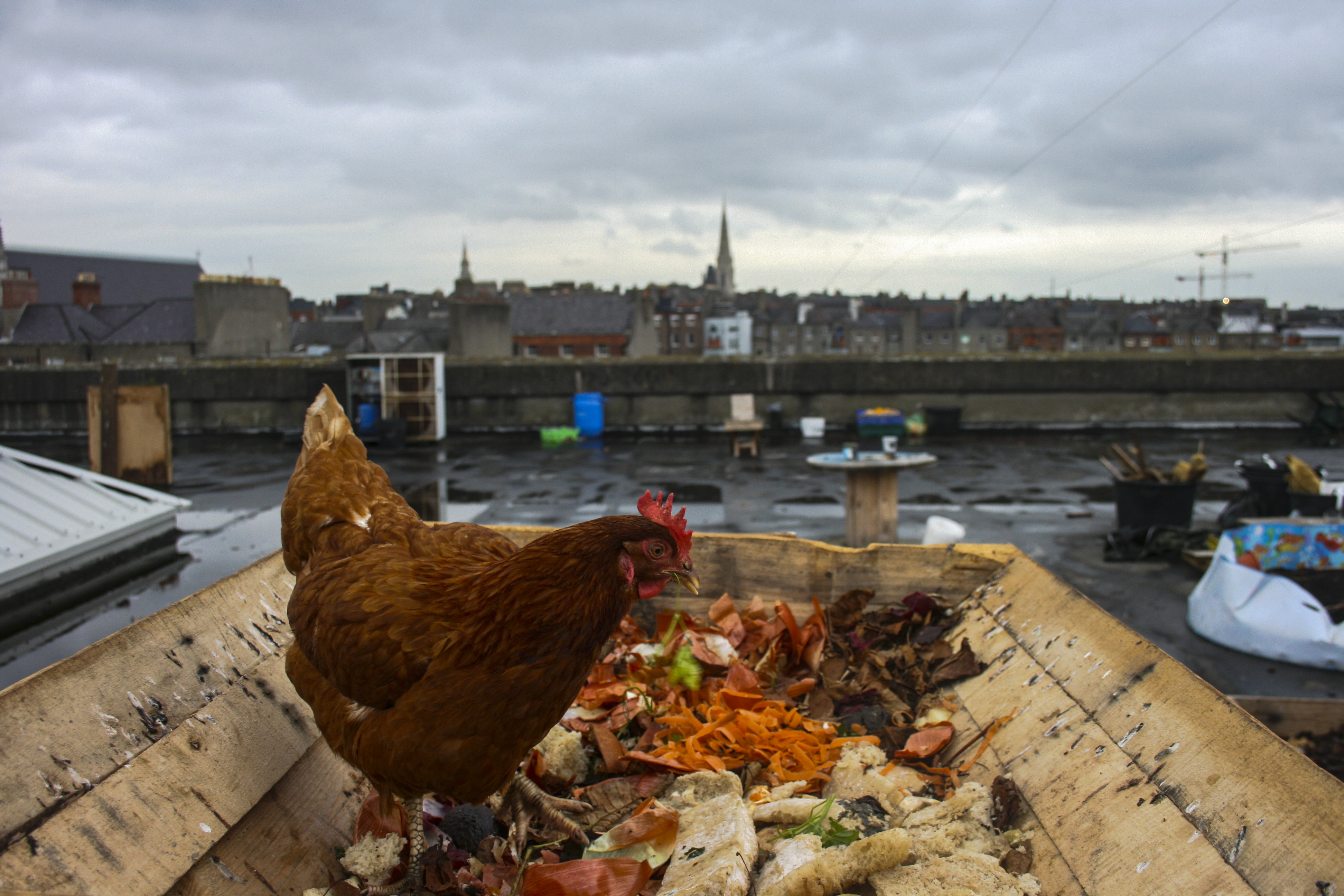
    “So we go up”.  We’re led up onto the roof, and are greeted by six friendly, well-fed chickens. Paddy asks them  not to drink his coffee as he places it on the ground. If the chickens are puzzled about being up above Dublin City on the roof of an old chocolate factory, they don’t show it, happily pecking away at the soil and compost.

    Image

    Paddy describes the roof as “stunning”, and it is and not just in its views. The work that’s taken place on it over the last four months is impressive, but only confined to one corner of the roof so far. Still, it’s exciting to look at what’s happened so far and imagine it multiplying five or six times. It’s exciting because what has happened has worked. I never thought of a roof going to waste before, but I guess they can, not this one though.

    Nothing at the Urban Farm is going unused. “It’s all about upcycling. Figuring out how we can use what we have” says Paddy. The slanted roof covering the doorway to the roof is being put to use housing plants. The chicken coop which Paddy and the rest of the urban farmers built themselves, has a plastic roof made from tiles they found. At the back of the chicken coop is a greenhouse.Image

    Now you see the end result of the pallet slaughterhouse. The multi-tier raised beds are all over the roof housing all sorts of plants and vegetables.

    “We’re trying to build a forest floor here”, Paddy takes us down a corridor, with around ten wooden boxes on either side, all filled with multi-coloured compost. Some of which the chickens, who Paddy is happy to report are producing a lot of eggs, are feeding out of. The floor is made from pallets, but between the wood is actual soil and as Paddy shows us, a lot of worms. “It’s a worm highway essentially. We’re trying to figure out how to use every space.”

    Image
    The compost comes from various café’s around Dublin, like Cornucopia and Mother Hubbard’s that mostly serve vegetarian food. “We just layer it up with some soil and the chickens get at it”

    “We’re not 100% sure yet to what our plan is, it’s a bit of a work in progress at the moment ,” Paddy admits. “What we want to do is optimise the space itself, so we can work out different things to do with the space. it needs to be in a sense a classroom, but also aesthetically pleasing so people want to hang out here.”

    Image

    The urban farming students, who are quite impressed, are keen to ask about plans “Plans, there are plans, there’s talks of building a geodesic dome for example, whether or not that’s going to happen though…There are a lot of questions”.

    The roof, we’re assured, can take a lot of weight. “It used to be a chocolate factory. They’d store huge barrels up here. The roof can take at least 200 tonnes.”

    Image

    Paddy himself has a fine art background  and five years garden experience. He described the Urban Farm as being “five minutes from the Spire, fifteen minutes from Grafton St.”, not unlike a businessman, and he is, having started City Composting Ltd. two years ago. Like the Urban Farm, City Composting is all about sustainability. The Urban Farm is a great idea, it puts a space that would otherwise be going to waste to good use, it puts a lot of waste to good use, but it’s also sustainable as a business. The Urban Farm pays a “very fair rent” to the lease-holder of the Chocolate Factory, and they’re exploring ways to generate money.

    Before finding the Chocolate Factory, Paddy tried to go through Dublin City Council to show how empty spaces can be put to good use. It was in that process that he met his fellow two fellow urban farmers, and they started the Chocolate Factory. “There a lot of supportive people in the Council. But we got a bit sick of the bureaucracy. The Chocolate Factory understands what we’re doing. Now we can go to the Council and go ‘Here, this is what can be done. This is how easy it is’.

    “In ten years or whatever, there might be offices here. Fine. We can pack up and go easily enough.” The idea being they could lease a space easily, put it to use before maybe a business wants to move in. “We approached a few letting agencies about spaces and tried to explain the idea. They said sure ‘you can buy it for 2 or 3 million euros. They didn’t really get it. Meanwhile those spaces are still empty”

    Image

    “We’re a business with an ethos.” explains Paddy after the urban planning students are gone. “It’s about sustainability. We get transition year students doing their work experience here. We get volunteers. They help us out building things, but they also learn a lot. If they want to use some of our nails and varnish and throw us so money to cover them, that’s fine”.

    On King’s Inn Street, you wouldn’t think there’s an urban farm taking place above your head, but there is. As an eco-concious business , upcycling all the materials they can get their hands on, it’s a great idea. I asked Paddy if there was a lot of old junk in the space when they moved in. “Yeah, a lot of old wood, plastic tiles. It was great”. But in Dublin especially, upcycling what would be another vacant space in the city centre into a useful, living area, is a brilliant initiative.