According to figures released by the HSE, Dublin has seen the most restaurant closures so far in 2017.
Dublin accounted for 44 percent of the total closures in Ireland so far. Following Dublin is Donegal and Cork, each accounting for three percent of the closures.
The lowest amount of closures took place in Laois, Kildare, Longford and Wicklow, with each of these counties only having one food establishment closed.
There have been no closures recorded as of yet in counties Carlow, Cavan, Clare, Galway, Kerry, Kilkenny, Leitrim, Mayo, Monaghan, Offaly, Roscommon, and Waterford.
Punjab Pantry is one of the many food establishments that have been closed this year due to breaches of food safety legislation.
Punjab Pantry, with an address of 39 Richmond Street South, Dublin 2, was closed in February this year by an environmental health officer working with the HSE.
Documents released by the HSE have revealed the reasoning behind the restaurant’s closure, with many legislation breaches being documented.
The environmental health officer recorded approximately 90 to 100 rodent droppings at the back entrance to the premises, as a result of the back door not being adequately pest proofed. A large hole was noted around the pipework at the back entrance also, giving access to the rodents.
Poor temperature control was also noted on the premises with chicken and garlic mayonnaise being stored at the wrong temperatures.
Drainage facilities did not meet the requirements of legislation either. The equipment sink in the kitchen was not connected to the drainage system and the wash hand basin in the basement kitchen was blocked.
The equipment and food preparation surfaces were also a cause for concern, with rust found on the interior of the cooking equipment and dirt, food particles, human hair and debris noted on food preparation surfaces and equipment.
According to the HSE report, the conditions of the restaurant were ‘filthy’.
The restaurant trade in Ireland has been booming in recent times, but as Gary Ibbotson explores, it’s not as glamorous for the workers making it happen.
A shortage of chefs will result in the closure of restaurants, according to the Restaurants Association of Ireland (RAI).
The RAI says that 5,000 chefs are required by 2016 to fill the thousands of vacancies in the industry.
The RAI is calling for the re-establishment of ‘CERT’, which is a former State Training Agency for Tourism in Ireland, in order to train chefs to fill these jobs.
According to the RAI, it has gotten to the stage where some restaurants now face closure, let alone being able to stay open for 7 days.
“Restaurants are closing midweek now,” said RAI CEO Adrian Cummins. “Usually on Mondays, Tuesdays and Wednesdays, because they can’t have a 7 day operation, due to not having a chef.
“They might have a head chef, but they mightn’t have enough chefs to keep it going for the rest of the week. Because of this … you’re talking about 5% of all restaurants currently closing because of that reason across the country.”
Cummins believes that CERT should be re-established, yet at the moment there is no talk to suggest it will happen.
“We believe that bringing back CERT is the right thing to do, and at the moment the ball is in her [Minister of Education Jan O’Sullivan’s] court,” he said.
“We would be advocating that she would, and we will be doing everything in our power to work with her to do that.”
When asked if it was an issue concerning wages, Cummins replied: “It’s not an issue of wages at all, it’s because chefs aren’t training enough.”
Conor Roban is currently Kitchen Manager in Boojum, Dublin (Millennium Walkway).
“Cases of people getting paid €450 to work 70 hours and more a week are common,” Roban said.
As someone who deals with staff in restaurants, Roban explained that, “A stressful environment results in a large turnover of staff and so a lot of people will head off to other countries where they know they will be paid a real wage as a skilled workforce.
“I think people being under paid feel under-valued,” he added.
Many people applying for the positions currently are deemed not to be appropriately qualified and this reflects the fact that there is not enough chef training centers, according to the RAI.
Currently 1,800 chefs qualify each year from certified culinary training programmes.
Most of us don’t question how many calories are in a steaming plate of creamy tagliatelle when out for a meal or while ordering our favourite takeaway, but very soon we will not be able to avoid this. In February this year, Ireland’s health minister Leo Varadkar announced that by 2016 all menus from restaurants, takeaways and any establishments serving food must include the calorie information on the menu.
While statistics show that obesity is a growing crisis in Ireland and something that must be tackled – according to the Irish Heart Foundation (IHF) obesity has increased by 67% between 1990 and 2000 – do we really need to know the calorie count for our meals when we’re eating out? What once in Ireland may have been a monthly treat has now turned into a regular occurrence and with so many people eating a number of their meals outside of the home, will calorie information positively impact on Ireland’s obesity crisis?
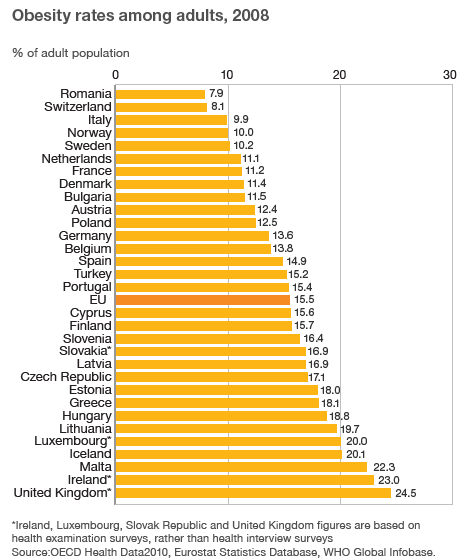
Irish Obesity rates are now the second highest in Europe at 23 percent according to the Organisation for Economic Co-operation and Development. European obesity levels map
2 out of 5 adults are overweight and 1 in 5 children aged between 5 and 12 are overweight or obese.Irish obesity level statistics
“I think there is an issue with passive eating,” says Sinead Shanley a dietician from the Irish Heart Foundation. “There are studies showing after 20 minutes of sitting, there is a massive change in hormones, in your resting metabolic rate, in the calories you burn, in the fat you burn. We are sitting down for much longer, with sedentary lifestyles people are sitting down for at least eight hours a day, and this affects our bodies.”
Obesity may not just be a matter of calories, but of appetites fuelled by the content of our food. Calorie information alone without details of fat, sugar and salt may be missing a big part of the problem. “The overriding message is we are eating too many convenience foods and whether we like it or not, they tend to be high in fat or high in sugar and/or salt,” Shanley says.”Anything that is high in energy and low in nutrition and is eaten on a regular basis makes it really, really difficult to try to control and manage your weight.”
Stacey Machesney, from Glenville Nutrition, agrees that there are many factors contributing to the massive increase in obesity rates in Ireland. “We must look at the overall picture, the increase in fast foods, the accessibility and convenience of cheap processed foods, the increase in the variety of high sugar foods, the cost of the ‘bad’ food compared to the healthy options, taste, increase in sedentary lifestyle, the list goes on,” she says.
While Ireland continues to lose the obesity battle, is it only governments that have a responsibility to keep up the fight? If our changed lifestyles are the main culprit for obesity, then the health sector, the food industry and the education system, among others, need to work together to ensure the problem is dealt with.
“The onus is on the wider community and government to fund and allow charities to go in and implement initiatives and give support,” Shanley says. “It is the responsibility of society, the community and the food industry to try and regulate and make the healthier choices the easier choices. We need to support the individual making the choices.”
People still choose foods based on factors other than health. Machesney recalls: “The Irish Universities Nutrition Alliance carried out a nutrition survey of 1,500 adults between 18 and 90 years of age in 2011 to see what adults are eating. They were given six food choice motives, including taste, cost, health and nutrition, convenience, ‘feel good’ (i.e. mood), and weight control. What do you think was the number one? Taste. Even when adults know about food health they still choose taste over health.”
Rachael from TheCity, spoke with the managers of Joe Burger Jo’Burger on Castle Market Street and Urban Picnic Urban Picnic in George’s Street Arcade about the calorie information on menus and the effects this will have on their business.
Calorie information in restaurants will no doubt help the public on better educating themselves on rough guidelines when eating out, and it is a step in the right direction, but, as Shanley says, “just a step”. She says the Irish Heart Foundation would particularly like to see an emphasis on informing eaters about salt content: “Overeating and excess calories is a real problem in Irish obesity but this information doesn’t highlight the salt, so that would be a huge difficulty we would have with it. If we reduce our salt intake by half a teaspoon per day it would prevent 900 deaths per year from stroke or heart attack.”
The IHF also recommends a traffic light system which looks at fats and the quality of fats along with calories. “We are looking at what type of fats are in the food. From our point of view the quality of fats is really important and that is missed completely.”
Again, Machesney agrees. “I think it is never too late to make a change. As a society we are getting bigger in numbers and in waist sizes. We need to educate ourselves on what we are eating. It is great adding calorie information to menus but then let us also teach people how to read calories properly. It is not enough to count calories but we need to know what portion is being given to protein, carbohydrates and fat. If we could help people to help themselves we will have a better chance than trying to force change.”
There is also the argument that the implementation of calorie information on the culinary industry will have grave repercussions for small businesses due to cost. The Food Safety Authority of Ireland (FSAI) have an online tool for businesses but Shanley suggests there needs to be more support.
Shanley is, in the end, optimistic. “When calories are displayed, restaurants will make more of an effort to actually change and opt for healthier options because they are exposed,” she says. “The government have said calorie posting was one of a range of measures on obesity planning for 2015 and other measures will be revised like healthy eating guidelines a new obesity policy action plan such as the Health and Wellbeing Operational Plan 2015.”
Looking at calories alone is not enough to ensure a healthy balanced diet but it can help people avoid meals that are extremely high in calories – which will more likely be high in fat, sugar and salt. But the focus needs to be more on overall health. The onus is on everyone from the schools to businesses and everyone in between to make the effort to provide healthy foods and to educate people on healthy eating, which in turn will lead to society making better choices with food.
Experts’ Top 3 tips for a healthy lifestyle
Sinead Shanley, dietician from the Irish Heart Foundation, recommends:
Reducing consumption of processed foods. We know now that they are generally the types of foods that are high in the unhealthier fats and also can be high in sugar and salt. Some 65 to 70% of our salt intake comes from processed foods. Freshly prepared food would be number one. That goes from breakfast to lunch boxes to dinners.
Keeping fats to a minimum. Keep high-quality fats in your diet, particularly polyunsaturated, which is in line with the Mediterranean style diet and the diet we advocate.
Prioritising fibre is key as it reduces your bad cholesterol, makes you feel fuller for longer. It is almost a negative calorie, as the body does not absorb any of the calories from fibre as it simply pushes through the body.
Stacey Machesney from Glenville Nutrition recommends:
Eating the Rainbow – ensure you are eating a colourful range of fruits and vegetables.
Eating a little protein with every meal to help balance insulin levels and keep you fuller for longer.
Measuring your portion size. Many people are overeating without even knowing. The recommended meat portion is the size of a deck of cards.





You must be logged in to post a comment.