
Tag: rsa

  • How has the Covid-19 pandemic changed cycling in Dublin City?

    How has the Covid-19 pandemic changed cycling in Dublin City?

    Since the start of the Coronavirus pandemic, people have looked for alternative methods of travelling to avoid busy public transport. Eibhin Kavanagh investigates how the pandemic is affecting cycling in the city.

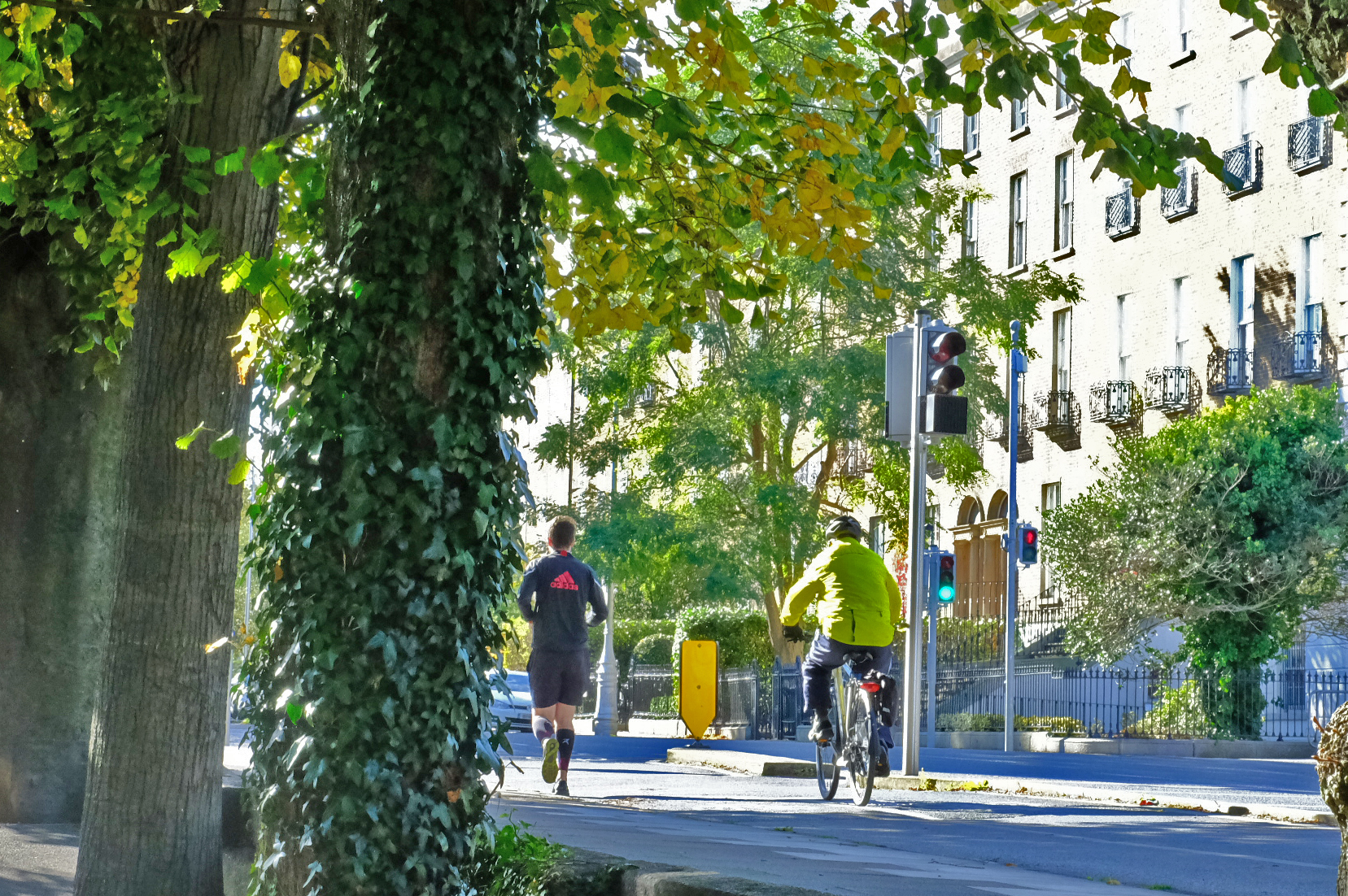
    Is cycling in Dublin City safe? Photo by Eibhin Kavanagh

    With our movements once again restricted, people in Ireland are limited to travelling within 5km of their homes. Walking and cycling have become a more popular means of exercising as a result of gyms closing and sporting events being cancelled.

    In the last ten years, Dublin has seen an increase in the number of people cycling. A number of bike share schemes have become well established. However, 2020 has seen an exponential increase in cyclists, which Dublin City has had to accommodate. This change, due to social distancing restrictions, means more space is required for both pedestrians and cyclists to make their way around the  city.  

    Councillor Michael Pidgeon talked to The City about the recent changes related to cycling in Dublin City.

    “In some ways I think the people are ahead of where the city is,” Pidgeon said. “We know that outside of peak hours there are now more people cycling than there were at this time of the year last year; there’s been a huge increase.”

    Dublin City Council projected  a 200% increase of cyclists in Dublin City from 2019 to 2020.This would be an increase from 13,131 to 39,000.

     2019 FiguresLikely Future ChangePotential Future Figures
    All Public Transport116,28780% Capacity Reduction30,000
    Car57,985Approx. 30% reduction41,000
    Taxi2,661Assume 30% reduction1,900
    Walk24,691Target 100% increase50,000
    Cycle13,131Target 200% increase39,000
    Goods983No change1,000
    Motorcycles1,485No change1,485
    Total (persons)217,223 164,385
    Source: Dublin City Council 

    Source: Dublin City Council 

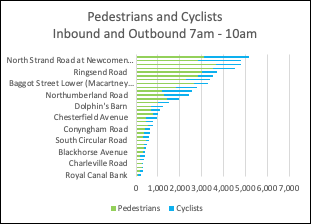
    The Canal Cordon Count was analysed by Dublin City Council to determine where the greatest demand for walking and cycling was recorded. The table below shows the number of people crossing the canal cordon (both directions) during the morning peak period from 7am to 10am in November 2019.
    Source: Dublin City Council 

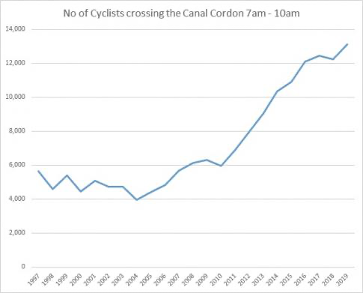
    From 1997 to 2019, the number of cyclists crossing this cordon heading into the city centre between 7 am and 10 am increased by 133%, from 5,628 to 13,125.

    The number of cyclists remained between  4,000 and 6,000 between 1997 and 2010 before increasing by approximately 15% year on year until 2015 when the increase slowed up until 2017.  There was a small decrease in 2018,  but cycling numbers increased by 7.3% in 2018 and 2019. 
    Source: Dublin City Council 

    According to research conducted by the Road Safety Authority, 4 in 5 cyclists are injured on urban roads. More cyclists are  injured during morning and evening commutes. Of all collisions involving another vehicle – 4 in 5 cyclists are injured by cars. 1,056 cyclists were injured in collisions in 2018.

    In Dublin, the number of cyclist deaths since 1997 has remained relatively low with a slight increase in 2017, according to figures collected by the Road Safety Authority.
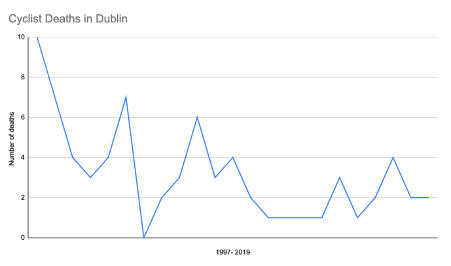
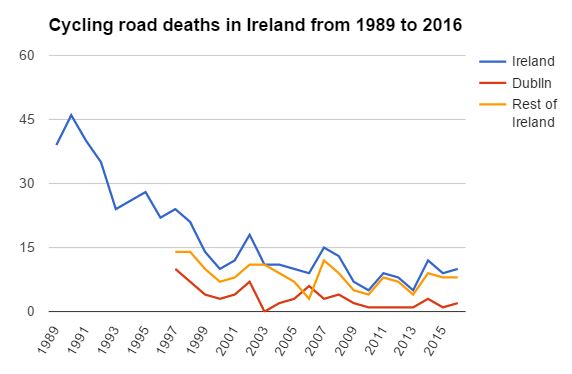
    Image Source- Irish Cycle.com

    Dublin has over 120 miles of cycle routes. While changes have been ongoing to improve cycling infrastructure in the city, especially since lockdown in the spring, the demand is high for safe and accessible cycling.

    “It felt like at the start of the pandemic there was a real understanding that we needed to take more space for cycling to encourage more people to do it, but it feels like that momentum has dropped a bit,” said Pidgeon. “So, I think that we need to get that going again.

    “In terms of infrastructure, I think the big changes we have seen are some of the temporary measures along the quays, particularly along the northside quays.”

    Some of the Cycle Safety interventions introduced since April include the installation of Nassau Street contra-flow cycle track from Clare Street to Dawson Street, the partial installation of key sections of the Interim Liffey Cycle route, removal of on-street car parking from Inns Quay and Ormond Quay, and a section of work from Church Street to Ha’penny Bridge, according to Dublin City Council.

    Dublin City Council also discussed other plans to ensure safe cycling in the city, including the reduction of the number of traffic lanes to accommodate protected cycling facilities on both sides of the road, while maintaining a balance for other required services. While there have been major changes made within Dublin City Centre to ensure safe cycling, other parts of the city have yet to see changes that will make cycling accessible and safe.

    “One of the things is to start looking at the urban villages, so instead of just focusing on the very core city centre, you would be looking at areas like Inchicore, Rialto, Stoneybatter, Phibsborough, Rathmines,” Pidgeon said in relation to making cycling consistent for everyone.

    “What we seen in the pandemic is that people are happy enough to stay within a few kilometers of where they live, so we shouldn’t just be designing a cycle lane with a view that will just take office workers from the suburbs to the city centre, because that’s not what the demand is right now. That’s important, we should definitely do that, but it will have to also be about making sure that local routes around your home are safe.

    “There’s still a lot to do, but equally I’d like to say that cycling in Dublin City is safe. There’s a perception of danger that I don’t think is entirely there. There’s a lot the city needs to do to feel a lot safer and be safer with segregated lanes, but if anyone’s considering it, I’d say just ask a friend who does cycle regularly and they can show you some good routes give you some tips and you’ll be up and running in no time.”

  • Learner drivers least likely to pass their test in Dublin

    Learner drivers least likely to pass their test in Dublin

    Ennis is the driving test centre with the best pass rate in Ireland in 2016 according to a new report published by the Road Safety Authority.

    Overall, 73.25 percent of people who took their driving test in Ennis passed.

    The Road Safety Authority (RSA) have published a list of the pass rates for all its driving centres in 2016.

    The figures account for the fifty driving centres that the RSA operates around Ireland.

    Churchtown was the driving centre with the lowest pass rate for drivers at 42.41 percent.

    In Dun Laoghaire (45.16%), Tallaght (45.22%), Raheny (46.53%), Finglas (48.05%), Naas (49.16%) Rathgar (47.77%) and Wicklow (48.87%) less than half passed their driving test.

    new-piktochart_26722024 (3)

    The overall average pass rate for all driving centres was 53.65 percent. According to the RSA, these are some of the most common reasons why people fail driving tests:

    1. Inadequate observation moving off, at junctions, at roundabouts and when changing lanes.
    2. Failure to anticipate the actions of other drivers.
    3. Incorrect road position on the straight, on bends, turning left, turning right, at roundabouts, and when overtaking.
    4. Inadequate progress at junctions, roundabouts, on the straight, and when overtaking.
    5. Incorrect or inadequate use of mirrors and signals.
    6. Non-compliance with traffic controls, e.g. road signs and markings and traffic lights.
    7. Incorrect, inadequate or inappropriate use of vehicle controls, including gears, clutch, accelerator, steering, handbrake, foot brake, and secondary control.
    8. Excessive speed for the road or traffic conditions.
    9. Failure to yield the right of way to others.
    10. Lack of competence in the reverse and U-turn manoeuvres.

    When asked if there was any plans to open more driving centres in 2017 the RSA said they have no plans to open any new centres but will review resources available in existing centres around the country.

    “The RSA does not have any plans to open any additional driving test centres in 2018, but continues to review resources and to monitor waiting times closely and is constantly reviewing and adjusting the deployment of driver testers in order to meet demand as much as possible at the centres where the need is greatest,” said a spokesperson for the Road Safety Authority.

    The pass/fail statistics for 2017 will not be finalised until early 2018. “We will publish these statistics on our website once they are finalised. It is the case that pass and fail rates are usually quite similar from year to year,” said a spokesperson for the RSA.

    By Keeva Tyrrell


  • RSA earned €3 million from failed driving tests

    RSA earned €3 million from failed driving tests

    The Road Safety Authority (RSA) has taken in over €3 million in income from failed driving tests this year.

    To be categorised as a failed driving test, an RSA spokeswoman said that a person must have sat their test and failed it.

    This means that those whose learner permits may have expired pre-test or other ways of failure are not included in the €3.04 million figure.

    “A failed driving test includes only those tests which have been scheduled, conducted and have failed to pass,” confirmed the spokeswoman.

    The figures, obtained under the Freedom of Information (FOI) Act, include the period spanning between the 1st March 2017 and the 29th September of this year.

    Fadhila Hajji, 20, failed her driving test in April 2017. The exam cost her €85 but she failed due to her car breaking down during the exam.

    She took her car to the mechanics before the exam. The test was going well until the last ten minutes when the engine would not turn on.

    “Everything was going so smoothly. I was confident I was going to pass. I had ten minutes left of my test. Unfortunately, my car broke down. The engine would not turn on, I opened the bonnet to see if anything was faulty but everything seemed to be in perfect condition,” said Ms Hajji.

    Eventually, her car turned back on but her signals weren’t working and the examiner said they should head back to the centre.

    “We went back to the office. The examiner sat me down and he said ‘I won’t fail you but I would have to terminate your test due to what happened with the car’. Also, I would have to re-book my test and pay for it again.

    “Things happen but I was disappointed due to the fact that he didn’t take into consideration what just happened and how well it was handled. Also, I had ten minutes left before my car broke down. By then I had done all of the requirements,” she said.

    Ms Hajji said the incident made her “lose confidence” and she did not take her test again until September. She passed on her second time.

    Money received from failed driving tests is one of the sources of income for the RSA and it is used primarily for costs associated with conducting the driving tests.

    The money is primarily used to cover the costs “relating to scheduling and conducting each driving test” regardless of the outcome of the test, the RSA explained in response to the FOI request.

    The RSA has a number of other income sources, said Kim Colhoun, the RSA’s Finance Manager.

    Ms Colhoun explained that the RSA is a “statutory body that earns revenue from services provided to the public.”

    “The main sources of revenue are driver licensing income, national car test levies, commercial vehicle test levies, digital tachograph income (driver cards used for the bus and truck category), approved driving instructor income, carriage [of] dangerous goods income and other miscellaneous income,” she said.

    According to the RSA’s 2016 annual report, the Authority received €73.6m in ‘other resources’ that year, which included all the income the RSA received from the sources mentioned above by Ms Colhoun, as well as other income.

    As the RSA is a state agency, its 2016 annual report showed that it received a grant of €139,000 from the Department of Transport, Tourism and Sport. It received the same amount in 2015.

    In 2016, the RSA received just over €4 million from employees for the pension scheme. A grant of €279,000 was given by the Department of Transport, Tourism and Sport specifically to cover some of the RSA employee pensions.

    The annual report notes that the Department will continue to pay a grant to the RSA employee pension schemes on a ‘pay as you go basis’.

    The Road Safety Authority is a state agency which was founded in 2006 to promote road safety in Ireland.

    By Hajar Akl and Leanne Salmon