We took to Grafton street to find out what locals think of the proposed changes to the Presedential age requirement.
Sinéad Fitzgerald, Seraphine Habimana.

We took to Grafton street to find out what locals think of the proposed changes to the Presedential age requirement.
Sinéad Fitzgerald, Seraphine Habimana.
Are you still mama’s boy at 30? Your mum drags you out of bed to have breakfast, asks you what you will have for lunch or dinner and even reminds you to make your bed.
What are you playing at? Wake up at your mum’s breakfast and get a life: you can’t really grow up until you leave home.
Your parents will always be your parents; they will rarely be in a rush to see you leave as they might want you near them for some reason, but by all means you need to prove your independence.
A quarter of young people in the UK now live with their parents, according to the recent Office for National Statistics (ONS).
ONS released last year showed that British society is undergoing a significant shift, as one in four young adults now live with their parents. Those aged 20 to 34 are now more likely to be sharing a home with their parents than any time since 1996. Men are far more likely than women to be living with their parents.
In Ireland, more than four in ten people aged 18 to 29 live with their parents, according to a new European study.
Lack of employment opportunities often causes many young people to not go anywhere, or to move back home even when they graduate – at the time they should be becoming fully independent.
In the past several months, some studies have suggested that the reasons grown children are returning to the nest in greater numbers than ever may have less to do with the rise and fall of the unemployment rate, and more to do with lasting changes to young adult life, such as the growth of student debt and delayed marriage
The percentage of young adults living with their parents who are unemployed is almost twice the unemployment levels found amongst those in the same group who don’t live with their parents.
https://spritesapp.com/view/embed/26382
Least likely in London
The number of young adults living with their parents drops considerably to 1 in 5 while in Northern Ireland which is more than 1 in 3, above the national average.
In 2013, the study revealed that Northern Ireland had the highest percentage of young adults living with their parents with 36 per cent while London’s figures were the lowest with 22 per cent as you can look at the record levels below.
https://spritesapp.com/view/embed/26463
Case study
“It is not a matter of getting married or not. Living on your own as a man teaches you to be more responsible,” says Bob Murphy, a 59-year-old retired army officer, who says he left his parents when he was 18 to make his own life.
“It teaches you lessons that you would not learn from home. It helps open your eyes and earn living. You learn financial discipline, self-regulation and taking care of yourself,” he says.
Bob argues that a 30-year-old who still lives with parents is like someone who rides a bus and, when the bus gets to his stop, refuses to get off. Or a visitor who has overstayed their welcome. “Yet you can’t leave that person out of the door or tell that person that time is up! As parents, we will never throw them out, but we expect to see them setting out their own stall and finding their way of living.”
Elsewhere in the world people are more likely to move on. Renatus Mushi, 33, a lecturer at the Institute of Finance Management in Tanzania, argues that it is not good to stay with parents too long – most of his friends of that age have already got married and have kids.
“I got married when I was 28 years old. Now I have a six year-old kid. Most of my colleagues have gone on the same path.
“Some of them prefer to rent a single room staying with their colleagues, but once they get good financial positions they shift to good houses where they can get married: that is the most common situation in Tanzania.”
Renatus says in Tanzania, more than 70 per cent of people grow up in villages. In many cases around age 20 to 22 they move out from their parents’ home for college, and after that they run to towns to look for jobs and start their own lives.
“Most people in their twenties in my country, they are out of their families, even though there are some people who have genuine reasons for taking this dreaded decision to move back. After they graduate, they may come back to stay with their parents for one month, then they shift.”
Renatus adds that in his country a “mama’s boy” is always the butt of jokes when the boys are out for drinks.
“What is mum making us for dinner today?” “My son, I washed and ironed your clothes!” “Your mother will vet all your girlfriends or chase them out!” “Your father asks you what time you are coming home?” Such are the questions anyone in the unfortunate position of living with his parents will have to grapple with whenever he is out with friends in Dar es salaam.
Roisin Crowe, 21, a fourth-year college, student says she would have problems dating a guy who at 30 still lives with his parents. “Living by yourself is totally prized. I bet that a grown man who still lives with his parent would be an alarm bell. If a guy like that wants a date, you run as fast as you can,,” says Roisin, laughing.
But this is not only about Bob, Renatus and Roisin. What about the people whose pictures we use as screen savers or wallpapers on our computers, phones or tablets? Where were they at the age 30?
Nelson Mandela, before he turned 30, had married his first wife Evelyn, had two children, became the first national Secretary of the ANC youth league and was a force to be reckoned with in anti-colonial politics.
Fidel Castro, celebrated revolutionary who many regard as one of the few who boldly showed the American government the middle finger and got away with it, turned 30 in 1956. By then he already had a wife, had opened a law firm, led a revolution and unsuccessfully run for congress.
At 30, Steve Jobs, the one who changed how we view gadgets, had cofounded the world’s renowned brand Apple, featured on the front page of Time magazine and became a global celebrity.
Facebook founder and the social network genius, the young tech tycoon Mark Elliot Zuckerberg, is now 30 years old. He got married at 28, but before getting married he used to rent a month-to-month apartment in California. He didn’t live with his parents.
By Seraphine Habimana
By Seraphine Habimana
Ini(not her real name) is tall and glamorous and her short afro is rugged and shaggy. She has so much energy that it is hard to imagine her standing still or asleep. She is 35 years old, though you’d never guess it. She constantly uses words like ‘forgiveness ‘, ‘change’ and ‘healing’ as she offers non-stop pronouncements on how her story would heal other many survivors.
It was very challenging and frightening for her to accept that she had been abused, she was in denial at first. She says the shame, embarrassment, stigma and many other things weighed down on her but she said to herself that she had a choice to either remain silent and wallow in self-pity or swallow her pride, break the silence and free herself from the burden of shame and help others who are probably experiencing the same feelings.
When I first meet Ini, she is seated in a living room decorated with African crafts and group photos of other children and women. Most photos in her house are labelled two words: love and care. But what is the story behind those labelled pictures, I ask.
“For many who live in developing countries, and from “special cultures”, abuse in all its form is seen as a norm- a normal way to live. If this never happened to me I would not believe that it can occur in this world”.
At 20 – Ini was forced by her husband to come abroad. “It was not my choice to come to Ireland in the first place, all the way from Nigeria. My husband told me that he wanted me to raise our child abroad and if I did not come he would impregnate another woman”.
The beginning
During her final years in secondary school, Ini fell in love with a teacher. “I could speak freely with him about anything. I had made a friend who understood me I thought. Just after I graduated from secondary school, he invited me to his friend’s house and there he tried to rape me after offering me some Guinness. It was a very narrow escape for me. I was still a virgin and wanted to keep it that way”.
She says it got her quite upset and she ended her friendship with him. “After I left home for the University, he would call my house to ask about me. Once I came home for holiday, he came as usual and said he wanted to talk. He used words which I interpreted as being him asking me out. He showed an interest in me at that time and I forgave him even though he never apologised for attempting to rape me. It was not long after that I fell in love with him. I was so young and so naïve. But I never knew that there is another dark story behind all his interests in me,” says Ini, after drying tears on her chest as I was trying to comfort her.
She says they got married in 2000 when she was 20 years old, without the consent of her parents. “Even though he always told me he did not love me but only wanted me, I still married him because I really and truly loved him. We did not live as a couple until 2001, after our official church wedding. Just after the wedding, I discovered he had lied – he had a child from another woman. We were more than two in the marriage (story for another day)”.
Coming to Ireland
Ini, who was born in Nigeria, first came to Ireland in 2001 against her will. Her husband, she says, kept telling her he wanted his children to be raised abroad and kept intimidating her and told her that if she refused to travel he would then take another wife. She became resigned to her fate. “I had no idea where we were going”.
“He told me that he wanted our child to be raised abroad. This caused a lot of tension between us because I did not want to leave Nigeria. I became sad and depressed without realising it. I was broken emotionally and mentally. I was in a lot of pain. I carried this inside without talking about it because when I tried talking I was told ‘it is normal to experience all these things in marriage’. My parents kept on telling me that I had to be brave and build my marriage”.
She adds that at that time, she was eight months pregnant. She came to Ireland with her husband but when they arrived at the airport he left her with empty hands. He just gave me 100 euro to pay the taxi. He immediately went back to Nigeria and left me alone.
“After paying the taxi, I was left with only 20 Euro. I did not know where to start from, I was desperate. How would I give birth and raise my child in that situation,” says Ini with a choke. At the airport I met a young lady who said to me she lived in Cork, she offered me a room”.
After one month in Ireland, Ini gave birth. She says that her husband refused to send her money to survive in Ireland, adding he even refused to pay her fees to go back to college, and did not support the idea of her having a business as he had promised.
Although she tries to hide her tears from me during our discussion, when she starts talking about leaving her country at a young age she bursts into tears.
“You know when you are passionate about your country and your career? When you had set your goals and stick to achieve them and then it all falls apart suddenly? You know when you are trapped, not living your life but living to please someone who had no atom of love for you. I was brainwashed into accepting a lot of false information. Sometimes, when I wanted to be intimate with him, he would say a woman should not be asking for that. When I asked him questions, he would say I talk too much. In order to be the submissive wife he wanted, I changed to please him even though something inside me did not really accept his approach and actions toward me”.
Despite all his mistreatment, I remained in the marriage with the hope that he will one day love me. I always wondered why he married me if he really did not love me. “After sometime, I decided to go back to Nigeria. Maybe I can save my marriage, I thought”.
On her return to Nigeria, she discovered her husband was as much of a husband to the mother of his first child as he was to her. “I was heartbroken when I realised it. I returned to Ireland and found out that I was pregnant again. I told him and he asked me to get an abortion”.
This was the height of anything I could accept. I was very weak from my entire ordeal and wanted no more. He threatened me and I told him I would not have an abortion and if he insists on me having an abortion, I wanted no more of him. That was the end of our marriage.
As any aging couple would say, “Marriage is not a bed of roses.” The Ini’s marriage has never been smooth and in 2005, she went into another relationship and was abandoned with a two month pregnancy. “I was withdrawn, depressed and lonely. I had no real friends because those I thought as friends either used me, bruised me or exploited my vulnerability,” says Ini, now a mother of three.
She says it was before 2007 when she chose to accept her experience, forgive herself and everyone else and let it go. “I have learnt to forgive and love again because I had given up on love. I had also learnt to love who I am now and this helped my inner healing. I am grateful to my children because I am still here because of them,”.
Ini, who is now a wealthy farmer, involved in ‘Love and Care for People’, a group which helps people, particularly children, young people and women affected by abuse.
She is currently doing a Masters in Entrepreneurship, which she says will enable her to build a business empire.
Are you still mama’s boy at 30? Your mum drags you out of bed to have breakfast, asks you what you will have for lunch or dinner and even reminds you to make your bed.
What are you playing at? Wake up at your mum’s breakfast and get a life: you can’t really grow up until you leave home.
Your parents will always be your parents; they will rarely be in a rush to see you leave as they might need you near them for some reason, but by all means you need to prove your independence.
National statistics released last year showed that British society is undergoing a significant shift, as one in four young adults now live with their parents. Those aged 20 to 34 are now more likely to be sharing a home with their parents than any time since 1996. Men are far more likely than women to be living with their parents.
In Ireland, more than four in ten people aged 18 to 29 live with their parents, according to a new European study.
Lack of employment opportunities often causes many young people to not go anywhere, or to move back home even when they graduate – at the time they should be becoming fully independent.
Least likely in London
The number of young adults living with their parents drops considerably to 1 in 5 while in Northern Ireland which is more than 1 in 3, above the national average.
In 2013, the study revealed that Northern Ireland had the highest percentage of young adults living with their parents with 36 per cent while London’s figures were the lowest with 22 per cent as you can look at the record levels below.
https://spritesapp.com/view/embed/26463
Case study
“It is not a matter of getting married or not. Living on your own as a man teaches you to be more responsible,” says Bob Murphy, a 59-year-old retired army officer, says he left his parents when he was 18 to make his own life.
“It teaches you lessons that you would not learn from home. It helps open your eyes and earn living. You learn financial discipline, self-regulation and taking care of yourself,” he says.
Bob argues that a 30-year-old who still lives with parents is like someone who rides a bus and, when the bus gets to his stop, refuses to get off. Or a visitor who has overstayed their welcome. “Yet you can’t leave that person out of the door or tell that person that time is up! As parents, we will never throw them out, but we expect to see them setting out their own stall and finding their way of living.”
Elsewhere in the world people are more likely to move on. Renatus Mushi, 33, a lecturer at the Institute of Finance Management in Tanzania, argues that it is not good to stay with parents too long – most of his friends at that age have already got married and have kids.
“I got married when I was 28 years old. Now I have a six year-old kid. Most of my colleagues have gone on the same path.
“Some of them prefer to rent a single room staying with their colleagues, but once they get good financial positions they shift to good houses where they can get married: that is the most common situation in Tanzania.”
Renatus says in Tanzania, more than 70 per cent of people grow up in villages. In many cases around age 20 to 22 they move out from their parents’ home for college, and after that they run to towns to look for jobs and start their own lives.
“Most people in their twenties in my country, they are out of their families, even though there are some people who have genuine reasons for taking this dreaded decision to move back. After they graduate, they may come back to stay with their parents for one month, then they shift.”
Renatus adds that in his country a “mama’s boy” is always the butt of jokes when the boys are out for drinks.
“What is mum making us for dinner today?” “My son, I washed and ironed your clothes!” “Your mother will vet all your girlfriends or chase them out!” “Your father asks you what time you are coming home?” Such are the questions anyone in the unfortunate position of living with his parents will have to grapple with whenever he is out with friends in Dar es salaam.
Roisin Crowe, 21, a fourth-year college, student says she would have problems dating a guy who at 30 still lives with his parents. “Living by yourself is totally prized. I bet that a grown man who still lives with his parent would be an alarm bell. If a guy like that wants a date, you run as fast as you can,,” says Roisin, laughing.
But this is not only about Bob, Renatus and Roisin. What about the people whose pictures we use as screen savers or wallpapers on our computers, phones or tablets? Where were they at the age 30?
Nelson Mandela, before he turned 30, he had married his first wife Evelyn, had two children, became the first national Secretary of the ANC youth league and was a force to be reckoned with in anti-colonial politics.
Fidel Castro, celebrated revolutionary who many regard as one of the few who boldly showed the American government the middle finger and got away with it, turned 30 in 1956. By then he already had a wife, had opened a law firm, led a revolution and unsuccessfully run for congress.
At 30, Steve Jobs, the one who changed how we view gadgets, had cofounded the world’s renowned brand Apple, featured on the front page of Time magazine and became a global celebrity.
Facebook founder and the social network genius, the young tech tycoon Mark Elliot Zuckerberg, is now 30 years old. He got married at 28, but before getting married he used to rent a month-to-month apartment in California. He didn’t live with his parents.
How Catherine fell in love with crocheting

Catherine Murphy says she learnt to crochet at a very young age, when she was in primary school.
“It was something that girls would like to do in our village, we used to crochet a piece of tablecloth and bring it to our class teacher at the end of the term exams as part of Art and get marks for it. I really enjoyed that and I felt good about that.
When she moved to Ireland from Tanzania in 2006, Catherine says she started involving herself in women’s groups where they did different crafts like knitting, crocheting, mosaics etc. “So I fell in love with crocheting all over again.
“Back then when I was a child, I was only inspired by women who crocheted table covers and furniture throws as a business. But now my inspiration comes from seeing people in cold regions wearing knitwear in a high fashion kind of way – it’s really cool.”
Since she moved to Ireland, Catherine says she has made lots of woollen hats and scarfs and sold them. Her craft prices range from €10 to €20.
“I do not want to be too greedy, I sometimes only charge less than €10 per hat and I am happy about that.”
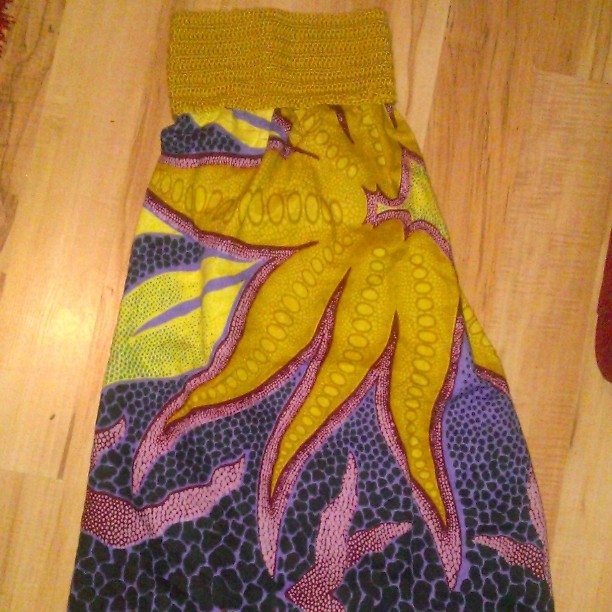
She began by making crocheted hats but Catherine is now making ‘tops’ with sarong or Kitenge (an East African fabric, often worn by women and wrapped around the chest or waist, or over the head as a headscarf).
“I recently made a top! This would be the biggest piece I have ever made; I usually like making small things for quick results,” says Murphy with a smile.
“I always try to find unique ways to crocheting and make it stand out a bit, so while I was exploring my talents, I got this idea of mixing African fabric and crochet. I made a hat and it turned out really well that I was blown away myself. Then I got people interested in it and placed their orders too.”

Why crochet?
“When I moved to Ireland, I did not realize that I would find a chance to do that again but when I saw some other women crocheted I decided to keep it up.
“I told myself why can’t I bring Tanzanian crocheting here to Ireland? On top of that I find crocheting comforting to me, especially in winter seasons where there is not much to do. So I would be very into crocheting while watching telly. So I crochet to keep myself occupied and also as a hobby. Apart from crochet, I also love and to make bracelets and earrings and designing an outfit. This business is helping me to put food on the table and pay bills: I am loving and enjoying it,” says Catherine, a mother of two.
Although Catherine showcases her products mainly in Ireland, her products are exported to other countries of Africa and Europe. “The work I am doing blends modern lifestyles with an African touch that is uniquely Tanzanian. It’s a simple way of expressing our culture and creative textile abroad and I like to mix it with Irish culture: it is a good move!”

Challenges
Catherine says the main challenges she faces is to find African fabric materials to provide a wide variety to customers, adding she had to order to all these materials all the way from Tanzania.
“To import the African fabric materials from Tanzania to Ireland is too expensive. Sometimes they can be delayed or go missing.”
The talented designer says she is planning to go to college this year, which she says might help to improve her business in the future.

By Seraphine Habimana.
Sitting in front of her house in Arklow in Wicklow county, Catherine’s style is uniquely Tanzanianl. Photo by Seraphine Habimana.
Catherine Murphy says she learnt to crochet at a very young age, when she was in primary school.
“It was something that girls would like to do in our village, we used to crochet a piece of tablecloth and bring it to our class teacher at the end of the term exams as part of Art and get marks for it. I really enjoyed that and I felt good about that.
When she moved to Ireland from Tanzania in 2006, Catherine says she started involving herself in women’s groups where they did different crafts like knitting, crocheting, mosaics etc. “So I fell in love with crocheting all over again.
“Back then when I was a child, I was only inspired by women who crocheted table covers and furniture throws as a business. But now my inspiration comes from seeing people in cold regions wearing knitwear in a high fashion kind of way – it’s really cool.”
Since she moved to Ireland, Catherine says she has made lots of woollen hats and scarfs and sold them. Her craft prices range from €10 to €20.
“I do not want to be too greedy, I sometimes only charge less than €10 per hat and I am happy about that.”
She began by making crocheted hats but Catherine is now making ‘tops’ with sarong or Kitenge (an East African fabric, often worn by women and wrapped around the chest or waist, or over the head as a headscarf).
“I recently made a top! This would be the biggest piece I have ever made; I usually like making small things for quick results,” says Murphy with a smile.
“I always try to find unique ways to crocheting and make it stand out a bit, so while I was exploring my talents, I got this idea of mixing African fabric and crochet. I made a hat and it turned out really well that I was blown away myself. Then I got people interested in it and placed their orders too.”

Why crochet?
“When I moved to Ireland, I did not realize that I would find a chance to do that again but when I saw some other women crocheted I decided to keep it up.
“I told myself why can’t I bring Tanzanian crocheting here to Ireland? On top of that I find crocheting comforting to me, especially in winter seasons where there is not much to do. So I would be very into crocheting while watching telly. So I crochet to keep myself occupied and also as a hobby. Apart from crochet, I also love and to make bracelets and earrings and designing an outfit. This business is helping me to put food on the table and pay bills: I am loving and enjoying it,” says Catherine, a mother of two.
Although Catherine showcases her products mainly in Ireland, her products are exported to other countries of Africa and Europe. “The work I am doing blends modern lifestyles with an African touch that is uniquely Tanzanian. It’s a simple way of expressing our culture and creative textile abroad and I like to mix it with Irish culture: it is a good move!”

Challenges
Catherine says the main challenges she faces is to find African fabric materials to provide a wide variety to customers, adding she had to order to all these materials all the way from Tanzania.
“To import the African fabric materials from Tanzania to Ireland is too expensive. Sometimes they can be delayed or go missing.”
The talented designer says she is planning to go to college this year, which she says might help to improve her business in the future.

Catherine wearing her hat made from Kitenge. Photo by Seraphine Habimana.
By Seraphine Habimana
It is said that most men fall head over heels for a gorgeous physique, hair extensions and high heels…
Although physical appearance can be the first thing men notice, when it comes to settling down ‘looks’ often come in last and count the least. For some men it can come as a surprise if they don’t recognise the woman that they’ve woken up next to.
Yes of course, there will be some men who love hair extensions. They adore seeing you when you turn your head around, and strands of your hair go all over and all that’s visible is some artificial hair trying to escape from the back of your scalp. The best part about hair extensions is when a girl feels comfortable enough to whip them off in front of the guy – that always goes down a treat.
But that is not all. Believe it or not, a gorgeous physique is besides the point. The things men like in women often have nothing to do with looks. Here are seven completely non-physical things men like in a women and I am pretty much sure that you will tick and confirm many more. Every man loves to be with a woman who is:
Many men appreciate a woman who is able to listen. They like to be heard and someone who shows them that they care. This involves being patient as well, you need to understand what a man meant to say and show them that you are there for him.
Ideally, a woman who has the ability to listen and really hear what is being said is one of the women many men love.
Most men like being able to “go with the flow”. Most of our male friends find this trait very appealing. You know what, you will never hear a man sing in front of a woman but they mostly love to hear women sing even if it sounds more like howling, it does not matter, they just like it. They love to see women dance around the house, they will gladly surprise a woman if they know the reaction will be positive and they love to see them being themselves (even if it involves a certain dose of silliness).
It is said that the only way to get to a man’s heart is through his stomach! Well, most men would love a woman who can cook and be would be more than willing to learn to cook for them.
Men love a real girl not the fake one, a girl who likes to smile, the one who does not care what others are thinking of her smile, her lips, teeth or whatever. A girl who can tell a joke, who does not use “words” like OMG, a girl who will not limit herself or have a nervous breakdown every time her foundation starts running.
Men will want to know whether you care for them or not but you have to be careful because repeating “I love you” until he cannot take it anymore is not a good way to let him know how you feel. A typical man will tell you that he loves you once and show you how much he loves you five times. Women should do the same and stop repeating “ I love you” rather than surprising him every once in a while, listen to his problems – show him everything you want to tell him because this quality is one of the very important things men like in women.
Believe it or not taking care of yourself will show your man that you will take good care of him as well. Men actually like when women spend money on all the creams and beauty products. They enjoy all the benefits of our waxing, beauty treatments and shopping.
Just because we like makeup does not mean that we have to wear it all of the time. Men love a girl who is natural when it counts. But I tell you what, a guy loves it when a girl doesn’t take two hours to look perfect when, in his opinion, she is perfect no matter what. He wants a girl who is so confident in herself, who doesn’t need anything but herself.
counts. But I tell you what, a guy loves it when a girl doesn’t take two hours to look perfect when, in his opinion, she is perfect no matter what. He wants a girl who is so confident in herself, who doesn’t need anything but herself.


By Seraphine Habimana
Here’s What People Say About Kanye West [VIDEO]
Why does Kanye West keep annoying people? Actually, no-one knows exactly. Over the years I have been aware of West, he has never ceased to embarrass and shame people. Every year he heaps annoyance on top of annoyance and never repents or apologises for his actions. There are many examples of Kanye seeming not to engage his brain before speaking or acting, a trait many call ‘immaturity’.
It is doubtful anyone was surprised to hear that Kanye recently crashed Beck Hansen’s Grammy acceptance speech. As Beck arrived on stage on 8 February 2015 to accept the best album honour at this year’s Grammy awards, Kanye stormed the stage, shouting that Beyoncé should have got the award.
Humble Beck first looked shocked but recovered later to respond: “You can’t please everybody, man. I still love him [Kanye] and think he’s a genius. I aspire to do what he does.” That was good of Beck – instead of lowering himself to Kanye’s level he rose above it, killing him with kindness.
This came after the infamous incident following Taylor Swift’s MTV Video Music Award for Best Female Video of the year in 2009, which she won over Beyoncé’s video for Single Ladies. Kanye interrupted Swift’s acceptance speech, invading the stage and shouting at her to give her award to Beyoncé, insisting that Beyoncé had made one of the best videos of all time.
I wonder if Beyoncé really needs Kanye West standing up or fighting for her in this way. She seems like she has everything covered. Recent reports suggest she was “disgusted” by Kanye’s recent outburst at the Grammys.
And that’s not all from Kanye. Let’s chat about some of his extensive history of annoyance:
2006: The birth of Yeezus
As well as calling himself Jesus, Kanye has also compared himself to God. Back in 2004, for instance, in his single I Am a God, Kanye rants that Jesus talked to him and asked him ‘What’s up, Yeezus?’ Indeed, you may have seen Kanye on the cover of Rolling Stone wearing a crown of thorns like Jesus. These incidents annoyed many Christians worldwide.
While many people find his comparisons to Christ offensive, West clearly liked the attention and decided to start worshipping himself, opening the Church of Yeezus and calling Yeezianity ‘the best church of all the time’.
Speaking of bizarre Kanye self–comparisons, Jesus and God are just two of those Kanye has compared himself to. Barack Obama is another; Kanye once said that his wife (Kim Kardashian) is more influential than First lady Michelle Obama, adding that the First Lady could not post bikini ‘selfies’ of herself like his wife. It is not surprising that Obama has twice called Kanye a ‘jackass’.
Kanye also said he is better than the Thriller singer Michael Jackson, and that Jackson could not have achieved what Kanye has achieved. Amongst others, West has also compared himself to Picasso, Steve Jobs, Jay Z, Beethoven and Disney character Vanellope von Schweetz.
2007: MTV Video Music Award ‘black and white thing’
When West was not asked to perform at the 2007 MTV Video Music Awards opening, he insinuated that he was not chosen because of his race, saying “Maybe my skin’s not right”. He later said “it’s not a black and white thing; it’s a money thing” and that MTV chose Britney Spears for the opening to get higher ratings. This entire episode was not received well as many people advised West to think twice before saying anything, especially in public.
2009: ‘I’ma let you finish’
‘Yo, Taylor, I’m really happy for you, I’ma let you finish — but Beyoncé had one of the best videos of all time,” said West to Taylor Swift when she was about to accept her accolade for the best female video at the 2009 VMAs, discussed above.
2013: Bound 2
Bound 2 – a song from West’s Yeezus album – is repeatedly derided as having one of the worst and most ridiculous videos ever released. The video features West on a motorbike, accompanied by his wife Kim Kardashian, naked. The video has led to many copycat videos – more press coverage for Kanye.
2014: Halted concert in Australia
During his Yeezus tour in Sydney, West insisted that everyone must stand up and dance to his next song. When West pointed out two people who were not standing (one was in a wheelchair and the other was also disabled), Kanye sent a bodyguard to verify their reasons, before finally starting his song. He did not apologize, even after members of the audience tried to signal to Kanye that one fan was wheelchair-bound. Some called West’s demand for fans to prove their disability ‘abuse’. West screaming at fans to stand up was not well received. The demand was outlandish and further cemented his reputation as an egotistical maniac.
2015: West’s Beck respect
After Taylor Swift’s 2009 Video Music award, it is hard to believe that Kanye could do it again. Thank God, the second time, it was Beck Hansen, a most humble person, even though he’s been a respected musician for much longer than Kanye West. You can imagine what it was like when Beck was ready to collect his award and walked up to the microphone like everyone else, celebrating his award with his fans in the house, then somebody else approached the stage: none other than Kanye West? Beck was visibly shocked.
Having explained that the “voices in his head” made him do it, Kanye later explained that although he did not say anything on the stage, he was there to fight for creativity. He also criticized the awards ceremony as ‘a joke’. Critics pointed out that Beck was the sole songwriter on his album, compared to sixty-eight writers on Beyoncé’s.
We cannot say that Kanye West does all these things in order to become more famous; he is already a huge celebrity. We do not even know if he wants the media to keep talking about him as he is already very well known, but if his ego is anything to go by along with his actions, it seems he certainly does want the attention to continue.
From what we have seen over the years from Mr West, it seems he needs to grow up and stop throwing his toys out of the pram, but the chances of him changing now are about as likely as seeing pigs fly.

By Seraphine Habimana
At an extraordinary public meeting about Top Climate Chaos, members of the Oireachtas environment committee and civil society organisations condemned the Climate Action Bill for being weak, saying the government has ignored the Committee’s proposal to include climate justice.
The draft Bill on Climate Action was published by the government last month to tackle climate change and reduce Ireland’s carbon emissions between now and 2050. Since then some opposition parties and environmental groups continue to criticise that it does not include specific targets on emissions reductions.
At the crowded gathering in Buswell’s Hotel, they backed motions saying that the Bill fails to set a ‘numeric target for emissions reductions for the future’.
Speaking at the conference, Friends of the Earth Director, Óisín Coghlan said that the Government’s Climate Bill is too weak to deliver the low carbon future it promises.
“It’s deeply disappointing that the Government has ignored the proposals of the all-party Oireachtas Committee. Politicians have repeatedly diluted it in the face of pressure from vested interests, who have insisted on stripping the Bill of any legally binding targets. It is now dangerously weak,” said Coghlan, adding: “at the very least the Government must accept the recommendation of the Oireachtas Committee it asked to review the Draft and insert a clear definition of low carbon.”
Coghlan pointed out that a climate law which has neither binding targets nor a clear definition of low carbon would be like a car without an engine. “It may look well but it’s not likely to get you where you want to go.”
The Bill amounts to an 80 percent reduction in emissions from electricity, buildings and transport and carbon neutrality in agriculture and land use.
On the other side, one of the participants Josephine O’Byrne said she is happy with the Bill, adding it should be ready earlier, before facing the consequences.
“At least we have got the Climate Action Bill but we should have had it before realising that we are in danger, although we still have a very long way to go, but there is hope that in 20 years we can have the better world we want to have,” she said, adding that the Bill gives a sustainable future for Ireland.
During her keynote address Lidy Nacpil, convenor of the Philippines Movement for Climate Justice, discussed the consequences of climate inaction on her home country Philippines. Speaking, several years ago, of the campaign for keeping below one degree, that scientists have already said it is not possible to do that. “Now we have to adjust it to 1, 5 degree. We have no choice, we have to live this reality and accept it.”
Nacpil said the people who hear about targets in terms of degrees sometimes do not realize that even half a degree matters.
“It matters because for instance at only 0.8 degree in temperature we are already suffering thousands of deaths every time in Philippines, even if Ireland’s temperature may be stable or not, we are 7000 times of Ireland but how soon since most of Ireland is populated.”
The Climate activist pointed out even if with the good Bill or agreement, there is still need for National legislation to give a little more insurance for it to be implemented.
She added that although a lot has been done, efforts and commitment need to reach 2020: “We can achieve it with justice and equitable share.”

You must be logged in to post a comment.