Tag: sex

  • Love in the time of Corona

    Love in the time of Corona

    faceless young couple drinking takeaway coffee on terrace
    Photo by William Fortunato on Pexels.com

    Valentine’s Day can be a tough time for single people. Scrolling through photos of happy couples sometimes triggers that voice in your head that reminds you – you’re alone. 

    Add a global pandemic, isolation, and government-imposed celibacy to the mix, and it’s not a far reach to assume this year’s going to be a lot harder than usual. 

    In-person socialising has been put on hold and life is happening online. It is no surprise that the sense of loneliness this brings can have a massive impact on someone’s mental health.

    “Dating is, at its core, about hope and connecting with somebody”

    Roe McDermott

    Speaking to TheCity, Roe McDermott, Sex and Relationships Expert at The Irish Times, said she believes people are really underestimating the importance of physical contact and dating throughout the pandemic.

    “Dating is, at its core, about hope and it’s about connecting with somebody. Even a mediocre or bad date, it’s the hope that you’ll get an entertaining story to tell your friend. Losing that sense of hope and connection when we are so isolated is seriously psychologically damaging,” she says.

    Many people have turned to online dating as a means of coping with this. Match Group – who own popular dating platforms like Tinder and match.com – have reported a significant increase in users since the pandemic hit.

    Enda Collins, a 22-year-old musician from Dublin, has been taking part in online dating for the past year.

    “One guy sent me, let’s just say a very explicit picture, with the caption ‘Can you handle this?’ I was like oh my god. You’ve ruined it!”

    Enda, musician

    “I think it can be good, but I miss physical contact. You get to that point after a few days of chatting online where you want to meet up but it’s like… you just can’t,” he says.

    While he feels these conversations can be helpful to combat loneliness, some users only have one thing on their mind – and it’s not the R number.

    “You get people messaging you like ‘what do I have to do to get you to come out now?’

    “One guy, we were chatting for over an hour and really hitting it off. Next minute, he sends me, let’s just say a very explicit picture with the caption ‘Can you handle this?’ I was like oh my god. You’ve ruined it!”

    However, Frances Kelleher, a Killarney based dating coach, believes online dating can be a beneficial tool in helping you find the right person.

    “I believe online dating is great if you know how to use it correctly and know how to sell yourself,” she says.

    “You have to be strategic in the way you use it. I advise my clients to be online as you can throw your net so much wider in the pool of potential partners. The more you put yourself out there, the better chance you have of meeting the right person.”

    McDermott also believes online dating can be a great experience, but its potential benefits are relative to how you present yourself. Being clear about what you’re looking for is essential and can help you navigate the online world more easily, as well as counteract any time wasting or negative experiences.

    “The basic act of filling out your profile – which a lot of people don’t do – is about saying what you’re looking for and telling people what you have to offer. It takes [dating] to a different level of thoughtfulness and seriousness,” she explains.

    Your profile is in your hands, so why not put your best self out there, you might not meet the right person, but you might get a funny story or two and find a welcome respite to lockdown boredom.

    Online dating presents its own set of challenges, it is far from perfect, but it can be what you make of it, and for singles everywhere, now is the perfect time to give it a try.

    For those out there who are reluctant to dive into the world of online dating, Frances thinks it’s worth a shot.

    “For people who are reluctant, I would say just give it a try. There are different apps so try a few to see which one you prefer. You can always come off if you hate it.”
  • Dublin’s Monthly Fetish Party

    Dublin’s Monthly Fetish Party

    DSC_0172
    Photo: Louise McLoughlin

    Nimhneach is a fetish or BDSM club night held in Dublin on the first Saturday of almost every month. The club boasts an age range from 18-80, and attracts men and women from all walks of life – although careers aren’t on the night’s conversation list. Instead leather, whips, dominance and submission are the focus of the evening.

    The name Nimhneach comes from the Irish word for ‘painful’ or ‘sore’ and, according to some of its attendees, that sums up the experience of the night pretty well. Erotic author, Evie Hunter, states on her website that the scene pushed both my erotic and ouchie buttons” and adds that for her first experience,

    “If it wasn’t for the metal cage in the middle of the dance floor, it might have been a perfectly normal evening.”

    After moving on from its run in The Academy, Nimhneach’s new venue is The Hub in the middle of Temple Bar, located right under the noses of unsuspecting Dubliners and tourists alike. The club is in the venue’s basement, but one attendee says the atmosphere doesn’t reflect the tucked away location.

    “What genuinely surprised me the most my first time was how lovely everyone was…I actually get harassed in regular clubs a lot, but here it was far more open.”

    DSC_0146
    Photo: Louise McLoughlin

    Like many clubs, Nimhneach has a strict dresscode policy of ‘No effort, no entry’, but in the case of Nimhneach that doesn’t mean put on a nice shirt or dress. Its website sums up the dresscode pretty simply –

    Look in the mirror and ask yourself this, Could I walk into most bars in town and get served wearing this without looking seriously out of place?”. If no, you’ll probably pass!”.

    Nimhneach sends out a strong sexually charged vibe – outfits are revealing and provocative, and play between people such as spanking and rope play is encouraged. Because of this there are also strict guidelines for both physical safety and to remove anyone who is deemed to be harassing anyone else. Nimhneach’s organiser says that staff called ‘dungeon monitors’ patrol the floor constantly, overlooking play to make sure that its safe, and making sure that everyone is behaved and comfortable. Rules are strictly enforced, and include:

    Not touching people without consent or interfering in a ‘scene’ (where people are involved in BDSM play) without being invited”.

    However, the organiser says that for people who don’t want to dive into the deep end of the scene events called Munches are held in Dublin every second Saturday and third Tuesday of the month. At these attendees dress in what is called Vanilla (non-fetish) clothing, and newbies can be eased into the scene in a non-fetish environment.

    For more information, see nimhneach.ie or check out the Nimhneach Facebook page.

  • Are females exploited by the music industry?

    Are females exploited by the music industry?

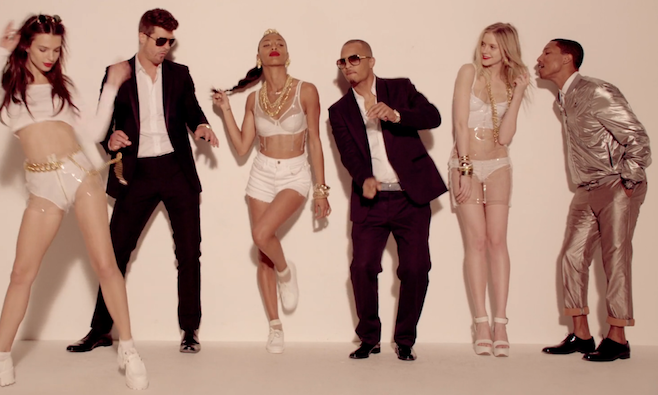
    Robin Thicke and Miley Cyrus performing at the 2013 VMA's.

    Robin Thicke and Miley Cyrus performing at the 2013 VMA’s.

    It is a well-known fact that the music industry’s sole purpose is to generate one thing and one thing only, and it is not music.

    Music is merely the by-product of the industry’s ravaging thirst to generate money. An industry whereby female sexuality – and sexuality in general – is one of the tools that the industry uses to increase potential profits. However, to say that females are exploited by the industry is a step to far.

    Exploitation is the unruly use of a person or a group of people in a cruel and unjust manner

    The vast majority of females who are “exploited” by the music industry receive (quite handsome remunerations for their services.

    Just like in advertising, the music industry employs the idea that “sex sells”. Miley Cyrus is not the first, nor will she be the last female artist to use her sexuality, her figure or her desirability in an attempt to increase her profile within celebrity culture.

    Cyrus is merely just the newest recruit to enlist into the sexuality culture to which the music industry has adopted – not created.

    Men find women desirable, women find other women desirable. These human elements are used to help generate profit in whatever manner possible.

    In 1981, Duran Duran hired female actresses to wrestle one another in mud, topless, in the video for ‘Girls on Film’.

    Madonna has been infamous for her use of sexuality throughout her music career – be it in her music videos or during her stage performances.

    The use of sexuality is not confined to just female artists.

    The gesture of crotch-grabbing is synonymous which Michael Jackson, while R’n’B artist D’Angelo starred completely naked, and oiled, in his video “Untitled (How Does It Feel)”.

    Females are not portrayed favourably in some sections of the music industry – especially in hip-hop or rap –  there is a strong case to claim that there is a high levels of misogyny in the aforementioned genres of music, but the females are not exploited. They are paid. If they are comfortable with flaunting what god gave them for the world to see in music videos, or gyrate in a sexual manner, that is their prerogative as professional female adults earning a living.

  • Ireland: embarrassed by sex education?

    Ireland: embarrassed by sex education?

    Almost a third of Irish people aged 20-29 have received no sex education in their teenage years, according to the Durex Sexual Wellbeing Global Survey.

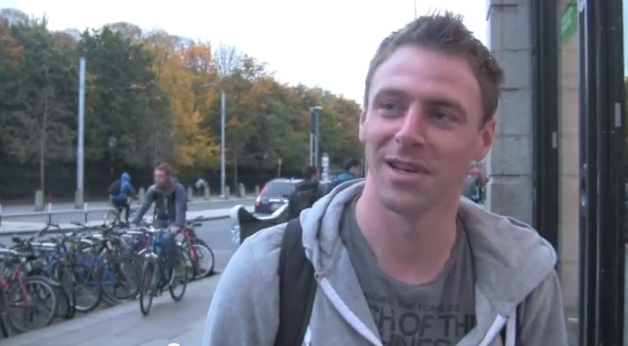
    TheCity.ie asks the people of Dublin about their views and experiences.

    [youtube.com=https://www.youtube.com/watch?v=4b69yNg-Tv0]

    By Cormac O’Connor and Liam Keegan