With recent reports stating that the new National Children’s Hospital (NCH) is 80% complete, it would be an understatement to suggest that the long-awaited project has come with its criticisms of the escalating cost and timeframe of the project.
The National Children’s Hospital under construction in 2018. Photo source: bamireland.com
First recommended by the Royal College of Surgeons in 1993, it was February 2006 before the HSE commissioned a report which recommended the merging of the three existing children’s hospitals; Our Lady’s Hospital in Crumlin, Temple Street Children’s Hospital and the National Children’s Hospital in Tallaght.
In 2007 the National Paediatric Hospital Development Board (NPHDB) was established, choosing The Mater Hospital in Dublin 7 as the location for the new hospital. This plan was nullified in 2012 by An Bord Pleanála as it would overdevelop the Dublin skyline.
In June 2012, The Government announced that St. James’ Hospital in Dublin 8 would be the location for the NCH, despite criticisms of access and its central location. A projected delivery date of early 2018 was also announced.
With an original estimated cost of €500 million, and an agreed location, a series of delays arose for the Government in the following years.
Rising cost: the cost of the National Children’s Hospital has risen by over €1.2 billion since its Dublin 8 location was first agreed
Planning permission wasn’t granted until 2016, prior to the then Minister for Health Leo Varadkar announcing an additional €150 million in costs for the project in August 2015, bringing the estimated cost to €650 million.
Further delays in the process came about the following year, as it wasn’t until April 2017 that the hospital was signed off on by Varadkar’s successor in the role, Simon Harris.
Harris denied that the budget for the hospital had spiralled out of control, despite the cost rising to over €1 billion.
“We are doing an awful lot more than was estimated in that figure – we did not include the hospital school, the third level research centre, the retail and the parking. It didn’t include the equipping and it certainly didn’t include making this Ireland’s first digital hospital,” said Mr. Harris in April 2017.
“I expect, and the government expects, for this to come in on budget and on time.”
It did not, and the estimated cost rose again to €1.433 billion in December 2018 when Leo Varadkar addressed the Dail on the project.
Fast forward to April 2022, when current Minister for Health Stephen Donnelly confirmed that costs have risen to €1.7 billion, while the hospital still hasn’t been built, over four years after its first estimated delivery date of early 2018.
As things currently stand, the new opening date for the NCH is September 2024, as was announced at the hospital’s media tour last month. It was also announced that the project is now 80% complete.
Current reports have suggested that the total costs for the project could exceed €2 billion, with Minister Donnelly refusing to rule out this possibility.
On Thursday October 8th, 2020, 886 CAO applicants received places in college courses as a result of the 4th round of offers. Among these were the students who had been affected by the Leaving Cert grade errors. Erin Killoran explores the effect these errors had on students.
Photo taken by Jesse Ashmore. Sourced from Flickr.
On Thursday October 8th, 2020, 886 CAO applicants received places in college courses as a result of the 4th round of offers. Among these applicants were 424 Leaving Cert students who were affected by the calculated grades coding issue. This resulted in 6,500 students’ grades being miscalculated and given lower amounts of points than were predicted by their secondary school teachers.
Minister for Further and Higher education, Simon Harris, tweeted regarding these students stating: “I said that we would move mountains to ensure students who had errors in calculated grades were given the places they deserved. The CAO identified that 424 students required new offers. I am delighted that this morning all 424 have been offered a place for this academic year.” Mr Harris was highly criticised for this tweet by angered Leaving Cert students and their parents who were also affected by this error.
Speaking to 18-year-old Leaving Cert student, Áine Kennedy, who was due to start in Maynooth in September, she told The City, “On Thursday I was offered my dream course, but have had to defer it till next year.”
She continued by explaining, “I was given five days to decide if I wanted to accept it or not. That’s just not enough time to find accommodation and I would already be four weeks behind in my first year. So, for me personally, the best option is to start next year where I can hopefully have a somewhat normal college experience.”
Miss Kennedy expressed her dismay with the education system and the Irish government. “I am deeply disappointed with the education system; I feel as if they have failed me to a certain extent.
“They simply did not do enough to help us students who were affected by this situation. It’s disgraceful that it took them this long to sort the issue out.”
However, the young student did explain that she is not all negative about the situation. “At the end of the day, I’m delighted to have been offered the course. It’s just a shame that it had to happen this way. But it’s nice knowing that I’m not the only person going through this- it could potentially be a blessing in disguise and hopefully I’ll be starting next year with no restrictions and can be a more enjoyable experience for me.”
“They simply did not do enough to help us students who were affected by this situation. It’s disgraceful that it took them this long to sort the issue out.”
Ian Russel, the student engagement officer at Maynooth University, spoke to The City regarding these late starting students and how they would be helped to integrate into their courses. He stated: “Once the student registers they can access Moodle which would have all the resources for each module – recorded lectures, readings, etc.
“In terms of my office – I hosted an online session for the Round 4 students where they got to meet the Programme Advisory Office, Academic Advisory Office, Student Services, and the Students Union. This took place last Friday [9th October].”
On top of the coding error, almost 13,000 students appealed 34,000 grades following the release of the Leaving Certificate results. Minister Simon Harris has stated that these will be due by the end of the month.
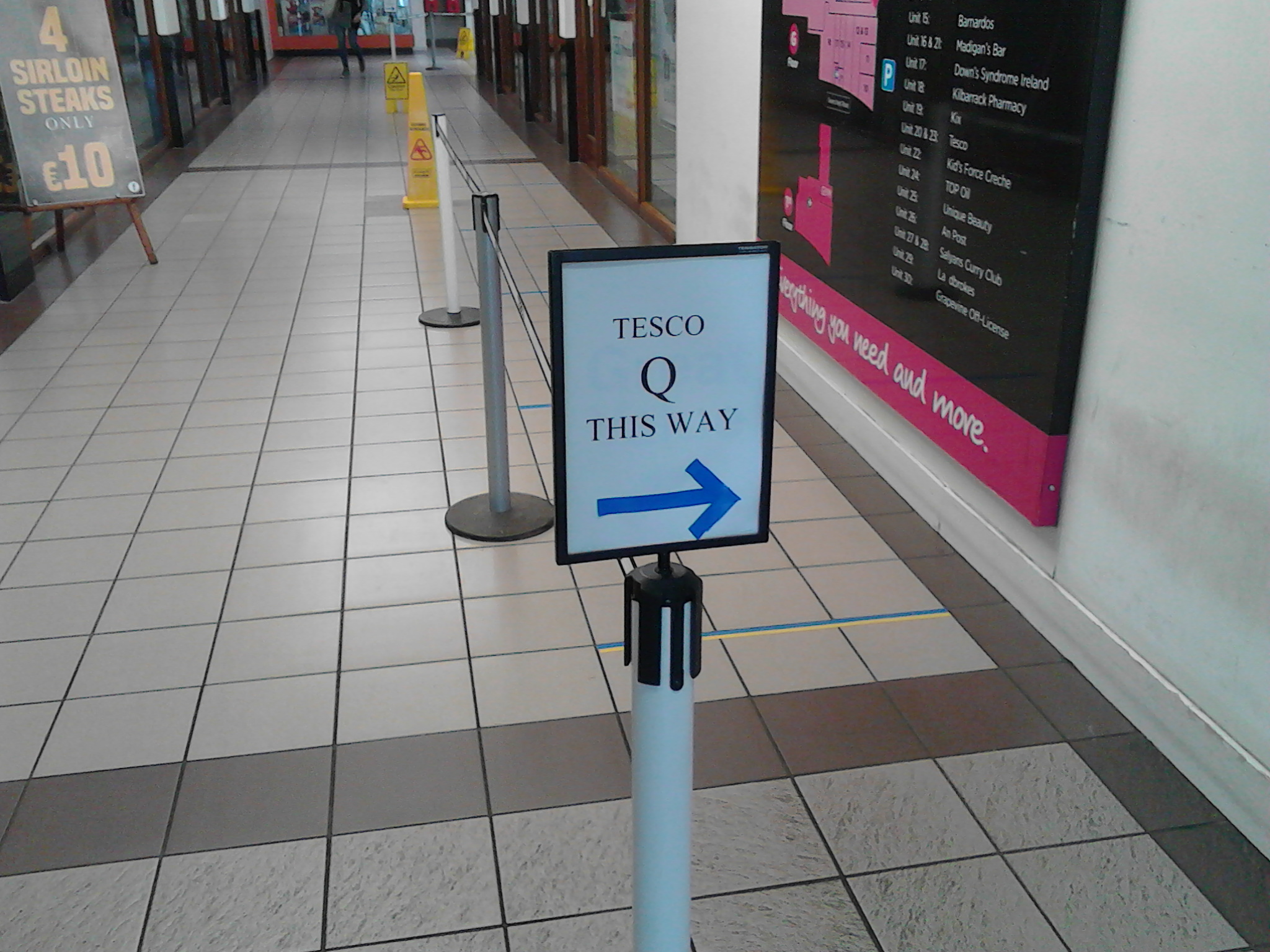
STRICT: Currently, queueing outside supermarkets is the new normal, with many outlets only allowing in one shopper at a time and banning children in some cases as Coronavirus continues to spread (Photo: Paul Caffrey)
During the month of March, the population went on a €363million panic-buying spree. The shops are much calmer now, but queuing outside supermarkets — with stricter controls on how many customers can enter a store at any one time —has become the new normal. In words, pictures and video, TheCity.ie’s Paul Caffreyhas been keeping track of the “shopageddon” phenomenon since March 13
“No sausages. No teabags. No potatoes,” the senior security guard at a north Dublin supermarket boomed with a wry grin to a colleague over his two-way radio.
The weary-looking herds of shoppers rushing from one aisle to another — just trying to grab what they can — didn’t seem to have registered a word of his worrying summary.
But that was only the start: there was no bread left and most of the fruit, vegetables and frozen food were gone, too – even though there was a full delivery to this store at eight o’clock this morning.
Meanwhile, queues for the checkouts — one family after another with an overflowing full-size shopping trolley — were snaking back into the aisles.
It was nearly 6pm on the evening of Friday, March 13 at Tesco Kilbarrack in north Dublin — 31 hours since Leo Varadkar announced a virtual shutdown of the country on account of the global Covid-19 outbreak — and the place was full of people completely ignoring Government pleas not to panic buy.
Throughout this large store, which acts as a lifeline to thousands of families and elderly people in the long-established north Dublin areas of Raheny, Kilbarrack, Coolock, Artane and Donaghmede, there was an air of quiet panic.
Even though people here were keeping calm and being respectful to others, many seemed grimly determined to buy up everything in sight.
However, this “emergency” buying wasn’t quite what you might put at the top of your essentials list for what was then expected to be a fortnight of being housebound. At one checkout, a man was hurriedly purchasing exactly 20 Easter eggs and not much else.
NEW ORDER: Local councils were quick to create new markings on walkways to reflect the social distancing rules intended to combat the spread of Covid-19 (Photo: Paul Caffrey)
At 11am on Thursday, March 12, the Taoiseach announced from Washington that all colleges, schools and various other public facilities would close for at least two weeks.
Up until that moment, students at TU Dublin Aungier Street had been assured by college officials it was largely “business as usual”, with classes proceeding as normal.
Everything changed on that Thursday morning, when students were suddenly told to leave the building by 6pm and not return until further notice.
Similar to the situation in supermarkets, the college library was gripped by a sense of panic as students anxiously rushed to get the books and other materials they’d need to complete their assignments (not due for months).
“If people go out and buy products that they don’t need to stockpile, they are going to cause a problem,” Minister Humphreys warned on Thursday, March 12. And she tweeted the following day: “Shop as normal.”
But her advice, echoed by Health Minister Simon Harris, was largely ignored. In scenes that have been echoed the world over, throngs of eager shoppers descended on supermarkets and chemists, even leading to some forced store closures.
Tesco in Clarehall on Dublin’s Malahide Road was forced to close temporarily on Thursday, March 12 for restocking, while Tesco Liffey Valley reportedly shut down for 30 minutes that day after a big influx of customers. Lidl and Aldi then introduced “product purchasing limits” on selected items.
Gardaí were placed on alert, with officers told to “patrol the environs of supermarkets and chemists, with a view to providing comfort and reassurance” to shoppers, according to a memo sent by Assistant Garda Commissioner Pat Leahy to rank-and-file members on the night of Thursday, March 12.
SLICED PANIC: This north Dublin Tesco was fully sold out of bread by midday on Friday, March 13 – but these shelves had been full only three hours earlier (Photo: Paul Caffrey)
On Friday March 13, my first visit to Tesco Kilbarrack is at 9.30am, when stocks are at healthy levels thanks to an 8am delivery.
I recognise a friendly local taxi driver who wisely makes straight for a well-stocked bread aisle. By midday, every last sliced pan here will be gone.
Normally stationed at the Dublin Airport rank, he’s decided that his normal place of work is a no-go zone due to the Coronavirus outbreak.
The self-employed middle-aged Dubliner will be out of pocket as a result, but he’s accepting of the situation and even appears relaxed about it.
“There’s no way I could work the airport today. They’ll all be coming back from Cheltenham, full of booze and all over each other, then jumping into my car.
“Not to speak of the people who could be flying in from anywhere in the world. I’ll sit tight for a few days — it’s for the good of our health, after all,” he tells me.
At a café opposite the Tesco, a cautious barista is very short on customers. Wearing a standard-issue facemask, he’s trying to offload his best fresh pastries for the knockdown price of €2 each.
This Tesco store nearly ran out of all fruit and veg by the afternoon of Friday March 13, with bananas, cucumbers, lettuce and potatoes all sold out by 4.30pm (Photo: Paul Caffrey)
When I return to the Tesco itself some hours later, at about 4.30pm, a team of three senior staff is standing near the frozen food section looking suitably grave in a huddle with their arms folded.
The bread section is completely cleared out; I’m told all sliced pans were gone by midday — while most of the fruit, vegetables and frozen food has also disappeared.
It took only four days before that extreme weather eased off and life was largely back to normal.
The managerial team walk around surveying the empty and near-empty shelves, making notes on their clipboards. Pointing to one well-raided cosmetics shelf, one of the executives remarks: “Those will all be gone by tomorrow.”
How one newspaper reported the disquiet in our shops in its Friday, March 13 edition (Photo: Twitter/Irish Daily Star)
At the checkouts, an elderly woman queuing just ahead of me with a modest number of purchases in her black and red tartan wheelie bag is bemused by the slightly frenzied atmosphere and crowds of customers surrounding her.
“I don’t know what all the fuss is about,” she calmly tells me.
“Though, I’m just buying for myself. At least this has made them open a few more checkouts than they normally do, but it’s still not enough, is it?”
Reflecting on the public health emergency at hand, she tells me: “I’m 89, so I’m supposed be in the ‘at-risk’ category, aren’t I?
“But I’m not letting it worry me. I don’t see why we can’t go about our business as normal — as long as we don’t travel.”
Later that afternoon, I call round to my 101-year-old neighbour. She’s exceptionally fit and alert and still leads an active life. I’ve known her since I was a small child and she’s never seemed afraid of anything before.
Despite no official guidelines having yet been issued for the over-70s, she already intends to stay indoors at all times and is resigned to miss Mass, regular coffee mornings with her friends or any other activities involving the outdoors or groups of people for at least a fortnight.
Gesturing towards her television that’s switched to standby while we chat, she insists: “I won’t be going anywhere until this is all over. It’s out there somewhere, so I could catch it.”
DESERTED: Dún Laoghaire town centre at 5pm on the dot on a weekday in March 2020. For decades, this key intersection has been chock-a-block without fail during evening rush hour (Photo: Paul Caffrey)
By the night of Sunday, March 15, this north Dublin Catholic church was in shutdown, with a typed notice on the main doors advising parishioners: “Mass in this church is suspended until further notice.” (Photo: Paul Caffrey)
At midday on Saturday, March 14, I returned to Tesco to find the shelves well stocked again. But, pointing to the bread shelves, the head security guard told me: “If you need any bread, I would get it now.”
Present-day at the same supermarket, the numbers entering the premises are being more tightly controlled with customers made to queue outside — and only being allowed in one at a time. This is enforced by in-store security.
On Sunday March 15, all pubs were asked to close until March 29 at the earliest — but not all publicans immediately complied.
TheCity.ie called to three Dublin public houses on that Sunday evening and while two were closed completely, one was still defiantly doing a brisk trade.
How one popular north Dublin neighbourhood pub announced its closure on Sunday, March 15 on foot of Government advice (Photo: Paul Caffrey)
You can catch up with how “shopageddon” had eased off by March 26 — only for panic-buying to make a return on March 28, the morning after lockdown was announced — in this follow-up video.
WATCH: ‘The calm before the storm’
This video made by Paul Caffrey for TheCity.ie documents events of March 26-28 in the supermarkets and on the streets of Dublin
During a €363million nationwide panic-buying spree in the second half of March, €3.5million was spent on loo rolls alone, according to consumer habits researchers Nielsen.
Since then, Tesco.ie has asked its customers to shop in store if possible because home-delivery slots have become a “precious resource” that should be set aside for those who need it. The grocery giant has been experiencing high demand for its home-delivery service, with a message on its homepage for registered customers this week warning of low stocks.
This warning to would-be home-delivery service users appeared on Tesco.ie’s homepage for registered customers this week (Photo: Tesco.ie)
As of April 28, there are 19,877 confirmed cases of Covid-19 in the Republic of Ireland. There have been a total of 1,159 deaths related to the virus here.
The government
has set up a committee to deal with the issue of period poverty. The new
committee, which has been set up by the Health Minister, is chaired by the
Department of Health.
Period poverty is not something that is mentioned or
talked about so therefore not many people may know it is a thing. Period
poverty is an issue where girls and women struggle to afford sanitary products.
This is happening everywhere all over the world.
Earlier this year, Health Minister
Simon Harris committed to taking action on free sanitary products in all public
buildings in Ireland to make girls and women feel comfortable and safe. This is
one step towards taking action on the issue.
In a press release Simon Harris spoke of the first step
of this journey. “Period poverty is a global challenge but I believe Ireland
can be a leader in this regard. Menstruation is not a choice. Women are facing
significant costs for looking after their health and I am pleased we are taking
steps, with my colleagues in Government, to address this area.”
The decission for this committee to be set up was a
result of a survey that was done last year. The survey included more than 1,100
young girls. The survey stated that half of females aged 12-19 in Ireland have
experienced issues paying for sanitary products.
The Oireachtas passed a
motion calling on the government to provide free sanitary products in all public
buildings in Ireland. By passing this motion it has allowed the Health minister
to set up the committee to solve the period poverty problem in Ireland. The motion which was tabled by the Oireachtas women’s caucus, is aiming
to have sanitary products stocked for free in schools, universities, hospitals,
Direct Provision centres, garda stations and prisons.
Deputy Catherine Martin, who is part of the National
Women’s Council, had this to say about the issue on the motion page of the Oireachtas
website “The average woman will have 507 periods from age 12 to 51. In Ireland,
sanitary products can cost from €2 to €6 per pack, with the average pack
containing 10 to 15 pads or tampons, and that a 12 pack of pain relief tablets
costs between €6 and €10. Most women and girls will have 13 periods a year,
with some using up to 22 tampons and/or towels per cycle leading to an
estimated annual cost of €208 for sanitary products and pain relief, costing
€8,100 over a lifetime”
As according to the World Health Organization’s
constitution the motion has called on the government to provide a wide range of
safe and affordable sanitary products in all public buildings and also for
menstrual education to be viewed as a human rights context
Menstruation happens all over the planet, in every
country every day, yet it is almost taboo to discuss it. The only sanitary
product provided for free in most bathrooms across the world is toilet paper. For
most of us period poverty is not an issue but it is a matter that needs urgent
action and attention.
Ireland’s population is set to rise by nearly a quarter by 2030 according to a new report by the Economic and Social Research Institute (ESRI).
According to findings in Projections of Demand for Healthcare in Ireland, 2015-2030, Ireland’s population of people aged 80 and over is set to rise by almost 94 percent. This, alongside an increase in the general population, will have a significant impact on Ireland’s health service.
The report states that demand across all health and social care sectors will “increase significantly” for all years up to 2030. This report used population information from the census of 2016, alongside statistics from the past twelve months regarding the use of a range of healthcare services, including public and private hospital inpatient care, emergency department use, and GP services.
In a breakdown of the impact on health services, the report states that the demand for home help and residential care will skyrocket by up to 54 percent, with the demand on inpatient beds in public hospitals set to rise by 37 percent. Also, the demand for local GP visits will also increase by up to 27 percent.
The report also remarks that Ireland’s population over the past twenty years has increased by 31 percent. This boom in population was significantly higher than the EU average, which was only 6 percent.
Minister for Health Simon Harris has responded to the publication of the report, stating that he has “long been of the view that we need to increase capacity in our health services, but that this must be done in an evidence-based manner.” The Minister added that he welcomes “the publication of this report and the development of the underlying projection model upon which the analysis and findings are based”.
With the plans for the new National Maternity Hospital swaddled in controversy, Hannah Lemass examines the reasons behind the row
Plans for the new National Maternity Hospital (NMH) may be in jeopardy as the board of St Vincent’s Hospital will review the project amid ongoing criticism.
The plans have faced controversy since it was announced that the St. Vincent’s Hospital Group (SVHG) would have ownership of the new NMH.
The Sisters of Charity are the largest shareholder in the SVHG and will, therefore, be the owners of the new €300 million building.
Planning permission posted at St. Vincent’s University Campus, image Hannah Lemass
St. Vincent’s University Campus, image Hannah Lemass
St. Vincent’s University Campus, image Hannah Lemass
St. Vincent’s University Campus, image Hannah Lemass
The planned site for the new National Maternity Hospital, St. Vincent’s University Campus, image Hannah Lemass
Protest
Demonstrations took place outside of maternity hospitals nationwide last weekend.
The first protest occurred on Thursday 20 April.
The crowd which included representatives from Parents for Choice and Midwives for Choice gathered outside the Department of Health headquarters on Poolbeg street in Dublin’s city centre.
The lunchtime demonstration was organised by Workers’ Party Councillor Éilis Ryan.
She criticised Minister for Health Simon Harris for tweeting on the issue of the new NMH rather than actively engaging in negotiations.
“We would prefer if you actually got involved in the negotiations and didn’t leave it up to the doctors to have to come out and make public statements about what kind of healthcare we should be having in this country.
It’s a minister’s responsibility to take back control of healthcare from the church, put it into medical hands and make sure they are the ones making the decisions”.
“It’s a slap in the face to the women of Ireland” -Robyn, a protester at the Department of Health, image by Hannah Lemass
Religious institution or independent hospital
“As technology allows us to provide better and better medical care we’re going to have more and more procedures and treatments that the church rejects… the delay that I don’t want is when some form of new stem cell treatment is introduced, the board of the new NMH will have to have months-long negotiations about whether or not they approve it,” Councillor Ryan said.
Critics are fearful that having a religious order as owners will impede patient access to medical procedures that the church does not approve of, such as abortion and fertility treatments.
Former master of the NMH Dr Peter Boylan has been very vocal in his criticism of the plan for the new hospital’s ownership
“Hospitals on land owned by the Catholic Church are obliged to follow Catholic teaching and Canon Law on medical practices and procedures,” he said on Newstalk’sPat Kenny Show.
“To believe the new National Maternity Hospital will be the only hospital in the world owned by a Catholic congregation to permit serialisation, IVF, abortion, gender reassignment surgery and any other procedures prohibited by the Church is naive and delusional,” he added.
New Maternity hospital will have full clinical,operational,financial & budgetary independence, free of any religious or ethnic influence 1/2 https://t.co/1g2mHkjbrj
He was concerned when Sister Agnes Reynolds of the Sisters of Charity – and sitting member of the SVHG board – did not directly comment on the influence the congregation will have at the new NMH.
When asked by The Irish Times what influence the Sisters of Charity would have she said that she“can’t make a judgment on that.”
“What she probably means is that we can’t make a judgment on that now, but wait until the hospital is built and then we will make a judgement call,” Dr Boylan said on Morning Ireland.
Acting Deputy Chairman Nicholas Kearns requested that Dr Boylan resign due to his “public intervention to criticise and oppose the overwhelming majority decision of the Board.”
Independence of the maternity hospital will be copperfastened by reserved powers and golden share held by Minister for Health of day. 2/2
Initially, Dr Boylan said he would not resign. However, on Newstalk’sPat Kenny Show,he revealed that he had in fact submitted a letter of resignation.
“I can no longer remain the member of a board which is so blind to the consequences of its decision to transfer sole ownership of the hospital to the religious Sisters of Charity and so deaf to the disquiet of the public which it serves,” he wrote in his letter of resignation.
Minister Harris’s tweeted that the state will hold a golden share in the ownership of the hospital that will prevent the church from having any power to deny treatment.
Former Magdalene Laundry run by the Sisters of Charity in Donnybrook Dublin, image by Hannah Lemass
On RTÉ’sTodayWith Sean O’Rourke, current Master of Holles Street Hospital Dr Rhona Mahony said that any suggestion the new hospital will be run by nuns or under a Catholic ethos is not true.
She said that when the NMH moves, it will be an independent hospital with its own independent board “dedicated solely to the provision of gynaecological, maternity and neonatal service.”
The agreement between SVHG and the NMH over the operation of the New Maternity Hospital, as mediated by Kieran Mulvey, was made public on 25 April.
The 25-page document submitted to Simon Harris outlined that the hospital will be operated as a new company officially named The National Maternity Hospital at Elm Park DAC and the SVHG will be the sole owner.
Demonstrators at the Department of Health, image by Hannah Lemass
Demonstrators gather at the Department of Health, image by Hannah Lemass
Demonstrators outside of the Department of Health on April 20, image by Hannah Lemass
The Department of Health on Hawkins Street, Dublin, image by Hannah Lemass
Demonstrators protest at the Department of Health, image by Hannah Lemass
The first of several nationwide demonstrations was held on 20 April outside the Department of Health, image by Hannah Lemass
The report also states that “the parties [the SVHG and the NMH] are agreed that the creation of a special golden share in the DAC is the best mechanism to provide legal protection to the inviolability of the “Reserved Powers” arrangement.”
These “Reserved Powers” include:
“a) Clinical and operational independence in the provision of maternity, gynaecology, obstetrics and neonatal services (without religious, ethnic or other distinction) in the hospital at Elm Park, Dublin…
b)Control, utilise and protect all financial and budgetary matters as they relate to The National Maternity Hospital at Elm Park DAC (limited by shares)”.
— Upfront with Katie Hannon (@RTEUpfront) April 24, 2017
The Board
The board of directors at the new NMH will be made up four directors nominated by the SVHG, four nominated by the current NMH, and one independent international expert in Obstetrics and Gynaecology.
Deputy Chairman of Holles Street Nicholas Kearns wrote inThe Irish Times on 26 April that the new hospital “will operate in accordance with the law of the land, not canon law – just as it does now. It will have no religious ethos”.
He also explained that the hospital, which will take about five years to build, will have a ministerial lien which will prevent the Sisters of Charity from being able to borrow against or sell the property.
The City report on the National Maternity Hospital, video by Hannah Lemass
He also said that here is no alternative for the new NMH and that “women will benefit greatly from closer proximity to an acute adult site.”
They have been looking for a new NMH since 1998. He described the current Holles Street location as “dilapidated, antiquated building that is not fit for purpose”
Petition
An online petition started by UCD postgraduate student Denise Kiernan has over 100,000 signatures.
The petition calls for the prevention of the Sisters of Charity from becoming ‘sole owners’ of the hospital, for a formal apology from Sisters of Charity and that they pay their share of the redress scheme.
National Maternity Hospital petition (screen shot, May 1st, 2017), by Hannah Lemass
Denise, who is currently taking part in a work placement at Welcome to Justice for Magdalenes, told The City that “we need to stand in solidarity with those who have faced abuse at the hands of religious institutions”.
With no end in sight for this saga, it seems that we will have to wait a bit longer for the already overdue state of the art maternity services that the country requires.









You must be logged in to post a comment.