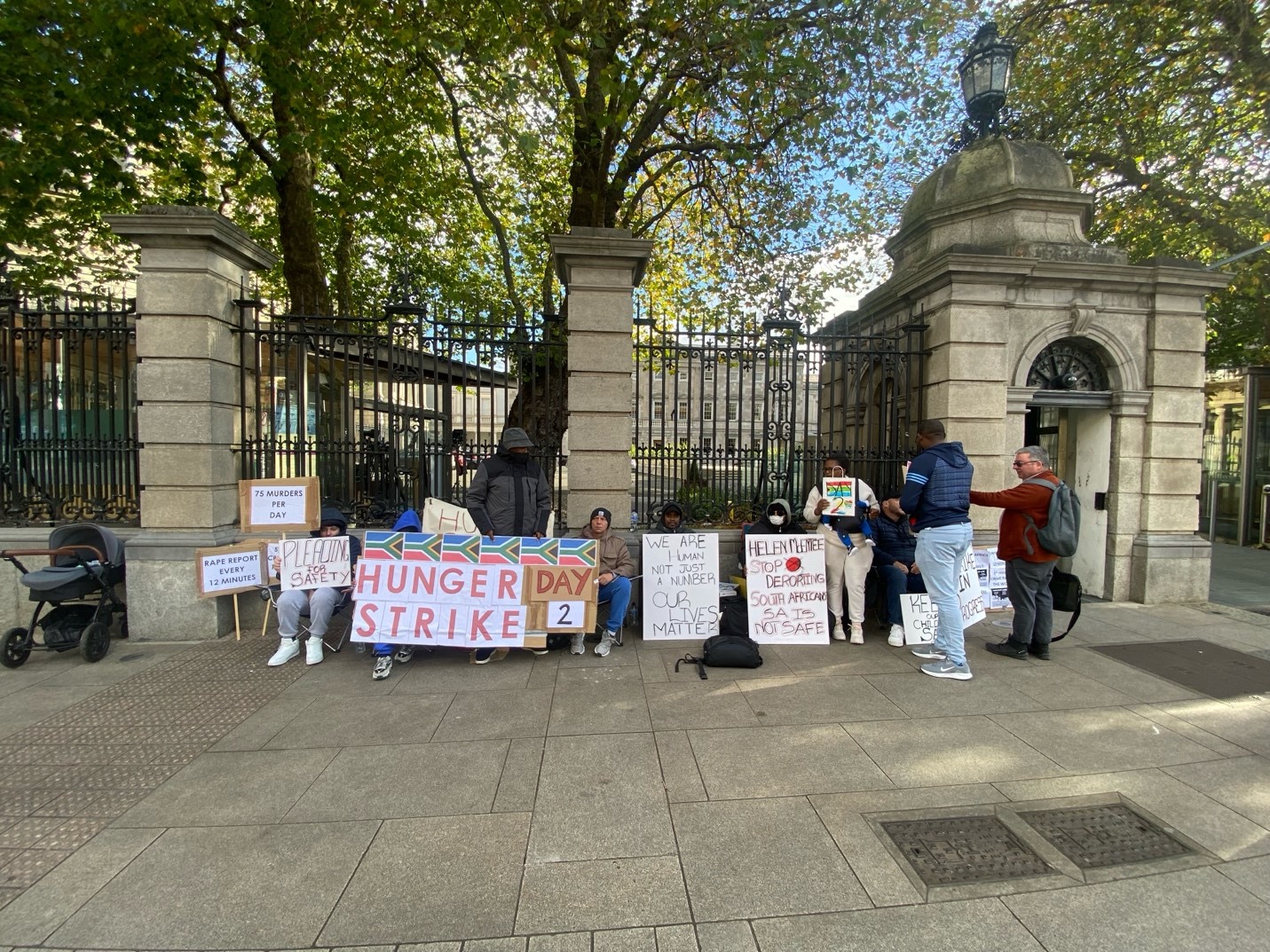
Since Monday 21 October, these South African men and women who are living in Direct Provision have gone on a hunger strike in the hopes that the Irish Government will reconsider having South Africa listed on Ireland’s ‘Safe Countries’ list.
The EU and Irish Government define a ‘safe country of origin’ as a country in which: “there is generally and consistently no persecution, no torture or inhuman or degrading treatment or punishment and no threat by reason of indiscriminate violence in situations of international or internal armed conflict.” Neels Heystek – a South African that are taking part in the hunger strike. Heystek told TheCity.ie his daughter is suffering from PTSD and is having regular panic attacks at school as a result of what has happened to their family in South Africa.
“This is our last resort now.”
Neels Heystek
Passersby and sympathisers have donated water to the hunger strikers.On the otherside of Dáil Éireann’s gates, was a protest held by Irish Healthcare Workers for Palestine. Some of these protesters came over to the hunger strikers in support when a far-right agitator arrived.The IrishHealthcare Workers for Palestine lending their megaphone to the South African hunger strikers to drown out the far-right heckler. A collection of the protester’s signs
‘Rape Report every 12 minutes’
‘75 Murders Per Day’
‘Pleading for Safety’
Hunger strikers displaying their respective signs telling those passing by why they are on hunger strike.One of the protesters, down on their knees sticking together another sign for passersby and government officials coming through the gates of Dáil Éireann to see and take notice of.Brian Mogotsi is another of the hunger strikers. He is taking part in this protest in the hopes that the Government will engage in a dialogue with South Africans that are living in Direct Provision to reconsider their position on deeming South Africa as a safe country
Ireland’s hopes of hosting the 2023 Rugby World Cup have been dealt a major blow after World Rugby have decided not to endorse their bid, choosing 1995 host South Africa instead.
World Rugby have selected their preferred candidate to host the 2023 World Cup after months of technical appraisals. South Africa came out on top with 78.97%, France second with 75.88% and Ireland last with only 72.25%.
Each country was assessed on five categories: finance and tournament guarantees, venues and host cities, tournament infrastructure, vision and concept, and tournament organisation and schedule.
Ireland didn’t top any of these categories and came last or joint last in all but one as shown on the table below.
World Rugby Chairman Bill Beaumont said: “The comprehensive and independently scrutinised evaluation reaffirmed that we have three exceptional bids but it also identified South Africa as a clear leader based on performance against the key criteria, which is supported by the board in the recommendation.”
This news, which came in the form of a 220-page document from World Rugby, is devastating for Irish rugby who received strong government backing, unlike France and South Africa.
Over €4 million has already been spent on Ireland’s bid to host the tournament by the IRFU and while it is not impossible for Ireland to be chosen as hosts, it now seems highly unlikely.
Joe Schmidt’s charges are off to a flyer in the Autumn Internationals after humbling the Springboks.
Knowing they couldn’t take on the South Africans in an arm-wrestle, Ireland played a very containing game in the first half dominating possession. This dominance was not entirely reflected on the scoreboard but thanks to a couple of Johnny Sexton penalties Ireland held a narrow 6-3 lead at the interval.
Having contained the much fancied Springboks in the first half Ireland made a dream start to the second half as Rhys Ruddock, a late replacement for Chris Henry, slid in for the games opening try within two minutes. After Johnny Sexton nonchalantly slotted over the extras from the corner it became a two-possession game 13-3.
After imposing their physicality South Africa eventually managed to breach the Irish defense for their opening try after 57 minutes, when Marcell Coetzee applied the finishing touches to an attacking maul.
South Africa were clearly the dominant side at this stage as Ireland’s tackle count started to grow, however after some stout defending Johnny Sexton yet again punished a South African infringement at the breakdown with an excellent kick.
Just three minutes later after clashing with Rob Kearney in the air, replacement South African hooker Adriaan Strauss was sin binned by referee Romain Poite who had consulted his TMO, a major turning point in the game.
With ten minutes to go Ireland started to turn the screw as the new centre partnership of Robbie Henshaw and Jared Payne showed their potential as they threatened to break through for a try. However cynical play by the South Africans in the ruck resulted in another penalty which was duly slotted over by Johnny Sexton making it yet again a two-possession game 19-10.
Just two minutes later Ireland were again knocking on the door of the South African 22, After a few near misses earlier in the game Connor Murray caught out South Africa’s flat defense as he sent Tommy Bowe clear with a grubber kick for a try in the corner. In his last act before making way for Ian Madigan Johnny Sexton slotted over the extras in what was a flawless kicking display and ultimately man of the match performance.
Madigan also got his name on the score sheet with a cracking penalty from 45 meters before some slack Irish defending allowed Willie La Roux to send JP Pietersen clear for a consolation try and final score 29-15, but no one other than perfectionist Joe Schmidt really minded. Unfortunately it also meant Ireland fell just four points short of their largest ever margin of victory over the Springboks.
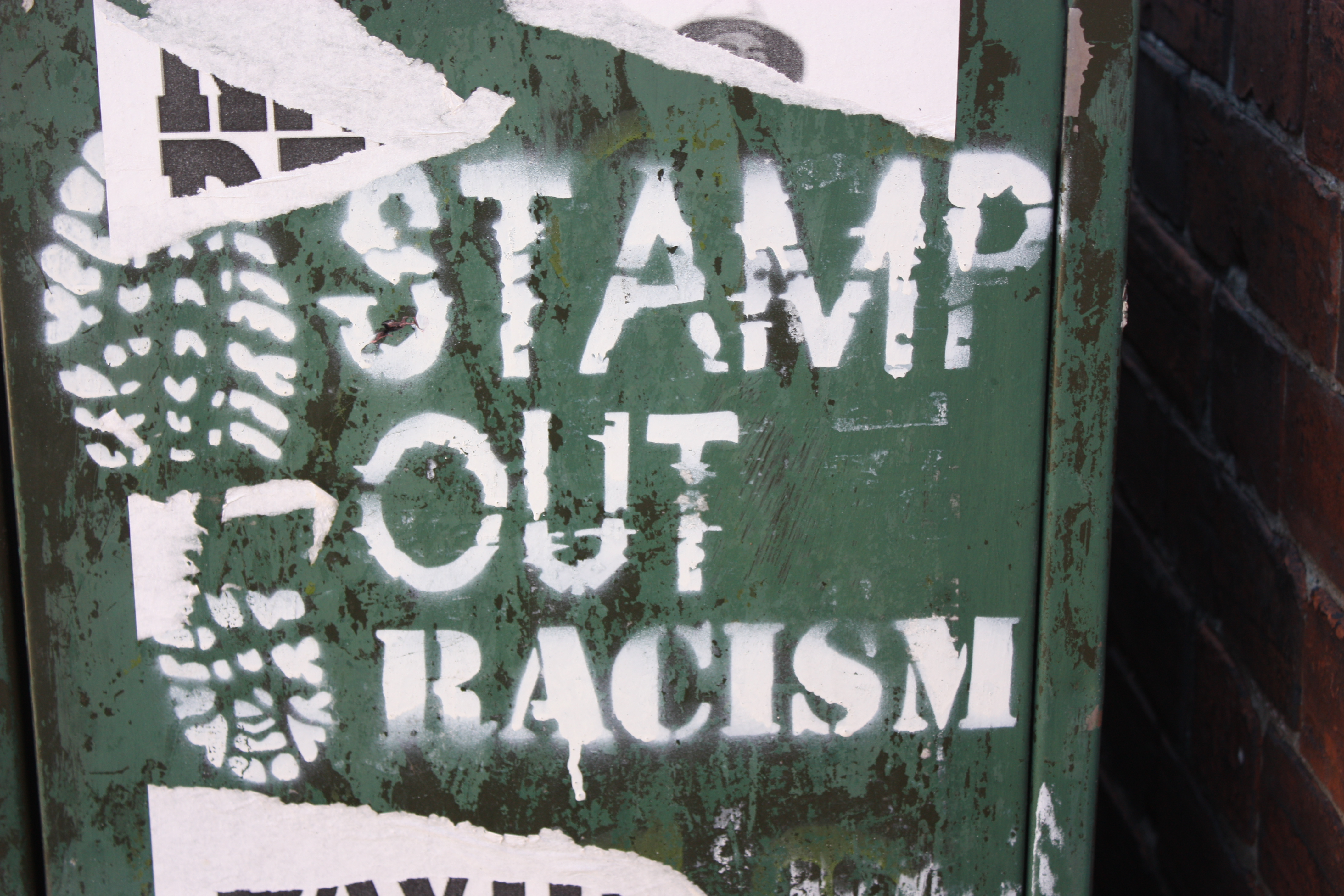
Racism seems to be an ongoing, unreported, issue due to the influx of foreign nationals over the past decade. Image by: Machine Made
According to a recent report racism is rampant in Ireland, with very few cases going reported.
The report was conducted by Dr Patricia Kennedy, of the School of Applied Social Science in UCD, and states that 60 percent of foreign people in this country have encountered racism.
An Garda Síochána Press & Public Relations Officer, Duty Sergeant Damian Hogan stressed that “All matters relating to racism should be reported to An Garda Síochána”.
He also noted that An Garda Síochána has a designated unit for dealing with racism at their Racial and Intercultural Office, which is located on Harcourt Street.
The Racial and Intercultural Office is deemed to be responsible within An Garda Síochána for the development and monitoring of the implementation of organisational policies and strategies, which deal with racial, ethnic, religious and cultural diversity.
The office received a thirty thousand Euros innovation prize by the European Commission in recognition of work already undertaken by the Garda organisation in raising awareness around racism and related issues.
“I have been abused cycling through the city centre,” said Donatas Okafor, a Nigerian national, who came to Ireland in 2006.
“I have had people drive by making monkey chants and stuff,” explained Donatas.
When asked if he any of these incidents were ever reported Donatas replied; “No. I don’t have the time to be going through the effort of dealing with reports. I just get on with life”.
Donatas did have some positive experiences to share about his time in Ireland: “I have lived in many countries over the years; England, Thailand, China, South Africa and Ireland is definitely the nicest of them to live in. There has been some isolated incidents but overall I would say Ireland is the least racist country I have lived in”.
It seems that people of colour may encounter racism more than other foreign nationals. Hungarian national Katalin Takacs said, “I have never been racially abused but I have seen Luas staff abused over the colour of their skin and being told ‘go back to your country”.
Katalin, who has lived in Ireland for the past 7 years, explained further, “I think people are angry over the economy and that state of the country and black people just seem to be an easy target for these people. It’s sad”.
Paul Zhang and Anna Slugacz, who have been in Ireland for the past eleven and 7 years respectively, have never encountered racist events.
“No one has ever been racist to me, or any of my friends thankfully,” said Anna. “I really like working in Ireland and at times you think that maybe some people think bad things about you, but no one has ever actually said anything”.
Paul found some humour in an otherwise serious issue saying, “Ireland loves Chinese food, so that might be why me and my friends haven’t been abused. Thanks to our food”.




You must be logged in to post a comment.