The Irish Government has announced that they will provide €154 million in contributions to fund a new pension scheme named My Future Fund, beginning in 2026.
This initiative will offer many young people their first opportunity to start saving for retirement, and those who aren’t focused on retirement planning can withdraw all contributions to the fund following the six-month minimum participation period.
Employees will have until the end of August 2026 to inform their employer that they wish to withdraw their funds and upon doing so, all contributions will be returned to them through their paycheck, minus tax.
“I never really thought about [saving for a pension], but it’s nice to have and even in a few months’ time if I need the money, I’ll just take out what I’ve saved,” Adam Drea, a 22-year-old student and barista, said.
Employees aged between 23-60, who earn €20,000 or more annually and are not already contributing to a separate pension scheme, will be automatically enrolled in the program, with auto-enrollment beginning Sept. 30, 2025.
Those who do not meet the criteria will still be able to partake in the program but will have to ask their employer to enroll them in the scheme.
Employees will pay 1.5% of their total income into the fund, and that money will be matched by their employer. The government will also contribute an additional 0.5% to the personal savings plan.
For example, if an employee pays €30 per week into their personal savings plan, their employer will be obligated to also contribute €30 and then the state will provide €10 to the fund, leaving the employee with a total weekly contribution of €70.
“Contributions are beginning at the low level of 1.5% for employees to ease the cost of the introduction of My Future Fund and give them opportunity to budget for contributions,” a spokesperson from the Department of Social Protection said.
While the scheme will have a minimum contribution of 1.5% of a person’s income in 2026, this figure will increase incrementally over the next decade, eventually capping at 6% in 2026.
This low minimum contribution in the early stages will also give small businesses an opportunity to prepare for an increase in their wage bill.
“Any additional cost to the business is always a challenge, especially in the current environment, and it is certainly a significant factor for 2026 costs and by extension, the available budget for salary increases,” Fergal O’Connor, CEO of Buymedia, said.
Employers will be expected to inform all of their employees on the implementation of My Future Fund and any business owner that attempts to hinder their staff from enrolling in the program may face a fine or imprisonment.
A key difference between My Future Fund and other government pension schemes is that it is not tied to a specific employer, so if you decide to change jobs, your contributions will continue to be added into the same fund when you start your new role.
The fund will be managed by the National Automatic Enrolment Retirement Savings Authority (NAERSA), a new state agency that has been established to implement the scheme.
Employees will be given the choice of whether they want their money invested in low, moderate or high-risk investment strategies.
Those who do not choose a specific investment strategy will have their savings invested in the ‘default’ strategy.
“The default risk strategy operates on a life cycle basis that de-risks as participants move towards retirement, taking advantage of higher risk growth in younger years and the stability of lower risk the closer they get to retirement,” the Department of Social Protection said.
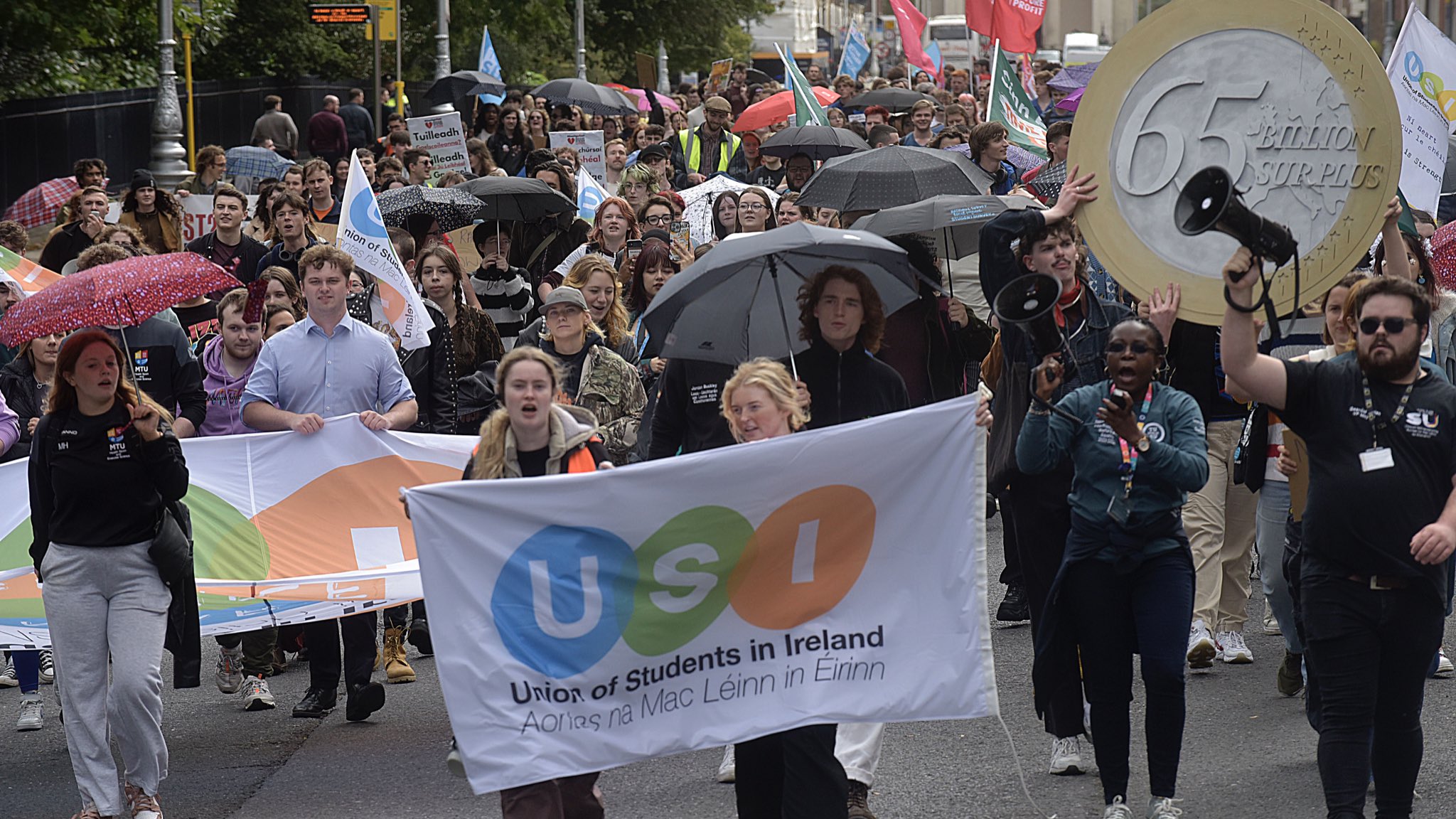
University students took part in a national demonstration, organised by the Union of Students in Ireland (USI) last Wednesday, where they protested the €65 billion budget surplus the Government is said to accumulate over the next three years. Students nationwide were outraged to hear the surplus would be used for a ‘rainy-day’ fund instead of the cost-of-living crisis.
The protest began at the Garden of Remembrance and made its way down to the Dáil with students chanting and singing about the issues they face while studying in higher education.
The student-led demonstration was organised to highlight the issues surrounding third-level education and to offer the Government solutions to fix these problems.
Brian Jordan, president of the Technological University Dublin’s Student Union said, “This is a national demonstration organised by USI […] The reason we’re protesting is because we’ve seen a lack of student accommodation. The Government has failed to give [students] capital investments, even though that is a clear solution.”
“We have a huge amount of private rented accommodation all over Grangegorman. Students are paying up to €1,100 [monthly], and that’s because the university hasn’t built their own accommodation,” he added.
Brian Jordan and the TU Dublin SU at the Garden of Remembrance. Image: @theusi/X
Environmental science student, Megan Tynan described how stressful it was to find accommodation closer to college.
“For my second year, I was commuting an hour and a half from college. By the time you get home, you’re wrecked,” she said.
“I was staying at a hostel for a few days during exams because my landlord decided to sell [the accommodation].”
“I was staying in a room with nine people, who were all strangers. It affected me negatively because it’s embarrassing to admit that you are struggling to find a place,” she added.
“It didn’t just fall out of the sky; it did not just happen. It was caused by Government policy.”
Dr Rory Hearne, Assistant Professor of Social Policy at Maynooth
According to the Pre-Budget Submission for the Budget 2024, submitted by USI, 33% of the total student population says they are experiencing serious financial issues. In 2019, that percentage sat at 26%.
President of Maynooth University Student Union, Alex Balfe said that “hundreds of students”, many of whom come from Donegal and Cork, are struggling to find accommodation on campus which is not “sustainable” for students.
“Students are waking up at five o’clock in the morning for their commute and they’re not getting home until very late in the evening,” Balfe said.
“There’s absolutely no accommodation in Maynooth, considering we’re a university town with more students than residents at the moment,” she added.
Third-level students march to the Dáil in protest of the accommodation crisis. Image: @rosspjboyd/X
The latest figures on Funding the Future — a document released by the Government in August 2023, mentioned that full-time student numbers are increasing and are expected to “peak” at 233,000 in 2030. It is also mentioned that there are currently 29,773 “oversubscribed” students who will not get accommodation in the 2023/2024 academic year.
The document mentioned that Minister Simon Harris confirmed “Government approval” for a new policy to be introduced that will provide “state assistance” to the “development of new and additional student accommodation for higher education institutions”.
The Government also “approved €62 million in additional funding” for 1,072 additional beds in universities like the University of Limerick (UL), Maynooth University (MU), University of Galway (UG), and Dublin City University (DCU). Assessment is still ongoing for all five Technological Universities (TUs).
Dr Rory Hearne, an assistant social policy professor at Maynooth said, “The housing crisis is forcing students to drop out of college, forcing them to pay unaffordable rents and to live in hidden homelessness. College days are supposed to be the best days of your life, but now, it’s a nightmare for many students.”
“It didn’t just fall out of the sky; it did not just happen. It was caused by Government policy.”
“Rents have increased by 100% since 2011, and 60% since 2020. Here’s a radical idea, in Berlin, in 2020, they reduced rents and put a five-year rent freeze in place. Why doesn’t the Government reduce all rents by 20%, back to the level they were in 2020?” Hearne said.
In 2021, Berlin’s Mietendeckle — a rent control law in Berlin, was declared ‘unconstitutional’ and was replaced with Mietpreisbremse — a new rent control law that limits how much rent the landlord can ask for. It is also possible to claim money that was overpaid for rent.
President of USI, Chris Clifford said, “How far away from reality is our Taoiseach when students and graduates are leaving the country by the plane load, when students have to decide between food and printing, and when a student’s room is the front seat of their car? That is the reality that this country has created for students.”
“We’re looking for the Government to fund the future of this country […] There’s a ‘rainy day’ fund of €65 billion and we’re asking for five percent of that. That five percent reduces waiting lists in hospitals, that five percent means that there’s enough childcare practitioners in this country, and it also means that there are enough civil engineers out there to get these houses, that not only students, but the public are crying out for.”
“Five percent for the future of Ireland,” Clifford added.
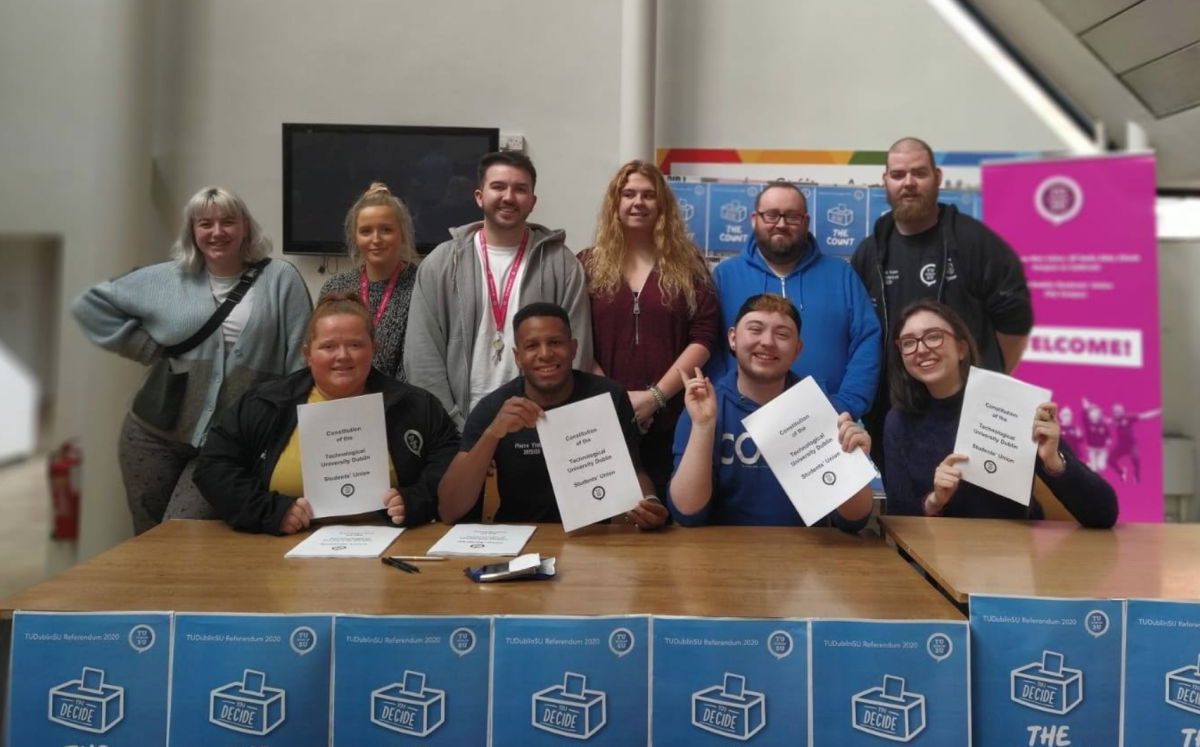
TU Dublin SU at the count on February 21, 2020, at Grangegorman after the Referendum to amend the Constitution passed. Photo: Kim O’Leary
Students attending TU Dublin are this March being invited to nominate themselves for full-time or part-time positions with the university’s Students’ Union for the 2020-2021 academic year. TheCity.ie’s Kim O’Leary sits down with outgoing TU Dublin Student Union president Pierre Yimbog to find out what the upcoming election means for the student body and the university itself.
The last twelve months has seen a time of great change for our university, and on 1 January 2019, TU Dublin was formed by the amalgamation of three existing institutes of technology on the Dublin area- Dublin Institute of Technology (DIT), Institute of Technology Blanchardstown, and Institute of Technology Tallaght (ITT).
Meanwhile, the Students’ Union was set up a mere eight months ago on 1 July following a referendum in February 2019, which saw the three existing unions merge into one single union.
The Students’ Union is a representative body democratically elected by students each year, and its responsibilities are to provide representation and support for all students at both academic and non-academic level.
There are 23 elected officers in the Students’ Union who are here to represent students within the University and nationally. The officers are directly elected by students every year in the Annual Elections normally held in March.
There is the full-time officers, who are paid and full time elected representatives who normally would have graduated from their course upon taking on the role. The part-time officers are still full time students themselves and some have specific roles and campuses to represent.
After three years working for the student union at TU Dublin, its outgoing president Pierre Yimbog has seen the successful passing of two Referendums.
Pierre Yimbog at the count for the Referendum on 21 February, 2020. Photo: Kim O’Leary
In the aftermath of the successful Referendum and prior to the March Elections, Pierre said that the last year has been particularly busy for the Students’ Union.
“It’s been a good year for us at the TU Dublin Students’ Union, it’s not been without its challenges like any role. Last year saw the three existing unions merge into one and now we are pleased that the Referendum on the amendment to the constitution has now passed so it’s been good overall.
“The Referendum in February saw a unanimous YES vote from the students who voted with a great turn-out, there was great support and everyone went out campaigning. Now we’re hoping the March elections will ensure everyone has a say in how the Students’ Union operates,” said Pierre.
— TU Dublin Pastoral Care and Chaplaincy Service (@TUDubChaplaincy) February 21, 2020
A fully-united Students’ Union has been confirmed by a vote. Photo: Twitter
Explainer: What was the 2020 Referendum?
On February 19 and 20, the student body went to the polls at the various campuses across Dublin to vote whether or not to approve the amendments to the TU Dublin Students’ Union Constitution. The newly amended Constitution included a number of changes including;
Forming a legal entity that will allow funding for the Students’ Union to provide support staff to all officers and students, make services available across all the campuses and to ensure parity of service for all students.
The other major change is to reflect the move of 10,000 students to Grangegorman from Cathal Brugha Street, Kevin Street and Rathmines in September 2020. The four new College Officer positions proposed are Central Quad, East Quad, Aungier Street (including BIMM) and Bolton Street.
The other amendments were to refine the governance, transparency and accountability in the Students’ Union.
How did we vote?
There were 3,501 votes casted over the past two days and the results is an OVERWHEMINGLY YES to adopt our Constitution!!
Thank you to all the were invovled, including polling clerks, volunteers, staff, officers,… https://t.co/YPYLmQJRbt
3,501 votes were cast, and the result was a resounding YES for a new Constitution.
On Friday 21 February, the ballot boxes were opened and counted at Bolton St. The total number of votes cast was 3,501 which exceeded the total required votes of 2,918. It is understood that the total valid poll was 3,489 due to 12 spoilt votes. Ultimately, it was a majority win for YES voters with a total of 3,352 votes while NO votes totalled just 137, making it a landslide victory for those in favour of the new Constitution.
As decreed in the new Constitution, the coming year will see the Students’ Union, already unified in principal and intent, create one legal entity as a CLG as TU Dublin prepares for the opening of the new Grangegorman campus. Approximately 10,000 students will be moving from Cathal Brugha Street, Kevin Street and Rathmines to the new Grangegorman campus from September 2020.
Pierre is certain that the new Constitution can only be a positive for the Students’ Union and student body.
“This will ensure that we can work towards equal support services for all elected officers and most importantly an equal service for all students, no matter what campus you are based on,” said Pierre.
However, Pierre confirmed that he cannot run again in the upcoming March elections as the term for a full-time officer on the Student Union is just one year, and the Constitution states that three years is the maximum in any full-time role. Pierre has already been President and Vice President for Education in DIT Students’ Union and those years are counted so his time is up.
“The nominations for the elections opened on 27 February and will remain open until March 10, all of the details for those seeking to run for part-time or full-time Officer positions are on the Student Union website. Everyone can run in the elections and we hope it will pave the way for the future of the Students’ Union,” explained Pierre.
How can candidates apply and what positions are open?
The following are the positions any registered student can run for on the City Campus: President (Overall, Full-time paid),Postgraduate Officer (Overall, Part-time paid), Deputy President for City Campus (Full-time paid), Vice President for Education (Full-time paid), Vice President for Equality and Citizenship (Full-time paid), College Officer for Aungier St & Bimm (Part-time paid), College Officer for Bolton St (Part-time paid) and College Officer for Grangegorman East (Part-time paid).
The outgoing Students’ Union Committee. Photo: Instagram
To run in the elections, candidates must submit and fill out a nomination form, write a manifesto and include in the form, and get 100 signatures (full-time positions) or 50 signatures (part-time positions) from students and present into any SU office. Candidates must also provide a €20 refundable deposit to any SU office before 12pm on Tuesday 10 March.
In addition, it should be noted that candidates running for election for Grangegorman Central College Officer must attend hustings in Kevin Street and Cathal Brugha Street, while candidates running for election for Grangegorman East College Officer must attend hustings in Grangegorman, Rathmines and Aungier Street.
According to Pierre, the next important step for the Students’ Union in the wake of the successful Referendum is to negotiate the union’s funding with the University.
“With such a strong turnout in this Referendum, the University should be in no doubt that students desire a strong and well-funded Union that truly works for them. Also, having a single union makes things easier to arrange funding but next year whoever is elected to the union will have to ensure that is maintained,”explained Pierre.
So what is next for Pierre after his term ends as president of the Student’s Union? Pierre explained that he all ready has a degree in Law and is considering his options moving forward.
“My initial plan is to maybe travel this Summer, to have a bit of a rest and see from there if I want to go out into the workforce or pursue further education.”
Nominations for officer positions on the TU Dublin Students’ Union are now open until 12pm on Tuesday, 10 March. The Annual Elections are happening on 31 March and 1 April 2020.
Students will find more details on the specifics of the different positions, how to run and how to conduct your campaign on tudublinsu.ie
The rising rents in Dublin are forcing students to endure long commutes in order to attend their desired university. Students are enduring daily round-trips to Dublin in particular. Although this lifestyle certainly has its benefits as it’s cheaper and less stressful than having to fend for yourself and you get to stay in the comforts of your home and enjoy your mum’s cooking.
However, the journey to and from university is definitely not easy as you don’t have the luxury of being able to wake up and make it to the lecture room 15 minutes later. Organisation skills are a must, as well as ensuring you have enough free food stuffed in your bag. By the time you get to college you have been awake for four hours and there’s nothing worse then when someone complains about waking up only an hour ago.
5:00 It’s a Monday morning and the lecture isn’t until 9, yet still, you are getting up. Having to wake up four hours before the lecture isn’t ideal, and the weekly debate always starts: ‘Do I get up and go, or shall I sack it all off, stay in bed and forget about university all together…’
6:15 Make my way to the bus station and wait for my 6:30am bus that will be packed with other unfortunate students. You are praying that it doesn’t arrive late and that traffic will be on your side, which it never is.
8:00: Off the bus and make your way to college which involves a 20 minute walk or another bus.
17:00: Back on the bus home, college friends will be home in 20 minutes and you will hopefully be home in 2 hours. It’s hard to do work on the bus but it has to be done as by the time you get home you just want to sleep.
Sarah is a student in UCD. She commutes every day to college. She said: “It can be very frustrating as you know you have to leave college at a certain time to beat the heavy traffic and its so depressing when you just miss a bus so you have to wait around for an hour for another one.”
Commuting means students miss out on
opportunities. While their on-campus friends enjoy a ready-made friendship network
in student accommodation from freshers’ week, commuters do not benefit from
this privilage and they often have to make more of an effort to forge
friendships.
“The day is super long and it makes it hard to concentrate on assignments as all you want to do is rest. People don’t realise that travelling can be mentaly draining. And the worst part is that sometimes you only have one class and you have to travel for two hours for it,” Sarah added.
“If you think getting up early in the morning is the worst thing about commuting then you are wrong. Commuting to college makes life hard and you miss out on so many things. Students who commute feel left out and alone. Your social life is close to non existence as you always have to catch a bus home and you aren’t near college on the weekends so you miss out on the social gatherings.
“Missing out on drinks and the fun stuff
that college is all about is hard and it makes is harder to have friendships
with the people in the class.”
“Between waking up early, missing out on the fun and then the dreaded workload, it makes the commute ten times worse for students. It is mentally and physically draining.”
There has been a rise in Dublin third-level students taking part in the Erasmus+ programme, statistics obtained via Freedom of Information act have found
Over the last five years, four Dublin colleges (UCD, DIT, Trinity and DCU) have seen an increase in students studying abroad at partner European universities. DIT however, has the highest number of participants. In the 2017/18 academic year alone, DIT sent 549 students to partner universities.
Peter Dalton, Erasmus coordinator at DIT, said: “The significance of the Erasmus programme is life changing for students, it allows students to broaden their horizons, both academically and personally.”
Mr Dalton explained how beneficial the programme is for students and their future careers. He said: “Any student who undertakes an Erasmus abroad, from an employability point of view, in the years ahead will stand out amongst the rest. It shows an employer that a student can adapt to change and learn new cultures.
“The Erasmus programme is an academic and personal journey in life that should be experienced by all students.”
UCD have sent over 2,000 students abroad over the past five years. UCD student, Jane Moloney, took part in the Erasmus programme in the 2017/18 academic year. Jane said: “I originally chose to go on Erasmus because I was not overly happy with the course I was doing in UCD. I decided that if I went away for a year it would really stand to me in my future career and set me aside from my peers when applying for jobs and graduate programmes.”
Jane, who studied at Utrecht University in the Netherlands, said a year away from Dublin did her the world of good as she had the opportunity to experience a new lifestyle and culture. She said: “It is so important for students to take part in the Erasmus programme because there are so many different countries right on our doorstep in Europe.”
Jane said her time abroad allowed her to become more confident and independent. She said: “As someone from Dublin, who goes to university in Dublin, I never actually got the chance to move out of my family home, so it was good to be able to get the chance to do that in such a cool country. I gained, not only an international degree and international experience, but also international friends and connections that will last a lifetime.”
Erasmus+ is a European Union programme which gives students the opportunity to study abroad and develop their educational and social skills. It also allows students to live and study in another European country for up to a year and experience a new way of life.
Influencer. It seems to be the term of the moment.
This single word is usually always followed by the same question; what the hell is an influencer?
To put it simply, an influencer is a social media user who has an influence over a large number of followers.
There are fashion influencers, beauty influencers, fitness influencers, and so on. You name it, someone is trying to influence it.
These influencers are often sponsored by large companies to promote their products to followers. Some of Ireland’s most successful influencers include Suzanne Jackson (So Sue Me), Pippa O’Connor Ormond, and Rob Lipsett.
Emma Doyle is a 21 year old fashion design student from Dublin who is trying to make her mark as a social media influencer in a saturated market.
Emma Doyle, a rising star in social influencers
“I started my blog the summer after I finished school in 2014,” says Emma. “I was looking at doing fashion design in college so I started it as a fashion blog and I wanted to put up different outfit pictures.
“I didn’t expect it to become anything,” she explains. “I just wanted to do it for myself to see if I liked it.
“I found out that I really liked makeup and beauty, which I didn’t realise. I started incorporating that in as well and doing reviews when I bought new makeup and products.”
It has been a challenge for Emma to establish a following. She started her blog from nothing and it has taken a lot of time and effort to build her profile. She now has 12,000 Instagram followers and 1,500 people who log on to Snapchat to watch her everyday routine.
“It’s weird because [my following] kind of goes up and down,” she says. “You get out what you put into it. If I have a busy few months when I’m in college and I’m scraping by trying to put up a post a day, I won’t get many new followers.”
Often, followers come when you least expect them. Emma explains: “Say when I’m away on holidays and I’m putting up a load of pictures when I’m away, I’ll end up getting way more followers that week.
Emma Doyle finds posts on holiday outfits attracts followers
“It might not even be blog related. It could be my outfit on holidays and that would be it. It’s weird.”
When Emma started blogging in 2014, it was the fashionable thing to do. Snapchat was in its infancy and Instagram videos or stories had not yet been introduced on the picture sharing app.
However, as technology has changed, so have Emma’s tactics.
“I feel like people don’t really read that much anymore so I rarely write on my blog,” Emma explains. “I think it’s moved to watching things. You need to Snapchat and make videos to get your point across.”
Emma believes that coming on camera and speaking to her followers creates a level of intimacy and this is why people continue to follow her.
“I have a small audience but they’re all interactive,” she smiles. “They all do really care.”
Despite her growing success, there are times the fashion design student wonders why she continues to blog.
“Sometimes I do question ‘should I keep going with this?’ and think about the things I shouldn’t do anymore,” Emma says.
Are there ever days where she’s just not bothered?
“Definitely,” Emma says with a firm nod of her head. “There are days that I feel like I’m in a rut and like you feel that you’re not improving. You’re wondering what’s the point in me doing this if it’s not going to be really successful?
“I think it’s hard because no matter how far you go, you think this. When I first started, I never thought I’d get to where I am now. Now I’m here, I feel like it’s the same and I haven’t gotten anywhere.”
It’s the small things, however, that motivate Emma to keep going.
“I get press stuff sent to me now,” she smiles. “I get sent new products and I didn’t get that at the start. So I have to think about that too and think of that as success.
“Sometimes a bigger company will reach out to you and it’s like wow. In your head you’re thinking ‘I can’t believe that this is happening’ and you’re shocked by it. You can’t even imagine it happening a month before.
“Things happen that you don’t expect and it gives you a bit of motivation.”
Talking to Emma across a small table in a Dublin coffee shop, she radiates confidence. There is an air of self-assurance that streams from her voice as she speaks passionately about what she does.
She explains, however, this was not always the case.
“Anyone who knows me knows I have never been overly confident,” Emma says. “Speaking on Snapchat and Youtube has made me a different person. I feel like I can talk to people.
“Even in college I can talk to my lecturers much easier. Before, I wouldn’t even ask a question.”
What changed?
“I just don’t care,” Emma smirks. “You grow a thick skin and now I actually just don’t care. Sometimes I’m thinking ‘should I post this? It’s a bit risky or a bit weird’. I wonder ‘should I say this?’
“Then I realise that I just don’t care and I post it.
“If I cared, I wouldn’t be where I am. At the start if I had cared when I got my first nasty message, that would have been it and I would have finished.”
Social media influencers have come under fire in recent months about the authenticity of their posts and whether they are talking about a product because they actually like it or because they are being paid to talk about it.
The Advertising Standards Authority of Ireland (ASAI) launched a new code of conduct for bloggers and influencers in January 2016. This states that influencers must say when they have been paid by a company to promote a product by writing either #ad or #sp (sponsored) on their photos and videos.
Despite these rules, influencers have gotten into hot water recently for not posting the relevant hashtags. In recent months, at least two influencers have been issued warnings by the ASAI for not disclosing ads.
Should we be questioning the authenticity of influencers?
“I question it myself,” Emma says. “Sometimes you see a post and you just know it’s sponsored. You know when you look at it. You can tell by the picture and the way it’s posed.
“I can almost predict it and then I scroll down to the caption and I see #ad I know I’m right.
“I do think that’s it fair that they’re paid,” Emma says. “I don’t think it’s bad being paid. Why wouldn’t they get paid for doing it? It is a full time job.”
She is forced to stop when I start laughing. I question whether it is a full time job.
“I think it is,” she says. “I understand how much time and work goes into it.
“For every sponsored Instagram post, they have to do their makeup and get a photographer. Say for example #IWorkWithPrimark, they have to go and shoot those looks. They get a voucher, go into Penneys, buy the stuff. Obviously you wouldn’t complain about that. That’s not a chore.
“Then you have to go hire a photographer and get them to take the photos. They have to do their makeup and style their outfits. They have to edit the photos, put them up and write a caption as well. It does take time. That’s a couple of hours out of your day. If they’re paying that photographer, that’s money out of their own pocket. It is fair they get paid.”
Is it a sustainable full time job that Emma would consider when she leaves college?
“I don’t think it’s going to be going anywhere,” she says. “I think it’s only going to get bigger. More people want to work with influencers. It’s hard to know what it will be in the future.
“I don’t know what I want to do when I finish college,” she reveals. “Last year, I was thinking about not going back to college and just seeing where it would take me. I wasn’t sure if I definitely wanted to do my course. So I was going to try and see what I could do by blogging full time.
“I decided to go back to college and finish it off because it’s only one more year. I’m happy I did go back. My course is beneficial and I need something to back me up. It’s not safe for me to do it full time yet and I need a steady income and routine.”
So what does the future hold for Emma Doyle?
“I’m not thinking about what I’m going to do when I leave college just yet,” Emma says.
“I’d love to try fashion buying or styling. I’d love to design or have my own online fashion shop.”
A classic outfit post influencers would be expected to post
It’s clear Emma will have a lot of options and opportunity when she leaves college next May. Whether she will continue to blog and “influence” remains to be seen.
What’s also clear however, is that influencers are here to stay. In fact, the influencer industry is only going to grow as we become more and more dependent on that rectangular piece of glass we carry around in our pockets.
With this week’s Budget still fresh in the minds of many across the country, how are the measures announced going to affect the third level students of Ireland?
Cian Gaffney is a final year Religion, History and Teaching student in Mater Dei who had this to say about the Budget as a whole: “I do think the budget was technically fair, in that its pros slightly outweighed its cons. I think this is a carefully crafted budget that finely walks the balance between being safe for the parties involved, while giving the illusion of being more progressive than it probably is. Put simply, it’s just politics.”
Students like Cian Gaffney could breathe a sigh of relief when they discovered the Student Maintenance Grant would remain at the same amount as the previous year. However, with rent prices in Dublin continuing to increase the Wexford native felt it was “unfair” not to increase the monthly grant, given the current cost of living.
“Given the ever-increasing exorbitant rent in cities around the country, [particularly] Dublin from personal experience, I think the grant remaining the same is absolutely unfair. The grant should be relative to the average cost conditions of the student body, and this is simply not the case. A balance needed to be struck, and it wasn’t,” he said.
“Whether by incorporating more into the existing student grant, or creating another measure entirely, something should have been done to tackle this directly. The exclusion of such is all the more obvious in this budget given the progressive strides in other areas.”
Those who like Mr Gaffney will be entering the workforce in less than a year also had to pay attention to tax measures being addressed in the Budget. With the hugely unpopular Universal Social Charge (USC) remaining in place but being decreased it was clear the Government was out to win some votes before the general election next year.
“In terms of the USC, taking into account the field my studies would naturally enter me into, I shouldn’t realistically be affected too much either way. However, any adjustment to an unpopular levy in the general populace’s favour will naturally be seen as a positive one,” Mr Gaffney said.













You must be logged in to post a comment.