Students up and down the country have began college over the last few weeks a lot of whom share a common burden about the cost of everyday necessities like food and drink.
Students that have to move away from home for college face further challenges paying the high accommodation costs.
One question many are asking is, what is the Government doing to help students counteract this problem?
SUSI grants are available for those who may not have the means for one reason or another to pay the price in full. However, this can be a battle to get, as you must go through many different steps to avail of the grant, like family earnings.
In Ireland the average price for a home was between €198,000 to €682,334 last year, according to the latest CSO (Central Statistics Office) figures. cso.ie
As RTE reported Taoiseach Micheal Martin has confirmed that the upcoming budget comes with an increase in tax credit for renting in Ireland which will make renting slightly easier for students. RTE.ie
Many students going through college only rely on their part-time income for expenses, with a minimum wage set at €14.94 an hour from 2027. Irish Independent
Transport for ireland confirm an increase in Luas fares has also made commuting to and from college that bit more difficult.
A recent survey conducted by the National Youth Council of Ireland NYCI recently stated that 7 in 10 young adults will be forced to move away from Dublin for more affordable living. This comes off the back of the recent increase in a range of prices for 2027.
Dr Rory O’Farrell teaches at TUD in Grangegorman in the tourism and hospitality sector. He has previously worked in the science, technology and innovation directorate in OECD in Paris. (Tudublin.ie meet our lecturing staff)
Dr O’Farrell said the biggest problem now is rent for students as the range in prices for a college dorm is not feasible for a lot of families to keep up with rising costs.
What Dr O’Farrell believes is that “colleges need more funding so that they can build more accommodation for students so that it renting affordable places is not as scarce”.
The TUD lecturer did hint at plans to build more accommodation buildings near TUD, TUD were contacted to comment on the matter however they have declined in their right to reply to questions asked about the recent project surrounding student accommodation
He fears that because the cost of living is rising “students grades will suffer because of them needing to work more, giving them less time for studying, which will affect their grades with some failing to progress”.
Even repeats, he said, would be a struggle financially, stating “the SUSI grant does not cover the cost of repeat exams or assignments”.
Regarding the emigration side of things, DR O’Farrell is not too worried about that as he went on to say that “emigration is part of what happens with young people, they go and explore, a lot of young people in Ireland move to Australia only to find that rent is just as high if not higher over there”. He also claims that people who are in temporary situations “tend not to put up a fuss if they can see an end to it”.
This podcast was recorded before the recent news of Jim Gavin leaving the presidential election.
With the upcoming presidential election drawing near, the political engagement of young people is once again in the spotlight.
Do they turn out to vote? If so, which candidates and issues resonate most with them? Today, our podcast will take a fresh look at this topic, including interviews from TU Dublin students.
Whether you’re a first-time voter, or simply curious about youth perspectives, this conversation sheds light on the role young people play in today’s political landscape.
In recent months the violence in Dublin City Centre has been top of the news agenda and it seems that violence has reached the university TU Dublin’s campus.
TU Dublin president, Professor David Fitzpatrick, wrote directly to the minister for justice Helen McEntee, appealing for more security around the campus for the safety of all students and staff.
In the letter earlier this year to then minister for justice Simon Harris, Fitzpatrick wrote to report about the anti-social behaviour and the lack of safety for students, “we have received reports that the response is slow and are also constrained by the fact that the University’s Estates and Security team cannot respond to off-campus incidents.”
The incidents have not been one-off attacks but have been regularly happening at the Broadstone Luas stop just outside campus.
Luas tram in Dublin City Centre. Image: Louis Hansel/Unsplash.com
“The Union has received increasing reports of anti-social behaviour in the Broadstone Plaza, right beside the Broadstone Luas stop, as well as the ‘main entrance’ to our Grangegorman Campus. Students do not feel safe entering and leaving the campus, particularly in the evening time,” said Brian Jordan, president of TU Dublin Students’ Union.
The attacks have also appeared to not be random students from the college as there has been a racial element. While it appears that ‘nobody is safe’, there appears to be a distinct racial element to many of the incidents. It’s also very possible from what I’ve heard and seen that these students are targeted specifically because of their race and/or ethnicity. Several victims of attacks here have reported that racial slurs were thrown at them during the incidents for example,” Jordan added.
With this still going on and no sign of any measures being taken by the college itself, the TU Dublin Students’ Union took matters into their own hands and held a demonstration at the Luas stop.
TU Dublin Student Union members held a demonstration to send a message to the Government. Source: @tudublinsu
The union said the reason they held the demonstration was to ‘show solidarity with the students who consistently feel let down by the government’ and the second reason was to apply more pressure on the government and McEntee to coordinate a far better response between the Gardaí, Transport for Ireland (TFI), and TU Dublin.’
“There were several speakers, including myself on behalf of the SU, Nekesa who is our VP for Welfare & Equality, who also happened to be a mature and international student in TU Dublin, several local ‘opposition’ politicians, as well as current students within the University who felt more needs to be done.
We received very little communication from the University about steps being taken (an unfortunately common trend). However, after a particularly ‘viral’ incident last semester, media reported that the President of TU Dublin wrote to the then-Justice Minister requesting more policing in the area,” said Jordan.
The previous attacks saw some students getting pelted with eggs and racially abused and another getting her hair pulled. This all happened at busy times in the evening when students were waiting at the Luas stop. Witnesses described the offenders as all boys aged around 15 years.
When asked what the desired outcome Jordan said, “We want Justice Minister McEntee to provide adequate governmental support to improve the safety of the Broadstone Plaza. This means improving resourcing to policing in that area like more of a garda presence, as well as a collective response from TFI and TU Dublin. It should not be the role of the Union to constantly try to coordinate these stakeholders when we have an incredibly well-paid Government whose role that is.”
Lavanda (left) and V-Face (right) on Lower Grangegorman Road. Photo by Colm McGuirk
“The fact that this unit was close to TU Dublin was a huge factor in the decision to go ahead with it.” Sarah Boland, owner of V-Face, is talking about her vegan fast-food restaurant’s proximity to the impressive new home of Technological University (TU) Dublin.
The city campus of what used to be called DIT, built as the centrepiece of a major regeneration programme for Grangegorman in north Dublin city, is ready to welcome around 10,000 students plus staff – once Covid restrictions are no longer necessary.
Boland’s is among a number of independent businesses on the Lower Grangegorman Road that had factored those numbers into their plans.
“It’s going to be a huge campus, so obviously footfall will increase massively,” Boland says.
In the turbulent 10 months since it opened, V-Face has had to make some think-on-your-feet adjustments to compensate for lost bums on its 40 seats. Among them is the outdoor eating area installed on the opposite corner, in cooperation with Dublin City Council, and the window hatch through which Boland speaks to The City.
“Coffee and sandwiches were never in the business model,” Boland says, “but we said ‘let’s bring out a lunch offering.’ The burgers were doing really well, but were more for the evening offering. [The hatch and coffee counter] have been designed in a way that, once the pandemic is gone, you can also swing around and serve people that come in.”
Dining tables installed by V-Face. Photo by Colm McGuirk
While V-Face benefitted from a model partly geared towards takeaway from the off, former Mediterranean restaurant Lavanda on the opposite corner has had to reset completely in the last year.
“We tried to do takeaway Mediterranean food during the first wave,” says Croatian owner Robert Velic, “but it didn’t work very well.”
Lavanda’s enforced rebirth was planned with the new TU Dublin campus in mind – it now sells toasties, slices of pizza and sweet treats.
“We’ll see when the students come back if we made the right choice”
Robert Velic
“The second wave came and then we completely changed. We were expecting those students. We adapted the prices to four or five euro,” Velic says.
“When the lockdown ends,” he continues, “it’s going to be a proper takeaway and we can add a few more things to the menu when business picks up and the colleges are back. We’ll continue to target students and walk-ins. We’ll see when the students come back if we made the right choice.”
A few doors up, Russia native Alexander Yegorov’s print and copy shop should be bustling.
His unit is next door to one of two new student apartment complexes on this stretch of road built in the controversial ‘co-living’ mould (and, in the ultimate symbol of the area’s gentrification, on the site of the former ‘Squat City’).
“We opened our shop three months ago,” Yegorov tells us. “They move the lockdown every two months. I expected the students would be here from the new year. But now, it won’t be until summer time.
“But it’s OK,” Yegorov adds. “We can survive until summer.”
“We knew it was a long game, but it’s been a lot longer than anticipated”
Rebecca Feely
On the next corner, Rebecca Feely of Kale+Coco tells The City that when she chose the location for her plant-based healthy food cafe in 2019, “it was under the assumption that there’d be lots of students.”
“We knew it was a bit of a long game,” Feely says, “because they were moving students bit by bit. But it’s been a lot longer than anticipated.”
While noting that her prices might be a little above the average student’s range, she tells us, “it’s always been in my head to focus more on marketing to students, but I haven’t had the chance yet because we haven’t had the students there yet.”
Kale+Coco has leaned more towards retail of food products to help stay afloat in what has been a difficult year.
Rebecca Feely in her cafe Kale+Coco. Photo by Colm McGuirk
“We were never actually told to close, so you feel almost obligated to keep trading because you have bills to pay,” Feely says.
“You have rent due. If you’re not ordered by the government to close, you’re not covered by any insurance, your landlords aren’t going to give you a break,” she adds.
While the eventual arrival of students should help jump-start these Lower Grangegorman businesses, it could well signal the end for Happy Days Coffee Van on the new campus a little further up the road.
The mobile cafe was set up by local resident Olivia O’Flanagan in response to the “inertia and isolation” her neighbours were faced with during the first lockdown last spring.
O’Flanagan, a former lecturer with no background in business, was given the green light to operate on TU Dublin’s campus for as long as its own catering services were closed.
“It’s a lockdown project to keep us all busy and connected and give some kind of focus for the local community,” she tells The City.
Happy Days Coffee Van set up at the entrance of TU Dublin’s Grangegorman Campus. Photo by Colm McGuirk
Hiring only locals helped her secure the temporary contract – staff can return to their own homes for the mandatory bathroom access.
“For me, it’s not a business endeavour,” O’Flanagan says, “though it has made money and is paying eight people’s wages on 20 hours a week. They’re all delighted and their parents are saying they were all sitting in their bedrooms cracking up.”
For students in direct provision, a lack of access to digital technology hinders their ability to pursue an education. Niamh Talbot spoke with Roos Demol, one of the women behind a campaign raising money to provide these students with laptops.
2020 marks the 20th anniversary since the introduction of the direct provision system in Ireland.
Direct Provision is intended to provide for the basic needs of people who are awaiting decisions on their applications for international protection. The system was designed as a short-term measure, However, the 2015 McMahon report found that 55% of asylum seekers had been there for five years or more. This average has now been reduced to 15 months, however many are still waiting years to hear their application results. The lengthy stays are associated with declining physical and mental health, self-esteem, and skills.
Currently, there are about 4,300 people in 34 direct provision centres across 17 counties. 38% of these are under the age of 18.
The system restricts these people from seeking employment and engaging effectively in education. Residents are not entitled to Social Welfare payments. Instead, they receive an allowance of €21.60 per adult and €10.40 per child, per week. For students, this environment, where their parents are not allowed to work and may be struggling with mental health difficulties, can have a very negative impact on their capacity to learn.
Many find it difficult to study or to finish their homework in environments that are often noisy and over-crowded, or indeed, in some cases, frightening and unsafe. Students in direct provision face huge barriers in continuing their education to third level. The additional costs of third level are prohibitive for students and families on a meagre weekly allowance. This means that many high-achieving students who qualify for a third level course cannot progress on to college.
Digital technology has come to play a huge role in how students are accessing education during the Covid-19 pandemic. Whilst some universities in Ireland are open for a limited number of lectures, most are delivered online.
A report from the National Forum for the Enhancement of Teaching and Learning in 2019, showed that just 76% of students had access to reliable WiFi at home and only 25% had access to recorded lectures.
Remote learning has presented unprecedented obstacles for many students. Poor broadband connection, strained family relationships, flailing motivation, and concentration levels.
But for students living in direct provision, the challenges increase tenfold. Many of these students relied on campus computers in order to complete their assignments. The move to online education has left many people who are unable to access computers without the means to take part in lectures and coursework.
Windows4Opportunity is a fundraising campaign started by Recruit Refugees Ireland aiming to provide laptop computers to 900 applicants currently enrolled in third-level education courses in Ireland who are in need of computers. The weekly allowance for adult International Protection applicants living in Direct Provision, means it is not possible for most people to purchase a laptop for coursework. Windows4Opportunity aims to provide people seeking protection in Ireland with the means to secure their own futures.
The campaign is raising money through their GoFundMe page but also encourages others to raise money through their own fundraising efforts.
Roos Demol, one of the women behind the campaign, spoke to The City about its importance. “Without access to technology, your chances of an education and your chances of securing employment are nil,” Demol said. “Sadly, for many students enrolled in courses that have since moved online, their ability to continue their studies is not possible.
“Having access to technology will not just allow people access to education and job opportunities, it will instil a sense of hope for their future.”
As of the 26th November, the campaigns GoFundMe has currently raised €6,525 euro of their €35,000 goal. Demol encourages people to give what they can: “Even sharing the campaign on social media can give it a huge boost,” she said.
“The students in Direct Provision need our help.”
In a report by Edmunds Rice School Trust, students spoke of the difficulties they face in accessing education. One saying, “Being a student in Direct Provision can be socially isolating. There is no appropriate study space in the centre. The best time for me to study is very early in the morning at 4am when it is quiet. My one desire is to become a doctor! But if I am successful in obtaining a place on the course there is huge uncertainty as to whether I will actually be able to accept it.”
There’s no denying that the last few months have been challenging for many in the Irish community around the world during the coronavirus pandemic. Niamh Talbot spoke with three people currently living abroad about how they’re coping with everyday life and being away from their friends and family.
While they can’t be here at the moment, many Irish living abroad are feeling the effects of the pandemic. Photo by Anna Shvets via Pixabay
Mark Moloney, a PhD student at St.Andrews University in Scotland, has been living abroad for three years now.
He said, “Being over here has been good and bad. We have much looser restrictions than home so day-to-day life has been pretty close to normal. Especially with the whole “eat out to help out” initiative, we were being encouraged to get out and socialise. But not being able to go home as often or as freely combined with nobody being able to visit me has been difficult.”
Moloney is also entering his final year of his PhD and is feeling the added pressure of the pandemic. “It’s all work and no play so I can feel an element of burnout coming,” he said. “There’s a pressure to catch up on all the time we missed in the lab over lockdown but at the same time there are restrictions in place that have made everything move a bit slower. Also, the state of the UK at the moment means I’ll probably have to deal with some kind of restricted living until I finish up next November.”
Despite this, he acknowledges he could have things much worse. “I know people who are living in the US or Australia who wouldn’t be able to afford a flight home at the moment even if it was an option. So, I count myself lucky that I’ll be able to get home for Christmas.”
Whilst some people are used to living away from their family, Dylan Talbot is living alone for the first time. He moved to Dubai in January of this year, being hit with a lockdown not long after settling in.
“At the start of lockdown it was very strict over here with a 24 hour lockdown. I found it quite difficult and was missing my family a lot because I was stuck at home on my own and wasn’t going to work. We weren’t allowed to leave our houses at all and I felt much more homesick than I would have if there was no pandemic,” he said.
However, with Ireland entering into Level 5 for at least 6 weeks, he says he’s actually glad to be where he is. “Life in Dubai feels normal, I can go out whenever, go to the gym, even restaurants and bars are open.” he explained. “ It makes me appreciate being here a whole lot more and doesn’t make me as homesick anymore. My mental health has improved so much being able to get out with my friends and exercise.”
He also noted that the weather makes a huge difference. “In Dubai it’s still bright out and the weather is great. You don’t look out the window and see a dreary day on top of everything else going on in the world. You wake up here and see another beautiful day that makes you want to get up and get out.”
Orla Breen is a student nurse currently finishing up her degree in Southampton. Her life and mental health has been majorly impacted by the pandemic.
She said, “I’ve loved living abroad the past few years. I was always a very anxious person and I think it really gave me the push to put myself out there and grow more confident and independent. That was until the pandemic hit.”
“I went from living in a house with 6 other students to living in halls on my own. With nursing placement, I wasn’t in a position to study from home like all of my friends, so I feel like I’ve been left behind here. Being such an anxious person, the loneliness hasn’t helped my situation at all,” she said.
Things have been looking up recently with some positivity on the job front, she admitted.
“I’ll be finishing my degree at the end of this month and luckily have been offered a position to stay on here. I hadn’t planned on staying on living here once I graduated but with so much job uncertainty at home, I decided it’s probably best to stay put here for a while.”
For the time being, she’s going to just have to see how things go. “I’m taking each day as it comes,” she says. “It’s really hard not being in the same country as a lot of your loved ones.”
She said, “It’s the uncertainty that’s the worst, not knowing when you’re going to see your family again.”
In one way or another the crisis brought by Covid-19 pandemic has had an impact on everybody’s lives. Three 3rd year journalism students from TU Dublin show how TheCity.ie how they are embracing these strange and uncertain times.
Niamh shares how much her daily life has changed since her college and the hostel she worked at have closed due to the pandemic. She also gives some creative ideas on how to enjoy the time in lockdown and remain positive.
Eric shares his experience on what it is like working in a supermarket during lockdown and how he finds a balance between completing his studies and working long shifts.
Gavin gives viewers a sneak peak into what it feels like to quarantine in rural Ireland, with all its pleasures and struggles.
This video was recorded for TheCity.ie by four third year TUD student journalists. They documented their daily routines at home during the covid-19 lockdown. These unprecedented times have cut the college year short for them, however it didn’t stop them from getting their assigned work done.
From exercising, to reading, to eating and to painting, these students have found many ways to keep themselves occupied during these difficult times. They documented all of their activities in this short video. The video goes to show that even during times such as these, you can keep entertained and enjoy yourself at home.
As the Covid-19 pandemic continues to impact Ireland, many people have reported that they are having sleep issues. TheCity.ie’s Kim O’Leary speaks to sleep physiologist Motty Vargheseabout how to ensure students get a good night’s rest – especially as they approach the final few weeks of assessments.
Students sleeping in lecture theatre (Photo: Pexels)
For the last four weeks, I have found myself spending the late night hours constantly tossing and turning in my bed, unable to drift off into an uninterrupted sleep. There is always a distraction of some sort.
The latest Covid-19 updates from Ireland and around the world, as well as the anxiety about final assessments at college, make it hard to ‘switch off’ and sleep through the night.
With the final few weeks of the academic year upon us, many TU Dublin students are wondering how they can get some peaceful rest, despite the troubling circumstances they are experiencing.
College student asleep at her desk (Photo: Pexels)
I started our interview by asking Motty Varghese,how many hours of sleep each night does the average person require?
Varghese: Sleep need is variable between individuals and every individual’s sleep need is unique to themselves. The recommended sleep duration for an adult is over seven hours, and not recommended is less than six hours or over 10 hours. In sleep problems like insomnia, your sleep quantity can be compromised. In sleep disorders like obstructive sleep apnea or restless legs syndrome, you will have a tendency to sleep for a longer time. However, despite increased sleep duration, the person can still feel tired.
Teenagers or young adults would also have a tendency to go to bed very late and wake up very late. If there is an extreme delay in sleep onset, it could be symptoms of Delayed Sleep Phase Disorder (DSPD) – unfortunately, this can have an adverse impact on their academic performance. This happens due to a delay in their circadian clock, not exclusively due to poor habits alone. This warrants therapy, since regularising their sleep patterns by strategic light exposure can bring multifaceted benefits.
O’Leary: As the Covid-19 pandemic continues, do you think there has been a noticeable change or disruption in sleep patterns? If so, why?
Varghese: Yes, this has been flagged as a problem by many. If you remember, the lockdown was implemented around the same time the clocks moved by an hour for DST. With the implementation of lockdown, many people started working remotely, and with it came some flexibility in the morning as well. Our sleep patterns changed and we started sleeping in in the morning. Along with it, there is a general anxiety about COVID 19 and this has been leading to an aroused mental state or a state of hyper-alertness for people. It is needless to say when we are hyperalert, our sleep onset can be delayed and the sleep quality can be compromised along with sleep quantity.
O’Leary: What recommendations/advice would you have as a sleep expert for TU Dublin students having difficulty getting enough sleep during the pandemic, as well as preparing for their final assessments and exams?
Varghese: Your approach to protect your sleep should focus on a few factors:
1. Avoid a state of hyper-alertness
Preoccupying yourself with thoughts of what is happening around you can lead to cognitive or mental arousal. You also want to be informed at the same time. Hence avoid consumption of news via TV, social media, or other sources close to bedtime. Relying on credible sources of information will help to avoid unnecessary panic. Engaging in some relaxing activities like meditating, doing some breathing exercises etc can also help reduce anxiety.
2. Prioritize sleep
You know how important sleep is for you, yet you cannot force it. Understand that sleep is a natural process, but you can nurture it by adopting certain good habits. It may go against what your preferences are, but prioritizing sleep will pay you the dividends now, more than ever.
3. Have a routine
It would also be unrealistic to ask you to adhere to the pre-lockdown sleep schedule since you have the flexibility of working/studying from home and not commute. You may be waking up late, but ensure you still have a structure and are not sleeping in too late. On the upside, at least you are not accumulating a “sleep debt” and focus on consistency of bedtime and wake time through the week. You can gradually move to an earlier wake time when the lockdown is over.
4. Know your rhythm
Whether you are working or studying, productivity is an important factor to keep our stress levels down during lockdown. Everyone has a chronotype – evening, morning, or intermediate – based on your genetic coding. We also call them “larks” and “owls”. This would also mean you will have a preferred bedtime, wake time, and time of optimal alertness during the day. For instance, an evening type person tends to go to bed late and wake up late and a morning type person will do the exact opposite. Pay attention to this pattern of sleepiness at night and alertness during the day. You will be able to be productive and get more done by following your circadian rhythm.
5. Light
Light is a powerhouse of energy. Focusing on light exposure during the day and reducing light exposure closer to bedtime indicates to our body about the day-night cycle and prepares itself for sleep at night and alertness during the day. Seek out natural daylight in the morning and avoid blue light exposure from screen devices for two hours before bed time.
Blue light from screens can hinder sleep (Photo: Unsplash)
O’Leary: Are there any particular food types that can help people to have a more restful night’s sleep?
Varghese: A lot of research has been done into the effect of food on sleep. Research indicated a carbohydrate-rich meal ingested four hours before bedtime in the evening reduced sleep onset latency. It is also advised not to eat any food within 2-3 hours of bedtime since this can increase the body temperature (and delay sleep), cause heartburn, etc.
Food that is rich in tryptophan is also mentioned in the proposed relation of food and sleep.
O’Leary: Is it true that less sleep may weaken the immune system and make people more susceptible to illness, such as this virus (Covid-19)?
Varghese : It is true that sleep and immunity have a mutual relationship. We have known for a very long time that there is an increased chance to catch a common cold or to have flu symptoms if you are sleeping poorly. There is also evidence that the flu vaccination was more potent in individuals who were good sleepers compared to poor sleepers.
It is also vital for us to prioritize our sleep during this time when we are constantly looking for a new line of defence against the virus. It would also be ideal if sleep becomes part of our public health messaging along with good dietary habits and exercise.
O’Leary: Do you think that more studies should be carried out to analyze sleep patterns during the Covid-19 pandemic?
Varghese: Pandemics like this are thankfully not a common occurrence and it will be useful to study how sleep patterns are affected during this period. It will help to prepare for any future pandemics if at all it happened. Sleep monitoring wearable devices (like Fitbit) will come in handy in situations like this to look at the sleep habits of a large number of people.
O’Leary: Some people are also reporting that they are having vivid dreams as of late, do you think that dreams are an important coping mechanism during this stressful time?
Varghese: Dreams occur during a specific stage of sleep called REM sleep. The functions of REM sleep are memory formation and emotion regulation. The information which we take in during the day is processed during REM sleep and converted to memory.
Unfortunately, we have an information overload now which is not very pleasant, and this may be having an effect on our dreams.
Most of the REM sleep or dream sleep happens in the second half of the night. So we may also be getting some more dreams in the extended sleep period in morning hours and these dreams are possibly influenced by the information we received the previous day.
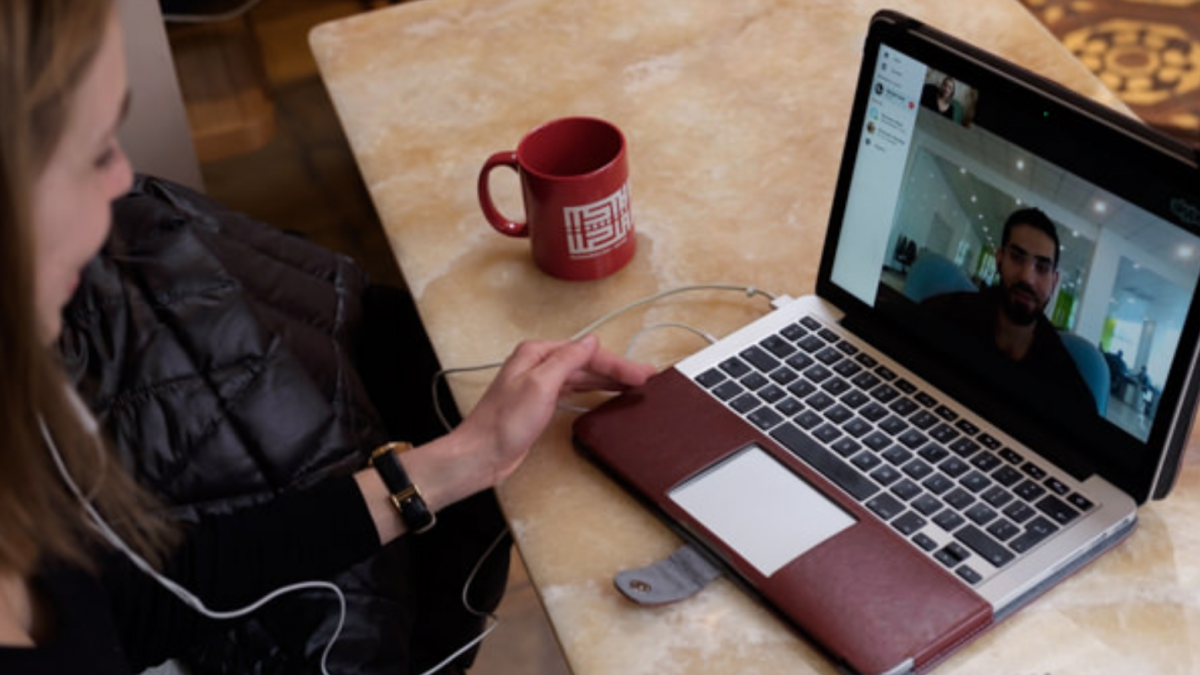
Learners and conversation partners connect online (Photo: NaTakallam)
The City’s Cameron Weymes examines the work of NaTakallam, a businessthat hires displaced people as language teachers online.
NaTakallam, which means “We Speak” in Arabic, was launched in 2016 by Aline Sara, a Lebanese-American woman who was looking for an affordable way to improve her native Levantine dialect of Arabic while living in New York.
Sara saw an opportunity to provide an income to displaced people through an online teaching service that would connect Syrians with learners from around the world, and decided to establish NaTakallam.
NaTakallam has subsequently expanded to include Persian, Spanish and French, hiring displaced people from Iran, Afghanistan, Venezuela and Central America.
Shadi Khaled is one of NaTakallam’s dozens of refugee employees.
Shadi was a music teacher in northern Syria when the war forced him and his family to seek refuge in neighbouring Iraq in 2013.
Despite this, Shadi found his teaching qualifications were not recognized by authorities in northern Iraq.
Shadi Khaled at his home in northern Iraq Photo: Shadi Khaled
After almost four years of working in a variety of jobs, including carpentry, he was hired by NaTakallam in 2017 as a language teacher.
Shadi now conducts online conversation classes in Arabic to students around the world from his home in a refugee camp near the Iraqi-Kurdish city of Erbil.
“The best thing about the programme is that it gives students an opportunity to practice their language skills and allows teachers to provide for themselves and their families,” he said.
“At the moment I currently have ten students, some of who are now fluent in Arabic. We do grammar and vocabulary along with discussions about various topics like politics, economics and history.”
Many displaced Syrians in the Middle East are unable to work due to a lack of work permits and other impediments.
As a result, millions of people, often highly educated, are reduced to handouts and cash in hand labour jobs.
NaTakallam allows displaced Syrians to overcome some of these obstacles by providing them with an income.
For example, Shadi is unable to send and receive bank transfers due to his refugee status in Iraq, but can now get paid by NaTakallam through the local Western Union.
According to Shadi, the coronavirus crisis has increased demand for classes, as learners seek to make use of their free time.
“The situation here in Northern Iraq is the same as other countries, we’ve been partially on lockdown, giving us more free time.
“Since the coronavirus crisis began many of my students are calling me from around the world and saying ‘we have extra time now, it’s a good opportunity for us to do extra practice’,” he added.
NaTakallam founder Aline Sara Photo: NaTakallam
Shadi uses his income from NaTakallam to provide for his wife and two children, who have also gotten to know some of the Arabic learners.
“My students speak with my family and I with theirs. Our lessons are an exchange in cultures and traditions,” Shadi added.
“We are not just teachers and students, our bond is greater than that. I tell my students not to be shy in asking anything from me, we are like family and it’s common to keep in touch after a course has come to an end.
“Natakallam has been my window to the world, each program allows me to travel the globe.”










You must be logged in to post a comment.