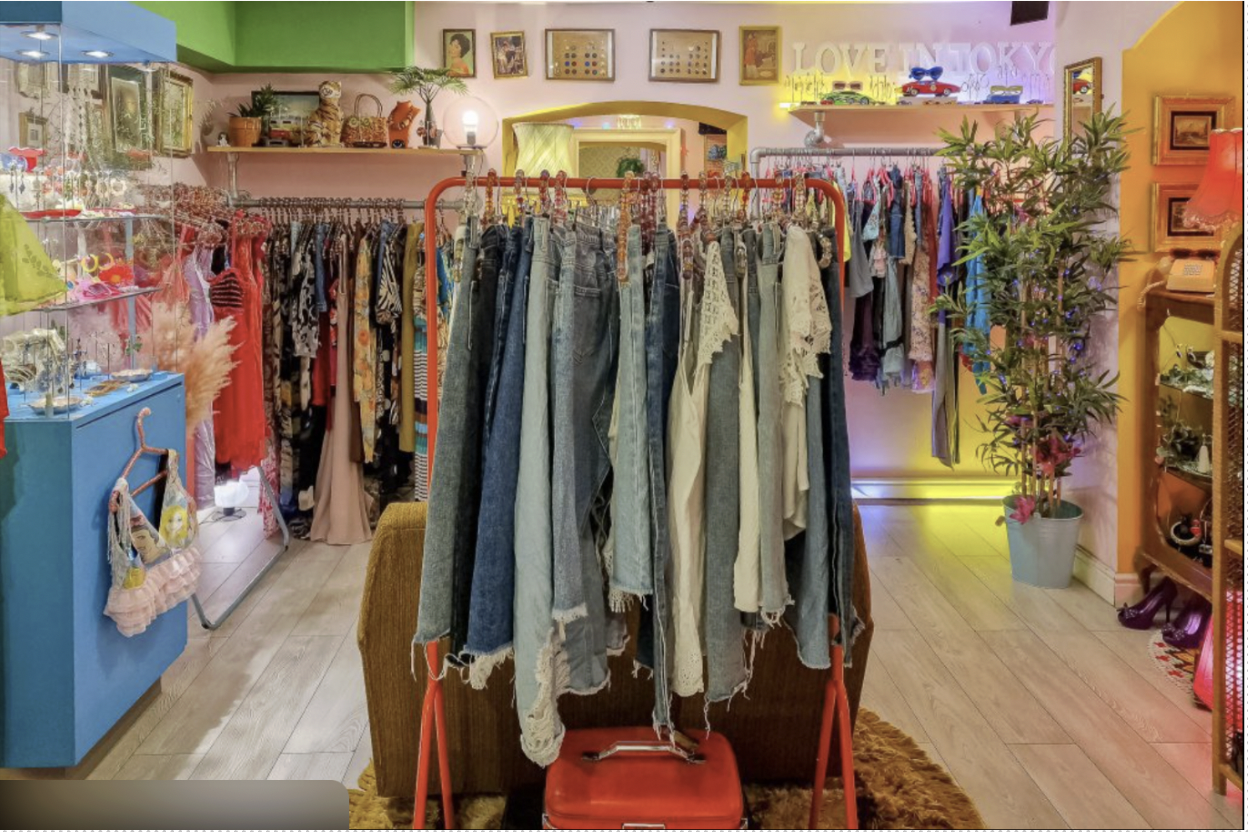
The rapid growth in resale platforms shows a shift in how young Irish consumers shop, as rising living costs accelerate a boom in Dublin’s thrift economy.
By Peace Okolo
As inflation and the high cost of living continue to shape consumers’ spending habits, second-hand fashion has emerged as one of the fastest growing retail businesses among young consumers in Dublin.
Globally, the second-hand apparel market is projected to reach $350 billion by 2028, growing three times faster than the overall apparel market, according to the ThredUp 2024 Resale Report.
Recent research by PayPal also shows that over 780,000 adults purchased second-hand clothes in a single year, totaling more than €61 million, with Gen Z making up nearly half of this group.
“I love shopping secondhand fashion because a lot of the items are vintage, so you’re unlikely to look the same as everyone else,” said Sasha Robinson (20), from Dublin.

Second-hand shops and online resale platforms like Vinted and Depop are expanding at a faster rate than conventional clothing retailers, and this growth is driven largely by Gen Z buyers.
Dublin college student Erin Murray said she initially joined the platform to find unique pieces at affordable prices.
“I started using Vinted about a year ago because I’m always looking for cool, unique clothes,” she said. “I love fashion, but as a broke college student it has to be done on a budget.”
Since launching into European markets, including Ireland, Vinted has seen an accelerated growth in consumer engagement and activity.
In 2024, the online shopping platform reported a 36% increase in global revenue (€813.4 million) and a 330% jump in net profit.
The company’s expansion into markets such as Ireland, Croatia, and Greece was cited as a key factor in this growth.
According to Vinted’s latest EU filings as of 31 January 2026, the platform had an estimated 29.3 million monthly active users across Europe, including countries like; France, the Netherlands, Spain, Italy, Portugal, Austria, Germany, Belgium, and Luxembourg.
The app lets people buy and sell second-hand items directly with each other, creating a large marketplace network.
“I sell on Vinted because my income is too small, and I buy on Vinted because I can’t afford to buy new,” Murray said. “It feels like the price of everything just keeps going up.”
Many young people in Dublin are now using these platforms not just to clear out their wardrobes, but as a way to manage the rising cost of living.
Kala Akinniranye, 19, said the rising cost of living has forced her to rethink how much she spends on clothing.
“The ads on Vinted were really enticing, the whole ‘get rid of clutter’ idea. It was well marketed,” she said.
However, affordability remains the main factor behind her interest in second-hand shopping.
“It’s more sustainable, but it’s also cheaper,” she said. “In this current economy, I can either buy clothes or buy food.”
She added that resale and thrift fashion have become normalized among her peers.
“All my friends use Vinted or Depop. Poverty is touching everybody right now.”
Holly O’Donnell, like many young consumers in Dublin, said the rising cost of living has increased how often she uses resale platforms.
“Whenever I want to buy something, I check Vinted first because it’s nearly always cheaper,” she said, adding that she buys or sells around ten items a month.
For many, resale platforms are not just about decluttering; they have become a side hustle.
Thrift store manager, Siobhan Murphy, 34, from Dublin’s Temple Bar, said:
“We’ve definitely noticed more young customers coming in who are curious about resale and thrifting. They buy from us, sell online, and sometimes come back looking for new stock to flip. It’s a completely different kind of shopping now.”
According to a 2025 PwC circular fashion survey, around 40 % of Gen Z and 28 % of millennials surveyed have bought second-hand fashion, and 41 % of Gen Z have also sold thrift items.
Emma Okoli, 21, who both buys and occasionally sells on Vinted, said resale has changed how she thinks about shopping.
“I don’t see it as decluttering anymore; it’s more like managing my wardrobe as an asset. If I buy something, I’m already thinking about what I could resell it for,” she said.
The growth of the resale economy is also evident in delivery trends.
By late 2025, An Post reported that online sales made up almost 7% of all Irish retail, with packages sent between consumers – like those from Vinted or Depop – growing faster than traditional online shopping.
This suggests that buying and selling second-hand is no longer a small niche, it’s now a normal part of Ireland’s retail scene.
You must be logged in to post a comment.