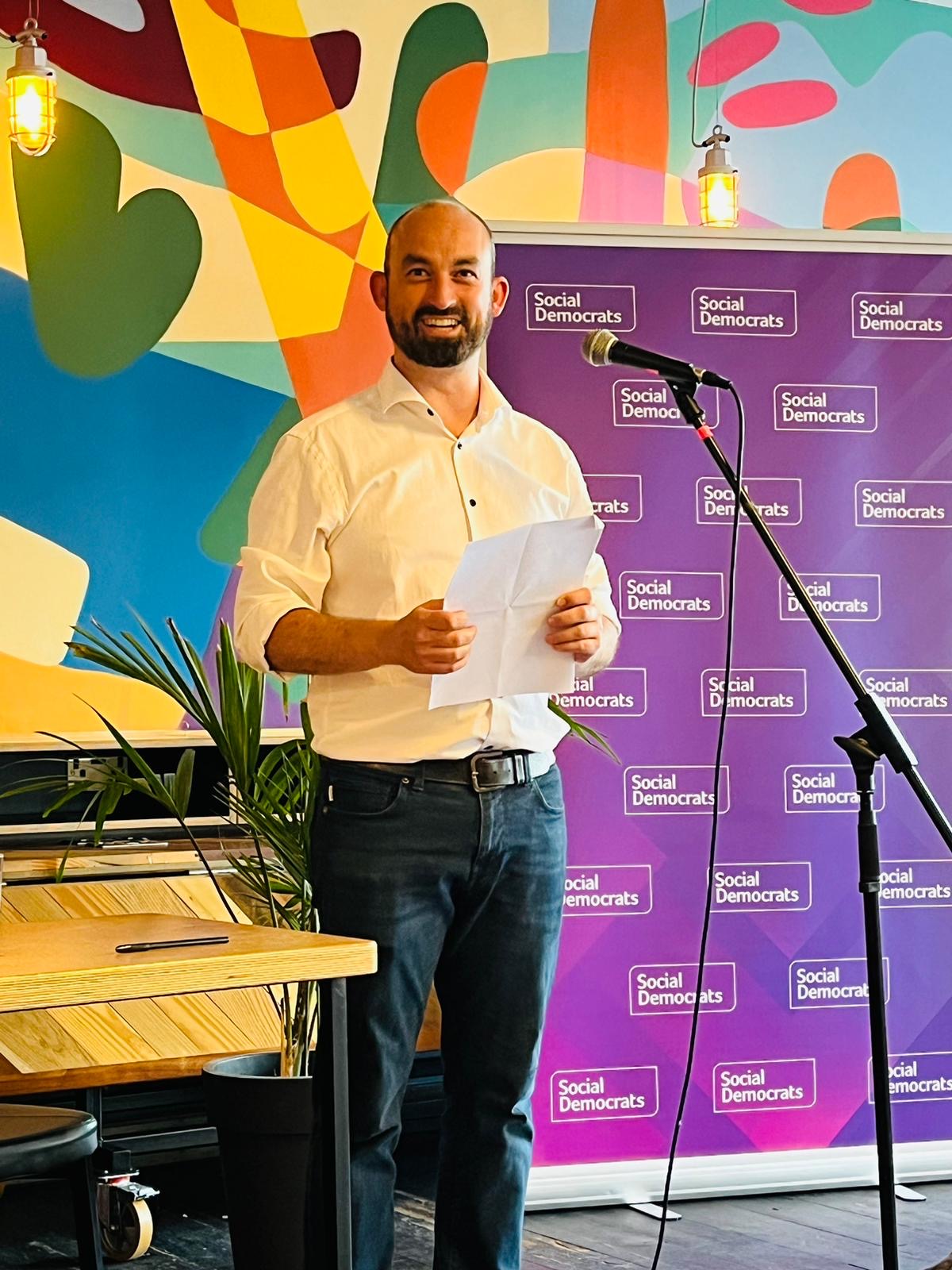
Social Democrats TD Eoin Hayes will remain a party member following the revelation of his use of blackface in 2009, party leader Holly Cairns announced on Sept. 16.
The controversy became public on the morning of Sept. 15 when the Dublin Bay South TD released a statement on X apologising for his actions after a news outlet contacted him the evening prior to confirm that they would be releasing pictures of the event.
“At a Halloween party 16 years ago, while President of the Student’ Union in University College Cork, I dressed up as someone I greatly admired at the time, US President Barack Obama — whose re-election campaign I went on to work for in 2012. As part of this costume, I wore brown makeup on my face and hands,” Hayes said in his statement.
Dressing in blackface is considered by many to be deeply offensive as it has historically been used to promote racist stereotypes.
“Blackface is part of a very, very long tradition of white performance which by and large ridicules blackness From around the 1830’s, across the 19th and well into the 20th century, white people have dressed up as black people to ridicule them, but also to mobilise different kinds of stereotypes,” Anna-Maria Mullaly, a member of both TU Dublin’s race equity group and the Social Democrats, said.
“For instance, black people would be displayed as stupid, as sexually aggressive [and] as lazy in these types of performances.”
Mullaly added.
Hayes’ stated that he “didn’t have an understanding of how hurtful [blackface] was at the time” and reiterated that he takes “full responsibility” for his actions and apologises to “any and all hurt” caused by what he did.
Mullaly, however, is sceptical of Hayes’s excuse that he did not understand the offensive nature of blackface.
“An argument has been made in some quarters that it was a different time, or that it was youthful student folly, I really don’t buy that,” Mullaly said.
“Tropic Thunder, the movie, came out the year before Eoin Hayes dressed up like this on his way to a party, and there was quite a bit of discussion about Tropic Thunder’s satirical take on blackface, so it was certainly in the news, and he would have been aware of those discussions,” she said.
Social Democrats Party leader, Holly Cairns, responded to Hayes’ statement in an interview with RTÉ on September 16th saying she was “hugely disappointed and annoyed about this situation.”
Cairns later confirmed that Hayes would not face any disciplinary action from the Social Democrat Party as the incident occurred before he joined the organisation.
“I want to be clear that it’s not an excuse, but the context of it being 16 years ago is something that I have to consider and I am taking it into consideration,” Cairns said.
Cairns also stated that Hayes “deserves an opportunity to work hard now and to try to regain people’s trust.”
This decision riled some members of the Social Democrat Party with the chairman of the party’s Dublin West branch and local election candidate, Luke Daly, citing the decision as one of the reasons that he and his secretary, Jack O’Reilly, would be leaving the party.
Mullaly seconded Cairns’ sentiment and said that Hayes “should be given the opportunity to follow through now and demonstrate, via action, his actual commitment to anti-racism.”
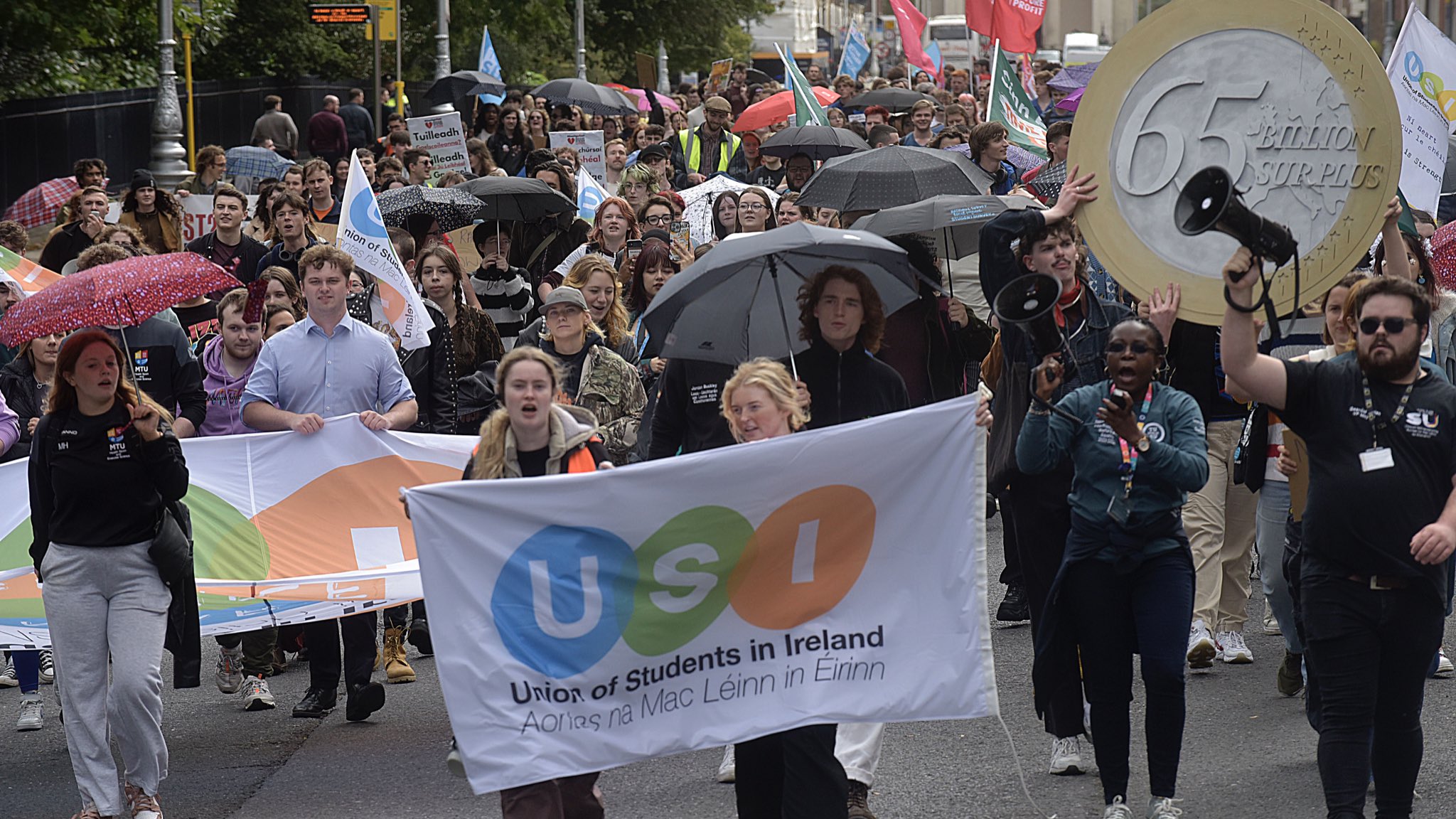
University students took part in a national demonstration, organised by the Union of Students in Ireland (USI) last Wednesday, where they protested the €65 billion budget surplus the Government is said to accumulate over the next three years. Students nationwide were outraged to hear the surplus would be used for a ‘rainy-day’ fund instead of the cost-of-living crisis.
The protest began at the Garden of Remembrance and made its way down to the Dáil with students chanting and singing about the issues they face while studying in higher education.
The student-led demonstration was organised to highlight the issues surrounding third-level education and to offer the Government solutions to fix these problems.
Brian Jordan, president of the Technological University Dublin’s Student Union said, “This is a national demonstration organised by USI […] The reason we’re protesting is because we’ve seen a lack of student accommodation. The Government has failed to give [students] capital investments, even though that is a clear solution.”
“We have a huge amount of private rented accommodation all over Grangegorman. Students are paying up to €1,100 [monthly], and that’s because the university hasn’t built their own accommodation,” he added.
Brian Jordan and the TU Dublin SU at the Garden of Remembrance. Image: @theusi/X
Environmental science student, Megan Tynan described how stressful it was to find accommodation closer to college.
“For my second year, I was commuting an hour and a half from college. By the time you get home, you’re wrecked,” she said.
“I was staying at a hostel for a few days during exams because my landlord decided to sell [the accommodation].”
“I was staying in a room with nine people, who were all strangers. It affected me negatively because it’s embarrassing to admit that you are struggling to find a place,” she added.
“It didn’t just fall out of the sky; it did not just happen. It was caused by Government policy.”
Dr Rory Hearne, Assistant Professor of Social Policy at Maynooth
According to the Pre-Budget Submission for the Budget 2024, submitted by USI, 33% of the total student population says they are experiencing serious financial issues. In 2019, that percentage sat at 26%.
President of Maynooth University Student Union, Alex Balfe said that “hundreds of students”, many of whom come from Donegal and Cork, are struggling to find accommodation on campus which is not “sustainable” for students.
“Students are waking up at five o’clock in the morning for their commute and they’re not getting home until very late in the evening,” Balfe said.
“There’s absolutely no accommodation in Maynooth, considering we’re a university town with more students than residents at the moment,” she added.
Third-level students march to the Dáil in protest of the accommodation crisis. Image: @rosspjboyd/X
The latest figures on Funding the Future — a document released by the Government in August 2023, mentioned that full-time student numbers are increasing and are expected to “peak” at 233,000 in 2030. It is also mentioned that there are currently 29,773 “oversubscribed” students who will not get accommodation in the 2023/2024 academic year.
The document mentioned that Minister Simon Harris confirmed “Government approval” for a new policy to be introduced that will provide “state assistance” to the “development of new and additional student accommodation for higher education institutions”.
The Government also “approved €62 million in additional funding” for 1,072 additional beds in universities like the University of Limerick (UL), Maynooth University (MU), University of Galway (UG), and Dublin City University (DCU). Assessment is still ongoing for all five Technological Universities (TUs).
Dr Rory Hearne, an assistant social policy professor at Maynooth said, “The housing crisis is forcing students to drop out of college, forcing them to pay unaffordable rents and to live in hidden homelessness. College days are supposed to be the best days of your life, but now, it’s a nightmare for many students.”
“It didn’t just fall out of the sky; it did not just happen. It was caused by Government policy.”
“Rents have increased by 100% since 2011, and 60% since 2020. Here’s a radical idea, in Berlin, in 2020, they reduced rents and put a five-year rent freeze in place. Why doesn’t the Government reduce all rents by 20%, back to the level they were in 2020?” Hearne said.
In 2021, Berlin’s Mietendeckle — a rent control law in Berlin, was declared ‘unconstitutional’ and was replaced with Mietpreisbremse — a new rent control law that limits how much rent the landlord can ask for. It is also possible to claim money that was overpaid for rent.
President of USI, Chris Clifford said, “How far away from reality is our Taoiseach when students and graduates are leaving the country by the plane load, when students have to decide between food and printing, and when a student’s room is the front seat of their car? That is the reality that this country has created for students.”
“We’re looking for the Government to fund the future of this country […] There’s a ‘rainy day’ fund of €65 billion and we’re asking for five percent of that. That five percent reduces waiting lists in hospitals, that five percent means that there’s enough childcare practitioners in this country, and it also means that there are enough civil engineers out there to get these houses, that not only students, but the public are crying out for.”
“Five percent for the future of Ireland,” Clifford added.
Rory O’ Connor, author of the bestselling book Rory’s Story, delivered a seminar on Monday aimed at tackling mental health stigma to TU Dublin students.
Known as Rory’s Stories on social media, Mr O’Connor is a prominent advocate for mental health in Ireland today, serving as brand ambassador for the Construction Industry Federation.
During his talk at Blanchardstown Campus, he shared details about his own struggles and experiences to raise awareness for suicide prevention and mental health awareness.
“When I was a young fella my cousin took his own life completely out of the blue, had everything going for him from the outside world but obviously he didn’t feel that internally.
“This is why mental health and suicide prevention is so important and trying to find ways to combat it.
Speaking about a particularly low point in his life, Mr O’Connor said “In 2013, I hit rock bottom. The club I adored playing for were knocked out of the championship, when we were favourites to win.
“I took that to heart, the next day I went into Dublin and spent all day in the bookies and pubs, running away from my problems.
“I put my last 200€ on a roulette table in a casino and lost it in minutes. I should have really said to my friends I was going to go off gambling, but that’s the thing with addiction, you never want to admit it.”
Since then, Rory has built a career doing what he loves, producing comedic skits and performing stand-up routines, while doing more to improve his mental health.
“I met with Gerry Cooney from the Rutland Centre, he told me how my addictive personality could be used on a positive platform like some of the most successful people in the world.
“I made a Rory’s Stories Facebook account in 2014, where I started to do sketches of the GAA and these started to go viral very quickly. That’s where Rory’s Stories came from.”.
“I can’t emphasise how important exercise is for your mental health, along with talking about the good days and bad days.”
Lavanda (left) and V-Face (right) on Lower Grangegorman Road. Photo by Colm McGuirk
“The fact that this unit was close to TU Dublin was a huge factor in the decision to go ahead with it.” Sarah Boland, owner of V-Face, is talking about her vegan fast-food restaurant’s proximity to the impressive new home of Technological University (TU) Dublin.
The city campus of what used to be called DIT, built as the centrepiece of a major regeneration programme for Grangegorman in north Dublin city, is ready to welcome around 10,000 students plus staff – once Covid restrictions are no longer necessary.
Boland’s is among a number of independent businesses on the Lower Grangegorman Road that had factored those numbers into their plans.
“It’s going to be a huge campus, so obviously footfall will increase massively,” Boland says.
In the turbulent 10 months since it opened, V-Face has had to make some think-on-your-feet adjustments to compensate for lost bums on its 40 seats. Among them is the outdoor eating area installed on the opposite corner, in cooperation with Dublin City Council, and the window hatch through which Boland speaks to The City.
“Coffee and sandwiches were never in the business model,” Boland says, “but we said ‘let’s bring out a lunch offering.’ The burgers were doing really well, but were more for the evening offering. [The hatch and coffee counter] have been designed in a way that, once the pandemic is gone, you can also swing around and serve people that come in.”
Dining tables installed by V-Face. Photo by Colm McGuirk
While V-Face benefitted from a model partly geared towards takeaway from the off, former Mediterranean restaurant Lavanda on the opposite corner has had to reset completely in the last year.
“We tried to do takeaway Mediterranean food during the first wave,” says Croatian owner Robert Velic, “but it didn’t work very well.”
Lavanda’s enforced rebirth was planned with the new TU Dublin campus in mind – it now sells toasties, slices of pizza and sweet treats.
“We’ll see when the students come back if we made the right choice”
Robert Velic
“The second wave came and then we completely changed. We were expecting those students. We adapted the prices to four or five euro,” Velic says.
“When the lockdown ends,” he continues, “it’s going to be a proper takeaway and we can add a few more things to the menu when business picks up and the colleges are back. We’ll continue to target students and walk-ins. We’ll see when the students come back if we made the right choice.”
A few doors up, Russia native Alexander Yegorov’s print and copy shop should be bustling.
His unit is next door to one of two new student apartment complexes on this stretch of road built in the controversial ‘co-living’ mould (and, in the ultimate symbol of the area’s gentrification, on the site of the former ‘Squat City’).
“We opened our shop three months ago,” Yegorov tells us. “They move the lockdown every two months. I expected the students would be here from the new year. But now, it won’t be until summer time.
“But it’s OK,” Yegorov adds. “We can survive until summer.”
“We knew it was a long game, but it’s been a lot longer than anticipated”
Rebecca Feely
On the next corner, Rebecca Feely of Kale+Coco tells The City that when she chose the location for her plant-based healthy food cafe in 2019, “it was under the assumption that there’d be lots of students.”
“We knew it was a bit of a long game,” Feely says, “because they were moving students bit by bit. But it’s been a lot longer than anticipated.”
While noting that her prices might be a little above the average student’s range, she tells us, “it’s always been in my head to focus more on marketing to students, but I haven’t had the chance yet because we haven’t had the students there yet.”
Kale+Coco has leaned more towards retail of food products to help stay afloat in what has been a difficult year.
Rebecca Feely in her cafe Kale+Coco. Photo by Colm McGuirk
“We were never actually told to close, so you feel almost obligated to keep trading because you have bills to pay,” Feely says.
“You have rent due. If you’re not ordered by the government to close, you’re not covered by any insurance, your landlords aren’t going to give you a break,” she adds.
While the eventual arrival of students should help jump-start these Lower Grangegorman businesses, it could well signal the end for Happy Days Coffee Van on the new campus a little further up the road.
The mobile cafe was set up by local resident Olivia O’Flanagan in response to the “inertia and isolation” her neighbours were faced with during the first lockdown last spring.
O’Flanagan, a former lecturer with no background in business, was given the green light to operate on TU Dublin’s campus for as long as its own catering services were closed.
“It’s a lockdown project to keep us all busy and connected and give some kind of focus for the local community,” she tells The City.
Happy Days Coffee Van set up at the entrance of TU Dublin’s Grangegorman Campus. Photo by Colm McGuirk
Hiring only locals helped her secure the temporary contract – staff can return to their own homes for the mandatory bathroom access.
“For me, it’s not a business endeavour,” O’Flanagan says, “though it has made money and is paying eight people’s wages on 20 hours a week. They’re all delighted and their parents are saying they were all sitting in their bedrooms cracking up.”
STRICT: Currently, queueing outside supermarkets is the new normal, with many outlets only allowing in one shopper at a time and banning children in some cases as Coronavirus continues to spread (Photo: Paul Caffrey)
During the month of March, the population went on a €363million panic-buying spree. The shops are much calmer now, but queuing outside supermarkets — with stricter controls on how many customers can enter a store at any one time —has become the new normal. In words, pictures and video, TheCity.ie’s Paul Caffreyhas been keeping track of the “shopageddon” phenomenon since March 13
“No sausages. No teabags. No potatoes,” the senior security guard at a north Dublin supermarket boomed with a wry grin to a colleague over his two-way radio.
The weary-looking herds of shoppers rushing from one aisle to another — just trying to grab what they can — didn’t seem to have registered a word of his worrying summary.
But that was only the start: there was no bread left and most of the fruit, vegetables and frozen food were gone, too – even though there was a full delivery to this store at eight o’clock this morning.
Meanwhile, queues for the checkouts — one family after another with an overflowing full-size shopping trolley — were snaking back into the aisles.
It was nearly 6pm on the evening of Friday, March 13 at Tesco Kilbarrack in north Dublin — 31 hours since Leo Varadkar announced a virtual shutdown of the country on account of the global Covid-19 outbreak — and the place was full of people completely ignoring Government pleas not to panic buy.
Throughout this large store, which acts as a lifeline to thousands of families and elderly people in the long-established north Dublin areas of Raheny, Kilbarrack, Coolock, Artane and Donaghmede, there was an air of quiet panic.
Even though people here were keeping calm and being respectful to others, many seemed grimly determined to buy up everything in sight.
However, this “emergency” buying wasn’t quite what you might put at the top of your essentials list for what was then expected to be a fortnight of being housebound. At one checkout, a man was hurriedly purchasing exactly 20 Easter eggs and not much else.
NEW ORDER: Local councils were quick to create new markings on walkways to reflect the social distancing rules intended to combat the spread of Covid-19 (Photo: Paul Caffrey)
At 11am on Thursday, March 12, the Taoiseach announced from Washington that all colleges, schools and various other public facilities would close for at least two weeks.
Up until that moment, students at TU Dublin Aungier Street had been assured by college officials it was largely “business as usual”, with classes proceeding as normal.
Everything changed on that Thursday morning, when students were suddenly told to leave the building by 6pm and not return until further notice.
Similar to the situation in supermarkets, the college library was gripped by a sense of panic as students anxiously rushed to get the books and other materials they’d need to complete their assignments (not due for months).
“If people go out and buy products that they don’t need to stockpile, they are going to cause a problem,” Minister Humphreys warned on Thursday, March 12. And she tweeted the following day: “Shop as normal.”
But her advice, echoed by Health Minister Simon Harris, was largely ignored. In scenes that have been echoed the world over, throngs of eager shoppers descended on supermarkets and chemists, even leading to some forced store closures.
Tesco in Clarehall on Dublin’s Malahide Road was forced to close temporarily on Thursday, March 12 for restocking, while Tesco Liffey Valley reportedly shut down for 30 minutes that day after a big influx of customers. Lidl and Aldi then introduced “product purchasing limits” on selected items.
Gardaí were placed on alert, with officers told to “patrol the environs of supermarkets and chemists, with a view to providing comfort and reassurance” to shoppers, according to a memo sent by Assistant Garda Commissioner Pat Leahy to rank-and-file members on the night of Thursday, March 12.
SLICED PANIC: This north Dublin Tesco was fully sold out of bread by midday on Friday, March 13 – but these shelves had been full only three hours earlier (Photo: Paul Caffrey)
On Friday March 13, my first visit to Tesco Kilbarrack is at 9.30am, when stocks are at healthy levels thanks to an 8am delivery.
I recognise a friendly local taxi driver who wisely makes straight for a well-stocked bread aisle. By midday, every last sliced pan here will be gone.
Normally stationed at the Dublin Airport rank, he’s decided that his normal place of work is a no-go zone due to the Coronavirus outbreak.
The self-employed middle-aged Dubliner will be out of pocket as a result, but he’s accepting of the situation and even appears relaxed about it.
“There’s no way I could work the airport today. They’ll all be coming back from Cheltenham, full of booze and all over each other, then jumping into my car.
“Not to speak of the people who could be flying in from anywhere in the world. I’ll sit tight for a few days — it’s for the good of our health, after all,” he tells me.
At a café opposite the Tesco, a cautious barista is very short on customers. Wearing a standard-issue facemask, he’s trying to offload his best fresh pastries for the knockdown price of €2 each.
This Tesco store nearly ran out of all fruit and veg by the afternoon of Friday March 13, with bananas, cucumbers, lettuce and potatoes all sold out by 4.30pm (Photo: Paul Caffrey)
When I return to the Tesco itself some hours later, at about 4.30pm, a team of three senior staff is standing near the frozen food section looking suitably grave in a huddle with their arms folded.
The bread section is completely cleared out; I’m told all sliced pans were gone by midday — while most of the fruit, vegetables and frozen food has also disappeared.
It took only four days before that extreme weather eased off and life was largely back to normal.
The managerial team walk around surveying the empty and near-empty shelves, making notes on their clipboards. Pointing to one well-raided cosmetics shelf, one of the executives remarks: “Those will all be gone by tomorrow.”
How one newspaper reported the disquiet in our shops in its Friday, March 13 edition (Photo: Twitter/Irish Daily Star)
At the checkouts, an elderly woman queuing just ahead of me with a modest number of purchases in her black and red tartan wheelie bag is bemused by the slightly frenzied atmosphere and crowds of customers surrounding her.
“I don’t know what all the fuss is about,” she calmly tells me.
“Though, I’m just buying for myself. At least this has made them open a few more checkouts than they normally do, but it’s still not enough, is it?”
Reflecting on the public health emergency at hand, she tells me: “I’m 89, so I’m supposed be in the ‘at-risk’ category, aren’t I?
“But I’m not letting it worry me. I don’t see why we can’t go about our business as normal — as long as we don’t travel.”
Later that afternoon, I call round to my 101-year-old neighbour. She’s exceptionally fit and alert and still leads an active life. I’ve known her since I was a small child and she’s never seemed afraid of anything before.
Despite no official guidelines having yet been issued for the over-70s, she already intends to stay indoors at all times and is resigned to miss Mass, regular coffee mornings with her friends or any other activities involving the outdoors or groups of people for at least a fortnight.
Gesturing towards her television that’s switched to standby while we chat, she insists: “I won’t be going anywhere until this is all over. It’s out there somewhere, so I could catch it.”
DESERTED: Dún Laoghaire town centre at 5pm on the dot on a weekday in March 2020. For decades, this key intersection has been chock-a-block without fail during evening rush hour (Photo: Paul Caffrey)
By the night of Sunday, March 15, this north Dublin Catholic church was in shutdown, with a typed notice on the main doors advising parishioners: “Mass in this church is suspended until further notice.” (Photo: Paul Caffrey)
At midday on Saturday, March 14, I returned to Tesco to find the shelves well stocked again. But, pointing to the bread shelves, the head security guard told me: “If you need any bread, I would get it now.”
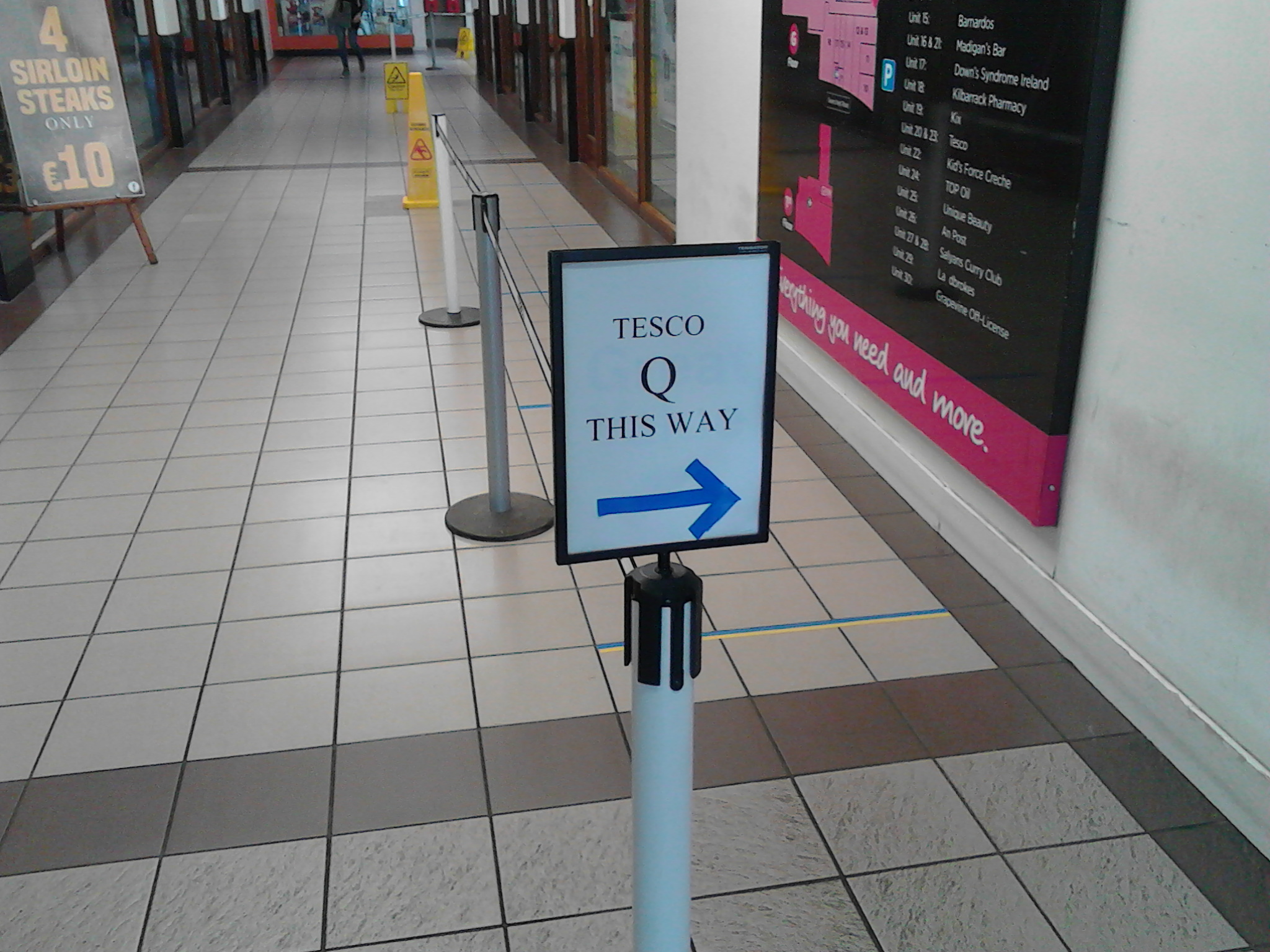
Present-day at the same supermarket, the numbers entering the premises are being more tightly controlled with customers made to queue outside — and only being allowed in one at a time. This is enforced by in-store security.
On Sunday March 15, all pubs were asked to close until March 29 at the earliest — but not all publicans immediately complied.
TheCity.ie called to three Dublin public houses on that Sunday evening and while two were closed completely, one was still defiantly doing a brisk trade.
How one popular north Dublin neighbourhood pub announced its closure on Sunday, March 15 on foot of Government advice (Photo: Paul Caffrey)
You can catch up with how “shopageddon” had eased off by March 26 — only for panic-buying to make a return on March 28, the morning after lockdown was announced — in this follow-up video.
WATCH: ‘The calm before the storm’
This video made by Paul Caffrey for TheCity.ie documents events of March 26-28 in the supermarkets and on the streets of Dublin
During a €363million nationwide panic-buying spree in the second half of March, €3.5million was spent on loo rolls alone, according to consumer habits researchers Nielsen.
Since then, Tesco.ie has asked its customers to shop in store if possible because home-delivery slots have become a “precious resource” that should be set aside for those who need it. The grocery giant has been experiencing high demand for its home-delivery service, with a message on its homepage for registered customers this week warning of low stocks.
This warning to would-be home-delivery service users appeared on Tesco.ie’s homepage for registered customers this week (Photo: Tesco.ie)
As of April 28, there are 19,877 confirmed cases of Covid-19 in the Republic of Ireland. There have been a total of 1,159 deaths related to the virus here.
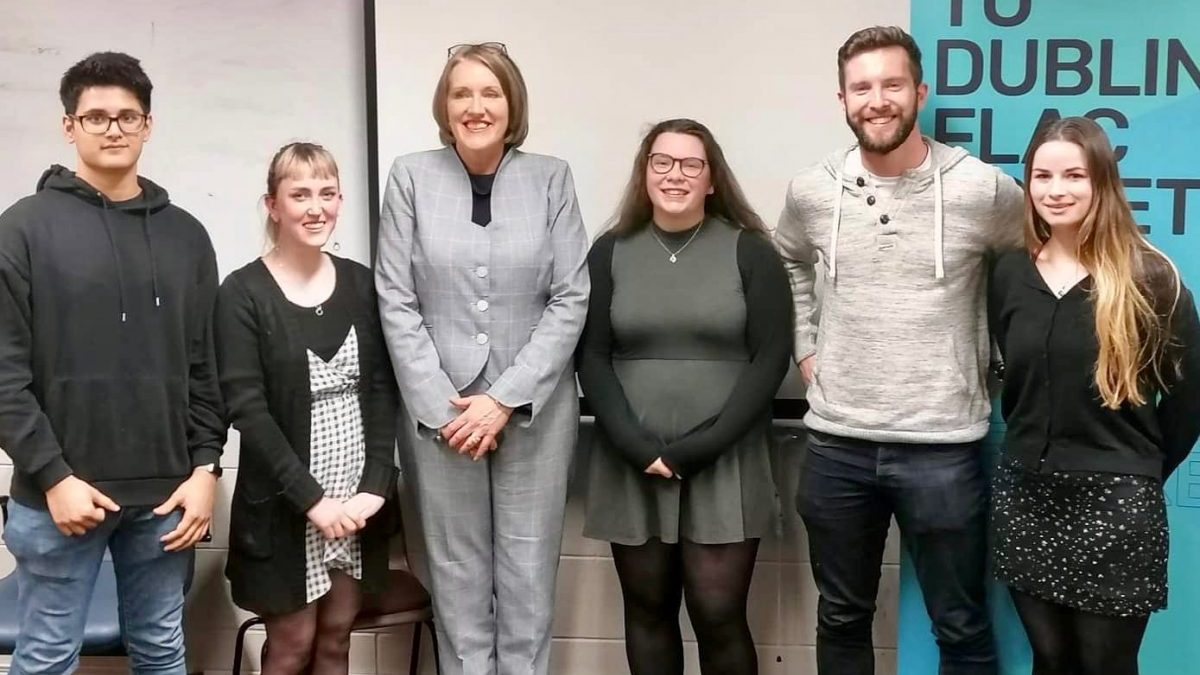
DPP Claire Loftus (third from left) meeting TU Dublin students after her pre-lockdown talk at Aungier Street (Photo: Facebook/TU Dublin FLAC Society)
Claire Loftus, the Director of Public Prosecutions (DPP), gave a rare behind-the-scenes insight into how she operates at a pre-Coronavirus shutdown TU Dublin Free Legal Aid Centres (FLAC) Society event. TheCity.ie’s Paul Caffrey, who attended the talk,describes how she keeps politics out of her decision-making
During a wide-ranging hour-long talk at the Aungier Street campus, the State’s current prosecutor-in-chief explained to students why she chooses not to prosecute in certain cases.
Claire Loftus said that in most cases, “crime should be punished”, but that sometimes her office concludes that “there is a public interest not to prosecute.”
Loftus said this is down to a range of factors including a suspect’s age (“very old or very young”) and whether their alleged offence could be viewed as a “one-off” or an “error of judgment”.
Claire Loftus paid a visit to TU Dublin’s Aungier Street campus last month (Photo: Kim O’Leary for TheCity.ie)
Her job involves deciding who should be put on trial in the law courts on the basis of evidence gathered by gardaí or another investigating authority. In each case, she’s tasked with deciding if there’s a reasonable prospect that the evidence available will lead to a conviction by a jury.
Loftus also revealed how she got “completely hooked” on crime as a young woman in her mid-20s and still finds her work “fascinating”.
Loftus — who became Ireland’s first-ever woman DPP in 2011 — insisted there is “no political interference” in her decisions.
She also vowed to “revolutionise” the courts system before she finishes her 10-year run as DPP next year.
She wants more pre-trial procedures used so that juries and witnesses are not left “hanging around” for weeks on end while lengthy legal arguments hold up major criminal trials, she said.
Former Anglo Irish Bank chairman Seán Fitzpatrick being interviewed by the media outside the Criminal Courts of Justice in Dublin following his May 2017 acquittal. Ms Loftus wants to create a more efficient system in the courts with shorter trials in future (Photo: Twitter)
The 2017 Circuit Criminal Court trial was so dogged by delays that it dragged on over an eight-month period with 126 days in court.
In 2017, Fitzpatrick had faced 27 charges of misleading the now-defunct bank’s auditors and of giving false information about multi-million euro loans between 2002 and 2007. Mr Fitzpatrick was cleared on all counts.
In the end, Judge John Aylmer directed the jury to acquit Fitzpatrick. Outside court afterwards, Fitzpatrick said it was “a wonderful day for me and my family”. In one post-verdict report, RTÉ said the trial “became a shambles”.
Seán Fitzpatrick appealed for his privacy when faced by the media outside the Criminal Courts of Justice straight after his May 2017 acquittal (Video: Independent.ie on YouTube)
Addressing a tightly-packed roomful of about 50 law students at Technological University Dublin last month, Loftus lamented the “huge amount of time lost” during some major criminal trials:
“Juries are being asked to come in and sit around for days or weeks. The issues aren’t crystallised because there is no pre-trial hearing.”
Vowing to change this before she departs as DPP in late 2021, she said: “It would revolutionise the whole system in the courts. Victims wouldn’t be hanging around. The system would be much more efficient. I’d love to see that [in place] before I go.”
The Criminal Courts of Justice in Dublin (Photo: Paul Caffrey)
Loftus said there is “no mathematical formula”, but that in most cases, “crime should be punished”.
The 52-year-old Dubliner said the law must strike a balance “between society’s right to see crime prosecuted and the rights of the defendant.”
She told the law students: “We have to be satisfied there is a prima facie [on its face] case and a reasonable prospect of a conviction…every case is considered on its own merits. There is no mathematical formula. It’s the product of a lot of experience.”
She added: “In most cases, the public interest requires a prosecution. Crime should be punished and people should be prosecuted and brought to justice. Sometimes, we decide there is a public interest not to prosecute.”
Seán Fitzpatrick walked free after a very lengthy court process (Photo: Twitter)
In reaching such decisions, “the office [of the DPP] is entirely independent of government”, Loftus stressed.
“I’m not required to report to the Minister for Justice or the Taoiseach. There is no question of any attempt to influence decisions.”
There is “no political interference in the process,” she added.
Claire Loftus told the students that Leo Varadkar is never involved in the decisions she makes (Photo: Facebook)
Back in the 1990s, after two months working in the Chief State Solicitor’s office as a recently qualified solicitor in her mid-20s, “I was completely hooked,” Loftus said.
“Twenty-seven years later I’m still in crime. I’m a career prosecutor. The work is really rewarding. I didn’t expect to get into crime,” she told the students.
She has worked as a prosecutor since 1993 and started out working on robbery and criminal damage cases and later moved on to murders.
She was also very interested in fraud and “white-collar” crime.
Her work as DPP since 2011 is “extremely varied…no two days are the same. It’s a fascinating job,” she said.
Claire is set to depart the office of DPP in 2021 after a decade in the job (Photo: Twitter)
Her office receives thousands of investigation files from gardaí yearly. Each day, she personally looks at “quite a number of files”, including “a lot of gangland crime cases”, and “every case is different”, she said.
Loftus revealed that gardaí “can phone us 24/7. If there is sufficient evidence, we’ll allow the guards to charge straight away.”
Renewing her commitment to setting up a dedicated sex offences unit in the DPP’s office by the end of 2020, she said: “We think this might help in these very sensitive and complex cases – hopefully by the end of the year, we’ll be in a position to get it up and running. The advantage for victims is of continuity…I’m very pleased, given the focus on sex offences currently.”
During her March 11 visit to the Aungier Street campus, she also wished TU Dublin students well in their exams and future endeavours.
The next academic year will see many changes on the way for staff and students at TU Dublin, reports Kim O’Leary. With the move to Grangegorman slated for September 2020 and the last of the old buildings hitting the market; a brand new chapter for the university has officially begun.
TU Dublin’s Aungier Street building has entered the property market with a guide price of €110 million – and its sale will signal a new era for TU Dublin, according to the university’s president.
The property has been brought to the market by selling agent CBRE on behalf of TU Dublin — the successor of DIT — and while the worldwide markets have taken a nose dive recently due to the outbreak of Covid-19, the sellers are confident that now is a good time to invest.
“We expect to see considerable interest from a range of interested parties for D2HQ given the scale and development potential to provide for a brand-new urban quarter in Dublin 2,” Peter Garrigan, head of CBRE’s development land division, told TheCity.ie.
“There is huge potential from anything from offices to hotels and student accommodation, it’s in such a prime location right in the city centre and now is the time for ambitious developers to make a bid.”
Indeed, the Aungier Street property is situated just 350m from St Stephen’s Green. The 1 hectare (2.5 acre) D2HQ site is zoned “Z5 City Centre” under the Dublin City Development Plan 2016-2022, offering the purchaser scope to provide for a broad mix of uses including offices, retail, residential, hotel and student accommodation.
The existing Aungier Street buildings range in height from four to five storeys above basement, and extend to 25,833sq m (278,064sq ft) in total and were developed in phases between 1989 and 2004. The building accommodates 5,000 students at present.
The 2.54 acre Aungier Street campus comes to the market just over one year after TU Dublin secured €140 million from the sale of its nearby Kevin Street campus to developer Shane Whelan’s Westridge Real Estate.
In acquiring the Kevin Street portfolio, Westridge fended off bids from several of the country’s top developers, including Johnny Ronan’s Ronan Group Real Estate (RGRE), Sean Mulryan’s Ballymore, Joe O’Reilly’s Chartered Land and Pat Crean’s Marlet Property Group.
— TU Dublin / OT Baile Átha Cliath (@WeAreTUDublin) October 29, 2019
Potential buyers
In recent weeks, speculation has been growing concerning who will eventually buy the Aunger Street campus, with rumours of interest from Dublin Business School. However, according to sellers CBRE, official offers have not been made as of yet.
Meanwhile local businesses have cautiously welcomed the entry of the DIT Aungier Street property to the market.
“It’s obviously a great location for either a hotel or a big office block, the college has plenty of history and someone will surely snatch it up very quickly,” said one local business owner.
Meanwhile, another business owner said that local shops will miss the business brought to them by students making their way to the Aungier Street campus:
“The students usually pop into my shop to pick up rolls and sandwiches on the way to their classes and during their lunch break, so I suppose I’ll miss the business they bring. It’ll be a big change for everyone, local businesses in the area, the staff, and the students themselves when the move to Grangegorman goes through.”
The move by TU Dublin to sell both its Kevin Street
and Aungier Street properties forms part of its master plan to relocate its
entire student body and faculty to its new centralised campus at Grangegorman
in Dublin 7.
According to president of TU Dublin — Professor David FitzPatrick — the sale of both campuses and the move to Grangegorman will see the ‘beginning of a new era’ for TU Dublin:
“Our College of Business in Aungier Street, with 5,000 students and staff, is the largest business school in Ireland. We are now preparing for them to join our students of many other disciplines and to enjoy the new facilities on our flagship campus at Grangegorman, just across the Liffey in September 2020,” he said.
The university is set to welcome 10,000 students and staff to Grangegorman from this September. The 29.5 hectare (73 acre) site will ultimately come to accommodate more than 20,000 students and 2,500 staff.
It’s certainly the beginning of a new era for TU Dublin.
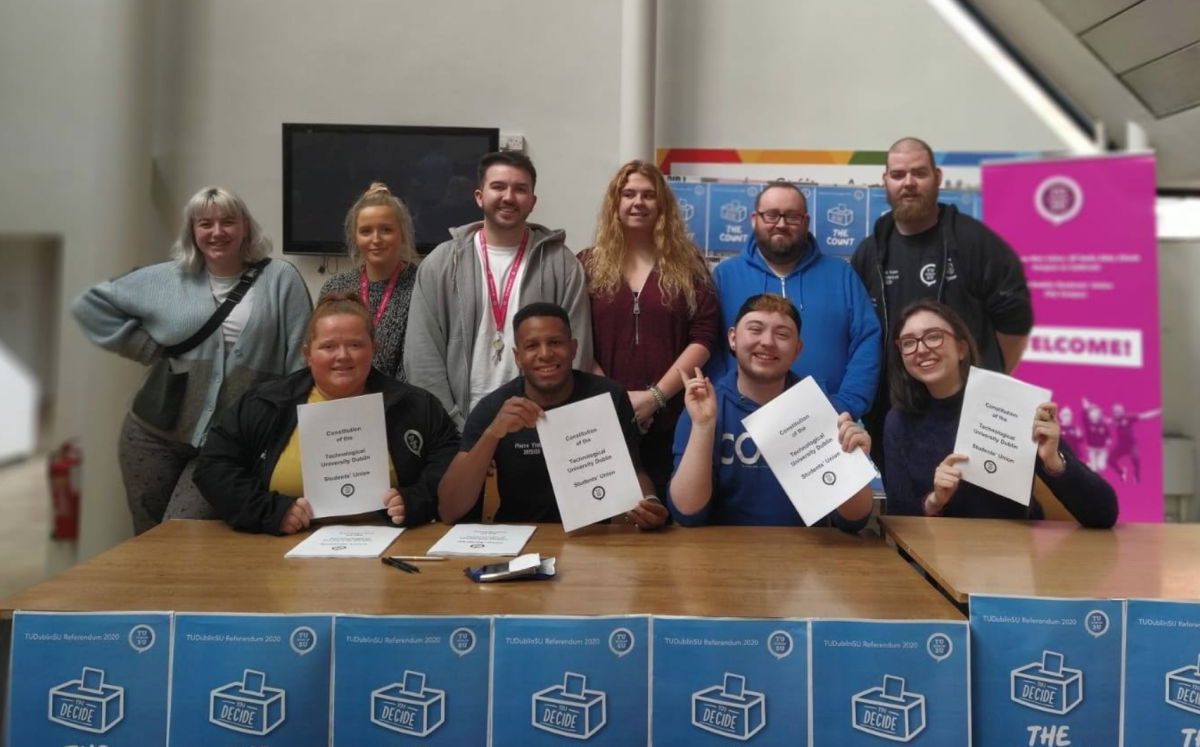
TU Dublin SU at the count on February 21, 2020, at Grangegorman after the Referendum to amend the Constitution passed. Photo: Kim O’Leary
Students attending TU Dublin are this March being invited to nominate themselves for full-time or part-time positions with the university’s Students’ Union for the 2020-2021 academic year. TheCity.ie’s Kim O’Leary sits down with outgoing TU Dublin Student Union president Pierre Yimbog to find out what the upcoming election means for the student body and the university itself.
The last twelve months has seen a time of great change for our university, and on 1 January 2019, TU Dublin was formed by the amalgamation of three existing institutes of technology on the Dublin area- Dublin Institute of Technology (DIT), Institute of Technology Blanchardstown, and Institute of Technology Tallaght (ITT).
Meanwhile, the Students’ Union was set up a mere eight months ago on 1 July following a referendum in February 2019, which saw the three existing unions merge into one single union.
The Students’ Union is a representative body democratically elected by students each year, and its responsibilities are to provide representation and support for all students at both academic and non-academic level.
There are 23 elected officers in the Students’ Union who are here to represent students within the University and nationally. The officers are directly elected by students every year in the Annual Elections normally held in March.
There is the full-time officers, who are paid and full time elected representatives who normally would have graduated from their course upon taking on the role. The part-time officers are still full time students themselves and some have specific roles and campuses to represent.
After three years working for the student union at TU Dublin, its outgoing president Pierre Yimbog has seen the successful passing of two Referendums.
Pierre Yimbog at the count for the Referendum on 21 February, 2020. Photo: Kim O’Leary
In the aftermath of the successful Referendum and prior to the March Elections, Pierre said that the last year has been particularly busy for the Students’ Union.
“It’s been a good year for us at the TU Dublin Students’ Union, it’s not been without its challenges like any role. Last year saw the three existing unions merge into one and now we are pleased that the Referendum on the amendment to the constitution has now passed so it’s been good overall.
“The Referendum in February saw a unanimous YES vote from the students who voted with a great turn-out, there was great support and everyone went out campaigning. Now we’re hoping the March elections will ensure everyone has a say in how the Students’ Union operates,” said Pierre.
— TU Dublin Pastoral Care and Chaplaincy Service (@TUDubChaplaincy) February 21, 2020
A fully-united Students’ Union has been confirmed by a vote. Photo: Twitter
Explainer: What was the 2020 Referendum?
On February 19 and 20, the student body went to the polls at the various campuses across Dublin to vote whether or not to approve the amendments to the TU Dublin Students’ Union Constitution. The newly amended Constitution included a number of changes including;
Forming a legal entity that will allow funding for the Students’ Union to provide support staff to all officers and students, make services available across all the campuses and to ensure parity of service for all students.
The other major change is to reflect the move of 10,000 students to Grangegorman from Cathal Brugha Street, Kevin Street and Rathmines in September 2020. The four new College Officer positions proposed are Central Quad, East Quad, Aungier Street (including BIMM) and Bolton Street.
The other amendments were to refine the governance, transparency and accountability in the Students’ Union.
How did we vote?
There were 3,501 votes casted over the past two days and the results is an OVERWHEMINGLY YES to adopt our Constitution!!
Thank you to all the were invovled, including polling clerks, volunteers, staff, officers,… https://t.co/YPYLmQJRbt
3,501 votes were cast, and the result was a resounding YES for a new Constitution.
On Friday 21 February, the ballot boxes were opened and counted at Bolton St. The total number of votes cast was 3,501 which exceeded the total required votes of 2,918. It is understood that the total valid poll was 3,489 due to 12 spoilt votes. Ultimately, it was a majority win for YES voters with a total of 3,352 votes while NO votes totalled just 137, making it a landslide victory for those in favour of the new Constitution.
As decreed in the new Constitution, the coming year will see the Students’ Union, already unified in principal and intent, create one legal entity as a CLG as TU Dublin prepares for the opening of the new Grangegorman campus. Approximately 10,000 students will be moving from Cathal Brugha Street, Kevin Street and Rathmines to the new Grangegorman campus from September 2020.
Pierre is certain that the new Constitution can only be a positive for the Students’ Union and student body.
“This will ensure that we can work towards equal support services for all elected officers and most importantly an equal service for all students, no matter what campus you are based on,” said Pierre.
However, Pierre confirmed that he cannot run again in the upcoming March elections as the term for a full-time officer on the Student Union is just one year, and the Constitution states that three years is the maximum in any full-time role. Pierre has already been President and Vice President for Education in DIT Students’ Union and those years are counted so his time is up.
“The nominations for the elections opened on 27 February and will remain open until March 10, all of the details for those seeking to run for part-time or full-time Officer positions are on the Student Union website. Everyone can run in the elections and we hope it will pave the way for the future of the Students’ Union,” explained Pierre.
How can candidates apply and what positions are open?
The following are the positions any registered student can run for on the City Campus: President (Overall, Full-time paid),Postgraduate Officer (Overall, Part-time paid), Deputy President for City Campus (Full-time paid), Vice President for Education (Full-time paid), Vice President for Equality and Citizenship (Full-time paid), College Officer for Aungier St & Bimm (Part-time paid), College Officer for Bolton St (Part-time paid) and College Officer for Grangegorman East (Part-time paid).
The outgoing Students’ Union Committee. Photo: Instagram
To run in the elections, candidates must submit and fill out a nomination form, write a manifesto and include in the form, and get 100 signatures (full-time positions) or 50 signatures (part-time positions) from students and present into any SU office. Candidates must also provide a €20 refundable deposit to any SU office before 12pm on Tuesday 10 March.
In addition, it should be noted that candidates running for election for Grangegorman Central College Officer must attend hustings in Kevin Street and Cathal Brugha Street, while candidates running for election for Grangegorman East College Officer must attend hustings in Grangegorman, Rathmines and Aungier Street.
According to Pierre, the next important step for the Students’ Union in the wake of the successful Referendum is to negotiate the union’s funding with the University.
“With such a strong turnout in this Referendum, the University should be in no doubt that students desire a strong and well-funded Union that truly works for them. Also, having a single union makes things easier to arrange funding but next year whoever is elected to the union will have to ensure that is maintained,”explained Pierre.
So what is next for Pierre after his term ends as president of the Student’s Union? Pierre explained that he all ready has a degree in Law and is considering his options moving forward.
“My initial plan is to maybe travel this Summer, to have a bit of a rest and see from there if I want to go out into the workforce or pursue further education.”
Nominations for officer positions on the TU Dublin Students’ Union are now open until 12pm on Tuesday, 10 March. The Annual Elections are happening on 31 March and 1 April 2020.
Students will find more details on the specifics of the different positions, how to run and how to conduct your campaign on tudublinsu.ie










You must be logged in to post a comment.