Tag: vehicles

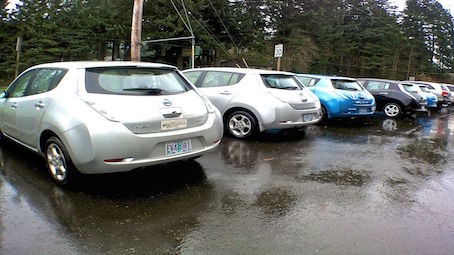
  • Electric vehicles – are they as good for the environment as we think?

    Electric vehicles – are they as good for the environment as we think?

    By Pádraic Daly

    Alternative fuel vehicles accounted for 10% of all new cars registered in 2019, according to statistics released by the Central Statistics Office.

    Between January and October 2019, 110,900 new private cars were registered. Of that, there were 3,119 electric vehicles (EVs) and 10,742 hybrid cars registered.

    Compared with the same period last year, there has been a 3.6% increase in new alternative fuel cars being registered on Irish roads.

    The Irish Government published their Climate Action Plan in July of this year, detailing their vision for a future without traditionally fuelled vehicles, which currently make up just over one quarter of all emissions. The Government hopes to have 840,000 private EVs on Irish roads by 2030.

    Sarah Doherty, from the Department of Transport, Tourism and Sport’s Climate Change Unit spoke to TheCity.ie about the Climate Action Plan’s expectations: “This is a very challenging target; however, as technology improves and becomes cheaper, and if we continue to incentivise and invest in EVs and the associated recharging network, we are ambitious that we can make real progress towards getting the electric vehicles we need on the road by 2030.”

    Compared to conventionally powered cars, the price of a new electric car can be anything from 15% to 50% higher. Currently, the Government offer a grant scheme to incentivise consumers to choose alternative fuel vehicles over traditionally fuelled ones. Currently, consumers can avail of up to €5,000 off their purchase, as well as €600 for the installation of a home-charging system.

    The notion that electric vehicles are a better alternative to other options has been widely disputed. An Post recently took a number of EVs into their fleet, branding them as “zero emissions”. This isn’t strictly accurate, as EVs do not remove emissions from the equation, but rather have zero “tailpipe” emissions, which means they do not have an exhaust and do not emit gases the same way traditionally fuelled cars do.

    Ms Doherty stated: “It must be remembered that emissions are generated to produce the electricity used to fuel these vehicles.”

    Despite a climate action plan in place, the Government does not predict we will lose dependence on fossil-fuelled vehicles anytime soon. “There will be approximately 2.45 million fossil-fuelled vehicles in 2030, of which, 1.75 million would be fossil fuelled private cars,” Sarah Doherty added, which suggests a mere 20% of vehicles will be EVs by 2030.


  • Imports Overtake New Buys in Irish Car Market

    Imports Overtake New Buys in Irish Car Market

    Fewer motorists are licensing new vehicles this year, with Irish road users turning increasingly towards the second-hand and import market in 2018, according to figures released by the Central Statistics Office.

    A total of 5,086 new vehicles were licensed in October, a decrease of 4.8 percent from October 2017. Altogether, 2,874 new private cars were licensed last month compared to 3,255 in October 2017, a decrease of 11.7 percent. However, there were more new goods vehicles licensed this October, with a 10.4 percent increase from 1,466 last year to 1,619 in 2018. The licensing of both new tractors and motorcycles has increased from October of this year to last, up 14 and 28 percent respectively. Vehicles in Ireland are licensed when a valid motor tax disc is issued for the first time.

    Figures for January to October of 2017 and 2018 show an overall decrease in the total number of new vehicles licensed in the country this year – down 2.7 percent from 157,285 to 153,001, a decrease of over 4,000 vehicles. Overall from January to October the licensing of new cars is down 4.9 percent this year to last, while an additional 1,327 new goods vehicles licensed in 2018 brought an increase of 5.9 percent on corresponding figures for 2017.


    While less new cars are being licensed this year, 2018 has seen an increase in the number of licensed used private cars, the majority of which are imported from abroad. From January to October of this year 84,502 used private cars were licensed, an increase of 8.7 percent on the 77,734 licensed in 2017.

    Figures for the licensing of used goods vehicles have also risen in 2018 – up 6.2 percent on 11,781 to 12,509. In total from January to October this year 106,874 used vehicles were licensed compared to 99,285 in 2017, showing an increase of 7.6 percent with the licensing of an additional 7,589 used vehicles.

    Of the 118,732 new private cars licensed from January to October of 2018, the majority were diesel engines, followed by petrol engines and electric cars, while just one single diesel & electric hybrid was licensed.


    The CSO defines a private car as a privately licensed vehicle, including hire, fleet vehicles and some commercial vehicles.  ‘New vehicles’ refers to vehicles which are licensed for use in a public place, in this country, for the first time, while ‘used vehicles’ refers to vehicles which are licensed for use in a public place, in this country, for the first time, mainly imports. In the first ten months of 2018, 1.3 percent of imported private cars licensed were less than one year old, while 4,045 (4.8 percent) were ten years or older.

    Certain vehicles fall under an ‘exempt’ status, meaning that these vehicles are licensed for the first time in this country but are exempt from paying road tax. Exempt vehicles are divided into four categories – state-owned, diplomatic, fire services and disabled drivers.

    A total of 203,234 new and used private cars were licensed for the first time in 2018 – with Volkswagen proving the most popular manufacturer. Overall, 23,873 new Volkswagens were licensed between January and October of this year, followed by 20,519 Fords and 17,089 Toyotas. Over 500 less BMWs have been licensed this year compared to last, while Hyundai has also seen a decrease in popularity of 13 percent on 2017 figures. At the other end of the scale, 257 Subarus were licensed, while 86 licenses being issued saw Ssangyong bringing up the rear as the manufacturer with the least number of vehicles licensed.