Tag: war

  • Focus on peace: Ireland’s pro-Palestine demonstrations  

    Focus on peace: Ireland’s pro-Palestine demonstrations  

    By Leon Thompson

    Ireland’s support during the Gaza crisis has extended following the announcement of €13 million in aid being sent to Palestine.

    Tánaiste Micheál Martin announced the aid in Dáil Éireann as an acknowledgement of the escalated violence in the Middle East. 

    Mr Martin hopes “a lasting and sustainable peace” can be achieved following Israel’s declaration of war on Hamas when Israeli citizens were attacked two weeks ago. Mr Martin has also said the Irish government unequivocally condemns the attacks made by Hamas and expresses their deepest condolences for the Israeli people affected.  

    The Ireland-Palestine Support Campaign (IPSC) is supporting demonstrations nationwide, while the national demonstration to end the slaughters in Gaza will take place in Dublin tomorrow afternoon. 

    Cork, Cavan, Clare, Kerry and Belfast will also see demonstrations tomorrow. 

    The Garden of Remembrance in Dublin 1 should expect demonstrators at 1pm on the 21st of October following IPSC’s announcement saying, “As Apartheid Israel continues pounding the captive and besieged people of Gaza with indiscriminate bombing and gets ready for a full-scale invasion, all with the blessing of Western powers, we ask you to join us at an emergency solidarity rally in support of the Palestinian people.” 

    Crowds are expected to attend while TD Mr Paul Murphy has announced his support and attendance saying, “When does Palestine get the right to defend itself? 75 years of ethnic cleansing and apartheid…17 years of a brutal siege on Gaza…10,000 Palestinians killed in the last 15 years. Stop the slaughter!”

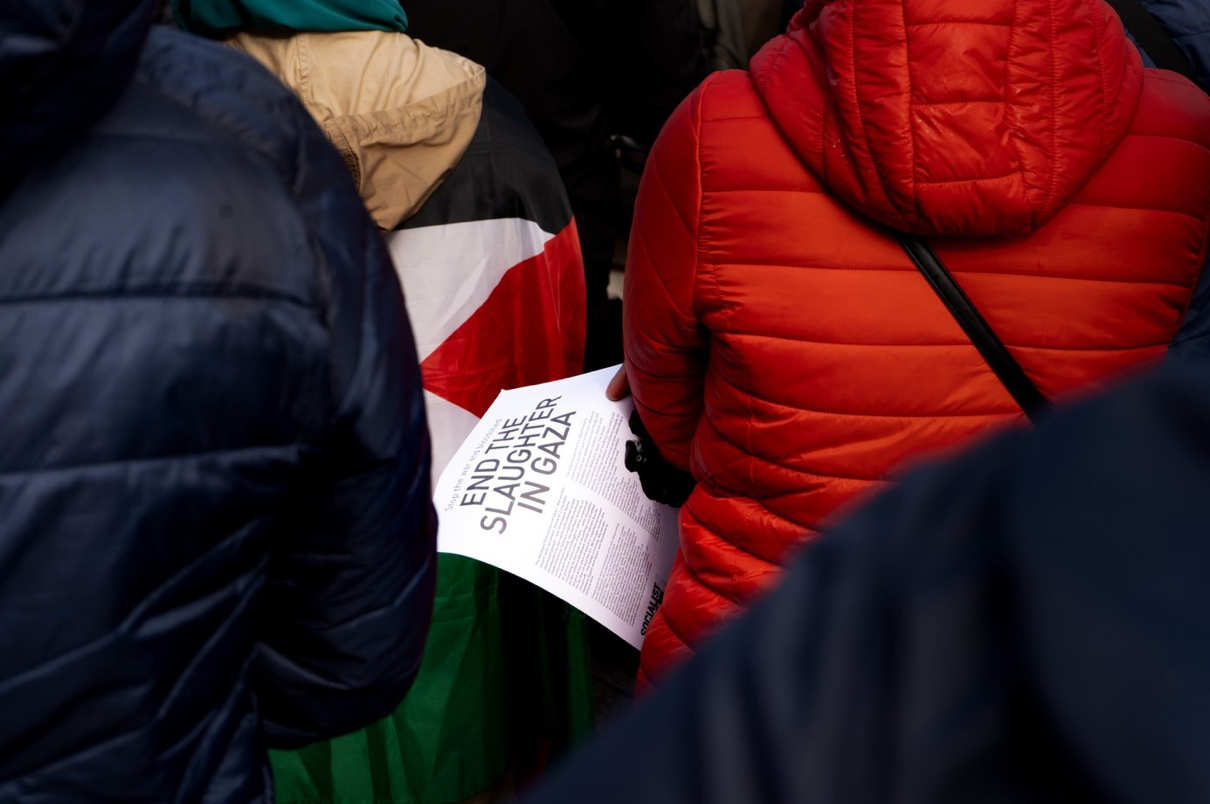
    Demonstrators at a protest. Image: unsplash.ie

    Other counties such as Tipperary and Antrim saw protests yesterday, October 19th while counties such as Louth, Longford, Cork, Down and Armagh will hold more demonstrations throughout the month of October. 

    The last demonstration supported by the IPSC is anticipated for Co.Mayo on the 25th of October. 

    Campaigners were outside of the Dáil on October 18th with Diarmuid Breatnach in attendance calling it “a duty and a pleasure” as he anticipated the outcome of the debate happening inside.  

    In Cork, one demonstrator Patrick Hobbart said: “…it’s deeply distressing to witness the enduring hardships faced by the Palestinian people who have carried the heavy burden of apartheid and colonialism for generations. It’s imperative to acknowledge that Hamas doesn’t speak for all Palestinians. The Israeli government must heed this plea and halt their relentless assault on innocent civilians. In this conflict, there are no victors…the international community must unite to demand an immediate ceasefire.” 

    Kevin Callinan, General Secretary of Fórsa Trade Union echoed Mr Martin’s sentiments, “The killing of Israeli civilians by Hamas and the collective punishment of the people of Gaza by the Israeli government will do nothing to end the occupation and bring about peace,” he said. 

    President of the EU Commission Ursula von der Leyen’s statement declaring “Europe stands with Israel” has led to a lot of pushback from members of the European Parliament (MEP) especially  

    MEP Clare Daly commended protesters that occupied the European Commission’s Office in Dublin saying: “So proud of friends and comrades…currently occupying the European Commission offices in Dublin as we here in Strasbourg go in to vote on a shameful Parliament motion that fails to condemn Israel for its ongoing crimes against humanity in Gaza.”

    Protesters outside of Dublin’s European Commission’s Office. Image: X

    The office was occupied by concerned citizens organised into a group called Dublin for Gaza, with one member Lamia Tadjine saying: “Let us be clear—blood is on the hands, not just of the Israeli military and leadership, but on the hands of those states and institutions who have provided cover for these atrocities, such as the European Union.”

  • ‘Instead of focusing on war, there’s now something fun for our youngsters to think of’ – the rise of Afghan cricket against the odds

    ‘Instead of focusing on war, there’s now something fun for our youngsters to think of’ – the rise of Afghan cricket against the odds

    Afghan reporter Diva Patang poses for a photo at the 2019 Cricket World Cup. Photo: Diva Patang

    By Cameron Weymes

    Despite enduring over 40 years of conflict, Afghanistan is currently ranked seventh in the world in T20 cricket.

    Cricket has only become popular in Afghanistan since the 1990s, when Afghan refugees played the sport while living in Pakistan.

    The Afghan team qualified for their first Cricket World Cup in 2015 and beat Ireland to qualify for the 2019 tournament.

    The team has also beaten established cricketing nations such as Bangladesh, Sri Lanka and the West Indies in one-day internationals.

    The effect of the team’s success on people back home has been massive.

    Cricket in one of Kabul’s parks. Photo: Cameron Weymes

    “Instead of focusing on the problems in the country such as war there’s now something fun for our youngsters to think of,” said Diva Patang, a reporter for the Afghan news station RTA.

    “Children now have role models that are examples for themselves. When you ask youngsters in Afghanistan who they want to be when they grow up, most will say one of the international players such as Rashid Khan or Mujeeb Ur Rahman,” she added.

    The Afghan constitution states that the country is home to 14 ethnic groups, the main ones being Pashtun, Tajik, Hazara and Uzbek.

    According to Diva, when the cricket team is playing the whole country is behind them, regardless of ethnicity.

    “Everyone supports them. President Ashraf Ghani even cites the cricket team as an example of Afghans being able to work together.”

    “All over the country you’ll find children playing cricket at school and on the streets,” she said.

    Street cricket in Kabul. Photo: Cameron Weymes

    The recent Afghan presidential election saw a turnout of less than 25% and took five months to declare a winner. 

    In addition, the Afghan government has been sidelined from the peace talks between the US and the Taliban, which resulted in agreement in late February.

    For the Afghan people, fatigued by war and politics, cricket is a welcome break.

    “If you tweet something about Afghan politics and something about Afghan cricket, you will see the difference in interest levels among the people,” said Diva.

    “For Afghans cricket means a lot. If there is something wrong with the cricket, they take it personally. There will be anger and demonstrations.”

    “There’s interest in other sports in Afghanistan, but cricket is number one,” she added. 

    Irish rivalry

    Afghanistan will play Ireland in India in a three-part T20 international starting on March 6, 2020 at the Greater Noida Sports Complex Ground, India.

    The teams are very familiar with one another having played 26 times at one-day internationals, winning 13 each. 

    However, it has been more one-sided at T20, with Afghanistan winning 12 of 15 encounters between the two.

    “Lately Afghanistan has been very successful against Ireland. The Afghan team has become very familiar with the Irish team and their tactics so I think Afghanistan is in a good position,” said Diva.

    “Our team has spent a lot of time in India and familiarised themselves with the hot weather. Speaking to the players myself, they say they are very keen and I think it will be a good match to watch,” she concluded.

    Flying kites during Newroz celebrations in Kabul. Photo: Cameron Weymes
  • Intervention in Syria : international peace or escalating conflict?

    Intervention in Syria : international peace or escalating conflict?

    Léa Pelard reports on the conflict in Syria in the wake of air strikes from the United States, United Kingdom and France. 

    (more…)

  • From the Frontline

    From the Frontline

    Hamas Rally in Damascus
    Hamas Rally in Damascus

    “Syrians have come to believe that the world knows what’s happening to them and just doesn’t care.”

    Two leading journalists in the field of war corresponding and foreign affairs were in Dublin last night to speak about the conflict in Syria and the challenges of reporting it. The Guardian correspondent Martin Chulov and freelancer Rania Abouzeid were the guest speakers at a From the Frontline talk hosted by the Clinton Institute, UCD in partnership with the Irish Times.

    The civil war in Syria is almost 3 years old and both journalists spoke eloquently of the way the story has failed to galvanise popular opinion and the role of journalism in combating this.

    “It is getting harder to get stories published”, said Abouzeid, “there is this emotional fatigue people have. The rising doesn’t seem to invoke the same passion. We haven’t seen any popular mobilisation and I don’t know what as a journalist to do about it.” She went on to recount that Syrians have become more reluctant to talk to journalists as the conflict has worn on, “the Syrians have come to believe that the world knows what’s happening to them and just doesn’t care.”

    As the war has dragged on so have the dangers in reporting it increased. Some 56 journalists have been killed and over 30 kidnapped. Both speakers recounted how their ability to report had been curtailed by the difficulty of gaining entry to Syria. Ramia Abouzaid told how, barred from getting a visa, she must smuggle herself across borders, substantially increasing the dangers she is exposed to.

    “The issue of safety has become so vexed, especially in the last 6 months”, said Chulov.

    Both guests had interesting and challenging things to say on the issue of social media and its role in journalism.

    “Twitter can be useful…but it is also a bubble which some people tend to live in instead of the real world…there is no substitute to being there” said Abouzeid.

    Martin Chulov sounded a similar note of caution,

    “Twitter can be an echo chamber. It’s a value add but must be handled with care. It’s easy to get burnt if you rely on it.” In a succinct summing up he said “social media is information and journalism is what you do with that.”

    Neither journalist had any optimism that there was any end in sight to the civil war or the suffering of the Syrian people. Martin Chulov was particularly downbeat in his analysis,

    “There is a real danger of a potential Balkanisation of the region, with divisions along sectarian lines and that is the nightmare scenario…something simply must be done.”