

Tag: water charges

  • How safe is your tap water? The precariousness of the water supply system in Ireland

    How safe is your tap water? The precariousness of the water supply system in Ireland

    Years of shortcomings, delays in planning, crumbling infrastructure, and leaking pipes have left the water supply in Ireland in a bad place. Dhai Almutairi investigates the ramifications of this.

    Last May, the European Commission threatened to take legal proceedings against Ireland for a failure to tackle drinking water issues dating back over a decade. 

    In recent years, the number of boil water notices issued by Irish Water has greatly increased. 
    Chart, pie chart

Description automatically generated

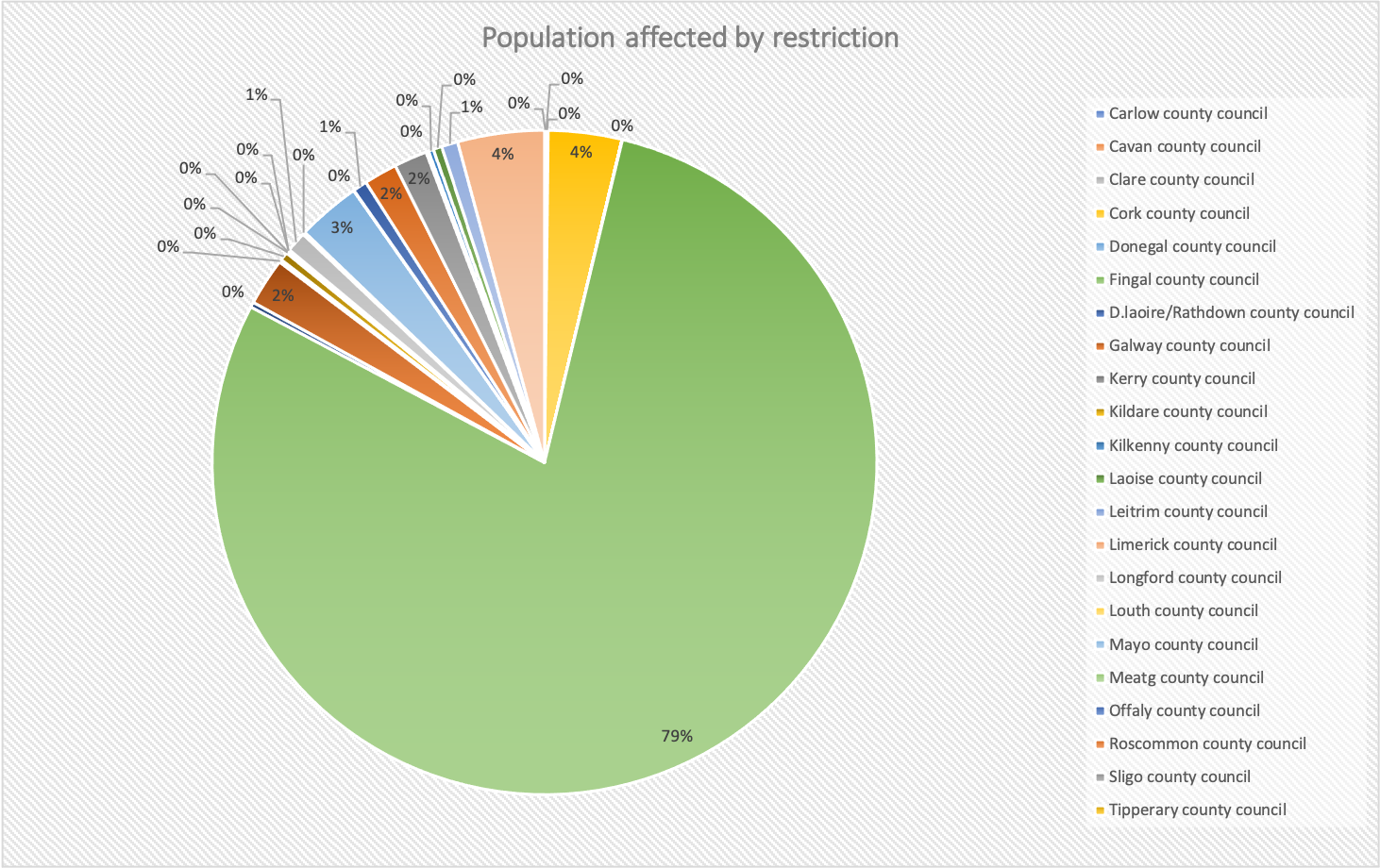
    The percentage of the population affected by boil water notices in Ireland over the past five years

    Between October and November 2019, two boil water notices were issued for consumers on the Leixlip public water supply. The first notice affected 615,000 consumers across Dublin, Kildare, and Meath, and the second notice affected 657,000 consumers.

    The table shows the Environmental Protection Agency’s (EPA) concerning trends of Boil Water Notices from 2017 to 2019.

    Table

Description automatically generatedImage source: The Environmental Protection Agency  

    Michelle Minihan, the senior inspector of drinking water at the EPA, spoke to TheCity.ie about the increase in water boil notices and the underlying causes for the delays in delivering critical improvements to the water treatment plan in Ireland. 

    “These notices were put in place to protect public health as there was a risk of a breakthrough of Cryptosporidium from the filters at the Leixlip Water Treatment Plant,” she said.  

    The notice was lifted shortly for these areas, but there are areas in Ireland with boil notices that have been still in place for over a year now. There are 27 properties in the Knockadoon water supply zone in Cork, with water boil notices issued on 31st June of last year that are still in place.  

    “The boil water notice in place for 27 consumers of the Knockadoon public water supply is due to inadequate chlorine time for those consumers,” Minihan continued. “This means the water is not properly disinfected as it has not had the required contact time for the chlorine to adequately disinfect the water when it reaches the consumer taps for the affected properties.”

    Irish Water plan to install ultraviolet disinfection for the affected areas and had briefed the EPA that the works are expected to be completed by the end of this year. Once the ultraviolet disinfection has been installed, Irish Water is planning to consult the HSE to agree on lifting the boil water notice. 

    There are 864 sites in the National Disinfection programme, and Irish Water has completed works on 230 sites. However, due to delays in accessing key equipment and delays with contract mobilization, the programme’s completion date has been extended from June 2020 to 2022.

    “The EPA is monitoring Irish Water’s progress in delivering this programme, including high-risk sites identified and prioritized during 2020,” said Minihan. “It is critical that Irish Water ensures the delivery of the disinfection programme is not delayed further.”

    Between July and August of this year, Irish Water received many complaints from consumers relating to the water’s unusual taste and smell. Irish Water investigated the causes of these complaints and sent samples of drinking water to the UK for specialist testing.  Results confirmed the presence of methylisoborneol – a naturally occurring substance produced by algae in lakes and rivers. 

    Irish Water informed consumers of the analysis and reported that the water remains safe to drink as the levels of methylisoborneol found in drinking water in parts of Kildare and Dublin have dropped significantly. 

    Irish Water monitors the drinking water quality on public supplies through its annual monitoring programmes. The programmes ensure that samples are taken at planned times throughout the year at planned locations in the distribution network. These samples are taken from taps in businesses and homes. 

    The EPA inspects Irish Water’s monitoring programmes to ensure that the results are from accredited laboratories. The laboratories analyzing the water samples must meet specific standards in their analysis methods.

    Irish Water planned to remove potentially harmful lead from public supply connections. However, there has been a significant reduction in their work plan.  “There is a lack of urgency in addressing the removal of lead from our network and buildings,” said Minihan. 

    While there was an increase in lead connection replacements in 2018 and 2019, compared to 2016 and 2017, during the four-year period, Irish Water has replaced 17% of service connections and backyard connections.

    Irish Water has now substantially reduced the previously set targets for the 2020-2024 period with a 90% reduction in its target for replacements in 2020 compared with 2019. 

    “Irish Water is highly unlikely to be able to meet its previous commitment in the Lead in Drinking Water Mitigation Plan to remove all public side lead pipework by 2026,” said Minihan.

    The high reports of boil water notice, particularly in Dublin, might indicate that Dublin needs a new water source as its existing sources are considered insufficient.

    “The Greater Dublin Area has been identified as an area where additional headroom is required as the demand for that area does not match the water supply,” said Minhan.

    Meanwhile, Irish Water is examining solutions to identify additional water sources that can be used to meet the demand and ensure a safe supply of drinking water. 
  • Dublin Protest Against Water Charges

    Dublin Protest Against Water Charges

    Saturday November 1 saw a nationwide day of protest against the proposed introduction of water charges.

    Marches were organised in all the major cities and towns across the country, with the largest gathering taking place in Dublin.  Smaller local marches took place throughout the greater Dublin region in the morning, with protesters then coming together in the city for the main event at 2pm.

    There were two starting points: one at Connolly Station, the other at Heuston.  The two groups marched on their respective sides of the Quays before joining and converging at the GPO in O’Connell Street.

    As with last month’s march the atmosphere was good, with no reports of arrests. At the same time, however, a palpable feeling of anger against the Government and Irish Water pervaded.  The message which the people were sending out was “enough is enough”, and that after years of austerity they were not prepared to be squeezed any more.

    Unlike many parts of the country the rain held off for most of the day, but by late afternoon the bad weather had set in and many people did not stay for the end of the speeches.  Nonetheless, the organisers once again claimed a higher turnout than expected, pointing out that the sheer volume of protesters sent a clear message to the Government.

    Speaking at the Fine Gael presidential dinner in Dublin that evening, Taoiseach Enda Kenny said that the Government would not be scrapping water charges. He admitted, however, that mistakes had been made in their introduction, and that the setting up of Irish Water had been badly handled.

    He went on to point out that the alternative to water charges would be an increase of 4% on the higher bracket of income tax, an option which he was not prepared to consider.

    Meanwhile, the latest opinion poll for the Sunday Independent shows a further slip in Government popularity.

    Dissatisfaction with the Taoiseach has grown to 67%, up 9% since September; Joan Burton’s popularity has also slipped by 8% in the same period.

    The poll also asked voters who they would vote for if a general election was called tomorrow.  Results suggest that Sinn Féin, at 26%, is now the most popular political party in the country, ahead of Fine Gael at 22% and Fianna Fail at 20%.

    Further water protests are planned for the end of this month.

  • Thousands protest water charges

    Thousands protest water charges

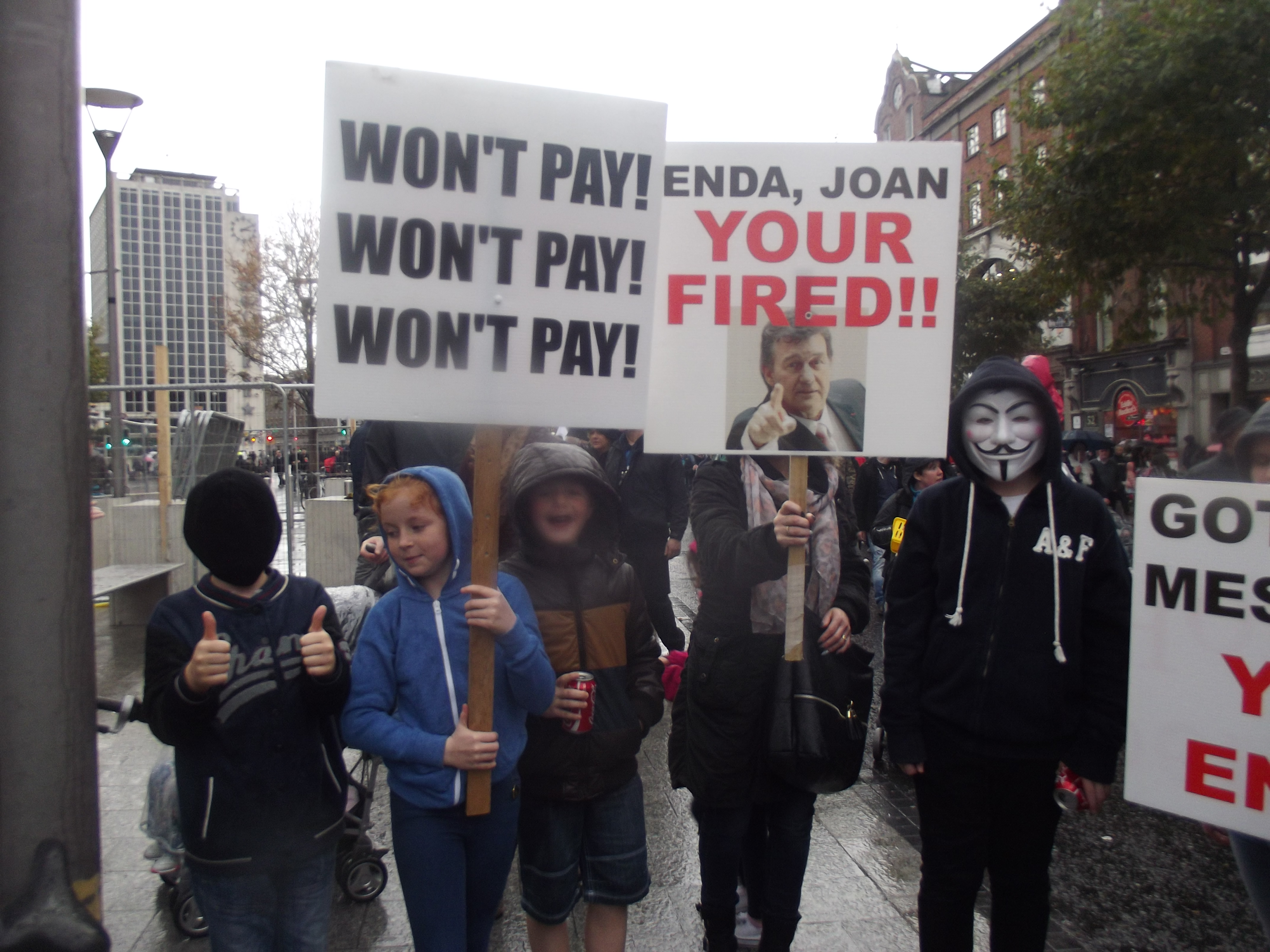
    This protester had a message for Joan Brution
    This protester had a message for Joan Brution

    The sheer scale of yesterday’s water protest march in Dublin yesterday appeared to take both the organisers and the Gardaí by surprise.

    The march was originally planned to start at Parnell Square at 2 pm and proceed down O’Connell Street, but by 1.30 pm the square was already full and newly arrived protesters were diverted around the Rotunda Hospital to form up. Eventually the queue stretched back as far as Dorset Street.

    From O’Connell Street the intended route was across the river and down D’Olier Street before doubling back down Westmoreland Street to assemble at the GPO. In the event the Gardaí realised that the crowd was too large and that the head of the procession would collide with the middle going in the opposite direction. Barriers were opened at College Green and the march was allowed to proceed unplanned past Leinster House and on round Stephen’s Green. From here it carried on to Aungier Street, down George’s Street, and rejoined the original route back at College Green.

    By the time the tail of the march had left Dorset Street the head was already at Leinster House.

    Water march
    Planned route in green; route on the day in red

    The result was that traffic was brought to a standstill on both sides of the city, and many drivers found themselves immobilised as the marchers swept past. Despite this the atmosphere remained good, with many of these same motorists sounding their horns in support.

    As always, it is impossible to accurately gauge the number of protesters. RTE last night quoted a Garda source at 30,000; other estimates are much higher, with many in excess of 100,000. Certainly from the ground a figure of 30,000 would appear impossibly low. Many of the protesters were critical of media coverage of the Irish Water issue, with RTE being singled out for alleged bias more than most.

    Much was made, by both the protesters themselves and the speakers back at the GPO, of Joan Burton’s recent comment about protesters owning expensive iphones. One placard read “Who pays for your smartphone Joan? We do”, people defiantly waved their camera phones in the air at every opportunity. Richard Boyd-Barrett urged everyone to take selfies and email them to the Tánaiste.

    Audrey Clancey, of the Edenmore Says No campaign, thanked Irish Water in a backhanded way by congratulating them on doing what no-one had managed to do before: to finally unite the people of Ireland in saying that “enough is enough”. This drew a large cheer.

    Independent TD Clare Daly declared that “today is an historic day when things will finally change”, and Richard Boyd-Barrett urged everyone present to keep the momentum going by supporting the next stage of the campaign: a day of nationwide protest in all towns and villages on November 1st.

    This slideshow requires JavaScript.