Tag: Wealth

  • ‘My beloved trade is in crisis and journalism itself is suffering – but we can’t lose hope’

    ‘My beloved trade is in crisis and journalism itself is suffering – but we can’t lose hope’

    PRINT TRADE: The vast selection of local newspapers we recently found at John Hyland’s Dún Leary’s Last Corner Shop in Dún Laoghaire (Photo: Paul Caffrey)

    As print sales continue to suffer in the era of smartphones, TheCity.ie’s Paul Caffrey reveals what it was like to endure a savage round of newsroom redundancies and examines the current state of the Irish newspaper industry

    The newspaper business is in crisis and I’m living proof.

    Last year was full of shocks for anyone working in newspapers, with 2019 characterised by one upsetting round of redundancies after another in the trade that was once king.

    It was a long time coming. Sales and readership figures of printed papers have been in steady decline since 2007 as digital options — smartphones in particular — have developed more and more. 

    In the second half of 2018, sales of daily national papers in Ireland plummeted by 10%. The Sunday market fell by 9%. Behind the scenes, the executives trying to keep their ships afloat had to take out their balance sheets and work out how to make cuts. As usual, they went for payroll.

    ‘The Newspaper King’: A video by TheCity.ie

    While investigating the current state of the newspaper business, we paid a visit to ‘Dún Leary’s Last Corner Shop’ in Dún Laoghaire, where newspapers of all kinds are still king. Bucking downward trends, owner John Hyland even sells a good selection of  “yesterday’s papers”. He keeps the Sunday papers – and some dailies – in stock for at least a week.
    (Video: Paul Caffrey)

    In March 2019, Ireland’s biggest newspaper group, Independent News & Media — publishers of the Irish Independent, Sunday Independent and The Herald — sought 35 redundancies. This led to the departures of many of its most talented and high-profile journalists. 

    Just a few months beforehand, in was described by SIPTU as a “massive blow”, INM had also shut down its own printing plant in Citywest, Dublin, with the loss of 84 jobs.

    Until April of last year, I had a good job covering the High Court for a national newspaper.

    On Friday, March 1st, I’d been in the middle of covering the closing stages of a libel action taken by billionaire Denis O’Brien against the Business Post — a case that could have bankrupted that paper had he won — when I was informed that my own employer was looking to remove about 35 of us from our jobs.

    While one newspaper was standing up for its very existence in court with a full defence against O’Brien’s action by respected journalists Tom Lyons and Ian Kehoe, the Irish Daily Mail was about to lay off a large chunk of its loyal staff.

    PRESS DEFENDER: Former Business Post journalist Tom Lyons, who now runs business website The Currency, was forced to defend his journalism from the witness box when brought to court by billionaire Denis O’Brien (Photo: YouTube)

    I was in shock. My gut reaction was, how can we run a newspaper on that basis? What will become of my colleagues? And will I be staying? I loved working for them. But, with a verdict imminent in the O’Brien case, I had no choice but to get on with the job. 

    All the while, I was getting a flurry of texts from senior colleagues back at the newsroom, including one that assured us that our paper was not closing down. That statement in itself I found shocking, as my mind hadn’t yet contemplated any such eventuality.

    Within 30 minutes or less, news of our “internal” strife was everywhere. RTÉ’s Industry Correspondent Ingrid Miley had been quick on the uptake and published it on the national broadcaster’s website for all to see.

    The last thing you want when your own organisation is hit with a crisis like this is to have to discuss it with anyone outside of your number, unless you’ve known them a long time. 

    You just don’t want their commiserations or polite enquiries before you’ve had even 20 minutes to process it yourself – even if they work in the media.

    And with O’Brien seemingly on the verge of yet another victory against a newspaper, it seemed that our industry was under attack from all sides. 

    However, in a stunning twist later that afternoon, the billionaire lost his case. The jury returned from its deliberations and found in favour of the Business Post. O’Brien had not been defamed, they decided.

    The newspaper was vindicated for its journalism and for having dared to publish a story concerning the finances of a number of well-known businessmen including O’Brien.

    PRESS VICTORY: Denis O’Brien lost his libel case on March 1, 2019 – the same day that yet another round of redundancies hit the print business (Photo: Paul Caffrey)

    It was a genuine victory for press freedom and a boost for all of us working in the media. It temporarily gave us all a lift and a cause for celebration.

    Emotions running high in the pouring rain outside the Four Courts. Tom Lyons, the paper’s former business editor, told the media:

    “We stood up to him, we fought for a full month, we stuck to our guns, we told the truth, did the right thing and thankfully the jury came down on our side.”  

    Ian Kehoe, the paper’s former editor, said at the time:

    “This is about the right of every media organisation in this country to publish what’s genuinely in the public interest and of public importance.”

    That night, there was a sense among us that, even if we were all about to lose our jobs, at least this much had been achieved. O’Brien’s case had been — in the words of the broadsheet newspaper’s lawyer Michael McDowell SC in his closing speech to the jury — “thrown out on its backside”.

    How the Business Post reported its court win that Sunday (Photo: Twitter)

    Before long, I had to consider my own situation again. Eventually, after much soul-searching and many tears during various meetings with my employer and a few long chats in quiet corners with my colleagues, with a heavy heart, I decided to join the leavers. 

    I was one of more than 40 editorial staff who left the place by the end of April. Our publisher — DMG Media Ireland — had employed 156 staff in Dublin until last April’s exodus.

    It was when I saw excellent journalists like our political editor Senan Molony — to name just one — being let go that I could clearly see that the number one priority for management was reducing the wage bill. There was genuinely no element of judging anyone by how well we did our jobs. 

    Even though this scenario was being echoed in newsrooms across the world, that makes it no easier to view it objectively when it hits your own workplace. 

    Leaving was a hugely difficult decision for me because I love newspapers and only ever wanted to work for one since I was 18. I felt at home there.   

    During the long process of negotiations about which of us might agree to take the bullet, falling newspaper sales and declining advertising revenue were constantly cited to us as the main reasons for the layoffs.

    Newspaper-free Zone

    TheCity.ie stopped by this Daybreak newsagent on Aston Quay, which has recently stopped selling newspapers altogether. The man behind the counter told me:
    “We don’t sell newspapers. It’s hard to cover the cost of it. Everyone is using the mobile applications. Some people feel it’s a waste of the trays.”
    (Photo: Paul Caffrey)

    However, I felt the whole process was handled as sensitively as it could have been. I departed wishing those who remained from our fantastic team of exceptional journalists, editors and sub-editors well — including editor-in-chief Sebastian Hamilton and chief executive Paul Henderson, both of whom I’d enjoyed working for.

    Certainly, if it’s a job you’re attached to and have done for a long time, redundancy is on a par with bereavement in terms of the devastating sense of loss it leaves you with for a long time afterwards. As this article from London’s Tavistock Institute notes, “Redundancy results in profound bereavement, not from the loss of others, but from the loss of self.” It’s also a comparison that’s been drawn extensively by academics and psychologists through the decades, as this 1987 study shows. 

    Over the past year, I’ve felt every inch of what these studies describe. Like the loss of a very close loved one, something I’m also painfully familiar with, it affects every part of your life. As to whether I’ll ever venture to take up permanent employment again, even if it’s offered, I’m still undecided.

    Meanwhile, there was further drama in May 2019 when the Rupert Murdoch-owned Times Ireland shut down its print edition less than two years after it had launched.

    Most journalists at the title were forced out of their jobs with redundancy pay that was condemned by the National Union of Journalists (NUJ) for being “miserly”.

    Many staff were reportedly furious to be told they wouldn’t be entitled to redundancy pay unless they’d worked for that company for more than two years.  

    Despite all this, about half a million newspapers are sold each day in Ireland, according to Irish Times Circulation Director Fran Walsh. He told TheCity.ie

    “People think print is dead…If you launched any product today into the market and went and said, ‘we can sell half a million of this product on a daily basis’, it would be a phenomenal business.”

    However, back in the early Noughties, the Sunday Independent alone boasted having one million or more readers on its front page, week after week. 

    The Sunday Independent proudly advertising its 1.1 million readers on its masthead in the pre-smartphones era – October 6, 2002. (Photo: Paul Caffrey)

    Despite all the upheaval since those glory days, newspapers remain an essential part of our daily life.

    Without them, the Watergate scandal would never have been exposed by Washington Post journalists Bob Woodward and Carl Bernstein. Their comprehensive, investigative exposé led to President Richard Nixon’s resignation in August 1974. 

    The painstaking investigative work of Woodward and Bernstein was dramatised in the 1976 film All The President’s Men.

    PRINT TRADE: TheCity.ie found this pop-up newspaper vending stand in Raheny, north Dublin, that still sets up near a church every Sunday (Photo: Paul Caffrey)

    Without newspapers, we’d never have learned the extent to which British MPs were on the take with their expenses claims from the Daily Telegraph in 2009. That newspaper made its own film, The Disk, about its findings.

    WATCH: The Disk: the real story of MPs’ Expenses – Full Film

    Equally, the betting scandal involving three Pakistani cricketers, revealed by the now-defunct News Of The World in 2010, would never have been brought to light.

    EXPOSED: How the now-defunct News of The World broke the story that rocked the world of sport in 2010 (Photo: Pinterest.ie)

    Newspapers also run important campaigns — such as the UK Daily Mirror’s opposition to the Iraq War in 2003, and closer to home, the Irish Daily Mail’s recent campaign to ban smartphones for under-16s.  

    According to the Project for Excellence in Journalism in the US (now part of the Pew Research Center), most original journalism is still produced by newspaper journalists. 

    Moreover, newspapers still largely set the broadcast and online news agenda. RTÉ’s Morning Ireland has two paper reviews each morning, while Sky News has two paper reviews each night and a more in-depth look at the day’s papers every morning. 

    WATCH: National Newspapers of Ireland video that explores why newspapers of all types are still important.

    Newspaper History

    Employment crises in newspapers are nothing new. TheCity.ie recently found this Linotype-style machine, produced by the Intertype Corporation (founded in 1911) sitting in the foyer of the Irish Times printing plant at Citywest, Dublin. Machines like this were used to typeset material for newspapers from the 1880s until the 1980s in some countries. On Fleet Street in the ’80s, there was huge resistance to modernisation by typesetters’ unions anxious to prevent job losses. The so-called ‘Wapping Dispute’ of 1986 saw Rupert Murdoch infamously sack over 5,500 print workers after they went on strike over the impending changeover to new technology
    (Photo: Paul Caffrey)

    The global surge in redundancies also poses a clear threat to journalism itself.

    With job security in the newspaper business now harder than ever to come by, many talented journalists I know have left the industry and secured jobs in public relations and communications roles instead, working for political parties, State bodies, charities and NGOs. 

    And when the poacher turns gamekeeper, surely the quality of the journalism on offer to the public suffers.

    CRISIS YEAR: People are still buying newspapers (Photo: YouTube)

    According to a 2019 report by the Federal Communications Commission in the US, mass redundancies in print newsrooms result in: 

    “…stories not written, scandals not exposed, government waste not discovered, health dangers not identified in time”.

    In my view, the only solution for now is that good journalists keep striving to hold the rich, the powerful, the incompetent and the reckless to account with rigorously researched and verified original content.
  • Hard times for former Gresham owner who once had world at his feet

    Hard times for former Gresham owner who once had world at his feet

    PRESSURE: John Joseph Murphy at the High Court in February where he was questioned about his debts (Photo: Collins Courts)

    John Joseph Murphy recently suffered a heart attack 24 hours after being questioned in court about his unpaid €3.5million bank loans. TheCity.ie’s Paul Caffrey, who’s been in court covering this extraordinary case as it’s developed since February, profiles this Wexford businessman and explores his rise and fall over the past two decades.

    As a co-owner of the landmark Gresham Hotel in Dublin during the boom years, property developer John Joseph Murphy was riding high.

    Brimming with hope and confidence when interviewed by The Irish Times in July 2004, having just won control of Ireland’s oldest hotel, he brushed aside fears that he might turn it into one big apartment block.

    “The Gresham will always be the Gresham. There will be no change there. It’s business as usual,” he told the newspaper. 

    The 200-year-old Gresham Hotel on O’Connell Street, Dublin, that John Joseph Murphy once owned (Photo: YouTube)

    Irish Times business journalist Jane O’Sullivan reported that Murphy told her with a laugh: “We are not going to knock anything down and build apartments. We do believe in the underlying business and the value it can deliver.”

    Perhaps at the time, he could afford to be light-hearted. It was the height of the Celtic Tiger era and he was one of a consortium of three investors who’d just won control of the Gresham Hotel Group

    This included its flagship, 200-year-old, 323-bedroom hotel that dominates Upper O’Connell Street in the capital, along with Cork’s Gresham Metropole, London’s Gresham Hyde Park and the Gresham Memphis in Amsterdam.

    The group also controlled the Gresham Belson in Brussels, the Gresham Carat in Hamburg and the Royal Marine Hotel back home in Dún Laoghaire.

    WATCH: Explaining the historical significance of the Gresham Hotel that’s welcomed guests from the Beatles to Princess Grace (Video: Dublin City Public Libraries/YouTube)

    Sounding like a man who was ready for anything when interviewed 16 years ago, Murphy told The Irish Times about his apparent plans for world domination – in the hotel domain, at least.

    “We are not afraid to invest where we see fit. We are not afraid to acquire more hotels. But where we see any particular asset that can’t deliver, we won’t be afraid, if necessary, to dispose of it.”

    John Joseph Murphy speaking in 2004

    Back in the early to mid-Noughties, the easy availability of credit created endless temptation for those with any stake in the booming property sector. 

    This all came to a shuddering halt with the September 2008 global economic crash that was exacerbated in Ireland by the collapse of our then-bloated property market. 

    Known as JJ to his friends, Murphy was a seasoned developer with a solid pedigree in the property industry. He appeared to be set up for life as he embarked on a range of projects.  

    Between 2000 and 2007, he drew down loans totalling €6.2million from Bank of Scotland (Ireland) with a business partner to buy and develop Castle Oaks Hotel that overlooks the Shannon in Castleconnell, Limerick, the High Court heard.  

    PICTURESQUE: Castle Oaks Hotel in Limerick that John Joseph Murphy sold in 2018 to pay off about half of his bank debt – but it wasn’t enough to get him off the hook (Photo: YouTube)

    Resulting from the December 2018 sale of that hotel property, that dates back to the 19th Century, the father-of-three managed to reduce his debt by nearly €3million, the High Court heard.

    After signing a deal to purchase the 64-bedroom hotel in December 2018, Supermac’s owner Pat McDonagh told the Limerick Leader: “It is going to be business as normal.” 

    But it’s Murphy’s failure to repay the remaining €3.45million that has led him to the High Court where he’s now being sued for the full return of his bank borrowings.

    Bank of Scotland having pulled out of Ireland in 2010, his loans were later purchased by finance fund Feniton Property Finance. It was Feniton that took the legal proceedings against him. 

    The High Court’s commercial wing first ordered him to pay back the €3.45million to Feniton in April 2019. 

    When he didn’t pay the debt, the fund looked for other ways to pursue him. 

    The Four Courts in Dublin, where John Joseph Murphy’s case is being heard (Photo: Paul Caffrey)

    On February 18 last, Feniton’s lawyers cross-examined Murphy in court about what assets he may have at his disposal to satisfy the unpaid judgment.

    In robust exchanges, Feniton’s barrister Micheál O’Connell SC told him: 

    “You are going to have to answer these questions.”

    CROSS-EXAMINATION: Seasoned barrister Micheál O’Connell SC questioned property developer John Joseph Murphy at length about his unpaid debt on February 18 (Photo: The Bar of Ireland)

    But Murphy’s lawyers later claimed in court that on the following day, February 19, the father-of-three suffered a heart attack after getting an email from Feniton’s legal team that was “of concern in terms of its content”. 

    The exact contents of the email was not outlined in court. 

    Murphy, of Stony Park, Wexford, was rushed to the Mater Hospital in Dublin and underwent quadruple bypass surgery for his “very serious condition”, the High Court was told. 

    When his lawyers announced this in court on March 5, Feniton’s lawyers argued it was “extraordinary” to suggest an email from their side had brought on his heart condition.

    But Mr Justice David Barniville, who was presented with a GP’s report detailing Murphy’s condition, agreed to put the case on hold for at least a month.

    Timeline infographic: Paul Caffrey

    TheCity.ie was in court in February for Murphy’s testimony 24 hours before his health scare. We returned on March 5 when the court was told of his health condition.

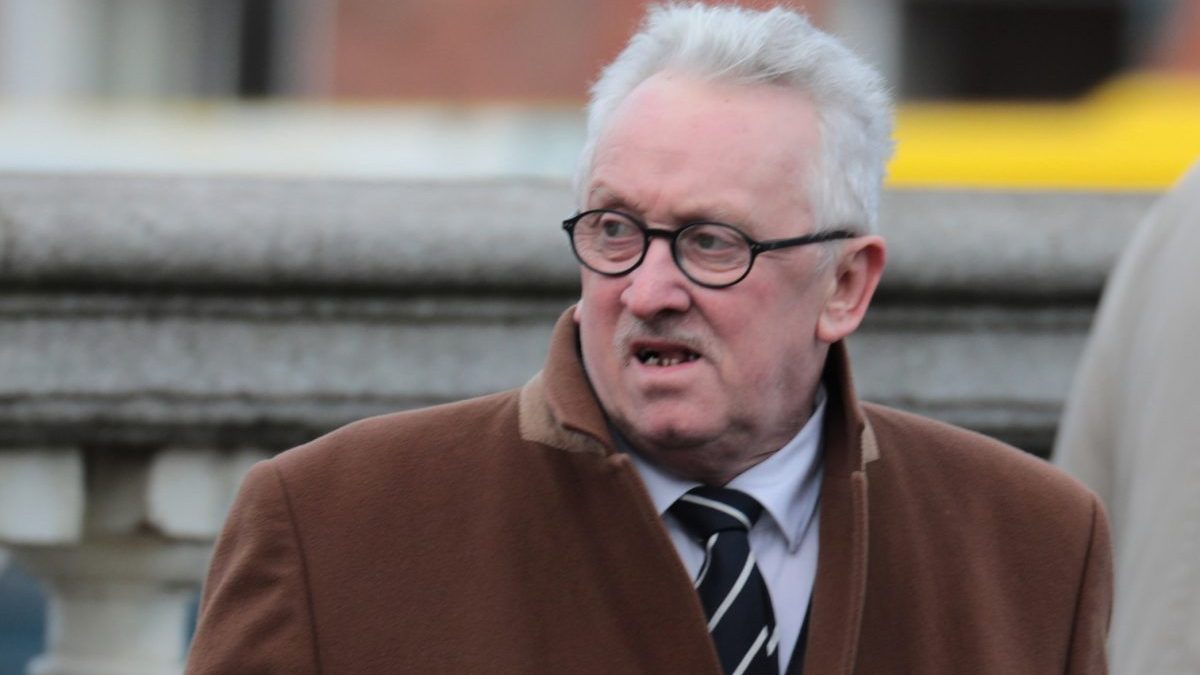
    Dressed in a three-piece grey suit with white shirt, black and white striped tie and bronze-coloured cufflinks, he was questioned for almost three hours about what assets (any property or cash) he may have to satisfy the debt. 

    From the witness box, the waistcoated Wexford developer claimed he had “no assets” to pay back the millions. 

    Under questioning by Micheál O’Connell SC, for Feniton, Murphy claimed he was “kept” by his three adult children who paid his bills for a decade after he fell on “hard times”.

    His three offspring “supported me for many years when I was on hard times,” the developer told the court, adding: 

    “I had no money. Over a period of ten years, these people kept me.”

    Murphy explained: 

    “They’d have paid my bills, my ESB insurance. I had no income during that period.”

    Murphy has a 41-year-old son who’s a chef and two daughters in their 30s, one who works for a US tech company, it was heard. 

    HISTORIC: The Four Courts complex in Dublin is where all High Court commercial cases are heard and decided on (Photo: Paul Caffrey)

    Asked by Mr O’Connell SC if the children helped “out of the goodness of their hearts”, Murphy replied: “Completely out of family…This was a family matter.”

    Murphy later “decided to reimburse” them by giving them €250,000 collectively, it was heard. 

    But Feniton struggled to find any record of that payment, it was heard.

    Later, Murphy told the court: 

    “I don’t have any assets. This is the whole point here.”

    Asked if his attitude was that his creditors “can wait”, Murphy said the outstanding €3.45million debt related to a partnership with a man he hasn’t seen nor spoken to “in eight to ten years.”

    And he added: 

    “I don’t even know what this [€3.45million] debt is for – it’s ten years old.”

    (Factfile infographic: Paul Caffrey)

    Before he left court on February 18, Murphy was ordered to provide further information and/or documents to Feniton about his assets by 5.30pm on Tuesday, March 3. 

    He was due to appear in court again on Thursday, March 5. Instead on that day, his lawyers brought news of his February 19 heart attack.

    The case is currently on hold as the courts are dealing only with urgent cases during the Covid-19 lockdown. Chief Justice Frank Clarke recently made a statement on the matter.

    According to official Companies Registration Office (CRO) records seen by this website, Murphy hasn’t been a director of the Gresham Hotel Company Ltd since December 2006 when he resigned from that position. 

    His December 7, 2006 resignation was recorded in documents filed with the CRO in February 2007.