

The low number of apprentices remains a legacy of Ireland’s economic crash, as Eimear Dodd learns
Tag: work
-

Behind the kitchen door: the realities of working in the food industry
The restaurant trade in Ireland has been booming in recent times, but as Gary Ibbotson explores, it’s not as glamorous for the workers making it happen.
-

Lack of regulatory framework is leading to exploitation of au pairs
There is no legal framework in place specifically for au pairs working in Ireland, according to citizensinformation.ie. However, it is generally understood that there should be some specific written agreement in place between the family and the worker in relation to how many hours per week they will work and how much they will be paid.
Unfortunately, this does not seem to prevent the exploitation of the, more often than not, foreign students who come to Ireland hoping to improve their English, both through academic courses and practical interaction.
Roberta*, a 21-year-old from Brazil was one of these students. While studying, she began to run short on money and, taking into account the conditions of her visa allowing her to work twenty hours a week, she decided to get a job as an au pair.
She moved in with a family and agreed to look after a two year old girl, Sarah*, on weekday mornings before attending her English classes in the afternoon.
“In the beginning it was fine, I woke up at 7am and made breakfast for Sarah, dressed her and prepared anything she might need for the rest of the day. Sometimes her mother would ask me to come to the supermarket with her and the children. Sarah didn’t like this and would often behave very badly, her mother rarely disciplined her for this and I had to distract her,” Roberta explained.
As the months went by conditions became more difficult for Roberta.
“They didn’t provide me with a lock for my room or cabinets and I noticed that sometimes things would be in a different position than when I left them. One day I returned to see my perfume smashed on the floor, when I asked her mother what happened she said that Sarah had gotten into my room when she wasn’t looking and had broken it.”
Although the agreement was that Roberta would only work on weekday mornings, she was put under pressure to get up with Sarah on Saturday and Sunday mornings too.
“I ended up working Saturdays and Sundays with Sarah, and I was also asked to clean the house while the family were gone. I was paid €120 per week regardless of how many days I worked and I rarely had any time to myself as I was studying every day too.
“At that time I had very little English and no confidence to confront them about how unhappy I was,” she reveals.
Roberta was later told that her services were no longer needed as Sarah’s mother couldn’t afford to pay her anymore.
“She let me stay for one week and I had to argue with her to pay me for that week as I was still minding Sarah. I stayed for three months in total, but it was the worst experience of my life.”
Founder of the Au Pair Rights Association, Jane Xavier, reveals that she has dealt with cases much worse than this one, where domestic workers work forty hour weeks and get paid as little as €3 an hour.
“Domestic workers are an historically vulnerable group. Despite doing essential and important caring and cleaning work in all societies, facilitating others to work outside the home, domestic workers are undervalued, underpaid and overworked,” she explains.
To improve conditions, Xavier says a fair wage is key and also that the National Employment Rights Authority (NERA) keeps a close eye on au pair agencies.
“NERA has the power to inspect the employment conditions of anyone working in a private home. They must work closely with families employing au pairs to protect and uphold our rights and protections under the law, in addition to tackling au pair agencies who are in breach of employment laws.”
*Sarah and Roberta’s names have been changed to protect their identities -
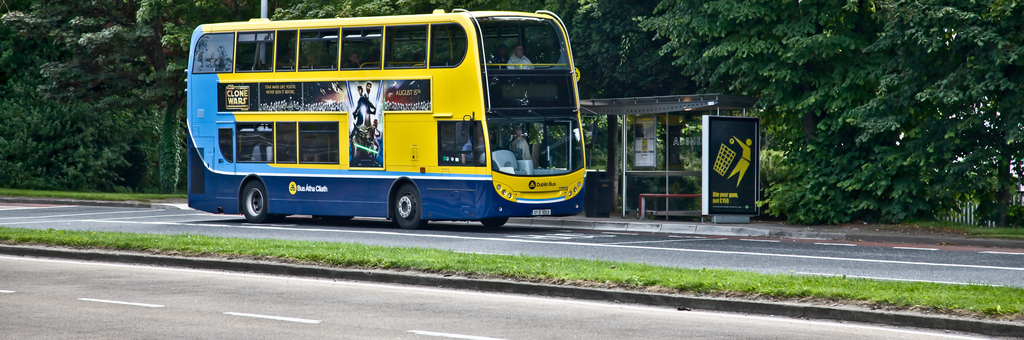
What not to do on Dublin Bus
As someone who takes the bus into the city every day I have grown to adopt certain habits and mannerisms. I also notice the habits of other people. I felt it was the right time to compile a list on what not to do when travelling on Dublin Bus.
1- Don’t play music out loud.

If you are going to listen to music, make sure to use these. Image by Khairil Zhafri on flickr If I wanted to listen to music on the bus, I would have brought my own earphones. A quiet bus is not an open invitation for you to take out your phone or iPod and start playing your music for the whole bus to hear. Also, just because you are wearing earphones, doesn’t mean you can listen to your music as loud as you want. If I can hear your music, through your headphones, and even worse, through my headphones, it’s a sign you need to turn it down.
2- Don’t be obnoxiously loud on the phone.

Is it really necessary to be that loud? Image by Martha Soukup on flickr By all means, have a conversation or phone-call. No one will have a problem with that. The problem arises when everyone else can hear every single word you say in this conversation, no matter where they are sitting. It’s a bus; not O’Connell Street, you don’t need to project your voice.
3- Don’t take up a full seat during peak times.

Image by Mark Hillary on flickr During peak times, passengers are usually heading to or from work or college. Either way, they are probably tired and not looking for hassle. The majority just want to find a seat and trudge along quietly. Don’t be the person with your feet up or with your bag beside you on your seat. The floor is a perfectly fine place to put them.
4- If it’s cold out, don’t open a window.

This is not a sign that the window needs to be opened. Image by Susan Sermoneta on flickr It’s a well-known fact that opening the window on a bus does absolutely nothing to cool you down. However, the passengers in the rows behind you will know all about it. Sitting on a bus with Baltic winds blowing in your face can turn the most upbeat positive people into cynical grouches. If it is cold outside, or even worse, raining, leave the windows closed.
5- Don’t light up a smoke.

Everyone is trying to get somewhere. Don’t be the one who delays them. Image by DragonLord878 on flickr The other passengers don’t care how badly you need it. Also, don’t try concealing it either. Firstly, the smell of smoke will give you up straight away, and then, more than likely, the driver will stop the bus until you put it out. If it’s one thing passengers hate more than sitting in traffic, it’s being delayed by someone on the bus itself.
6- Try to avoid eating.

Fight the temptation.
Image by _BuBBy_ on flickrI know sometimes it can be hard, but for the sake of the other people on the bus, please don’t eat something. Now, some foods are acceptable, like sandwiches or rolls, but try not to eat something with a strong aroma (we’re looking directly at you Subway lovers). The smell just fills the bus and makes everyone else jealous, or angry at you.
7. Observe personal space.

Observe the boundaries at all times. Image by Raúl Santos de la Cámara on flickr. If you sit down beside someone, remember, you’re sitting beside them. You’re not sitting on their lap. It is a shared seat, a 50:50 split, not 60:40.
-

Abandon Ship! Students on emigration
University College Cork’s recent study of emigration trends in Ireland last week revealed that nearly two thirds of emigrants had a third-level qualification. It also showed that half of those emigrating were doing so as a matter of choice, leaving a full-time job they had here in Ireland.
This provided some food for thought for experts and journalists who lamented the ‘brain drain’ as a tragic consequence of our crumbling economy. The claim that people are leaving unwillingly as a matter of necessity is now being called into question.
Perhaps the mass exodus has more to do with the quality of jobs available as opposed to the quantity. To put it simply, young Irish people don’t want to settle for what they see as menial jobs. But in this climate, the pressure is even greater to take what you’re given and be grateful. I went in search of answers from some final year college students.
 Hilary Pidgeon, 22
“When I graduate I’m probably going to emigrate. Maybe not permanently, I’d probably move away for a couple of years. There’s so much more opportunities in other countries like America and Canada. Some of my friends are doing jobs that are widely available in Ireland, but if they want to go far in their career they’d have to emigrate. I think it’s really bad. You’ve got your family here and your friends here. You’re basically cutting off the life you’ve built up here for twenty something years”
 Louise McLoughlin, 22
“I think I’m going to head straight to London after I finish. My boyfriend has already emigrated there, so that’s one reason but secondly I think there’s just a lot more opportunity especially for someone studying media. I think the majority of my friends are going to stay for the next few years at least but I think if something better is offered somewhere else they’re going to take it. People should do what’s best for them. It’s not our job to hold the country together. Why should be stick around just to stop a boat from sinking?”
 Tessa Flemming, 23
“When I graduate I know I probably won’t get work in my area of study so I’m just going out with a completely open mind, to experience life rather than find a career straight away. I really wanted to learn Spanish this year, I was thinking of going to South America or Spain and just live in another country for a year. I see myself as a wanderer, so any opportunities that are presented to me I’ll definitely say yes. I think people don’t really want to leave, but they’re doing crappy jobs at the moment that don’t reflect their skills. I really don’t want to happen to me. ”
 Barry Lennon, 21.
“Emigration isn’t really on my radar, but I wouldn’t mind moving abroad for a while to grow as person. I mean if push comes to shove and there is a better offer abroad perhaps, even just to get a different experience. I probably would like to return to Ireland depending on how things go. Maybe when I get my retirement and I can settle down with the wife. I’ll sell the house and buy a nice retirement home somewhere in west Cork. I think it’s bad though, the country is investing in these people only for them to go away.”
 Sean Carroll, 21
“I’ll head to the west coast of America for a year, hopefully with friends. I’m getting a degree in marketing, and I don’t have any interest in working in Ireland right now with the recession strangling any chance I have! We pride ourselves here in Ireland for having such an educated workforce, but people are getting educated here and then they’re leaving. Obviously people don’t want to leave their family and friends behind but if you’ve studied for four or five years in a particular field, it seems like a waste to stay here. If you have a degree in engineering but you have to work full time in Centra you’re not going to stay around.”


You must be logged in to post a comment.