
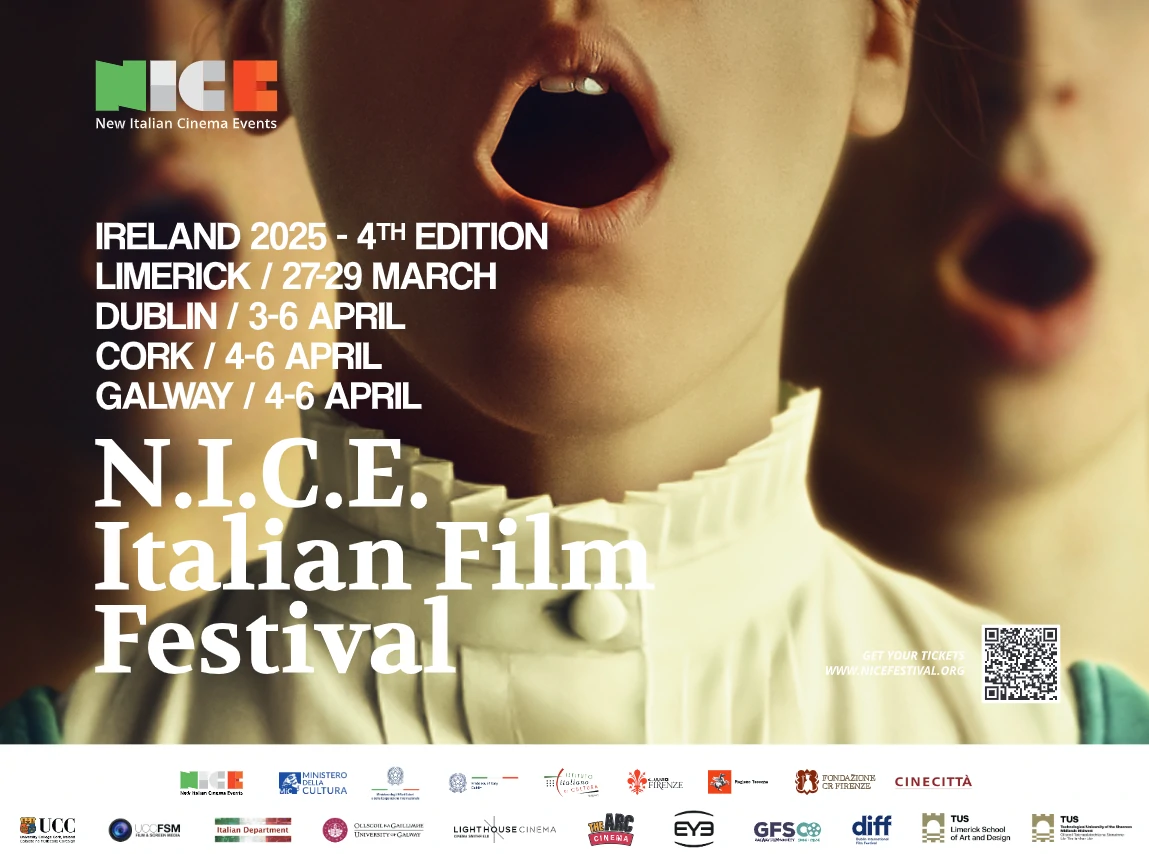
The N.I.C.E. Italian Film Festival returns to Ireland for its fourth edition, bringing a curated selection of contemporary Italian films to Dublin, Cork, Galway, and Limerick from March 27 to April 6, 2025.
Founded in Florence in 1991, N.I.C.E. (New Italian Cinema Events) promotes Italian cinema abroad, particularly the work of young and independent filmmakers. Over the years, it has grown into a prestigious cultural initiative with editions in the United States, Russia, China, and Europe, introducing global audiences to evolving trends in Italian cinema. In Ireland, the festival serves as a cultural bridge, fostering exchange and deepening appreciation for Italian storytelling.
Organised by the Embassy of Italy in Ireland and the Italian Institute of Culture, the festival showcases Italy’s finest talents, from acclaimed directors to emerging voices.
Since its Irish debut in 2022, the festival has expanded significantly. It began in two cities with ten screenings and now offers 22 across four locations, driven by enthusiastic audience response. N.I.C.E. organisation reports:
“When we were first approached by Marco Gioacchini, director of the Italian Institute of Culture in Dublin and our main collaborator in this endeavour, with the idea of bringing our festival to Ireland, we did not know what to expect from the Irish public. But the warm and engaged reception took us by surprise! Because of that, because of how the public has reacted to what we have to offer, we have been able to improve and expand every year.“
This increasing demand has enabled N.I.C.E. to bring more films, explore new themes, and reach wider audiences, strengthening cultural ties between Italy and Ireland.
The 2025 lineup focuses on female-driven narratives, reflecting the evolving interests of audiences and the industry.
According to the organiser, “This is in part a conscious choice, but it is also a direct reflection of the shift in interests of the audience. Simply put, female-cantered stories are now more popular than ever, and the market mirrors this interest by producing stories about women, often made by female filmmakers,” say the organizers.
One of the standout films is “Gloria!”, the directorial debut of singer-songwriter and actress Margherita Vicario. Set in an all-women musical institute in 18th-century Venice, the film explores themes of rebellion, artistic identity, and female agency — themes that still resonate today.

Maria Vittoria Dallasta, who plays Marietta, a character in the film, spoke with TheCity.ie about the experience.
“Working with Margherita was a wonderful and empowering experience,” said Dallasta.“She was a brilliant director that always connected us deeply to the story we were telling. Margherita is not only a director, but also a singer-songwriter and an actress… She’s a true all-round artist. Her creative approach to cinema, that fully embraces all the arts, is exactly what we need nowadays, and it’s brightly projected into the future.”
When asked if the film’s themes are still relevant for women today, Dallasta reflected on the emotional honesty of her character.
“Marietta is so pure and direct in what she does,” she said.” She allows herself to feel, without asking if it’s right or wrong. Playing such a spontaneous character was refreshing, because in my personal life I am too conditioned by what people expect me to do. Marietta stays true to herself thanks to the unbreakable bond with her friends… they rebel against patriarchal oppression through music. I truly believe that sisterhood and art are luminous values that resonate with women today and will always resonate in the fight for conquering the freedom to be who we are and who we want to be.”
One of the most talked-about selections of this year’s N.I.C.E. Festival is Parthenope, the latest film by Paolo Sorrentino. A poetic journey through youth, melancholy, and memory, the film pays homage to the director’s deep connection with Naples.

TheCity.ie spoke with Rienzo about the emotional depth of his character and what it means to bring Parthenope to Irish audiences.
“Working on set wasn’t too demanding; working with Paolo is a great privilege—everything runs smoothly.”
Yet the emotional preparation for Raimondo’s character proved more intense.
“Exploring such melancholic and poetic aspects of human nature—dark, in a way—such as absence, impossibility, and jealousy was an interesting yet exhausting task. Talking about suicide is like discussing a deep resignation, a great surrender, a complete detachment from everything that society today considers essential. Working on such an intense sense of detachment and letting go often felt beyond my reach. Looking back, I feel fortunate to have been part of a film like this, shaped by Paolo’s finest writing. It’s not every day that you get the opportunity to explore yourself so profoundly.”
As a Neapolitan, Rienzo spoke with deep affection for the city that serves as both backdrop and symbol in Parthenope:
“The idea of being Neapolitan and having taken part in a project of such poetic significance about Naples fills my heart with gratitude but also with pride. The Naples depicted by Paolo glides over a veil of cinematic beauty of the highest level, thanks in part to the incredibly sensitive photography of Daria D’Antonio. Finally, we get to see a distinguished Naples, with its own colours, without the violence that, in my opinion, unnecessarily characterizes it in the international perception. Naples is a very kind city.”
Reflecting on the film’s presence at N.I.C.E. Ireland, Rienzo shared a personal connection between Neapolitan and Irish culture:
“Bringing this film here to N.I.C.E. is also a great gift. I am a musician also, and Irish music has accompanied me for many years of my life, shaping the way I play the guitar. I have always deeply loved Dublin, and people have often told me that culturally, it is ‘the South of the North.’ I don’t know the city well, but I believe that this film about Naples—a city made up especially of sound and music—can resonate well with a culture as musically open as Ireland’s.”
Among the highlights of this year’s festival is “Romantiche” (Romantic Girls), the directorial debut of Pilar Fogliati, a film that follows four women navigating personal challenges and aspirations in their journey toward self-discovery. Another female-centered narrative is “Diamanti” (Diamonds) by Ferzan Özpetek, which takes audiences back to a 1970s Rome tailoring shop, weaving the lives and dreams of 18 female employees. The festival will also present historical dramas such as “Il treno dei bambini” (The Children’s Train) by Cristina Comencini, set in post-war Italy, and “L’abbaglio” (The Illusion), a gripping tale of deception and warfare during Garibaldi’s unification battles.
Contemporary issues are explored in “Real”, a documentary by Adele Tulli that explores the human condition in the digital age, and “Familia” by Francesco Costabile, a compelling thriller tackling domestic violence. Rounding out the programme is “Una storia nera”, a mystery following a man’s disappearance.
N.I.C.E. is not only about showcasing films—it also fosters meaningful connections between the Italian and Irish film industries. One example of this collaboration is the festival’s partnership with Irish Film Festa, a Rome-based festival that introduces Irish cinema to Italian audiences.
“Last year, we collaborated on a small series of screenings in Florence, our home base. It went very well, and we look forward to replicating the events this year too!” the organisers revealed.
This growing cultural exchange paves the way for stronger partnerships, co-productions, and artistic dialogue between the two countries.
Thanks to collaborations with UCC, the University of Galway, Galway Film Society, and the Limerick School of Art and Design (LSAD), the festival will be screened in multiple cities:
Limerick – TUS Millennium Theatre | March 27-29
Dublin – Odeon (Opening Gala), Light House Cinema | April 3-6
Cork – The Arc Cinema | April 4-6
Galway – EYE Cinema | April 4-6
All films will be screened in Italian with English subtitles.
With its blend of history, social reflection, and contemporary voices, N.I.C.E. Festival has become a key cultural event in Ireland. Whether you’re a cinephile or curious newcomer, this is a rare chance to experience Italy’s cinema in all its richness.

For the full festival programme, film synopsis, and ticket bookings, visit www.nicefestival.org.
You must be logged in to post a comment.