
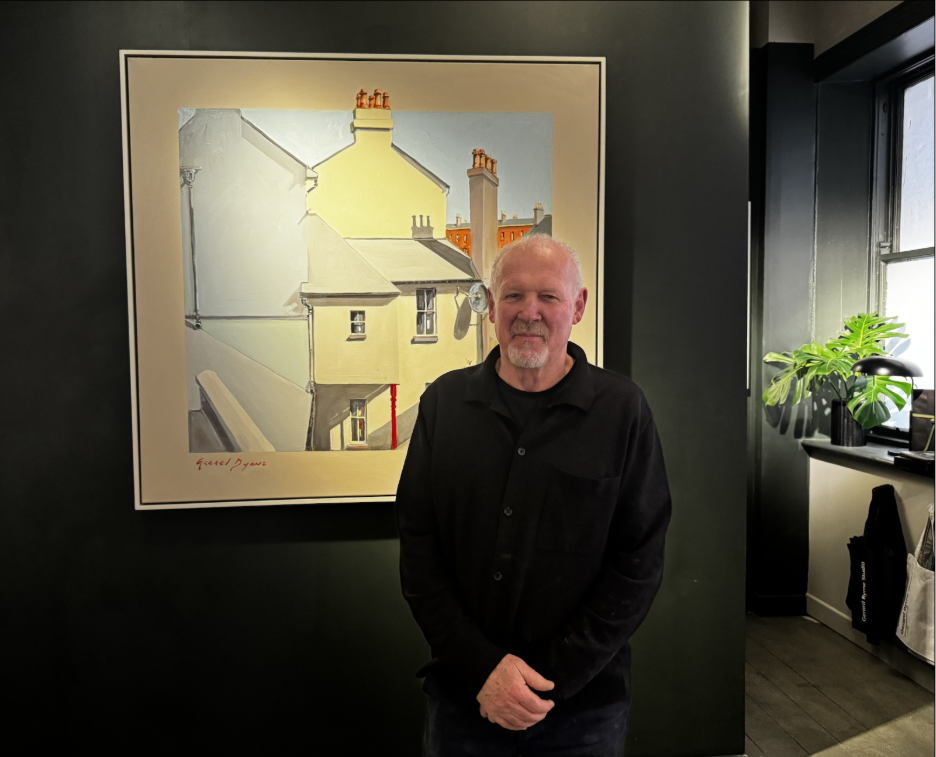
A new exhibition by artist Gerard Byrne highlights the impact of modernization on Dublin’s architectural character and cultural identity.
By Peace Okolo

An exhibition portraying Dublin’s evolving cityscape has opened at the Gerard Byrne Gallery on Trinity Street, with artist Gerard Byrne presenting a series of paintings that reflect the city’s architectural and cultural change.
Before I Go. Vanishing Dublin focuses on Georgian and Victorian buildings across the city, many of which Byrne says are being altered, neglected, or replaced as Dublin continues to modernise.

Byrne’s paintings draw inspiration directly from the Dublin he grew up in, a city he describes as having undergone constant change driven by globalization and commercial expansion.
“The city I grew up in has changed constantly since I was a young boy… it’s not the same Dublin anymore.”
The impact of that change, he said, is most visible in the built environment, where buildings once designed with care and detail are increasingly being replaced by more uniform developments.
“You might as well be in any city in the world… the same shops, no individuality.”
This loss of individuality, he suggests, is not just architectural but cultural reshaping how people experience the city itself.

While the exhibition is rooted in architecture, it extends beyond buildings. Byrne’s work reflects how modernization affects identity, memory, and emotional connection to place.
“Your surroundings basically make you as a person,” he said. “Those Georgian and Victorian buildings took time. They were designed to be pleasing to the eye.”
In contrast, he said much of Dublin’s recent development lacks that same level of consideration.
“Now it’s steel, glass and concrete,” Byrne said. “Something has been left out of the equation, how it affects people emotionally.”

For Byrne, older buildings carry a sense of character and intentionality that modern structures often lack. His paintings attempt to preserve that visual and emotional quality.
Although the exhibition appears to document a disappearing city, Byrne said that was not his original intention.
“I didn’t go out to document Dublin,” he said. “I went out to paint. But in doing that, I ended up documenting it.”

“I could see buildings starting to change, starting to look worse for wear,” he said.
Some of the locations featured in his work are already facing demolition, while others have been altered significantly.
“There are paintings here of buildings that are up for demolition,” he said.
He pointed to what he described as a broader pattern of neglect.
“We have a tendency in Ireland to neglect buildings,” Byrne said. “Landlords don’t have an interest, or people just see them as an investment and pass through them.”

Despite his concerns, Byrne acknowledged that Dublin’s development has brought certain benefits.
“It’s both good and bad,” he said. “It’s easier to make a living now. The city has grown.”
However, he believes the city risks losing what made it distinct in the first place.
“If you take away the culture and art, where do people go? What is left of the city?” he said.

While Byrne acknowledged that redevelopment is sometimes necessary, he believes more attention should be paid to what already exists.
“It could be a beautiful city if people took more interest in it,” he said.

The exhibition has drawn emotional responses from visitors, according to Byrne, with some reflecting on their own connection to the city.
“People come in and get emotional,” he said. “They say they never noticed the buildings like that before.”
For Byrne, the exhibition is ultimately about awareness and encouraging people to notice what remains before it disappears entirely.

Byrne said his connection to Dublin remains at the center of his work.
“I do love the city,” he said. “That’s why I paint it.”
As the city continues to change, Byrne hopes people begin to see it differently; not just as it is, but as something worth noticing before it disappears.
“When we appreciate what we have,” he said, “we’ll realize what we’ve lost.”

You must be logged in to post a comment.