
Author: Faye Thompson

  • “Prescriber mode, pharmacist mode”: Dublin Pharmacist On Life under the Common Conditions Service

    “Prescriber mode, pharmacist mode”: Dublin Pharmacist On Life under the Common Conditions Service

    In January and February of 2026, the HSE and PSI began the rollout of a new service for community pharmacy across Ireland called the Common Conditions Service. This campaign was to enable community pharmacists to provide advice and offer expanded treatment options to patients for eight common conditions. The service broadened the scope of pharmacists’ roles by providing training that allowed them not only to advise and refer customers, but also to prescribe to patients. Across Ireland, 1,802 pharmacies now offer the Common Conditions Service, making up 94% of pharmacies in the country, according to MIMS.

    Temple Bar Pharmacy’s Common Conditions Service Poster


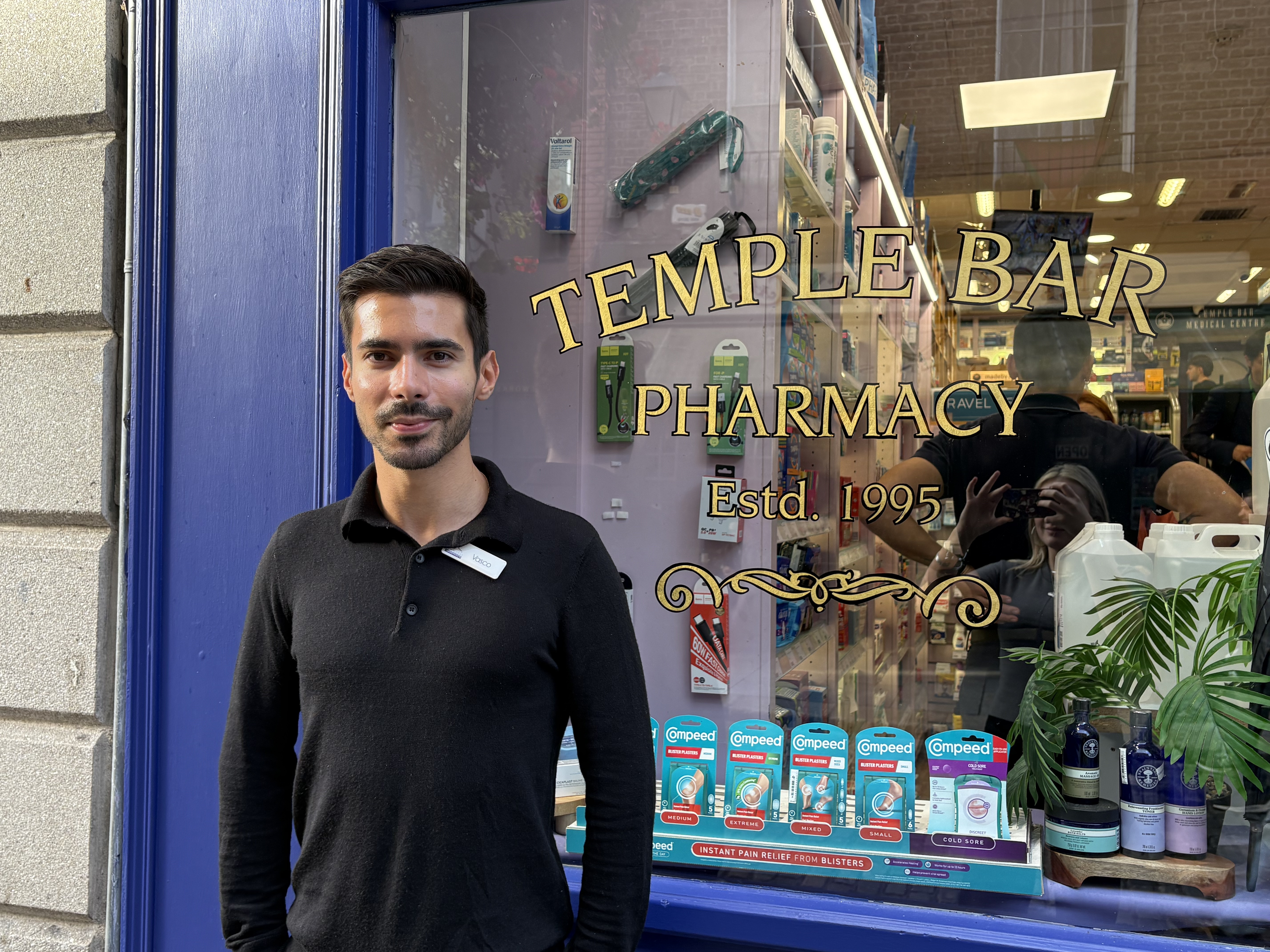
    The City spoke to Vasco Teixeira, a community pharmacist in Temple Bar Pharmacy in Dublin 2, about his experience with his new, expanded role as a community pharmacist. Teixeira began working as a pharmacist in Temple Bar Pharmacy in June of 2022, and since then, he has noticed many changes in pharmacy, especially since the emergence of the Common Conditions Service. “I feel like people are more willing to spend money in the pharmacy, as in getting the new service, and they don’t really mind paying for the service. They just want it quick, and they trust the service. They trust the knowledge of the pharmacists, so I believe we gain more confidence from the community, and they believe we are skilled professionals to prescribe and help with their minor conditions.”


    The introduction of the Common Conditions Service means that participating pharmacists now integrate prescribing into their extensive role. According to the HSE, participating pharmacists now assess symptoms, advise on self-care, recommend or supply appropriate treatments (where clinically appropriate) and advise patients to contact their GP if further care is needed. I asked Teixeira how his workload has changed since this extra onboarding of responsibility: “I kind of have to refresh everything that I should do, should say, should write, should register, and prescribe. The one that I do the most is the UTI, so that one I feel comfortable enough to do it without refreshing my memory. But for the other ones, I actually have to read the protocol all over again and prepare myself for the consultation as well, so I feel like that’s the most challenging thing. It’s because I don’t do it as much as I should, or as there’s no like demand for those kinds of services. I feel like I have to refresh my memory every time I need to do it… So yeah, I feel like time management is essential in this case.”

    Photo credit: Faye Thompson

    Teixeira mentioned that major changes like this don’t come without teething issues and the Common Conditions Scheme is no exception. Teixeira explained how it is hard to play three roles for one customer. “I feel like I’m doing everything, and I don’t think like the person will understand, but from my point of view, I should only provide the service and provide the prescription if the person wants to get the prescription in the pharmacy that I work in. But charging it, it’s a different thing because you know it’s for the pharmacy, not for me… in terms of dispensing and always changing mode, so prescriber mode, pharmacist mode, and then go back to the other prescriptions that I should check. I think time management is essential.”

    Overall, the offer of a consultation with a trained medical professional at a subsidised price and saving scarce GP appointments for people with more complex illnesses is the main goal of the Common Conditions Service according to Vasco.  “Although, in the future I would like to see the schemes expand and involve more than the current eight conditions.”


    Academic integrity declaration: I conducted all interviews and reporting for this article.


  • “I Think I’ve Cracked The Code”: How Sophie McQuade Is Keeping Temple Bar Runway Ready

    “I Think I’ve Cracked The Code”: How Sophie McQuade Is Keeping Temple Bar Runway Ready

    Along the cobbled pathway of Fownes Street Upper, tucked into the terraced buildings that face the all-too-tall and modern One Central Plaza, is an array of vintage shops, a product of the McQuade family. The historic building that houses these shops has maintained its roots, still looking unchanged since the sixties, creating a striking contrast with the wannabe Rockefeller Centre opposite. Up the apparel-adorned stairs inside the shop Flip, you will find the vintage haven Sacred Heart of Vintage. Owned and run by twenty-five-year-old Sophie McQuade, Sacred Heart of Vintage is a time capsule where decades of fashion collide, and micro trends are left at the door. Sophie opened the doors of Sacred Heart of Vintage in 2022, and has since turned the shop into a hotspot for vintage fashion enthusiasts and those curious to see what vintage has to offer.

    Sacred Heart of Vintage: Sophie McQuade

    I sat with Sophie in the warmly lit shop embellished with Virgin Mary statues and deer antlers decorating the walls. Just after 6 pm, when she closed the doors and moved mannequins aside, she began to tell me her story.  Sophie was never a stranger to buying and selling vintage fashion; she began her vintage fashion ventures working with her father, who planted his roots in Temple Bar in 1987. She then moved on to be his buyer until finally opening Sacred Heart of Vintage three years ago. Sophie likes to run her show a little differently to her father. “I like to involve my staff a lot; it’s always a team effort. I ask for their advice on clothes or what stock to buy,” she said.

    Sophie also places a major focus on women’s vintage fashion, “like 80% of my stuff is women’s, because there was such a gap in all the other vintage shops, they were selling both men and women’s, but mostly men. Whereas there was no one really selling just women’s, I did kind of take that from my dad, so I think I’ve cracked the code,” Sophie explained with a giggle.

    Growing up in Temple Bar is as unique an experience as any. Before it was the tourist hotspot it is now, Temple Bar was a central hub for the arts, gathering aspiring actors, singers, artists and all those in between with the attraction of cheap rent due to the neglect the area faced prior. In the early 2000’s when Sophie was growing up, Temple Bar had begun its rebrand as the cultural focal point of the city, home to punks, skaters and many other subcultures. “It was such a community, like a meeting point for people who didn’t really fit in. We want to keep that alive between all these mega pubs and big conglomerate restaurants.”

    Her frustration with these changes is tangible. The community was serviced by Flip vintage store along with its accompanying shops by providing fashion that was conducive to each individual’s stylistic desires. Sophie strongly expresses how she wants to continue this. “It’s a shop where people can go, ‘Oh well, I don’t really like that shop’, but this shop, my shop, it kind of has something to suit everyone.”

    Sacred Heart of Vintage: Sophie McQuade

    Sophie is no stranger to the limelight; Sacred Heart of Vintage is a staple in Dublin vintage shopping, and the proof is in the many articles that make this point. In 2025, Sacred Heart of Vintage was named by Vogue magazine as one of Dublin’s best vintage stores, with news editor Anna Cafolla hailing its unique decor and varied collection of attire. I asked Sophie how it felt to be trophied in the fashion bible; her face lit up as she explained, “it kind of reinforced this thing of like I’m doing something right. Which was really a really nice feeling, but it’s one of my like greatest accomplishments.”

    Sophie is a major advocate for supporting local. She mentioned it many times throughout our conversation, and the recent rise in demand for vintage and sustainable fashion has accelerated this. As fashion fanatics become more educated on the environmental impact of fast fashion and start to despise the cyclical nature of micro-trends, more people are turning to vintage fashion for an answer. “I think it definitely has created a new kind of lease of life. It’s more popular with, you know, people that when I was younger would have thought it was really strange to wear old clothes, and because it’s gotten so popular, it’s seen as a really cool kind of trendy thing. I really like it.” She’s not worried about the future of vintage fashion, but is passionate about the motivation behind it: “at the minute, it’s very kind of environmental. I think there will be a bit of a push towards shopping small and shopping local. I hope.”

    Sacred Heart of Vintage: Sophie McQuade

    At the age of 25, Sophie is single-handedly running and managing her own business, a role she took on at 22. Without having studied business or been taught how to build and run one, Sophie was thrown into the deep end when she took over Sacred Heart of Vintage from her father. The inner workings of running the business that go unnoticed by most are often the most rigorous tasks. Sophie explained to me the ins and outs of her buying trips. “I go over to our lovely suppliers who I have an amazing relationship with, who are also a small family business, and I’ll look through hundreds of tons of clothes in the space of maybe three days. I’m looking for quality, I’m looking if there’s rips in it, I’m looking to see if it’s missing buttons, broken zippers, all those details.” Counting on her fingers, she details the quantities she’s picking up: “I’m buying between 800 and 1000, sometimes 1500 kilos at a time.” Sacred Heart of Vintage is a curated vintage shop, meaning each and every item you see in the shop has been handpicked by Sophie and her staff on buying trips.

    Before we said our goodbyes, Sophie added that she is “beyond grateful” for her business. “I have met the most amazing people in this industry. Every day there is something new, whether it’s a challenge or triumph. Either way, I think me and my team we all are so lucky to get to continue learning new lessons every day.” Sacred Heart of Vintage is a testament to Sophie’s passion for vintage fashion and relentless courage to run a business at such a young age.