Author:

  • Give an artificial heart this Valentine’s Day

    Give an artificial heart this Valentine’s Day

    A human heart used in the spelling of “LOVE”. Although the hearts won’t be available by Valentine’s day, Carmat hopes to have them on the market by the end of 2021. Photo and design by Dolapo Agunbiade

    The month of February is a month designed to remind people of matters of the heart. That’s right, Heart Awareness Month is currently being celebrated across the globe. It is a time when people can reflect on their lifestyle choices, bring awareness and raise money for those who suffer from heart disease.

    “Heart disease is the number one killer of men and women across the United States and also worldwide and a lot of that is highly preventable,” said cardiologist Dr. Alex Harrison to KEYT News. 

    According to the Irish Heart Foundation, heart failure is one of Ireland’s leading causes of death. They stated that, in Ireland, there are approximately 10,000 new cases each year. The best remedy for severe heart failure is a transplant. However, thousands die each year waiting for their operation. 

    “The idea behind this heart was to create a device which would replace heart transplants”

    Stéphane Piat

    French company Carmat received their CE marking on 22 December from European regulators. This mark gives them the permission to sell their total artificial heart system. Their product, Aeson – named after a character in Greek mythology who drank a potion that added more years to his life – is designed to impersonate real hearts by using biological sensors and materials. The artificial heart is able to regulate blood flow by using its mechanical pump. 

    “The idea behind this heart, which was born nearly 30 years ago, was to create a device which would replace heart transplants, a device that works physiologically like a human heart, one that’s pulsating, self-regulated and compatible with blood,” Stéphane Piat, Carmat’s CEO, told Reuters. 

    For now, the three-part device will be used as a stopgap until a transplant is available for those suffering from severe, incurable heart disease. This will give patients who may not have received an organ in time a chance to wait patiently for donations. Even though the battery operated piece of technology is a temporary solution, it has been recorded that the hearts can last up to five years, allowing patients to live comfortably in the meantime. 

    In the company statement they say, “Carmat aims to provide a lasting solution to the treatment of terminal heart failure, a disease for which there are very few effective options today, the main one being heart transplants.”

    However, this device may not be available to everyone. It has been recorded that Aeson will be sold at the price range of €150,000 and upwards. This extravagant price-point is not suitable for lower-income patients who are in dire need of support.

    Another possible disadvantage of Carmat’s artificial heart is its weight. The device weighs in at 900g, which is three times more than the average heart – the average ranging from 250 to 300g. This size also alienates children in need from receiving the company’s temporary heart. 

    I spoke with former senior cardiology specialist Dr. Oye Akindele to understand the possible negative outcomes of artificial hearts.

    Dr. Akindele said, “the implications of an artificial heart are numerous. Due to its mechanical nature, parts can wear out or the electrical motor system could fail causing the blood passing through the system to form clots and cause strokes.” 

    He continued, “also, some patients are prone to severe bleeding. Their blood may be too thin from previous medications used to support the artificial heart.”

    Dr. Akindele then stressed the importance of heart donors and how the right donor should improve and prolong the recipient’s quality of life.

    A 3D demonstration of Carmat’s hear at work

    The three-part device might not be ready just in time for 14 February, but Piat estimates there will be “a smooth commercial launch during the second quarter of 2021”. The introductory launch will be focused on France and Germany and then subsequent distribution across Europe will follow. 

    What are the signs of heart failure? According to the Mayo Clinic, signs of heart failure include but aren’t limited to; shortness in breath, fatigue, rapid or irregular heartbeats and lack of appetite. 

    If you believe that you or a loved one is suffering from heart disease, please contact your local doctor.  

  • Love in the time of Corona

    Love in the time of Corona

    faceless young couple drinking takeaway coffee on terrace
    Photo by William Fortunato on Pexels.com

    Valentine’s Day can be a tough time for single people. Scrolling through photos of happy couples sometimes triggers that voice in your head that reminds you – you’re alone. 

    Add a global pandemic, isolation, and government-imposed celibacy to the mix, and it’s not a far reach to assume this year’s going to be a lot harder than usual. 

    In-person socialising has been put on hold and life is happening online. It is no surprise that the sense of loneliness this brings can have a massive impact on someone’s mental health.

    “Dating is, at its core, about hope and connecting with somebody”

    Roe McDermott

    Speaking to TheCity, Roe McDermott, Sex and Relationships Expert at The Irish Times, said she believes people are really underestimating the importance of physical contact and dating throughout the pandemic.

    “Dating is, at its core, about hope and it’s about connecting with somebody. Even a mediocre or bad date, it’s the hope that you’ll get an entertaining story to tell your friend. Losing that sense of hope and connection when we are so isolated is seriously psychologically damaging,” she says.

    Many people have turned to online dating as a means of coping with this. Match Group – who own popular dating platforms like Tinder and match.com – have reported a significant increase in users since the pandemic hit.

    Enda Collins, a 22-year-old musician from Dublin, has been taking part in online dating for the past year.

    “One guy sent me, let’s just say a very explicit picture, with the caption ‘Can you handle this?’ I was like oh my god. You’ve ruined it!”

    Enda, musician

    “I think it can be good, but I miss physical contact. You get to that point after a few days of chatting online where you want to meet up but it’s like… you just can’t,” he says.

    While he feels these conversations can be helpful to combat loneliness, some users only have one thing on their mind – and it’s not the R number.

    “You get people messaging you like ‘what do I have to do to get you to come out now?’

    “One guy, we were chatting for over an hour and really hitting it off. Next minute, he sends me, let’s just say a very explicit picture with the caption ‘Can you handle this?’ I was like oh my god. You’ve ruined it!”

    However, Frances Kelleher, a Killarney based dating coach, believes online dating can be a beneficial tool in helping you find the right person.

    “I believe online dating is great if you know how to use it correctly and know how to sell yourself,” she says.

    “You have to be strategic in the way you use it. I advise my clients to be online as you can throw your net so much wider in the pool of potential partners. The more you put yourself out there, the better chance you have of meeting the right person.”

    McDermott also believes online dating can be a great experience, but its potential benefits are relative to how you present yourself. Being clear about what you’re looking for is essential and can help you navigate the online world more easily, as well as counteract any time wasting or negative experiences.

    “The basic act of filling out your profile – which a lot of people don’t do – is about saying what you’re looking for and telling people what you have to offer. It takes [dating] to a different level of thoughtfulness and seriousness,” she explains.

    Your profile is in your hands, so why not put your best self out there, you might not meet the right person, but you might get a funny story or two and find a welcome respite to lockdown boredom.

    Online dating presents its own set of challenges, it is far from perfect, but it can be what you make of it, and for singles everywhere, now is the perfect time to give it a try.

    For those out there who are reluctant to dive into the world of online dating, Frances thinks it’s worth a shot.

    “For people who are reluctant, I would say just give it a try. There are different apps so try a few to see which one you prefer. You can always come off if you hate it.”

  • Five swaps you can make for a more eco-friendly Valentine’s Day

    Five swaps you can make for a more eco-friendly Valentine’s Day

    red rose bouquet on brown wooden table
    Photo by Pavel Danilyuk on Pexels.com

    Every Hallmark holiday has a massive carbon footprint – Valentine’s Day lockdown edition will be no different.

    What is different, however, is that this year we have more control than ever before over the amount of waste we create. No excessive portions at restaurants; no glossy tickets to throw away and no decorative garnishes in plastic-laden cocktails. This year, as we celebrate Valentine’s Day from the comfort of our own homes, there are several easy swaps you can make to show your love for the planet

    1 CARDS

    happy valentine s day card
    Photo by RODNAE Productions on Pexels.com

    Ditch them.

    If you’re going to see your loved one face-to-face, there’s no need to scribble your feelings on a card that’s destined for the recycling bin.  

    However, if you really feel you must give your partner a card this year, there are some alternatives to the standard shop-bought Valentines, which, let’s face it, are fairly pricey for something that’s going to be thrown away after a few days.

    You can go digital! There are plenty of subscription-based services which allow you to send e-cards for all occasions. These can be sent via email or they can be posted to the Facebook wall of the object of your affection.

    Or, if you’re crafty, you can always make a card out of materials you have at home!

    Yes, it will ultimately still end up being in the bin, unless your partner is a hoarder, but it will eliminate all of the carbon-producing processes which go into manufacturing and distribution of shop-bought cards.  

    This way, you have total control over what your card is made of so, you can be sure the materials are fully recyclable.

    2 FLOWERS

    red rose bouquet on brown wooden table
    Photo by Pavel Danilyuk on Pexels.com

    What’s more romantic than a big bouquet of red roses?

    Perhaps some flowers that won’t die after a week and arrive swaddled in cellophane.

    This year, why not consider seeds or a potted plant for your partner’s garden -or, more likely, windowsill? The pot can be used again and the longevity of the plant is a more romantic symbol of your relationship.  

    Flowers in a vase perish. Garden plants, if nurtured and cared for, will last a lot longer and bloom again and again.

    For the crafty ones among us, there are plenty of tutorials on YouTube which show you how to make a bouquet of flowers out of recycled paper or newspaper.  Not only is this a big help for the environment, but paper flowers will last as long as your relationship and it shows greater effort, which your partner is sure to appreciate.

    3 WRAPPING PAPER

    text
    Photo by cottonbro on Pexels.com

    The glossy wrapping paper and anything with plastic-based glitter, such as most glitter, cannot be recycled. This must be taken into consideration if you’ve bought your loved one a present that requires some kind of wrapping.

    Instead, why not invest in a few reusable gift bags or boxes? These can be just as attractive-looking and will save you money, and carbon footprint points, in the long run.

    If you absolutely must go the traditional wrapping paper route, make sure the paper you buy is (a) recyclable and (b) comes in little or no packaging. Even if the paper itself is recyclable, the light plastic film around it is not.

    Before your partner recycles your carefully-selected wrapping paper, make sure all sticky tape is removed because, once again, this cannot be recycled.  Don’t let tape be the downfall of all your effort to get plastic-free wrapping paper!

    4 CHOCOLATE

    food wood love art
    Photo by C Technical on Pexels.com

    As a lover of chocolate myself, I understand the desire to satisfy your sweet tooth for Valentine’s Day. I really do.  

    But the special Valentine’s Day chocolates – drizzled and dipped and decorated in heart-shaped boxes – all come with ludicrous amounts of packaging. There’s more plastic than consumables in those boxes.  

    Instead of buying into the over packaged and overpriced Valentine’s Day chocolate market, why not bake something sweet for yourself and your partner?  

    Flour, sugar, eggs, milk… all the basics are probably already in your kitchen and the packaging of these products are almost always recyclable or compostable.

    Again, this shows your partner you’ve gone to a greater effort, and you’ve saved yourself some money and a plastic-induced headache.

    If you’re not a baker, you can just pay extra attention to the options in your supermarket.  

    While Valentine’s chocolates will probably always come buried in plastic, if you look carefully you should be able to find some chocolate that comes in 100% recyclable materials.

    5 DINING

    crop friends taking slices of delicious pizza from cutting board
    Photo by Katerina Holmes on Pexels.com

    This one’s simple. We’re all going to be stuck inside ordering takeaway for this Valentine’s Day, right?

    Well, no, not necessarily. Takeaways come with a small mountain of trash: grease-stained bags, cartons, receipts, napkins, condiment sachets, plastic straws, you name it.

    Cooking at home drastically cuts down the amount of waste produced by your meal.  It means you’re using up what you already have and you know exactly what you’re consuming.

    It’s healthier for you, it’s healthier for your wallet and it’s healthier for the planet.  Funny how often those three coincide. 

    So, that’s five tips that I hope were helpful so, hopefully we can all show the planet a bit of love this year on Valentine’s Day.

  • Vale Tudo exhibition by Nelson Jamal

    Vale Tudo exhibition by Nelson Jamal

    Abderrahmen Ben Chouchane presents the artist Nelson Jamal, an ex-MMA champion who decided to retire to pursue his artistic career. From a young age he was involved with art and sports. In his latest exhibition called “Vale Tudo”, which means everything counts, he demonstrates how sports and art work perfectly together to describe us.

  • Increase in people feeling downhearted or depressed between April and November this year

    Increase in people feeling downhearted or depressed between April and November this year

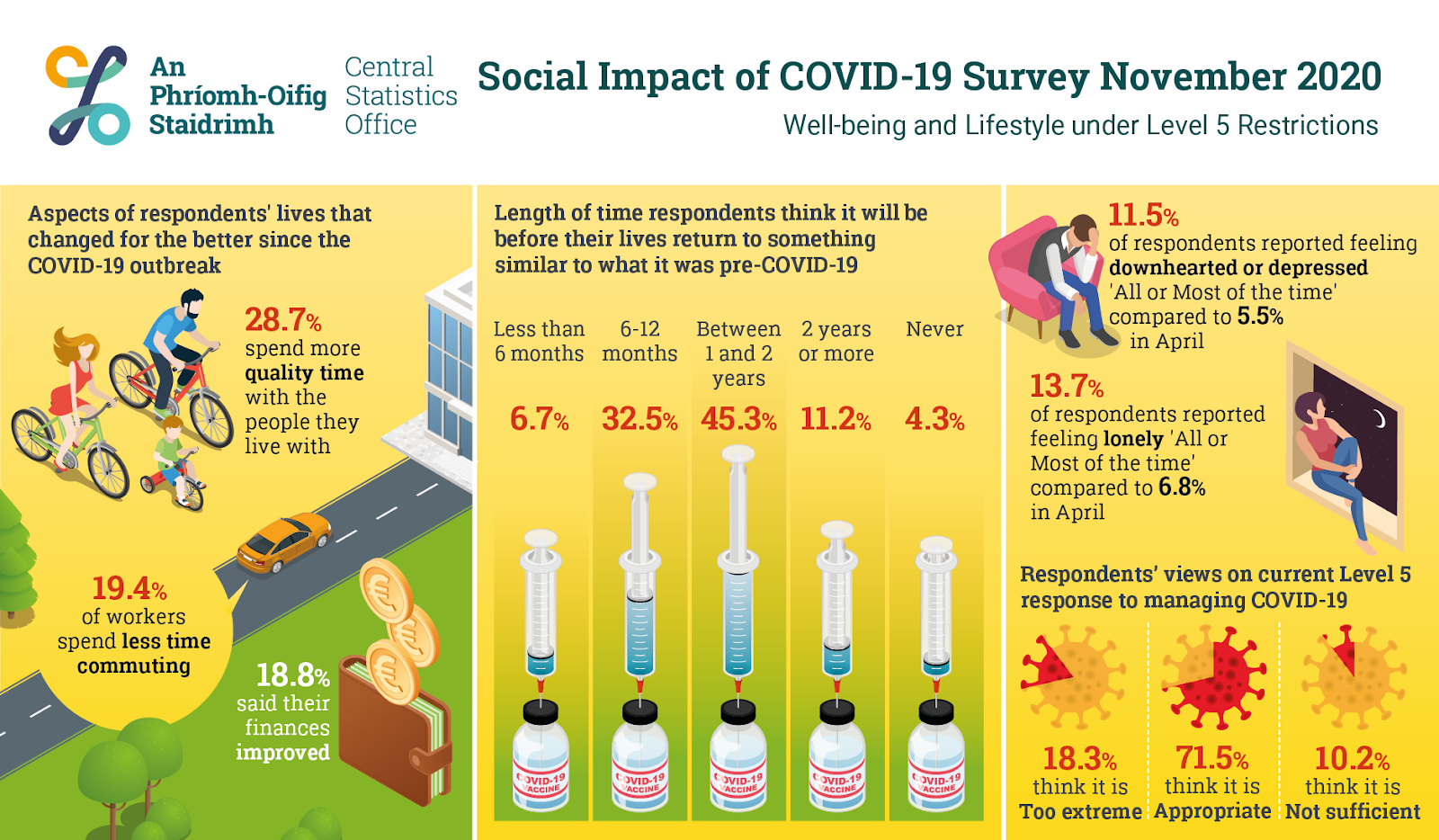
    The Central Statistics Office has released findings of a survey in relation to ‘well being and lifestyle under level 5 restrictions’– a survey relative to the social impact of Covid-19 for the month of November 2020. Gavin Dalton examines the results of this survey.

    Image source: Pikist

    Published on the morning of the 30th of November, the Central Statistics Office (CSO) well-being survey shows some eye catching findings. 19.4% of workers spend less time commuting, which was an aspect of repondants’ lives that have changed for the better during the pandemic, whereas in contrast 11.5% of respondants reported feeling downhearted or depressed ‘all or most of the time’. 

    The survey, which was carried out between Thursday November 12th and Wednesday November 18th, was based on a sample of 5,105 persons aged 18 and over. The survey availed of an online questionnaire to produce an achieved sample size of 1,585 individuals.

    There were some findings that arose in relation to the appropriateness of the implementation of Level 5 to Covid-19 risk, in which one could argue were rather expected results. Over 71% of those who responded to the survey indicated that the level 5 response was appropriate, 18.3% were of the impression it was Too extreme, with 10.2% feeling it was not sufficient. Analysing the findings by age shows the likelihood of a respondent feeling that the Level 5 response was Appropriate increased with age, with 63.2% of respondents aged 18-34 agreeing that the Level 5 response was appropriate rising to 88.2% for those 70 and over. 

    Some of the findings from the survey may raise cause for concern: The percentage of respondents that felt lonely All or Most of the time in the four-week period prior to interview doubled between April, when a similar survey was carried out and November 2020, from 6.8% to 13.7%, whilst the percentage of respondents that felt downhearted or depressed All or Most of the time in the four-week period prior to interview doubled between April and November 2020, from 5.5% to 11.5%.

    Speaking of these specific increases, councillor Mairin McGrath isn’t overly surprised but remains hopeful for the year to come. Speaking to The City, she said: “When we look at the first lockdown compared to the 6 week lockdown we’ve just come out of, there’s been a huge difference. There was probably a novelty to the first lockdown and although we were kind of facing into the unknown, it was genuinely a very scary time for the country, people being at home, having the long days and the good weather to do your few DIY jobs around the house and spend time like it was Christmas with family, was probably something a lot of people enjoyed.

    “And then when you compare the last 6 weeks we had in level 5 lockdown, it’s just been totally different. Much more grim in a sense. It wasn’t as much of a lockdown, life was still going on as normal for some people but I suppose the whole aspect of not being able to have that whole social outlet to look forward to, but I think people have grown more wary of the whole situation.

    “It has been very challenging. I’m not one bit surprised that the figures are as they are. As a young councillor, I for one can see it first hand through my job, I can feel the struggles myself. Working hard all week and then having nothing to look forward to at the weekend, no place to go, no plans to look forward to as we head into Christmas especially. So look it’s been a challenging year for all, it has been difficult.”

    Remaining positive for the approaching year, McGrath said: “The increase in figures doesn’t surprise me, but hopefully we can look forward to a better 2021 with lots of plans and get togethers with our friends.”

    CSO statistical publication, 30 November 2020, 11am. Taken from the CSO website.

  • All things Influence – An inside look at the ‘Instagram Influencer’

    All things Influence – An inside look at the ‘Instagram Influencer’

     Influencers are beginning to pop up on everyone’s social media, especially in 2020. Amber Baxter talked to Teresa Walsh about her phone experience online as one such influencer.

  • The endless quarantine in Argentina

    The endless quarantine in Argentina

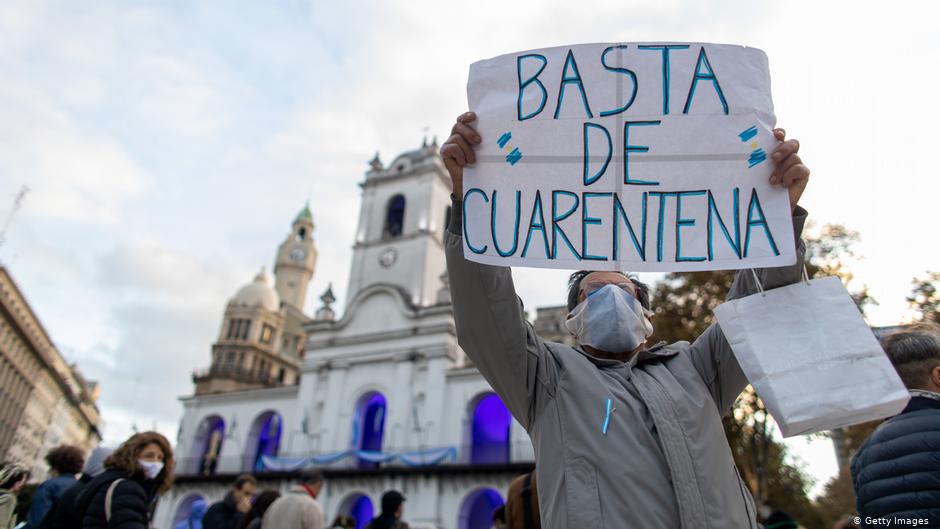
    On March 7, Argentina became the first Latin American country to announce a coronavirus-related death, four days after confirming the country’s first case. The president reacted quickly announcing, on March 12, a state of national health emergency. Eight days later, with the backing of all 23 local provincial governments, he imposed a mandatory and nationwide quarantine through the end of that month.

    Argentina began what would be one of the world’s longest quarantines. Despite that move, the country is among the world’s top 10 when it comes to confirmed COVID-19 cases. Abderrahmen Ben Chouchane spoke with Juan Pablo Miassi, a civil engineer living in Buenos Aires.

  • Animal testing statistics in Ireland unreleased for 2019

    Animal testing statistics in Ireland unreleased for 2019

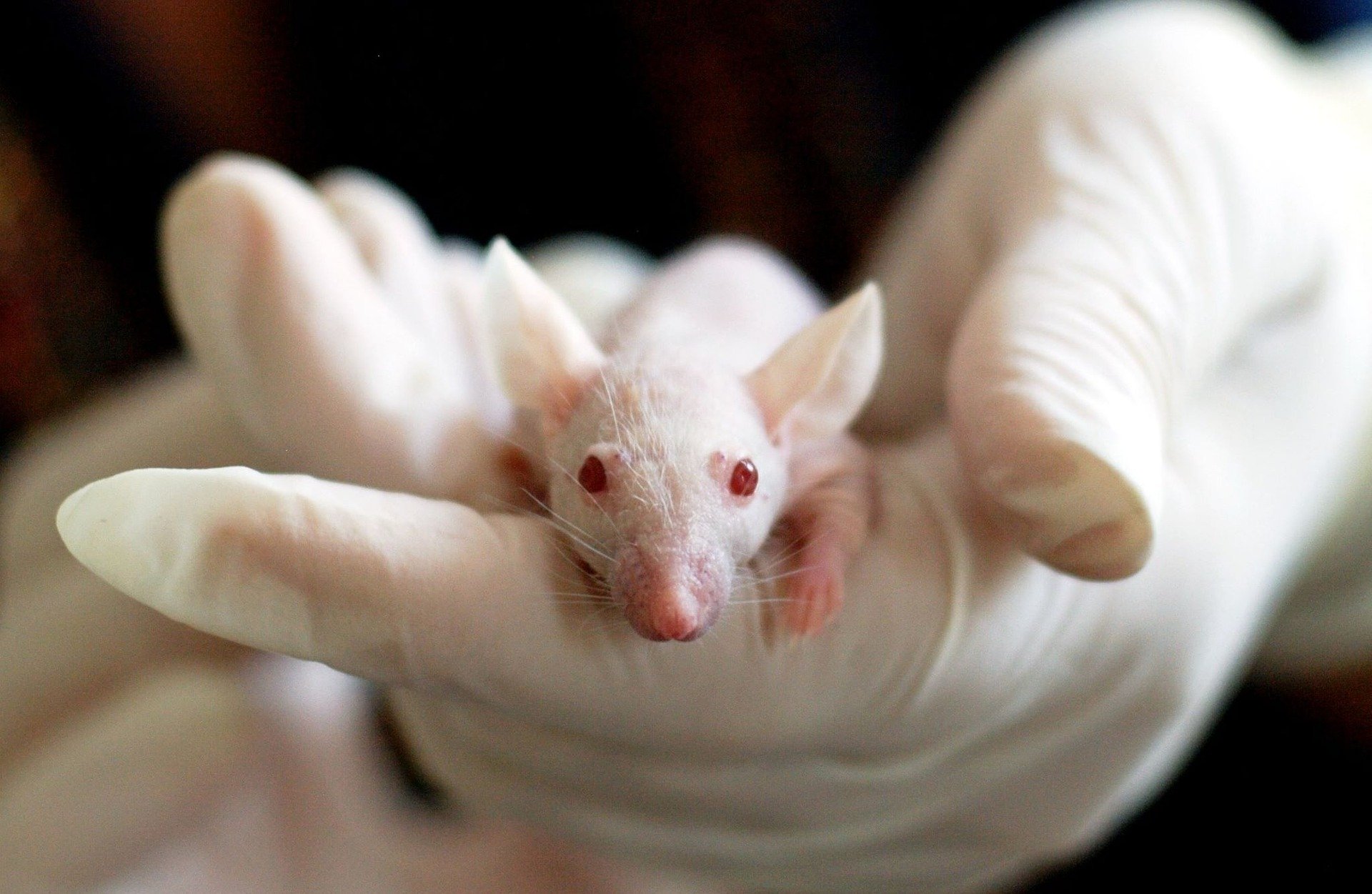
    Animal testing statistics for 2019 have yet to be released by the Health Products Regulatory Authority (HPRA). Amber Baxter explores what this means.

    Picture taken by Tibor Janosi Mozes courtesy of Pixabay

    The Health Products Regulatory Authority (HPRA) is the state agency responsible for regulating human and veterinary medicines, medical devices and other health products. From 1 January 2013, an EU Directive to protect animals used for scientific purposes came into effect in Ireland. In January 2013, the HPRA became the competent authority responsible for the Directive’s implementation. The HPRA has been publishing statistical data on animals used from 2013 onwards.

    The latest statistics released by the HPRA are for 2018 and previous years. It is unclear why the 2019 statistics have not yet been released, Dr Dan Lyons, CEO of Centre for Animals & Social Justice and public policy consultant for Irish Anti-Vivisection Society said “normally 2019 statistics should be out by now”.

    According to the HPRA statistics, in 2018, there were a total of 199,800 uses of animals for procedures, with reuse representing less than 1% of this number. Mice were the most commonly used animal with 75% of the total animal use.

    “This figure may well go up again for 2019 and 2020 because it just depends on how many botulinum toxin [Botox] producers there are in Ireland and how much they are producing each batch is tested on mice using a version of the Lethal Dose 50% test – one of the most severe,” said Lyons.

    One botox producer in Ireland is Allergan. Allergan operates out of Westport Co. Mayo which has been referred to as the ‘botox capital of the world’. Dr Lyons said, “They [Allergan] might be using less animals as they have developed a non-animal alternative for some of their testing. Ipsen is another one. There are probably others but the HPRA won’t say exactly who they are, but you can work it out from whichever companies are in this sector and producing in Ireland.” 

    Of the total number of uses of animals in procedures (199,800), 72% were used for regulatory purposes, which refers to legal requirements to test the safety, quality and potency of medicines for example biological medicines such as vaccines. Out of the total testing, 9,814 involved genetically altered animals, which represents 5% of all animal use.

    According to the HPRA the most common reported actual severity experienced by the animals during their uses in procedures was ‘mild’, at 55%, followed by ‘moderate’, at 27%.

    In 2017, there were a total of 242,302 uses of animals for procedures, with reuse representing less than 1% of that number. Mice were the most used animal this year with 85% of the total animal use.

    Of the total number of uses of animals in procedures (242,302), some 194,816 (80%) were used for biological purposes such as vaccines. Of the total number of uses of animals in procedures (242,302), 7,496 involved genetically altered animals, which represents 3% of all animal use.

    Between 2017 and 2018, there was a decrease of approximately 42,500 in the testing. This was “largely due to a reduction in regulatory testing (-approx 51000)”, said Lyons. These statistics refer largely to testing for ‘Botox’ or similar products, many of which are used for cosmetic purposes despite the ban on animal testing for cosmetic products. 

    “The Govt and HPRA don’t have any strategy or intention to achieve sustained reduction in animal testing and associated animal suffering – they are led by the nose by biotech industry. However, ‘Translational and applied research’ has increased by about 8500 experiments. Much of this is down to increases in the category of research called ‘animal welfare’. In reality this is more about research into farm animal productivity than animal welfare as such.”

    The HPRA works off the ‘Three R’s’: replacement, refinement, and reduction. Replacement involves the development and use of technologies that can be used to address important scientific questions without the use of animals. Reduction refers to methods that minimise the number of animals used per project. Refinement means that the animals used are provided with the best possible care and that suffering is reduced to an absolute minimum. 

     According to the HPRA they “aim to improve the welfare of animals used for scientific purposes and to promote the principles of the 3Rs. Every application received for a project involving animals is subject to a detailed evaluation process based on the 3Rs and requires scientific justification for the research techniques being applied. The likely impact on the animals must be minimised as far as possible by applying refinements and any harms experienced by the animals must be outweighed by the expected benefits of the work,

    “The HPRA considers whether alternative (non-animal) methods are available or appropriate, as alternatives to the use of live animals must be used where possible. In fulfilment of the HPRA’s mandate to promote the 3Rs, in 2018 the HPRA continued its efforts to enhance awareness and utilisation of non-animal alternatives as well as refinements in the conduct of scientific studies in animals through its work, including the regular dissemination of pertinent information to the regulated sector”.

  • HSE changes its Covid-19 policy to allow partners to attend 20-week scan

    HSE changes its Covid-19 policy to allow partners to attend 20-week scan

    The HSE has announced updates to their Covid-19 guidelines to allow for partners of pregnant people to be allowed to attend the 20-week scan. The measure that prevented partners from attending the scans were originally introduced as precaution in hospitals. Amber Baxter reports on what this means for those affected.

    Image by parentingupstream on Pixabay

    It is expected the HSE will ask maternity facilities to allow partners to visit for anomaly scans if possible.

    Emails and letters from people and their partners to the government have been released to Aontú leader and Meath West TD Peadar Tóibín following a Freedom of Information request (FOI). He described their content as “harrowing” and “deeply distressing”.

    A letter sent to Taoiseach Micheál Martin which was forwarded to Minister for Health Stephen Donnelly on the 30th of September stated that the Taoiseach asked his colleague if the “points raised could be examined” and if he could “advise me [Martin] of the position”. 

    The letter sent to the Taoiseach was from one woman who said she was left “exasperated” by the restrictions after going through the “heartbreaking, gut-wrenching” event of a missed miscarriage at 8 weeks. 

    The woman wrote in her letter: “Can you please tell me why I am able to eat a meal with women I have not seen in months, but my husband who I live with is not allowed to be there when I am told the most devastating news that a pregnant woman can hear?”

    Under the current guidelines, partners are allowed in for births but not for scans or emergency procedures. The news comes after hundreds of people and their partners wrote to Minister for Health Stephen Donnelly and Taoiseach Micheál Martin. A petition organised against the restrictions by campaign group, Uplift, has gathered 52,000 signatures and was handed into Cork University Hospital last week.

    Tóibín said, “During a six-week period over 170 emails were sent to the Minister for Health, the majority of them from women outlining their shocking experiences in maternity hospitals as a result of the Covid-19 restrictions.”

    He continued, “We must remember that one in four pregnancies ends in miscarriage in this country. No woman should be left to face this bad news alone, in a hospital corridor without a partner to support her.”

    Alan Kelly, Labour Leader, also called on the Government last month to consider modifying the restrictions on partners not being allowed to accompany or visit expectant mothers during and after pregnancy.

    Holly Smith, an expectant mother, told TheCity.ie: “People should be able to support their partners in person. Thankfully I was not in a position where I received bad news on my own but there are hundreds of women who are going to their scans not knowing what will happen.”

    She continued, “Partners and fathers shouldn’t have to receive bad news alone in a hospital car park on the phone.”

    Another of the letters from one woman who experienced a miscarriage read: “I had to sit in a room alone to be told my baby had died. I was sent from this room alone reeling from what I had just heard and left to sit on a busy ward corridor sobbing alone,

    “This is simply unacceptable. At no point was I allowed to have my husband present to provide any sort of comfort. I sat for hours alone and broken in one of your maternity hospitals. Not a single person to offer me the comfort I craved and needed.”

  • The importance of social media to content creators

    The importance of social media to content creators

    Over the past number of years, social media has slowly become a large part of most people’s everyday lives. The popularity of Facebook, Snapchat, Instagram and Twitter has grown exponentially over the past decade. Erin Killoran explores how content creators now rely on social media.  

    Image source: Pixabay

    Over the past number of years, social media has slowly become a large part of most people’s everyday lives. This has led to a phenomenon of a new way of promoting products, services and content via social media. As a result of this large companies such as the popular skincare brand ‘The Ordinary’ have changed their marketing strategies to advertising their company exclusively via social media platforms. 

    Recent studies have shown that the average adult spends 2 hours and 3 minutes on social media per day. This consumption of social media has allowed for ordinary individuals to create content and upload it online for the general public to enjoy, with the possibility of financial reward for the creators. Presently, Youtube, TikTok and Spotify are by far the most popular platforms for content creation. 

    The rise in popularity of podcasts has led to a huge surge of people creating a production of their own, covering a number of different genres. This new phenomenon is revolutionary as it allows the audience to listen in their own time, unlike traditional radio programmes. But in order to gain  any form of traction with these podcasts, these content creators need to promote themselves on various social media platforms to prevent getting overlooked in this heavily saturated market. 

    TheCity.ie spoke to the host of ‘GleeCap Podcast’, Conor Burke, who said: “Social media is essential for me for not only promoting my podcast, but also plays that I produce and star in. It is single-handedly responsible for getting a few thousand listeners a week on the podcast. I always tell people if I didn’t have to promote anything, I probably wouldn’t have any social media because it just takes up so much time.”. 

    Becoming a creator online has become extremely accessible for most people as there is no longer a need for a significant amount of funding to start up a project. Burke said: “I set the podcast up in late May, and our following has just grown organically through Instagram. It not only grew the following of the podcast on social media, but also my own personal social media accounts. Before creating this podcast, I don’t think I particularly thought about how heavily I would have to promote it online to achieve a consistent audience.”

    Prior to social media, any form of promotion was solely reliant on print media, TV and radio advertisements. Now, this is no longer necessary and has made advertising significantly easier for everyone. Burke told TheCity.ie: “There’s absolutely no way that this podcast could have grown to the extent that it has without social media. Without it,  I would have just recorded an episode and posted it online, but no one would be able to discover it and listen to it.”

    This method of social media self-promotion has eliminated the need for advertising and the assistance of marketing experts. Therefore, removing unnecessary costs for content creators working with a limited budget.

    Studies have proven that when social media users engage with their followers, they gain more traction. Burke said: “Interacting with listeners on Instagram and Twitter has grown our podcast exponentially. 

    “We often post interactive memes and get people to ask us questions prior to an episode. And while recording our podcast we’ll answer them. I have definitely found that the number of listeners go up due to this interaction as it allows them to look forward to the next episode. I also think that the numbers go up depending on the guest that we have on due to them promoting the episode via their social media accounts.”

    Due to his consistent  promotion of this podcast on social media, Burke has garnered the attention of a number of stars from the TV show Glee, including Dot Marie Jones, which has given him the opportunity to interview her and soon, a number of other stars of the show. He said, “I know that when the cast episodes come out, more people will listen because of their large social media following.”

    Burke also mentioned the importance of having a business profile as a content creator. “Instagram’s ‘business profile’ feature has been very helpful for myself. It has allowed me to see what posts my followers react well to and how much overall traffic my account is getting each day and gives me some kind of indication as to how many people are going to listen to my most recent episode.”

    The uses of social media for content creators is endless and continues to help millions of people grow their audience each day.