Tag: cinema

  • Alfonso Films is the all-female production company that’s smashing the glass ceiling

    Alfonso Films is the all-female production company that’s smashing the glass ceiling

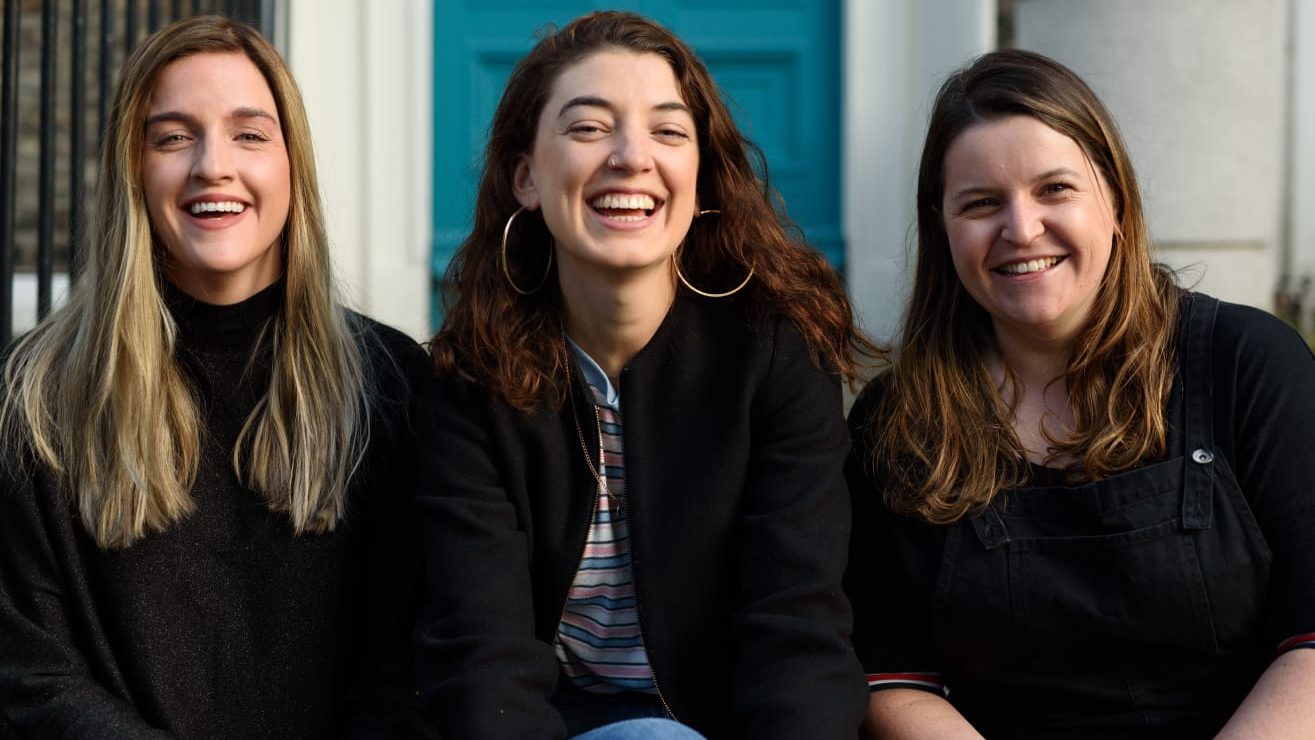
    Alfonso Films – Jo Halpin (left), Claire Byrne (centre) and Emma Wall (right) make up the tenacious multi-talented team.

    Until recently, it was commonplace to see women exclusively in acting roles, with very few able to break the glass ceiling into the male-dominated roles of writing, directing, and producing.

    Thankfully, the representation of women in these roles is growing, and Alfonso Films is a prime example. 

    Alfonso films is run by three women: producer Jo Halpin, director Claire Byrne and writer Emma Wall. They have been working together since 2017 on a variety of short films and are now in the development stage of their debut feature.

    Rather than a conscious decision to form the group, Jo Halpin gives me the impression that it fell together through happy circumstances.

    “We went to this mixer I think it was in maybe 2016 or 2017, it was to give you funding to make your idea, your short idea or whatever, and what they did was everyone had to hold up a sign and say what you were, a writer, a director producer or whatever. They wanted people to team up,” Halpin tells me.

    Byrne and Wall had already been familiar, and Halpin and Wall knew each other from university, so the three got chatting.

    “Emma had an idea that she was going to write, Claire’s prerogative was to direct, and so I kind of landed in the role of producer,” Halpin says.

    While they were unsuccessful in acquiring funding for their idea at the mixer, the team knew they were onto a good thing.

    Over the next few months, they went on to hold fundraising campaigns, events, pub quizzes and online crowdfunding.

    “It was brilliant because [hosting the events] got the three of us working together for months, by the time we went to make the film we were already so close,” Byrne tells me. 

    Eventually getting their film over the line, the team now had a hunger to keep the group going.

    “It just snowballed into ‘we’re addicted now, let’s make another one’, we made a couple of short films, music videos and then we started submitting applications to bigger stuff, and then stuff started going to festivals,” says Halpin.

    Their debut short Spent, screened at over 20 festivals worldwide and was winner of Women In TV & Film Ireland’s short of the year.

    It wasn’t until the inception of their latest short film PAT when the team transitioned into a limited company. 

    Incredibly, this transition was made possible due to an initiative set up by the dating app Bumble.

    In 2018, Bumble announced they would be moving into the world of film by introducing their own funding scheme aimed toward UK and Irish based female filmmakers: Bumble Presents… The Female Film Force.

    The initiative intended to give five female filmmakers across the UK and Ireland £20,000 (€22,500) to help finance their projects.

    This is when Emma Wall wrote the script for PAT and the team submitted it to Bumble.

    PAT, the story of an elderly Dingle woman and her relationship with her New York based son, connected from 3000 miles away by the village’s only telephone, is said to have blown the judges away, securing the grant. 

    To accept the funding however it was not enough to be an ambitious team of budding filmmakers, they needed to be a limited trading company – and so, Alfonso Films was born.

    “When you’re a limited company, you feel like you can’t give up now”

    Jo Halpin

    PAT went on to win Best Short at the Chicago Irish Film Festival 2020, as well as being nominated for Best Short at the Irish Film Festival London 2019.

    Wall (left), Halpin (centre) photographed on set with actor Roseleen Lenehan playing the titular PAT. Image courtesy of Alfonso Films

    “Especially in the last year we’ve really gone and grown in our own practices,” Byrne explains, telling me that the three women have spent 2020 focussing on their individual careers due to both the pandemic and new opportunities presenting themselves.

    While directing other projects outside of Alfonso, Byrne also does work on the post-production side of the industry as an editor.

    While Wall is holding down a day-job for casting company Spotlight.

    Halpin has worked as an assistant director on big-budget productions like Ridley Scott’s latest project and upcoming Apple TV sci-fi series – all while completing the advanced producing postgraduate course at TU Dublin.

    “I think at the moment we’re gearing up to kind of move forward together and we’re writing our first feature,” Wall tells me, explaining that individual success has not quelled their desires to push Alfonso films to the next level. 

    “It feels like the next natural step for us, it doesn’t feel massively daunting. I think we know we can do it and do it well,” she continues.

    “When you’re a limited company, you feel like you can’t give up now,” says Halpin.

    The process for acquiring the funding for a feature film is an arduous task: the team will have to submit proposed budgets, look books, treatments, a synopsis, and a vision for sales.

    Even after this, it is difficult to stand out from the crowd, even with high quality material – but being an all-female company could give them an edge.

    While historically the percentages of people in roles like producer, writer and director have been overwhelmingly male, now more women than ever before are securing and excelling in these positions.

    Organizations like Screen Ireland are now consciously striving toward a 50/50 gender balance.

    “It definitely helps when you put an application in and it says this is from a female, it feels exciting, it feels like loads more female stories are being told,” Halpin says.

    While it is still a male dominated industry and there is still massive room for change, the struggles of women in the industry over the past few decades has helped pave the way for a young batch of highly skilled, highly trained and educated female filmmakers.

    Byrne operates the camera on set in picturesque Kerry coast. Image courtesy of Alfonso Films

    “I think I’ve benefited from being a woman,” Byrne says. “It’s the time that I’m coming up at the moment. It does help get your name out there when there’s all these incentives.”

    “Irish women in the industry have built a great community who are supportive but also shining a light on women coming though,” Wall tells me. “There’s a sense of community and a sense that women are now having the same opportunities, but that’s only because of incredible work women have done before us in this industry.”

    At home and across the world, female filmmakers are beginning to break through within the industry and gain recognition not just as great female filmmakers, but as great filmmakers in their own right.

    And at Alfonso Films, there’s the feeling that things are only getting started.

  • Green Screen: The impact of the pandemic on the Irish Film Industry

    Green Screen: The impact of the pandemic on the Irish Film Industry

    Daithi Ó’Cinnéide on camera and in his element. Image courtesy of Daithi Ó’Cinnéide

    The year 2020 has provided highs and lows for the Irish film industry, and 2021 is already calling into question the future of our domestic productions.

    This time last year it seemed Ireland was reaching new heights in the domestic film and television industries. Ridley Scott had begun shooting his next blockbuster with Matt Damon – who was spotted ‘slumming it’ in Dalkey – and Normal People was hitting screens worldwide, with Paul Mescal engrossing audiences in O’Neill’s shorts.

    Like everything else, the Irish entertainment industry came to a crashing halt in March when Covid-19 struck.

    The production hiatus, which at the time of the first lockdown was indefinite, meant that up to 12,000 jobs in Ireland were put on hold and some were gone for good.

    Grip assistant Michael Nardone was hit hard by this hiatus.

    “Everything seemed to be going great, I was hopping from project to project, then like most people I’m sitting at home wondering what to do,” said Nardone.

    “Everything seemed to be going great, I was hopping from project to project, then like most people I’m sitting at home wondering what to do”

    Micheal Nardone

    Nardone has worked as a part of the crew in television series like Vikings, Dublin Murders, and Normal People. He had just begun exploring a new avenue, working with some fellow crew members on their own short film, when suddenly everything changed.

    “It was all out the window really, and without the backing that the big productions have, it seemed like it might never happen.”

    Nardone packed his bags for New Zealand.

    “I had been thinking about going for a long time, but I always had a reason to stay [in Ireland].”

    Productions had also been halted in Auckland, which gave him the time and opportunity to apply for work on bigger projects: “All the big productions were miles behind schedule, they were ramping up everything, preparing for reopening.”

    He is currently working on a new series for Amazon and has a full schedule right up to 2022.  

    “It’s mad hearing stories from back home, it feels like the whole pandemic has come and gone here.”

    One project, Paperboy, an independent feature film set in Belfast during the Troubles, was to begin filming in September.

    The project had attracted stars Bridget Moynahan (I Robot) and Colm Meaney (Law Abiding Citizen, The Snapper), with Donald Petrie (Mystic Pizza) attached to direct.

    Producer Kevin Murphy had spent the best part of two years trying to get the film made.

    Unfortunately, the lockdown proved too strenuous an obstacle and the project has since ceased indefinitely.

    “We are not doing much at the moment,” Murphy said in relation to production.

    An uncertain future has proved detrimental to independent filmmaking in Ireland. Filmmaker’s reliance on procuring funding from multiple sources is unstable in a time when producers and companies are keen to watch their expenditure.

    This is something that organizations like Screen Ireland and Screen Producers Ireland were aware of from the beginning.

    Screen Ireland acted quickly, first in making sure professionals were still getting paid – repurposing funding to support writers, producers and directors. 

    Screen Ireland and The Department of Culture, Heritage and the Gaeltacht have implemented funding initiatives to cope with the expanding crews and assisting in the hiring of “Covid Departments” working on set.

    The Covid Department monitors the sets to make sure people comply with rules like wearing masks and social distancing.

    “It’s mad hearing stories from back home, it feels like the whole pandemic has come and gone here”

    Nardone

    This has helped to keep bigger budget films operating in the country and it was these initiatives that allowed assistant director, Daithi Ó’Cinnéide to get back to work by late august and stay there until very recently.

    “The film industry seems to follow the construction industry, if they stay open, we stay open.”

    The diligence of these newly-proposed crews working in Covid departments has proven the real trick in allowing the productions to carry on while most other professions remain at home.

    The introduction of these protocols has helped to keep the industry running as smoothly as possible. However, at the drop of a hat operations can be shut down.

    “At the moment, I had work on another TV series coming up, 12 weeks work, but that seems to be pushed back until April, just with everything going on.”

    While film crews on the other side of the world get back to full swing, the future of the Irish film industry is called into question again. It may be awhile before independent Irish films grace our screens again, but the work of the governing bodies and industry professionals may provide a light at the end of the tunnel.

  • New Irish horror series Shudder Street to premier next week

    New Irish horror series Shudder Street to premier next week

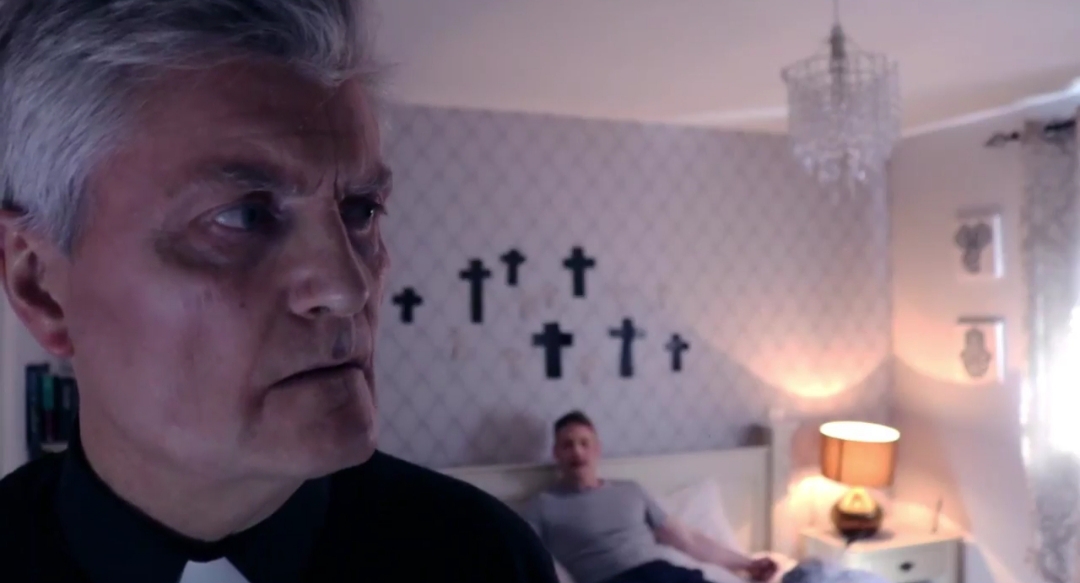
    Shudder Street, a new horror webseries, is coming to a screen near you next week. Erica Carter talked through the inspirations behind the new series with writer and director Seán Donohoe and producer Orlagh Doherty.

    Still from episode ‘Exorcism’. Image courtesy of Shudder Street.

    Shudder Street is a new anthology-horror series set in Dublin, due to premiere next week. There will be four different episodes, each set in a different house on the same street. As the series goes on, we’ll soon see each different plot connect to one another. Donohoe revealed where he got the idea for Shudder Street from:

    “I took a little inspiration from the British anthology series Inside No. 9, that tells a different standalone story every week, each set in their own singular location,” he said. “That gave me the idea to confine each segment of Shudder Street to its own individual house.

    Donohoe wanted to tell different, standalone stories due to the freedom to explore different subgenres and ideas, but liked the idea of connecting them all with one overarching narrative. “It made location scouting a breeze as we were working with virtually no money, but also presented us with certain limitations that we had to work around. It was a learning curve for all of us, but I think it worked out well for the most part!”

    Doherty came on board after the original script was written, and really enjoys the idea of an Ireland-based horror series. “It’s a different type of horror than a lot of series I’ve seen, the colloquial, everyday language used really makes it,” she said. “I think that having Irish slang in this really brings a different element to it. Definitely a great success!”

    “We are a country with such a morbid history and folklore, sure we’re the birthplace of Dracula, Carmilla, and Dorian Grey for God’s sake!”

    The idea of an Irish series in particular was incredibly important to Donohoe too: “I wanted to make a horror project that was distinctly Irish,” he said. “Not so much in the sense that there’s faeries and banshees running around the place, but more so in a colloquial sense.

    “I wanted to take these common horror conventions and tropes but set them in a world that was familiar and close to home, in this case suburban Dublin. I wanted these characters to speak in a way similar to how myself and the people around me speak. I feel like some Irish media can feel very Americanised and I wanted to avoid that with Shudder Street. For the most part I think we succeeded!”

    “I feel like Ireland has never really took off in the world of horror cinema the way that the UK or The States have,” he explained. “It’s unusual because we are a country with such a morbid history and folklore, sure we’re the birthplace of Dracula, Carmilla, and Dorian Grey for God’s sake!”

    Image courtesy of Shudder Street.

    Doherty is delighted that Shudder Street has now come together and is finally ready to be shown to the public, after almost two years in the making. “Seeing a vision on paper and getting it on screen is something I find so exciting to be honest,” she gushed. “It involved a lot of planning, we got a great casting director to come on board and we just set goals each week to get little things accomplished, such as locations and crew.

    “We just dealt with things as they came, and it all worked out. Seán and I originally started editing the script in January 2019, started filming around April that year and finished filming in May 2019. Post production has been the longest process though. Because it was a zero budget production we had to try to adapt to our cast and crew’s availability and time table so we didn’t have a set deadline for anything.”

    Due to filming taking place last year, Shudder Street luckily didn’t run into any Covid-19 related production issues, although the crew are sad that they can’t celebrate. “In an alternate covid-free world, there would definitely be a Halloween Shudder Street Spookapalooza!” laughed Donohoe.

    Shudder Street will be available to view on YouTube from Tuesday the 20th of October.

  • Oscar Wild: Best Picture nominations and predictions

    Oscar Wild: Best Picture nominations and predictions

    Concluding our Oscar Wild series, Hannah Lemass looks at the nominations for Best Picture and predicts who will win the coveted award on Sunday.

    (more…)

  • Oscar Wild: Best Animated Feature Film

    Oscar Wild: Best Animated Feature Film

    With the Academy Awards just around the corner, Clodagh Moriarty kicks off The City’s Oscar Wild series by taking a look at the contenders for the Best Animated Feature Film.

    (more…)

  • Review: The Hunger Games: Mockingjay Part I

    Review: The Hunger Games: Mockingjay Part I


    If you know your Hunger Games, you’ll know that heroine and coal miner’s daughter, Katniss Everdene (Jennifer Lawrence) was rescued from a life or death struggle in the Quarter Quell area at the end of the second film, by a group of rebels from Panem’s District 13.

    The film is based on the popular Suzanne Collins series of novels. 

    It was widely understood that District 13 was bombed into oblivion two generations ago, which resulted in the beginning of the Hunger Games, but in fact, much of the population survived and went to live underground plotting their revenge. Now the moment to strike back has come.

    They live in a subterranean missile silo, they have been stockpiling for years and they even have a leader with determination and the strategic nous to overthrow the despots in the Capital.

    The problem is that President Coin (Julianne Moore) of District 13 lacks the personality to ignite the districts into war, so they turn to Katniss, who has become a heroine to all the districts of Panem through her actions in the Hunger Games.

    Assisted by Plutarch Heavensbee (Philip Seymour Hoffman, in his final screen role) Coin devises a plan to transform Katniss into a weapon to sell to the masses.

    And that basically, is where we come in to The Hunger Games: Mockingjay Part 1. Katniss is increasingly uncertain about how she might be used in this rebellion and seems more concerned about the well-being of Peeta (Josh Hutcherson), her on-again, off-again boyfriend who has been captured by the Capital dictatorship and is being used as a central part of a propaganda campaign.

    “I never wanted any of this, I never wanted to be in the Games, I just wanted to save my sister and keep Peeta alive,” Katniss pleads with the villain of the series, Panem dictator President Snow.

    As Warner Bros did with Harry Potter, the final book in the Hunger Games franchise has been divided into two parts which result that Mockingjay Part I is about the build up to the war. This means although there is a lot of tension, it lacks the action of the first two movies in the series. At times the film seems stretched, and too much like a link between the previous instalment and the next, but the story line and tension is strong enough to hold.

    With a notable cast involved this makes for a funny and enjoyable movie and Lawerence comes into her own giving the film depth and emotion in some outstanding and haunting scenes. But one thing’s for sure we have an action packed Part II to look forward to next year, and as Katniss puts it…

    “Fire is catching! And if we burn, you burn with us!”

  • The Drop Movie Review

    The Drop is a thriller set in Brooklyn, which sees Tom Hardy play the role of Bob the barkeeper alongside his cousin Marv, played by James Gandolfini, who owns the bar. We learn from bitter conversations that the bar has now changed ownership to the Cechen gangsters of the neighbourhood, who took the bar over to act as a “drop bar.” This means that the bar is used as a location to drop and exchange dirty money out of sight of policemen.

    Hardy proves himself to be an extremely versatile actor, starring alongside the late James Gandolfini, in Dennis Lehane’s first adaption of his very own short story. As we are brought into a spiralling world of crime and violence, we learn that Marv seems to fancy himself as a tough guy while Bob is more the unwilling partner. But as they say blood is thicker than water and Bob stays beside his cousin but isn’t as innocent as he seems. He attends the local church, but never takes communion, letting on that there is more to his story then just being a simple barkeep.

    As the characters’ own stories begin to unfold, a robbery takes place at the bar. And Chovka, the leading gangster, is not happy. He wants his money back immediately, and indicates that the responsibility of this stolen cash is now on the two cousin’s heads.

    Whilst all this sets up the main action plot, another sub plot unfolds.  Bob finds a beaten-up pit-bull puppy in a woman’s trash can. Bob and this woman, Nadia, played by Noomi Rapace, strike up a friendship. As he learns about the animal and begins to love it, the original owner shows up and demands his dog back, but Bob refuses. The stranger starts harassing Bob, pranking him and threatening him, leaving Bob in a fragile and watchful state.

    As all these different plots begin to thicken and all the characters begin to tell their own stories, we learn that everything is not as it seems. Some things are connected in unexpected ways and Hardy, in probably one of his best roles to date, has no problem keeping the audience guessing. As Bob’s character begins to darken Hardy’s performance is captivating.

    The Drop gives the audience a strong, gritty, dark atmosphere where a sense of dread is felt at all times. This is a film that where the plot twists and turns in unforeseen ways. As for James Gandolfini, plays Marv, the man who feels he had his big dreams ripped away, perfectly. As Gandolfini’s last acting role before his death it he showcases his pinnacle of talent when it comes to playing what he knows best as the misunderstood tough guy who will keep you on your toes. The combination of Hardy and Gandolfini together brings nothing but pure movie magic.