
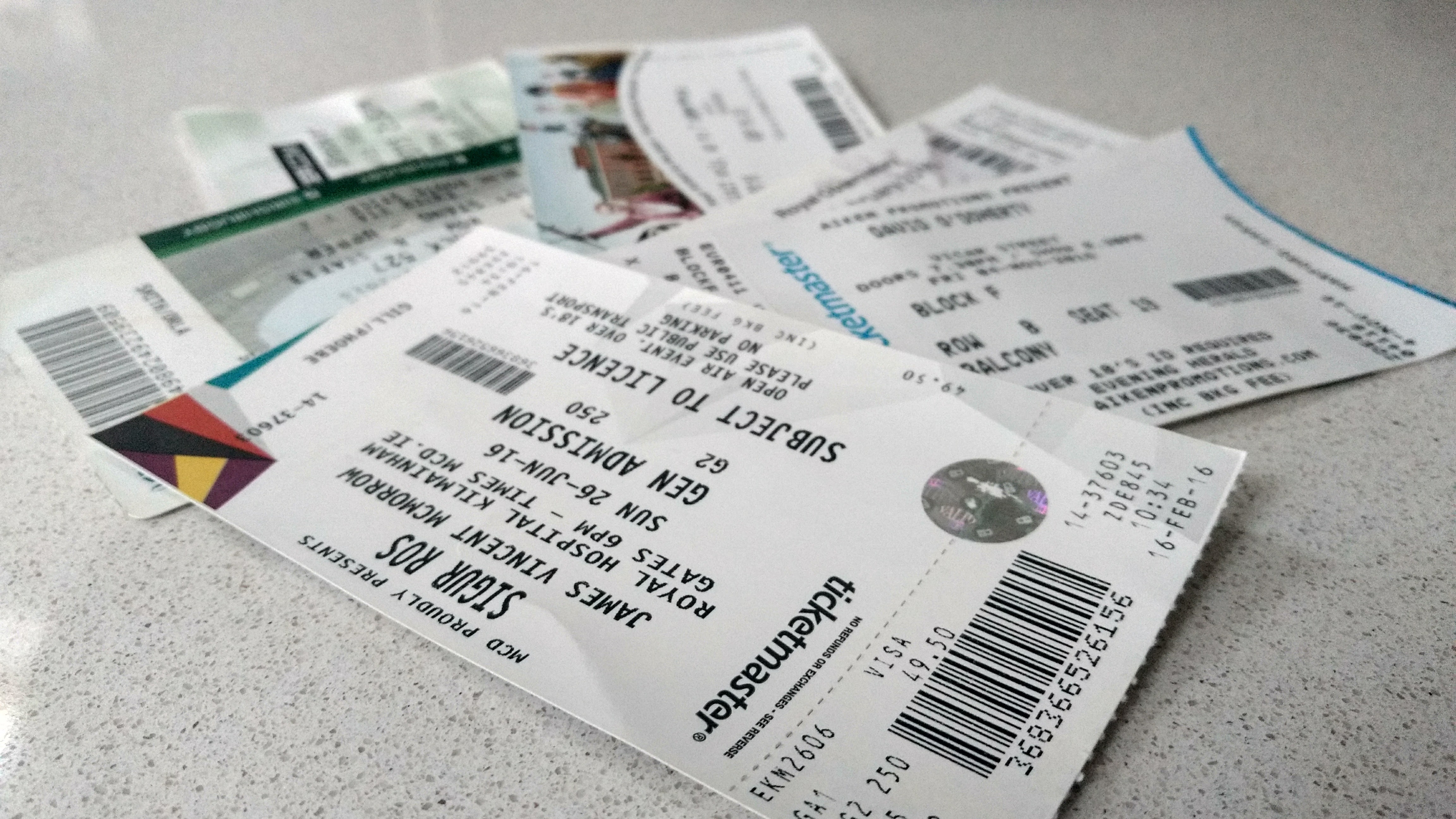
As the Government is being called on to introduce laws which would prohibit above-cost ticket selling, Sarah Harford looks into the complexities surrounding this practice.
This summer sees some of the biggest acts in the music industry performing in Dublin. Radiohead, Ed Sheeran, and U2 all have sold-out concerts coming up, but the dark cloud of ticket touting has loomed over these events, with thousands of fans being unable to secure tickets.
Call it reselling, scalping or touting – it’s not a new phenomenon. The problem has always been there, but the nature of the act is changing and is now becoming an increasing problem.
Technology has made it easier for people to profit at the expense of desperate fans. A more advanced generation of scalpers, often professionals, use special software to get around security restrictions and snap up large amounts of tickets before anyone else can.
Major events are sold out in minutes, but immediately tickets are being advertised on secondary sites at highly inflated prices.
https://twitter.com/_abbturner/status/827102336732524544?ref_src=twsrc%5Etfw
Rock ‘n’ roll
Noel Rock, TD for Dublin North-West, and Radio Nova started a petition to outlaw the practice of ticket touting. Amid the outcry over U2 tickets, the online campaign received almost 5,000 signatures within two weeks.
Now, Rock is proposing firm legislation on the matter. He delivered the ‘Prohibition of Above-Cost Ticket Touting Bill’ to the Dáil on 31 January, alongside TD Stephen Donnelly.
In the past there have been other attempts to propose similar legislation in Ireland, but none have succeeded. Will the strong public response help to initiate change this time?
https://twitter.com/NoelRock/status/826418842591191045
Solutions?
Major names in the music industry are starting to speak out on the matter. At one of her concerts in London last year, Adele remarked on how the situation has gotten out of control: “You’ve got all those terrible people selling tickets for £25,000 a pair. I hope no one paid that much. If you did I’ll pay you back.”
Changes to ticketing policies are being introduced in an effort to prevent this, such as printing the buyer’s name on tickets and then checking ID at the venue. However, both Radiohead and U2 implemented this system for their upcoming Dublin concerts, and the two events still sold out within minutes.
A quick look on secondary ticket sites at the time of writing showed that tickets for U2’s July concert in Croke Park are now on sale at highly inflated prices. In spite of an initial cost of between €39 and €186, there are now many being advertised for well over €1,000.

The Broadway musical Hamilton, which comes to London at the end of the year, is taking things a step further. The show will have no paper tickets; buyers must show up on the day with their confirmation email, the credit card they used to make the purchase, and photo ID.
Hamilton creator and star, Lin Manuel Miranda, has been very vocal about how ticket reselling is killing the industry.
“Tickets are taken out of circulation, punishing people who can’t afford to pay more than face value. The extra money doesn’t provide a better concert or show experience for you, the fan. Instead, it goes straight to the broker’s bottom line”, Miranda wrote in an op-ed for The New York Times.
Supply and demand
There are four main secondary ticketing websites – GetMeIn and Seatwave (both owned by Ticketmaster), StubHub (eBay), and Swiss-based Viagogo.
A conflict of interest is clear in the case of market leader Ticketmaster, who now benefits from both the selling and reselling of tickets. The company has said, however, that this is to prevent customers, some of which have genuine reasons for selling their tickets, from using less well-regulated sites.
But it has now become commonplace to see tickets advertised on these sites at exorbitant prices, sometimes even before general tickets go on sale. While some of these may have come from pre-sale booking events, it is likely that professional touts are engaging in the economic principle of speculative short-selling – selling stock you don’t yet own, hoping to purchase it later at a cheaper price.
The crux of the resale market, however, is based on a more fundamental area of economics – supply and demand. The simple way to render ticket scalping unsuccessful would be to increase supply or increase market value. But this is not always feasible. There are usually restrictions on the number of people who can fit into a venue, and the number of nights an artist can perform for.
So the other option would be to raise prices, at a time when concert tickets are already an expense for the average consumer. The music industry depends on revenue from concerts, and reaching a wide audience, but this will be difficult if many fans are priced out of the market.
Significance
The live entertainment industry is worth almost €2 billion euro in Ireland, according to a report released this week by Let’s Celebrate 2017.
Using data from Ticketmaster, the report showed that over four million people attended a live event or concert between March 2015 and February 2016, generating significant revenue for the country.
It also outlined wider economic benefits to sectors such as employment, accommodation, and tourism, highlighting that this is an industry that needs protection.


What next?
In December 2016, President Obama signed the Better Online Ticket Sales Act, outlawing the use of bots to purchase tickets in the US. This may be a step in the right direction, but it still places no burden on primary ticket sites or the organisers of events.
If similar changes are made to Irish legislation as a result of Noel Rock’s bill, will this put an end to the ticket touting culture?
A report published by the Department of Jobs, Trade, and Enterprise last month suggested that ‘action to address the issue may have a greater prospect of success if it involves a range of measures by all of the parties with a stake in the organisation of entertainment and sporting events and the provision of ticketing services for them.’
Furthermore, on 26 January, the Competition and Consumer Protection Commission announced that they have commenced an investigation into the issue, focusing on ‘potentially anti-competitive conduct by operators, including those involved in providing tickets and ticketing services, promoters and venues.’
New regulations are being established in the UK and US, but Ireland is still behind. It seems to be clear, however, that multiple measures will need to be taken in order to put an end to the complex matter of ticket touting.



You must be logged in to post a comment.