Tag: CSO

  • The main concerns of young Irish in today’s hectic world 

    The main concerns of young Irish in today’s hectic world 

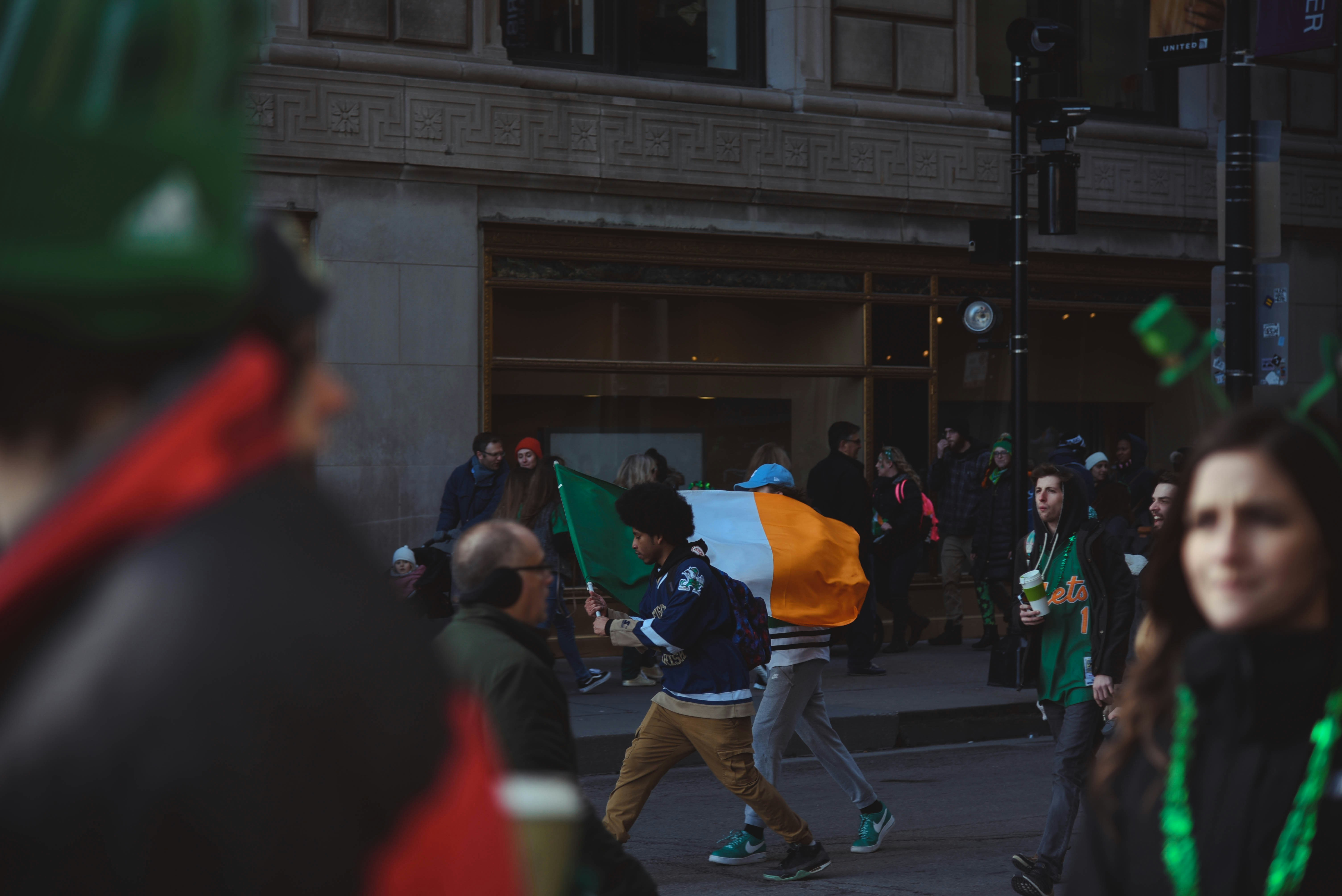
    A new survey shows that Ireland faces several challenges and major international problems, which make it hard for young people to grow up with confidence and ease when looking towards the future.  

    According to the most recent Central Statistics Office (CSO) “Growing Up in Ireland” survey, people aged 25 are mostly concerned about housing and poverty, with domestic issues being the most impactful. 

    Their concern is understandable. This is not only a policy issue but also a real and ongoing challenge. Many people in Ireland are aware of it through their own experience, or through family members and friends who are facing housing difficulties. 

    New stories emerge every week of students commuting long distances, couples in their 30s trapped in shared flats, or young adults who simply cannot afford to move out from their parents.  

    In total, over ten thousand people were officially homeless in Ireland in 2022, and more than 7,200 of them were in Dublin – a city rapidly becoming unliveable for many.   

    Although poverty and housing instability often come hand in hand, one of the main issues facing Irish families of all backgrounds is finding safe, reasonably priced homes. According to the latest government statistics, as of December 2024, more than 2,000 families in Ireland were residing in emergency housing. 

    This has a huge impact on children, as homelessness affects every aspect of their lives from infancy to young adulthood. Temple Street Hospital research shows that homelessness has a negative influence on a child’s physical, emotional, cognitive, and social development. 

    Even though the number of homeless people for young adults is not the highest out of the age groups, it is still a significant number, despite Ireland having one of Europe’s lowest youth unemployment rates (ages 15-24). 

    Ireland’s youth unemployment rate appears to be encouraging. Compared to several other EU member states, including Spain and Greece, where youth unemployment still surpasses 25%, the Irish percentage is far lower at only 12% of those aged 15-24 being unemployed or out of education. 

    But having a job does not guarantee housing access. Many young Irish workers are underemployed, working part-time, on zero-hour contracts, short term or temporary employment, and sometimes without any benefits or security being offered with the contract.  

    New data from the CSO shows that 18% of 25-year-olds went back to their parents’ house after attempting to live on their own, while 43% have never left. This indicates that by their mid-twenties, over 60% of young adults remain in the family home. Many of whom do so out of necessity rather than choice.  

    The numbers show a generation trapped by rising rents, stagnating incomes, and a property market that continues to price everyone out of the market but the wealthiest. While Ireland has one of Europe’s fastest-growing economies, many of its younger residents and workers are missing out on that wealth.  

    Having a stable place to live is one of the basic prerequisites for being able to engage as a full member of society and build your own independence, future and family. Yet it has become a privilege that is denied for so many young people in Ireland.  

    High pricing, a lack of availability, and low-quality housing are causing stress and worry, forcing thousands of young people to go abroad, including those educated and certified to become much-needed teachers and healthcare workers.  

    Without continuous and engaged government intervention, we risk allowing another generation to grow up not finding in Ireland the security and support they need to thrive.  
  • Increase in people feeling downhearted or depressed between April and November this year

    Increase in people feeling downhearted or depressed between April and November this year

    The Central Statistics Office has released findings of a survey in relation to ‘well being and lifestyle under level 5 restrictions’– a survey relative to the social impact of Covid-19 for the month of November 2020. Gavin Dalton examines the results of this survey.

    Image source: Pikist

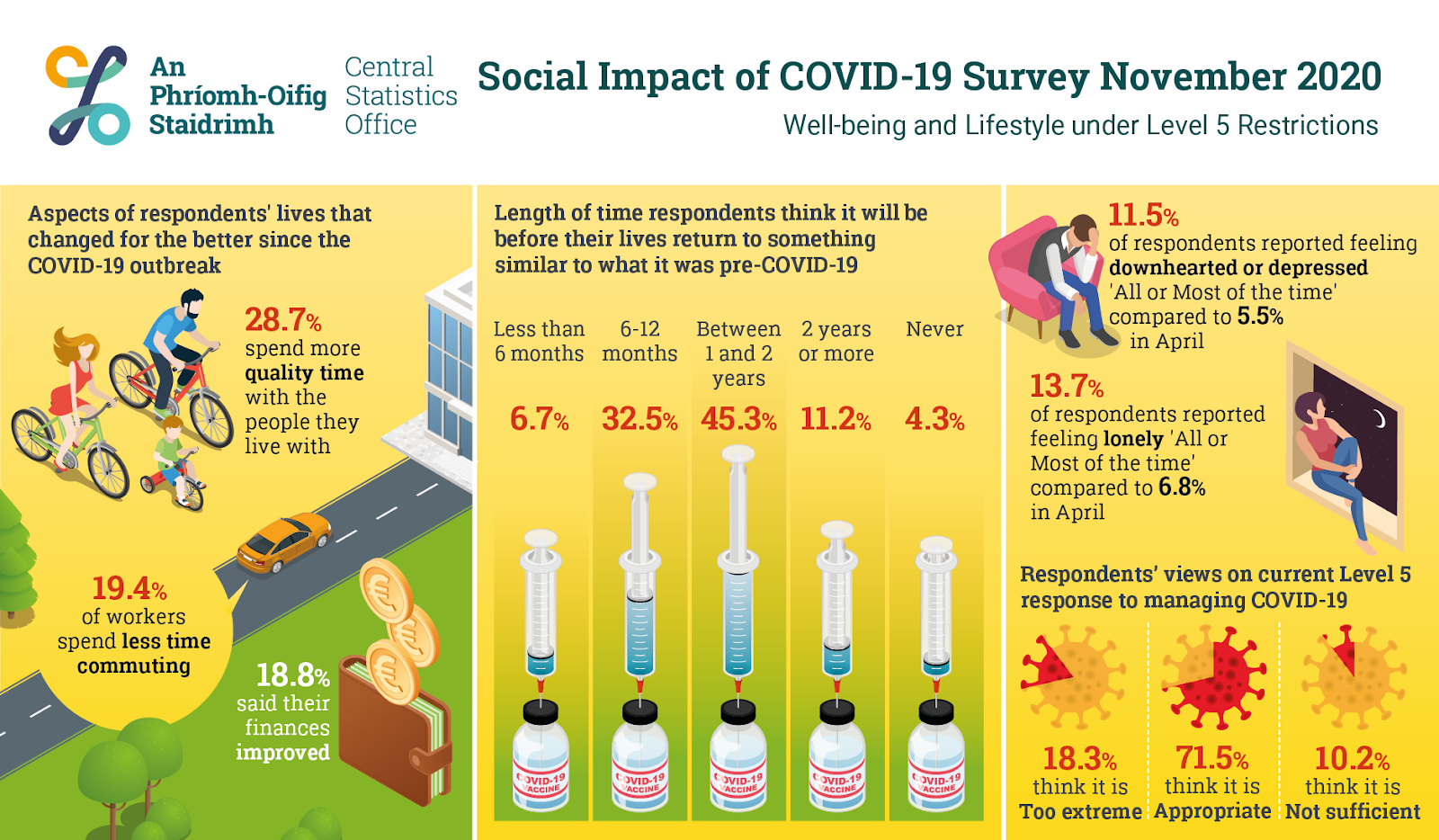
    Published on the morning of the 30th of November, the Central Statistics Office (CSO) well-being survey shows some eye catching findings. 19.4% of workers spend less time commuting, which was an aspect of repondants’ lives that have changed for the better during the pandemic, whereas in contrast 11.5% of respondants reported feeling downhearted or depressed ‘all or most of the time’. 

    The survey, which was carried out between Thursday November 12th and Wednesday November 18th, was based on a sample of 5,105 persons aged 18 and over. The survey availed of an online questionnaire to produce an achieved sample size of 1,585 individuals.

    There were some findings that arose in relation to the appropriateness of the implementation of Level 5 to Covid-19 risk, in which one could argue were rather expected results. Over 71% of those who responded to the survey indicated that the level 5 response was appropriate, 18.3% were of the impression it was Too extreme, with 10.2% feeling it was not sufficient. Analysing the findings by age shows the likelihood of a respondent feeling that the Level 5 response was Appropriate increased with age, with 63.2% of respondents aged 18-34 agreeing that the Level 5 response was appropriate rising to 88.2% for those 70 and over. 

    Some of the findings from the survey may raise cause for concern: The percentage of respondents that felt lonely All or Most of the time in the four-week period prior to interview doubled between April, when a similar survey was carried out and November 2020, from 6.8% to 13.7%, whilst the percentage of respondents that felt downhearted or depressed All or Most of the time in the four-week period prior to interview doubled between April and November 2020, from 5.5% to 11.5%.

    Speaking of these specific increases, councillor Mairin McGrath isn’t overly surprised but remains hopeful for the year to come. Speaking to The City, she said: “When we look at the first lockdown compared to the 6 week lockdown we’ve just come out of, there’s been a huge difference. There was probably a novelty to the first lockdown and although we were kind of facing into the unknown, it was genuinely a very scary time for the country, people being at home, having the long days and the good weather to do your few DIY jobs around the house and spend time like it was Christmas with family, was probably something a lot of people enjoyed.

    “And then when you compare the last 6 weeks we had in level 5 lockdown, it’s just been totally different. Much more grim in a sense. It wasn’t as much of a lockdown, life was still going on as normal for some people but I suppose the whole aspect of not being able to have that whole social outlet to look forward to, but I think people have grown more wary of the whole situation.

    “It has been very challenging. I’m not one bit surprised that the figures are as they are. As a young councillor, I for one can see it first hand through my job, I can feel the struggles myself. Working hard all week and then having nothing to look forward to at the weekend, no place to go, no plans to look forward to as we head into Christmas especially. So look it’s been a challenging year for all, it has been difficult.”

    Remaining positive for the approaching year, McGrath said: “The increase in figures doesn’t surprise me, but hopefully we can look forward to a better 2021 with lots of plans and get togethers with our friends.”

    CSO statistical publication, 30 November 2020, 11am. Taken from the CSO website.

  • Number of new cars bought this year down 26 percent

    Number of new cars bought this year down 26 percent

    The Central Statistics Office (CSO)  have recently released the number of vehicles that have been registered for the first time this year. Erin Killoran explores the actual effects of these statistics.

    Copyright free photo taken by user JCT 600 on Flickr.

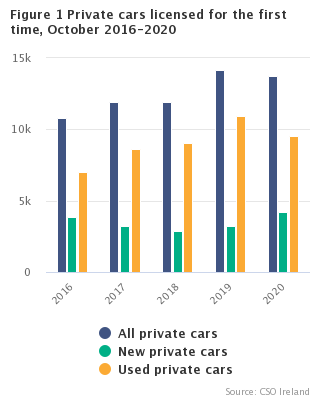
    The Central Statistics Office (CSO)  have recently released the number of vehicles that have been registered for the first time this year. These figures show 81,809 new private cars were purchased by the Irish public. This demonstrates a large decline of 26.2% in comparison to this time last year, where 110,900 new private cars were licensed for the first time. The number of imported private cars also declined by 32.2% when compared with 2019.

    However, there was a stark increase during the month of October of this year. The graph bellow shows sales were up 30.3% in comparison to last year as 975 more cars were registered in October 2020 than October 2019.  

    Figure 1 Private cars licensed for the first time, October 2016 - 2020

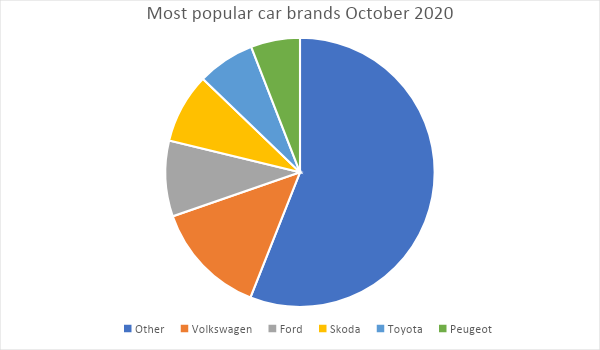
    The CSO also reported the most popular car brands for newly registered cars during the month of October 2020. Volkswagen was the most popular with 574 newly registered cars sold, followed by Ford 382, Skoda 350, Toyota 291 and Peugeot 247.

    Covid-19 has affected many businesses and industries, which could potentially be the main catalyst for the decline in the purchasing of new cars this year.  Studies have shown that 14% of people have lost their jobs due to the pandemic and a large number of people have been temporarily laid off. So perhaps, the financial insecurity that Covid-19 has provided has caused a significant decline in the number of new private cars that have been purchased. 

    Speaking to Paul Egan, sales executive at Sheehy Motors, Naas county Kildare, he said: “ We have experienced a downturn in sales, but not by much. In fact, we still beat our target set out by the brand for 2020.”

    With regards to any impact due to the pandemic, he said: “Covid did have an effect but the motor industry is also going through radical changes with technology. Customers are a bit confused about buying electric cars and the future of petrol and diesel cars.” 

    The CSO figures show that there has been a growth of electric and hybrid cars this year. 1,644 more hybrid cars and 625 more new electric cars were purchased this year compared with last year. Additionally, 35,067, new diesel cars were purchased throughout the first 10 months of 2020, which shows almost a 33% decrease from last year. 

    Egan spoke about his company’s plan for the final month of 2020. “Compared to last November, the pre-order intake for 2021 is approximately 15% behind. However, December orders should be stronger than last year because we are back open from December 1. Car sales are not considered essential retail so our showroom was closed during November. Any sales done until now were through email or phone.” Egan also stated that he believes that his company’s car sale figures are also representative of car dealerships nationwide. 

  • Road traffic falls by 55% during second lockdown

    Road traffic falls by 55% during second lockdown

    Data collected by the Central Statistics Office (CSO) shows that traffic volumes for the week commencing the 25th of October were 55.4% lower in regional locations and 51.3% lower in Dublin than the same week in 2019. Erica Carter explores the environmental impact of less cars on the road.

    Photo taken by Bertram Nudelbach. Sourced from Flickr.

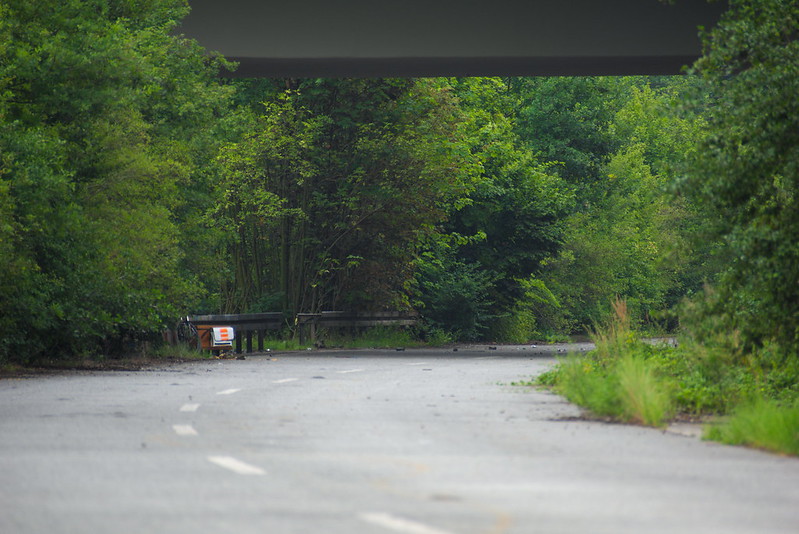
    This was the first edition of the transport bulletin since the introduction of Level 5 restrictions in Ireland on the 22nd of October. The impact of the increased restrictions can be seen in car traffic data throughout Dublin and other regional sites. The latest car traffic data available, for the week commencing the 25th of October, indicated that traffic volumes at the Dublin sites measured, were 51.3% lower than the corresponding week in 2019.

    In the figures below from the CSO, we can see that road traffic in both Dublin and the rest of the country has been significantly lower than last year. This decline is due to current lockdown measures, and as a result an increase in the amount of people working from home. 

    The data collected also shows a large decrease in the amount of people using public transport. The use of bus and rail services has fallen significantly since the introduction of Level 5 restrictions in Ireland on the 22nd of October. The total number of bus and rail journeys taken during the week commencing 25th of October was a quarter (25.3%) of that taken in early March. The number of bus journeys outside of Dublin now stands at 27.1% of pre COVID-19 levels. The corresponding level for bus journeys within Dublin is 28.1%.

    But what is the environmental impact of less cars on the road this year? According to data compiled by the Environmental Protection Agency in 2017, just under 20% of Ireland’s greenhouse gas emissions are due to internal transport. Road transport amounts to the bulk of these emissions.

    Phillip O’Brien, Secretariat for the Climate Change Advisory Council, highlighted that despite the huge fall in traffic this year, after the first national lockdown, traffic went back up to similar numbers to last year, and that the lower traffic numbers will likely not make any long term difference.

    “I fully expect that come December, we’ll see ourselves back up to the same levels as usual,” said O’Brien. “This is not a long term change and we haven’t reformed our driving habits.

    “When we get back out on the roads, we will slip back into the same habits – they may even be worse because people have been cautious to use public transport because of perceived higher risk to catch the virus.”

    “We do need policy to get our emissions reduced over the next decade,” he said, “but we want it to be planned.

    “This is not the way to reduce our emissions; taking cars off the road and infringing on people’s mobility. That is not the way forward. The goal is that people have the same amount of mobility, and can still move around, but that there are less emissions associated with it.”

    O’Brien also suspects that the energy use from people working from home could potentially balance out the lack of cars on the road. “People at home would be using more energy than usual – heating an office for ten people is more efficient than heating ten people’s homes separately.”

  • What’s in a name? The facts, figures and trends behind Ireland’s gurgling babies

    What’s in a name? The facts, figures and trends behind Ireland’s gurgling babies

    We often take our name for granted. What inspired the choice? How does it define you? Not everyone has a moving story to tell of how mam and dad looked longingly at their newborn baby, and the perfect name simply floated from the air like divine inspiration. Your name is what your mam roars when your dinner is ready. It’s a key foundational component of your identity.

    There’s a Johnny Cash song about a boy named Sue who hunts down his father as vengeance – and rightfully so – for his questionable naming. At the song’s denouement, Sue’s dad explains that he gave him that name because it would make him strong in life. The lesson being that your name can play a key role in how you are perceived and how you define yourself.

    But how do our names shift and change on a broader level, and over the course of time? Ireland, like any nation, is susceptible to the influences of cultural events, at home and abroad. It’s inevitable that we change as a people due to the impact of rapidly evolving technology, and the forces of globalisation. So it’s natural to assume that these steady shifts have the potential to impact our views, and ultimately what we name our babies.

    The lonesome demise of John and Mary

    For many years the iconic duo of John and Mary have dominated the ceremonial christening of a little one. However, time hasn’t been kind to the pair, with the likes of Tarquin and Blaze usurping the traditional and wholesome names of Ireland. According to the CSO.ie, John and Mary remained undisputed champions from the mid 1960s to the early 1990s, when their popularity began to waver, dwindling from a powerful rank – John fell from 5th to 13th and Mary fell from 16th to 34th between 1997 and 1998 (albeit to a still somewhat respectable standing).

    Ultimately it’s a substantial fall from grace. When the CSO records began, John and Mary were sitting pretty with their namesakes spawning in the thousands. Now in recent years they’d be lucky to break the hundreds. Their throne is now the home of Jack and Emily. The male counterpart is a curious one, as Jack is the diminutive form of the name John. So its transition seems somewhat natural. The shift from Emily to Mary is bit more difficult to explain. Maybe Emily is just a nice name … we agree Emily is a nice name!

    The troublesome threes

    While it’s surprising to see the fall of John and Mary, if you take a stroll into the depths of the CSO’s data, you will find some more famous names that have fallen out of favour. It’s important to note that the CSO does not include names that number fewer than three for privacy reasons. But a brief skim over some of the stats reveal some notable inclusions.

    Some vintage Irish names that you’d regularly hear around your local, are now at the rock bottom of the CSO’s database. Names like Sharon, Donna, and Kimberly as well as Walter, Roger and Christy are fighting for survival, just at the cusp of the relegation zone. Many of them are there due simply to anomalous spelling – Elisabeth rather than Elizabeth – or that the name is more prominently used in its full version, like Terence and Jennifer rather than Terry and Jenny which both number at 3 in 2017.

    Globalisation (or are our babies being Americanised?)

    Since the early 1990s, popular American names have started creeping into the naming bubble, with the likes of Taylor, Corey and Jacob having almost zero activity before then. But for names like Jacob, they began gaining traction once the naughties hit and are now a mainstay of the top 100. This influx of new names in the 1990s and 2000s could be considered a sign of Ireland’s increased globalisation. In that time we went from two channel terrestrial TV to the age of the internet. It’s only natural that there would be some overlap.

    Comparing the Irish CSO figures to America’s Social Security data, it is clear there is a direct correlation between rankings – particularly women’s names.  

    While there is a fluttering of crossovers in both, only Noah and James have managed to cement themselves in Irish culture. For the women, though, over half of the names feature on both lists – Amelia, Emma, Ava, Mia and Sophie. Though the men’s have a distinctly American slant, (Logan and Mason) the women’s sound more universal, unattributed to either nation. Often a trend is unexplainable, as the name Emma has shown. In Ireland she’s been the top dog – or thereabouts – since the beginning of the 1980s, and for America, it wasn’t until the early 2000s she began dominating the ranks. People just really like Emma.

    Pop culture effects

    Sometimes pop culture influences can cause a spike in an unloved name or generate a brand new one.

    Arya: HBO’s critically acclaimed TV series, Game of Thrones sent many expecting couples into a tizzy when the fierce, courageous and brazen Arya Stark revealed herself in the opening season of the show. The name may be unconventional, at least its fans didn’t feel compelled to use names like Ygritte or Gendry.

    arya
    Credit // Central Statistics Office

    Adele: Following a three-year hiatus, Adele made a blistering return with her seminal album 21 in 2011. The name vanished in 2004, but a surge of Adeles appeared through 2011 to 2012 on the CSO database – a direct response to the musician’s newfound popularity. Emotionally gnawing tracks such as “Don’t You Remember,” and of course, “Someone Like You” yanked on listener’s heartstrings, to the point where a bevy of mothers and fathers wanted their little girls to share their namesake with the talented, introspective singer. 

    adele
    Credit // Central Statistics Office

    Zayn: One Direction was such an obsessive phenomenon that almost every young teen had the group of dashing boys plastered across their walls, school bags and notebooks. The older demographic of the fandom went one step better by naming their newborn after their favourite member, even though Harry and Niall were already present and correct in the top 100, with the first little Zayns toddling onto scene in 2012.

    zayn
    Credit // Central Statistics Office

    Rihanna: The ultra-popstar now turned makeup influencer was one of, if not, the biggest names in music during the mid to late 2000s. Her whopping hit “Umbrella” turned a flurry of heads when it smashed through the charts. So much so, that a company of mini-Rihannas started pottering around the local supermarkets. She had a continual stream of hit albums – an average of one a year – between 2005 and 2012, and this was reflected in the amount of baby Rihannas in Ireland. Their numbers peaked in 2008 and 2009 on the CSO dataset.   

    rihanna
    Credit // Central Statistics Office

    While the aforementioned names represent an encroaching shift in popular Americanisation, a previously solid name can take a major blow when a not so pleasant human mobilises an army of partisan followers across the pond, or maybe it’s just coincidence Donald.

    donald
    Credit // Central Statistics Office

  • CSO figures reveal Irish women are better educated than men

    CSO figures reveal Irish women are better educated than men

    Latest census figures reveal that women in Ireland are better educated than men, as 43.2 percent of women aged 15 and over received third-level education in 2016 compared with 40.7 percent of men.

    Census figures released last month by the Central Statistics Office (CSO) showed that 42 percent (1,216,945) of the population aged 15 and over had a third level qualification, compared with just 13.6 percent in 1991.

    “This report shows a continuing decline in the numbers of early school leavers and increases in the numbers with third level qualifications,” said Deirdre Cullen, senior statistician with the Central Statistics Office.

    Hajar Infographic Education.png
    More women in Ireland hold third level degrees than men. Source Hajar Akl

    Broken down to age groups, out of those aged between 15 and 39, 56.2 percent of them had a third-level qualification, compared to 18.9 percent of those aged 65 and over.

    The counties with the highest rates of completed third-level education were Dún Laoghaire-Rathdown with 61.1 percent, Galway City with 55.2 percent and Dublin City and Fingal, both with 48.7 percent. The counties with the lowest rates were Longford and Wexford, at 32.5 percent.

    The figures also show that for people aged twenty, those with parents with higher levels of education were more likely to still be in education. In all, 60.6 percent of all 20-year olds in family units were students in 2016.

    And among those whose parents were educated to a maximum of lower secondary level, 44.9 percent were full-time students, increasing to 65.2 percent for those with both parents educated to upper secondary level. For those 20-year olds with both parents having a degree, 87.5 percent were full-time students.

    The figures also showed that those with a qualification in Arts had the highest unemployment rate in 2016, at 11.6 percent (down from 17.1 percent in 2011).

    Between 2011 and 2016 the unemployment rate fell the most for those with a qualification in Engineering, Manufacturing and Construction, from 15.7 percent to 6 percent. Those with a qualification in Education had the lowest unemployment rate in 2016 at 3.1 percent.

    Although more women had third-level education, more men (16,016) had a doctorate (Ph.D.) than women (12,743). The 28,759 people who stated that they had a doctorate level qualification was an increase of 30.9 percent on the 2011 figure, and up 99.5 percent on 2006. There were 23,296 persons at work among this group, while the unemployment rate was 3.4 percent.

    By Hajar Akl

  • Unemployment rate falls to post-recession low

    Unemployment rate falls to post-recession low

    Unemployment in Ireland is at its lowest since before the economic crash of 2008, according to new data from the Central Statistics Office (CSO).

    The latest figures from the CSO show that the seasonally adjusted unemployment rate for October fell to 6 percent, down from 6.1 percent in September.

    The unemployment rate has continuously decreased in the last year, with a 1.2 percent decrease between October 2016 and October 2017.

    The figures released show that 131,300 people in Ireland were unemployed in October 2017, compared to the 158,100 people who were unemployed in Ireland during the same month last year.

    Although the unemployment rate is higher in males than females, both rates decreased in the last year. In October 2017, the seasonally adjusted unemployment rate was 6.7 percent for males, down from 6.8 percent in September 2017 and down from 8.1 percent in October 2016.

    The seasonally adjusted unemployment rate for females in October 2017 was 5.1 percent, which remained unchanged from September 2017 and was down from 6.1 percent in October 2016.

    The unemployment rate for young people aged 15 to 24 years is still higher than the unemployment rate for people aged 25-74 at 14 percent in October 2017 down from 14.7 percent in September 2017. However, unemployment in young people decreased by 2.7 percent between October 2016 and October 2017.  The unemployment rate in people aged from 25 to 74 has remained unchanged since June 2017 at 5.2 percent.

    The Department of Finance has predicted that the unemployment rate in Ireland will fall below 6 percent by the end of the year.

    chart.png
    Unemployment expected to dip below 6% before the year’s end.

    Fiona McCudden from the Department of Business, Enterprise and Innovation directed thecity.ie to the government’s ‘Action Plan for Jobs’ initiative as one explanation for the encouraging employment figures.

    The most recent plan released by the government in February of this year details 164 actions and 430 measures to be implemented throughout the year 2017 by 16 Government departments and 43 agencies under the department’s remit.

    The plans aim to support job-creating businesses and remove barriers to employment. It also attempts to prepare businesses for unexpected disruption to the employment sector, such as Brexit, by providing advice on minimising risk regarding exports, investment and expansion etc.

    Since the first ‘Action Plan for Jobs’ was released in 2012, the unemployment rate has fallen by nine percent, but positive economic growth across all sectors of the economy is undoubtedly a contributing factor to these promising figures.

    By Cara Croke and Chris Kelly

  • CSO figures reveal increasing Muslim population

    CSO figures reveal increasing Muslim population

    With the CSO revealing that the Muslim population is growing year on year, Hajar Akl looks at how multiple generations of Muslim people are integrating into Irish culture and making Ireland their home.

    The Muslim population is the youngest religious group in Ireland, new Central Statistics Office (CSO) figures have revealed.

    The figures, released by the CSO last week, show that the Muslim population has also increased by 28.9 percent since 2011, bringing the total number of Muslim people in Ireland to 63,443 people.

    Sheikh Yahya Alhussein, Imam of Dublin Mosque on South Circular Road, said the fact that Muslims are the youngest religious group in Ireland is “an indication that Muslims are going to be here for a long time”.

    DSC_0239
    A young Muslim child celebrating Eid. Credit: Hajar Akl

    Sheikh Alhussein has been in Ireland since 1983. He said the presence of Muslims in different workplaces is much more evident today than it was back then.

    “If you go to the city centre, or other places, you’ll find Muslims everywhere,” he said.

    He said the country has changed since he has come here and has become more inclusive by providing a range of services to the “growing community, like halal restaurants and shops and, of course, mosques in different areas of Dublin and around the country.”

    Sheikh Alhussein said there was only one mosque in Dublin until 1996. “There are now over 50 places for prayer around the country today.”

    Mudafar Al Tawash has been the administrator of the Islamic Foundation of Ireland for the last ten years. He has been living in Ireland for the past 40 years and has noticed things change significantly when it comes to the Muslim population.

    He said when they first came to Ireland, they set up the Muslim National School. Students of the school have since graduated and now their children are attending the school.

    “We are starting to see the second generation,” Mr Al Tawash said.

    “We are very pleased to see them because the second generation live as Irish and grew up in the Irish society and will play an important role in society. They will, inshaAllah [God willing], try to get rid of the stigma surrounding Islam,” he said.

    Mr Al Tawash said: “The numbers are great. It’s great to see the young people are in good number because they will play a good role in the Irish society and will serve the country in a proper way.

    “I think the future is very bright for Muslims here in Ireland because we have these younger people.”

    Mr Al Tawash said the increase in the number of Muslims has helped Irish people to know more about Islam than ever before.

    “People are spreading around Dublin and Ireland and are integrated very well and we are very lucky here in Ireland, unlike communities in different parts of Europe,” he said.

    “I see a lot of Muslim women here in law, in the media, medicine, science, engineering and other fields,” he said.

    He said he has high expectation for the new generation of Muslims growing up in Ireland.

    “We are trying to encourage the youth, Islamic societies in colleges, and we’re trying to invest in younger generations,” he said.

    Sheikh Hussein Halawa, Imam of the Islamic Cultural Centre of Ireland, said the Muslim population in Ireland is relatively new.

    Having a younger age group “is good because this means they will be better integrated into Irish society than older generations,” he said.

    “Ireland has a promising future when it comes to multi-faith and cultural tolerance and integration,” he said. “The world is not as isolated as it used to be. It’s not even like a village, it’s even smaller. What happens anywhere reaches the other end of the world. So the presence of different cultures in this country is like gathering the whole world in one place.”

    Sheikh Halawa has been in Ireland for 21 years. Today, he sees a “huge difference” to how things were in the past.

    112
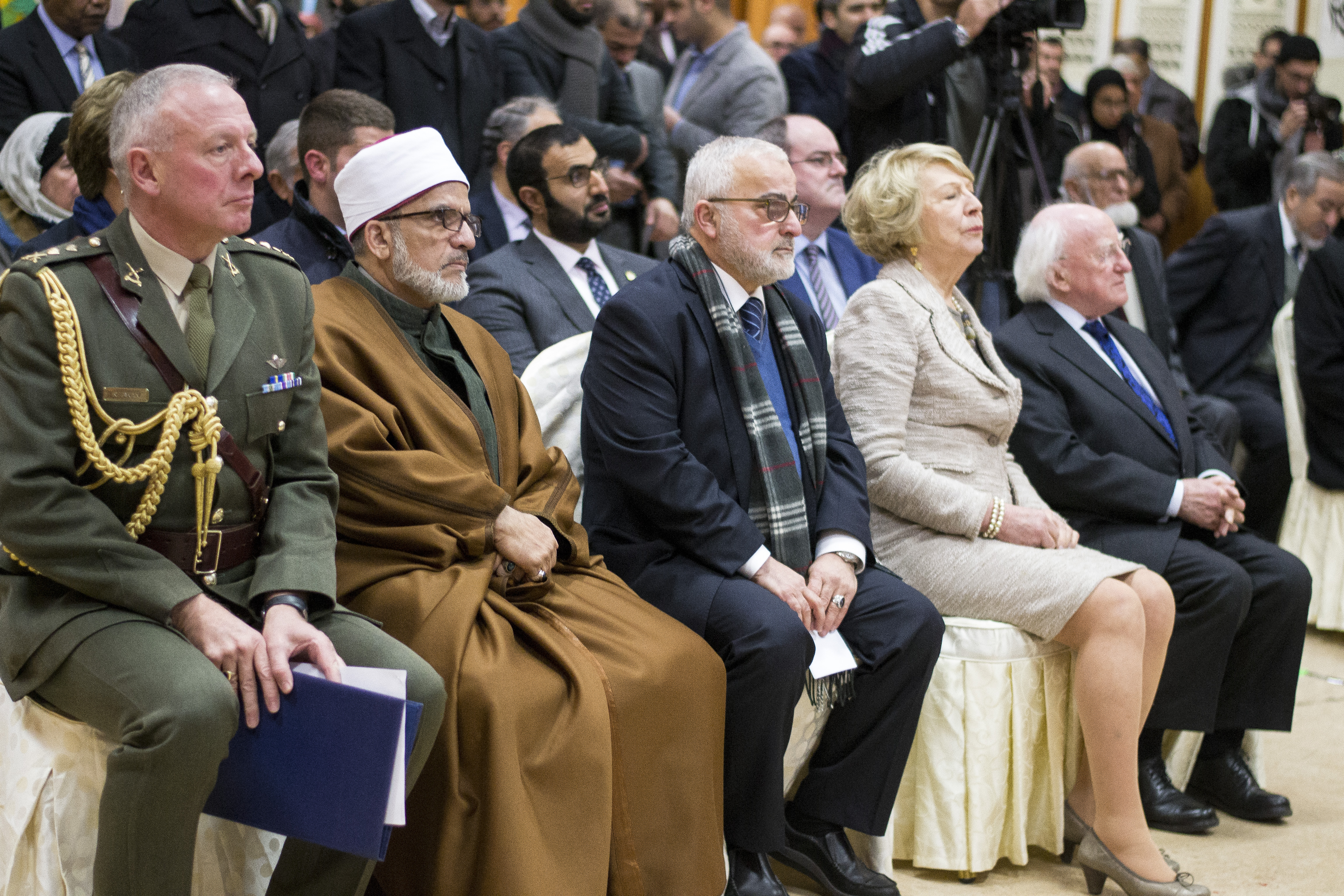
    Sheikh Hussein Halawa, Imam of the Islamic Cultural Centre of Ireland, with Cormac Devlin, former Cathaoirleach of Dun Laoghaire Rathdown County Council, and President Michael D. Higgins. Credit: Hajar Akl

    “Ireland has gotten to know a new culture and religion. When the population was small, there wasn’t that much awareness, but now there is,” he said.

    “A lot of Muslims in Ireland are very educated. This indicates the intellect of this group of people,” he said.

    “My hope is that this open communication between cultures [will] become the norm in the whole world. There are those who scare people of Islam and call for conflict. Those are the enemies of humanity. Islam is a religion of peace. My hope is for the world to understand that,” he said.

    Hiba Aburwein, secretary of the Muslim Association of Ireland also reiterated the thought that Muslims in Ireland are very educated.

    “The [Muslim] generations that are here really encourage their children to better their education. Most, if not all of them, are moderate Muslims who are helping to better the Irish economy and helping in improving the Irish community,” said Ms Aburwein.

    She said it’s “very encouraging” to see the numbers about the young Muslim demographic because “young ages are the ones that build society”.

    On the increasing numbers of Muslims in Ireland, she said: “We shouldn’t ignore that they are a growing community and part of society. If there are any policies that seek to alienate them, it will have a negative reaction. Muslims need to feel part of the Irish society.

    “We should try to push the wheel towards treating Muslims as part of society, not treating them as strangers. All organisations should work towards this,” she said.

    She said a large portion of Irish Muslims were born in Ireland.

    “We hope that Irish people will accept them as Irish citizens because we feel that Ireland is our home. Muslim doesn’t mean immigrant. There are a lot of Irish Muslims and different generations. Society needs to accept that this is our home,” Ms Aburwein concluded.