
Tag: #culture

  • From Thin Lizzy to Che Guevara: The Art of Jim Fitzpatrick

    From Thin Lizzy to Che Guevara: The Art of Jim Fitzpatrick

    Designing album covers for rock stars, having your work displayed at the Victoria and Albert Museum in London, and creating one of the most recognisable political posters of the 20th century is a dream career for any artist.

    For a kid from Glasnevin with no art degree or even art classes in school, this was reality.

    For over 60 years, Jim Fitzpatrick has quietly been shaping the landscape of Irish art. His work draws on Irish Celtic illustration and is influenced by earlier comic design. This versatility has allowed his work to translate across a range of different mediums, from posters and album covers to paintings.

    Fitzpatrick had an artistic upbringing in Dublin. He often painted and drew as a child. His father, as he puts it, was a mediocre artist but an excellent photographer. When his father abandoned the family when Fitzpatrick was five years old, his mother relocated the family to Glasnevin.

    He was encouraged by his teachers and priests at school to draw and paint on his own time. “I didn’t have art lessons or classes, they were unheard of in those days, but teachers and priests encouraged my curiosity by giving me books about art,” said Fitzpatrick.

    His head swiftly turned from his Leaving Cert in his final year to his passion for design when he got a job at the Irish Times.

    “I was doing my Leaving, and I got a job in advertising at the Irish Times for £2 a week and decided quickly that I couldn’t be arsed with the Leaving anymore,” said Fitzpatrick

    This acted as the foundation of his career as he began to develop his creative skills in a booming industry, but something called Fitzpatrick down another path.

    “I loved every minute of advertising, and I earned an absolute fortune, but I gave it all up to be an artist,” said Fitzpatrick.

    As he put it, the ‘Poster Boom’ of the 1960s was his encouragement to go headfirst into his dream of becoming an artist. Working closely with his football teammate, Eamon Carr, founder of the band Horslips, he began to create posters as his main form of work.

    It was through this very football team that Fitzpatrick would later be introduced to a new teammate and key figure in his career, Phil Lynott.

    As lead singer of one of Ireland’s biggest rock bands, Thin Lizzy, Lynott didn’t really have much time to design album covers, so he entrusted Fitzpatrick with this job. The pair met through their mutual football teammate Frank Murray, manager of The Pogues, and instantly hit it off.

    They shared similar interests in comics and art, but Fitzpatrick credits their shared experience of having an absent father in childhood as something that brought them closer to one another.

    Sharing this experience meant “we blended into each other and became close quickly in a way in which he could nearly read my mind about anything creative,” said Fitzpatrick.

    The creative process behind an album design was quite elaborate. He lived in Dublin and Lynott in London, so creative discussions took place via landline. The pair would discuss elements of the design, and he would send a first draft by courier to travel by, as he put it, “a randomer’s arse pocket”, to be at Lynott’s door the next morning. This would continue until the design was finalised.

    Fitzpatrick went on to design multiple iconic album covers for Thin Lizzy, such as Jailbreak, Chinatown, Johnny the Fox, and Black Rose. An original sketch of the Black Rose has recently featured in The Music is Black: A British Story exhibition at the Victoria and Albert Museum in London.

    Sketch of Black Rose as seen in the Victoria and Albert Museum Photo Credits: Jim Fitzpatrick


    Fitzpatrick, a proud Irishman, took to his website to state, “They wanted Thin Lizzy in this exhibition and rightly so. Philip Lynott was a Black Irishman, and Thin Lizzy were based in England and part of the British music scene, whether we like it or not. Much as we love to claim them as Irish, in those days you had to leave this country to get anywhere.”

    Although a great achievement for any artist, this wasn’t Fitzpatrick’s first piece of work to hang in the museum. His most iconic and important work, the Che Guevara Poster, was featured in this museum in 2006.

    This iconic, stark two-toned portrait poster of Che Guevara protruding from a red and black background was designed by Fitzpatrick in 1968 based on a photo by Alberto Korda taken in 1960.

    The Che Guevara poster. Based on Alberto Korda’s 1960 photograph Guerrillero Heroico and stylised in 1968 by Jim Fitzpatrick Photo credits: Jim Fitzpatrick

    The poster went viral around the world and is recognised by Pulitzer as the most reproduced image in the history of photography. Although the image was created by Fitzpatrick, he never chose to copyright it and has allowed people to download it for free to this day.

    As chance would have it, Fitzpatrick and Guevara’s paths crossed in 1961 in a pub in Kilkee. “I was working behind the bar, and this fellow in a trench coat came into the pub. It ended up being Che, and we had a long talk about Irish Republicanism and freedom fighters,” said Fitzpatrick.

    There has been a lot of confusion and controversy around the credits of the image. Later in his career, Fitzpatrick would begin to credit Korda for the photograph titled Guerrillero Heroico, which he used in the poster. Fitzpatrick stated that, before Korda died in 2001, he said to him that the poster made his photograph famous.

    His career is far from slowing down, as he is currently working on a project with Irish rap group Kneecap and has recently had his work featured in the Lost Love of Romeo exhibition in Studio 10 on Wicklow Street.

    For a career that took many different turns, from designing album covers, political posters, and Celtic psychedelic paintings, Fitzpatrick’s work is still deeply influenced by his unpredictability, curiosity and unapologetic Irishness.


    Academic integrity.

    To write this article, I contacted Jim Fitzpatrick through email, phone number, WhatsApp and Instagram DM. I eventually got hold of him through Instagram and was able to set up an interview to be done over the phone. This led to a 45 minute in depth interview, which I was able to base the whole article around. All photos used in the article are credited to Jim
  • The Irish-speaking Monk

    The Irish-speaking Monk

    From Gaelscoil to Monastery, Joey O’Toole is a unique Gaeilgeoir Monk living in Thailand but born in Dublin. 

    From studying “Géibheann” to studying the Dharma, from praying Sé do bheatha, a Mhuire to “Namo tassa Bhagavato”, Joey is living an extraordinary second life as a Buddhist Monk, after attending Gaelscoil Mide in Kilbarrack and Gaelcholáiste Reachrann in Donaghmede. 

    Joey on his Communion day
    Joey on his Confirmation day

    “I have been living in Thailand for three years now. I had a feeling I would be moving somewhere out of Ireland and thought we would move here because my granny lives here and so do my cousins in the village. We had to move because we were struggling financially in Ireland”. said Joey. 

    Joey was born in Dublin to a Thai mother and an Irish father. Growing up in Donaghmede Joey spoke Thai with his mother and his older sister, Ath and spoke English with his father at home. As well as speaking Irish in school and with his friends. 

    Once Joey and his family decided to move to Thailand, he chose to keep the tradition of his people alive. 

    “It is tradition in Thailand that when a male of the family turns 20 years old, they have the decision to get ordained as a Monk. I chose to keep the tradition alive and also to have some self-discipline, because Monks follow strict rules. I’m in my last month here, but usually people don’t do it as long as me. I’ve been here eight months, but people usually only stay for a week or two after being ordained.” 

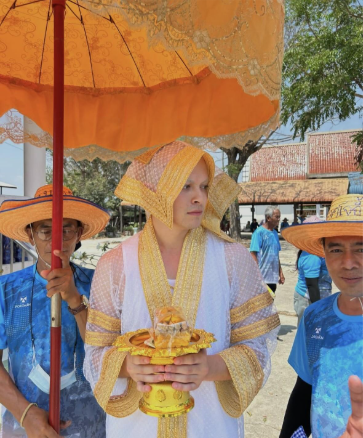
    Joey and his family are extremely proud of him for keeping tradition and for the fact he is currently the only Monk in his family. Joey’s whole village are proud of him too as over 200 people turned up at his ceremony for ordination. 

    Joey surrounded by the people of his village and other Monks during his ordination
    Joey having his head shaved

    “There is three days of ceremony before the ordination,” said Joey. “First, I had to cut my hair bald all the way down to the skin and then shave my eyebrows too, then there’s a big ceremony that your family have for you in the house with food, singing, drinking, like a party. There were so many people there for that too, everyone in my village is proud of the little half Irish, half-Thai boy following in the traditions.” 

    Joey mid ceremony after having his head and eyebrows shaved
    Joey receiving his Monk robes

    Joey’s routine in Thailand is very different to his normal routine he had here in Ireland for years. In Ireland Joey, would wake up at 7am to get up for school, have a small lunch at 10:30am, big lunch at 12:45pm and then finish school at 3:25pm and have the rest of the day to himself to do whatever he wanted.  

    In Thailand his routine is quite different for the last eight months he’s been a Monk. 

    “I have an early morning like all the Monks at 3:50am and I have my first morning prayer from 4:30 to 5:30 am. Then we all have our first meal of the day from 6am to 7am when we walk around the small village near the temple and the people living in the village feed us all. I’ll then have my first chores of the day to do at 8am and finish around 10am. We all then have our last meal of the day from 11am to 12am. We can’t eat after 12am but we can have mints and drinks are also allowed. If you are struggling with not eating after 12 and you are just freshly ordained, you can eat in that exception, but you must be fully honest with yourself if you can go without it until you’re allowed. From 1pm to 3pm I’ll have my long break and after that I have more chores from 3pm until our evening prayer from 5:30pm until 7:30pm. After 7:30 it’s light out.” 

    With such a hard strict routine, you would wonder if Joey ever missed his life here in Ireland. 

    “The last eight months have been so rewarding for me here because I am half Thai but of course I miss Ireland. I couldn’t say I prefer one over the other because I grew up in Ireland and loved it and also love my life here. All my friends I grew up with are in Ireland and there are some things I miss like Irish things. I do think Thai cuisine is better, but I really miss chicken fillet rolls and breakfast rolls and spice bags.” 

    Along with his rigorous schedule where there are no days off, there are also many rules that he and the other Monks must follow such as not being allowed to drink alcohol. 

    “Theres 227 rules we all have to follow, four of the rules are forbidden rules that you absolutely cannot break or else you will be banished from the Temple. Then there’s 13 of the rules that are slightly less serious than the forbidden four. If you break any of the 13, you won’t be banished but you will be punished. A punishment for this would be sleeping in the forest for ten days with other Monks that have also broken the rules.  

    “I can’t say too much because I don’t want to sin but some things I can’t do here would be to play football and also sing but we can’t express too much so I can’t sing songs like I would in Ireland”. 

    Joey was unable to give the name of his Temple or the village surrounding because it’s against the rules, however the city in which he and his fellow Monks reside in is Suphanburi. 

    One of the buildings in Joey’s Temple

    Joey doesn’t see his family very much as it’s important for him to spend as much time in the Temple as possible.  

    “I’m allowed to leave to go see my family if I want but it’s important I stay in Temple as much as I can and they can come visit me here, I’ll see my mam and sister more when I’m finished here”. 

    Once Joey is finished at the Temple this month, he is hoping to visit Ireland again sometime at the end of the year or the start of next year.