Tag: cycling

  • Cycling for a living: The untold realities 

    Cycling for a living: The untold realities 

    Delivery cycling in Dublin, and the overlooked challenges of making a living on Dublin’s busiest road.

    By Samuel Adeleke 

    I Citizens’ concerns in Dublin are usually centered on motorists and pedestrians. Still, recent statistics from the Road Safety Authority (RSA) shows that the greatest share of serious injuries was among those cycling for social trips, at 76 per cent.    

    In addition, the statistics also revealed that 187 cyclists were seriously injured while commuting to and from work, and the majority of these injuries occurred in Dublin. 

    These figures raise questions about the challenges faced by cyclists in the city center, especially for delivery cyclists whose livelihoods depend on riding these roads daily and who are exposed to different road and weather conditions without the protection of a vehicle. 

    Damilola Foluwashayo, a delivery cyclist with the delivery service Just Eat, said, “Cycling can be tedious when it rains. The roads become slippery, and there is a higher chance of getting a flat tire.”  

    This not only makes riding more difficult but also increases the risk of injury to the rider. 

    “If you ride too fast and want to apply the brakes on a slippery road, you might fall because there is no friction to hold your tires,” Foluwashayo said. 

    One of such fall led to Foluwashayo sustaining a serious injury. “I was trying to avoid two kids playing on the road. In the process, I stepped on the wrong brake, my tires got spoiled, and I broke my leg,” he said.  

    The changeable weather presents other challenges for cyclists. “In the first seconds it’s raining, the next seconds it’s not raining, just always take your safety gears with you and have your lights, lights make you safer,” said Judge Eddy, who uses his bicycle for grocery shopping for his wife. 

    In addition to challenging weather conditions, cyclists also have to deal with careless drivers.  

    “We often encounter reckless drivers on the road,” said Thomas Nve, a delivery cyclist with Deliveroo.  

    “Taxi drivers, in particular, seem determined to meet the metrics and quickly get to their next client,” he added. 

    But other road users criticise delivery riders for breaking the rules.  

    “I have a big thing against delivery riders; they have no lights, they go through red lights all the time, and they tend to just cross over all the time,” said Judge Eddy.  

    Eric Andrel, a delivery cyclist with Deliveroo, attributed an accident he had to the deplorable state of the road.  

    “There have been a lot of potholes because of the rain, I had an accident because the pothole was covered by water,” he said. 

    “The roads are also narrow and don’t give room to swerve safely,” Andrel said. To constantly keep himself safe, Andrel said, “I wear high-visibility clothes and always have my helmet on.” 

    Andrel says The Government should do more to keep all road users safe “They should create a system where, after 6pm, only public transport is allowed in the city.” 

    Mariann Finan, who is an all-year-round cyclist, said conditions have improved for Dublin cyclists, but problems remain.  “In terms of infrastructure for cyclists, it is better than it was; at least we have a lot of cycle lanes now, but they are not really finished. They stop and start, and you don’t really know where the next lane is.”  

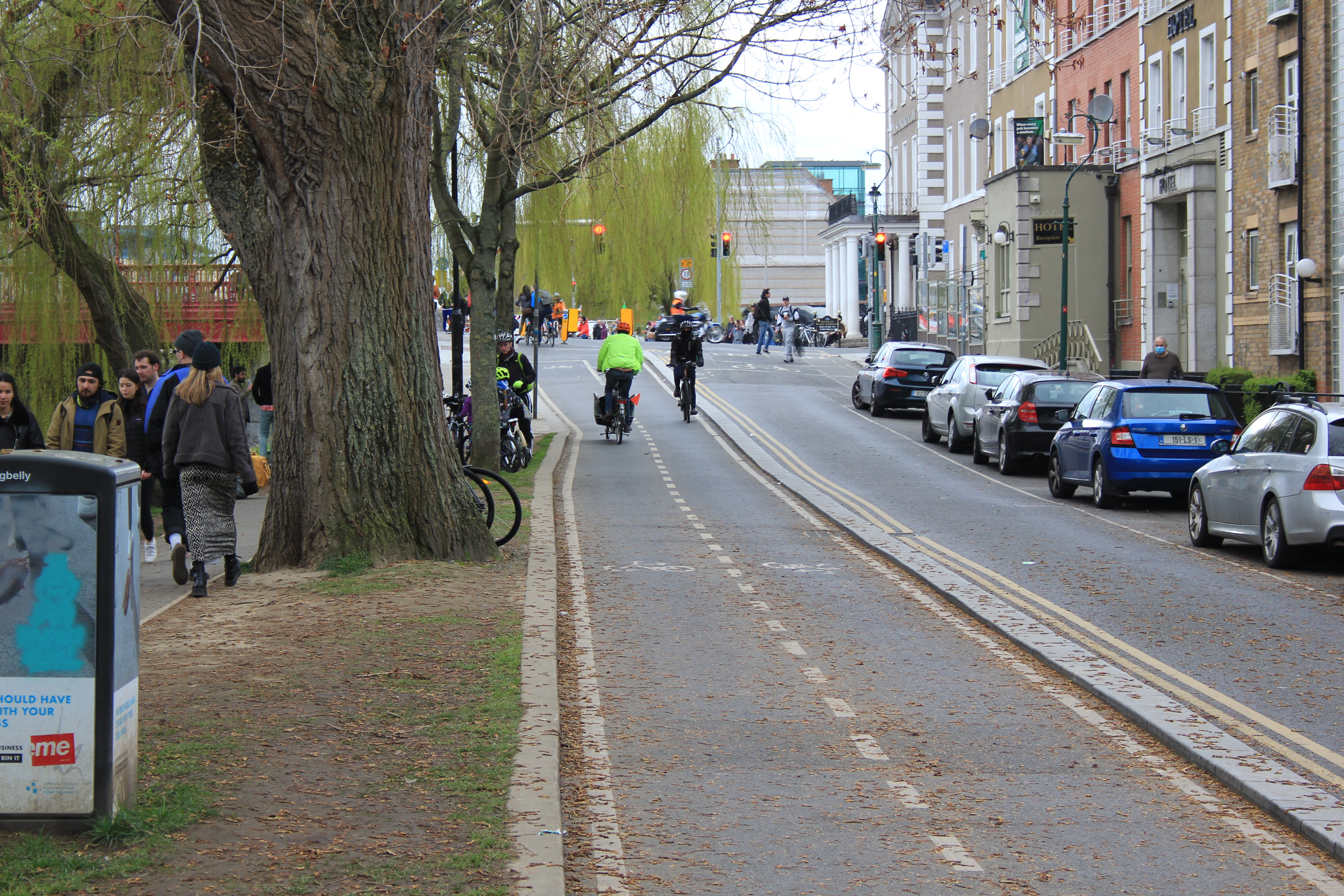
    Photo credit: Samuel Adeleke

    Finan also noted a pandemic of wearing headphones among cyclists.  

    “I don’t even know how anybody can wear headphones while cycling, because there is so much going on around you that you need to be alert to,” she said. 

    Finan warns of dangerous overtaking by cyclists. She said: “A lot of the Brazilians and Chinese delivery riders have electric bicycles and tend to overspeed, but they should always use their bells to alert other road users.” 

    Cliff Nolan, the owner of Bike Stops on Capel Street, Dublin, which sells and repairs bicycles, said, “I service a lot of delivery riders’ bicycles. The most recurrent issue with them is a puncture in the tyres, and their brakes always need a lot of attention.” 

    “Delivery riders should always buy quality parts instead of going for cheap parts, which puts them at risk,” Nolan advised. 

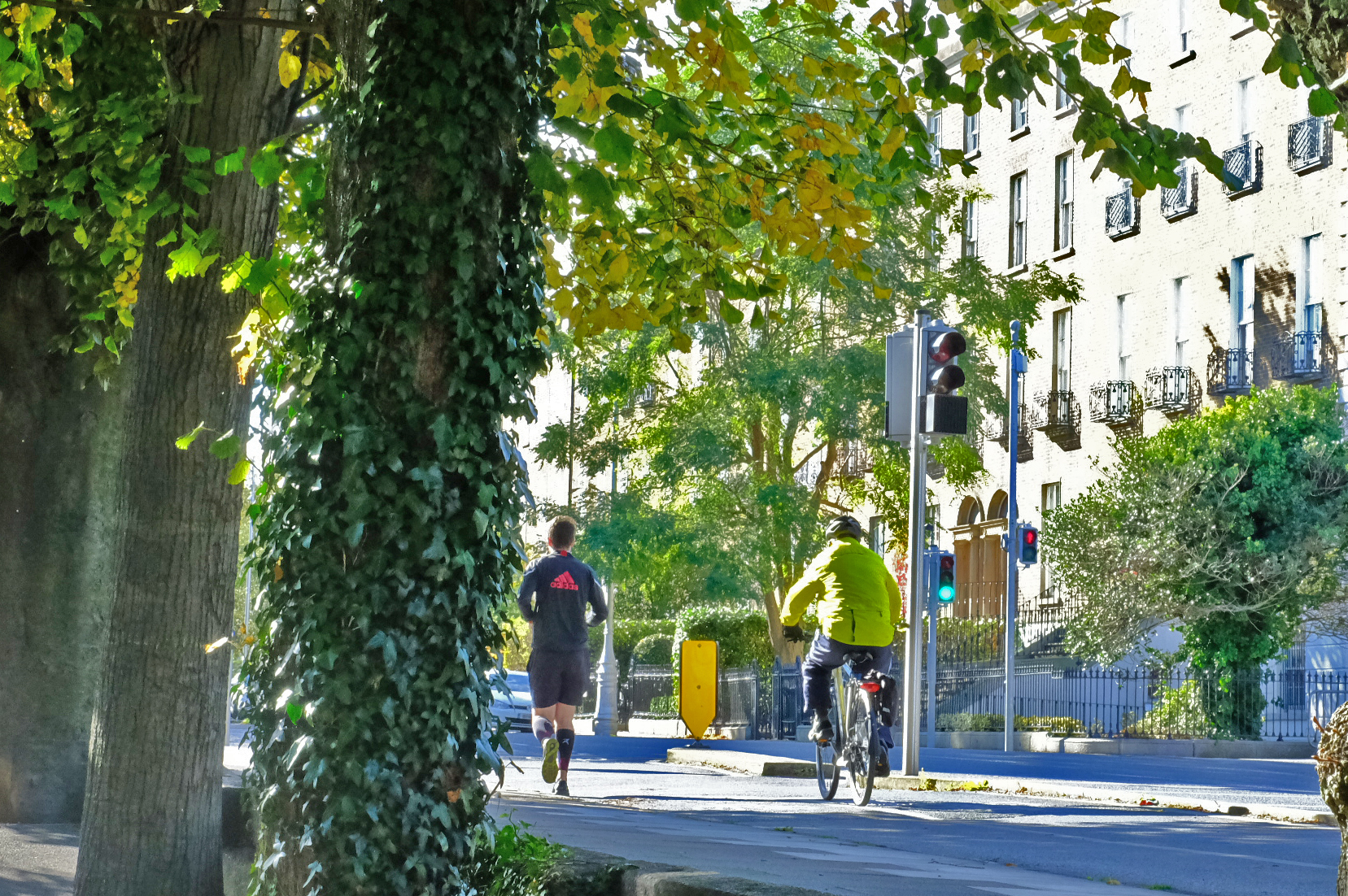
    Photo credit: Samuel Adeleke

    One Chinese worker with Deliveroo, who did not wish to be named, said, “There are many dangers on the road. There are robberies by teenagers, and our bicycles are easily stolen.” 

    He also highlighted other issues with the healthcare system that discourages drivers from seeking treatment for injuries.  

    “I have fallen so many times on my bicycle and have had to treat my own wounds,” he claimed.   

    “We generally don’t go to the hospital because going to the hospital will be troublesome and takes a lot of time. We figured we could handle it ourselves, and it would be much faster.” 

    “Cyclists should ensure that both they and their bikes are visible to other road users by investing in good sets of front and rear lights, and by wearing clothing that helps them be seen,” said John Paul Guiheen, the Executive Officer of Communications at the RSA, in an email correspondence.  

    “They should also consider wearing high-visibility materials and obeying the rules of the road,” he added. 

    The RSA stated that there was a deliberate effort last year to inform major food delivery companies about changes to the law concerning electric bicycles as introduced in the Road Traffic and Roads Acts 2023.  

    “Riders must obey the same rules of the road as drivers; the roads are a shared space. Hence, drivers must follow all speed limits, traffic signals, and parking regulations,” said Guiheen.  

    On other issues bothering on weather conditions, cycle lanes, and bicycle theft, the RSA said, “That should be directed to the NTA, local authorities who maintain roads, and the Gardai respectively.” 

     But “during severe weather events, we issue advice to all road users, including cyclists,” he said.
  • Bolt powering Bray’s E-bicycle Movement 

    Bolt powering Bray’s E-bicycle Movement 

    By Jamie Ryan  

    Since June of last year, popular taxi app ‘Bolt’ has extended their services to provide the people of Bray Co. Wicklow with electric bicycles.  

    These bikes have been a massive success across the town among people of all ages due to their cheap costs and easy accessibility.  

    Green Party Councillor for Bray East, Erika Doyle, was one of those involved in getting the scheme up and running in the town.  

    “With the introduction of the bikes, there has definitely been a modal shift, which is great because in a town like Bray we have a congestion problem. It’s very hilly as well, so with the pedal assist it has become much more accessible for people that otherwise maybe wouldn’t have used a push bike,” Doyle explained.  

    “It’s been a really positive thing for the town, and data from Bolt shows that these are being used even during winter months, because originally, there was a suspicion that they might only be used during the summer, but people are clearly just dressing for the weather and using them regardless which is great.”  

    The success of this scheme is partly due to just how easy the bikes are for people to use. Users simply download the Bolt app, scan the barcode on the bike, and they will then be charged 18 cent per minute.  

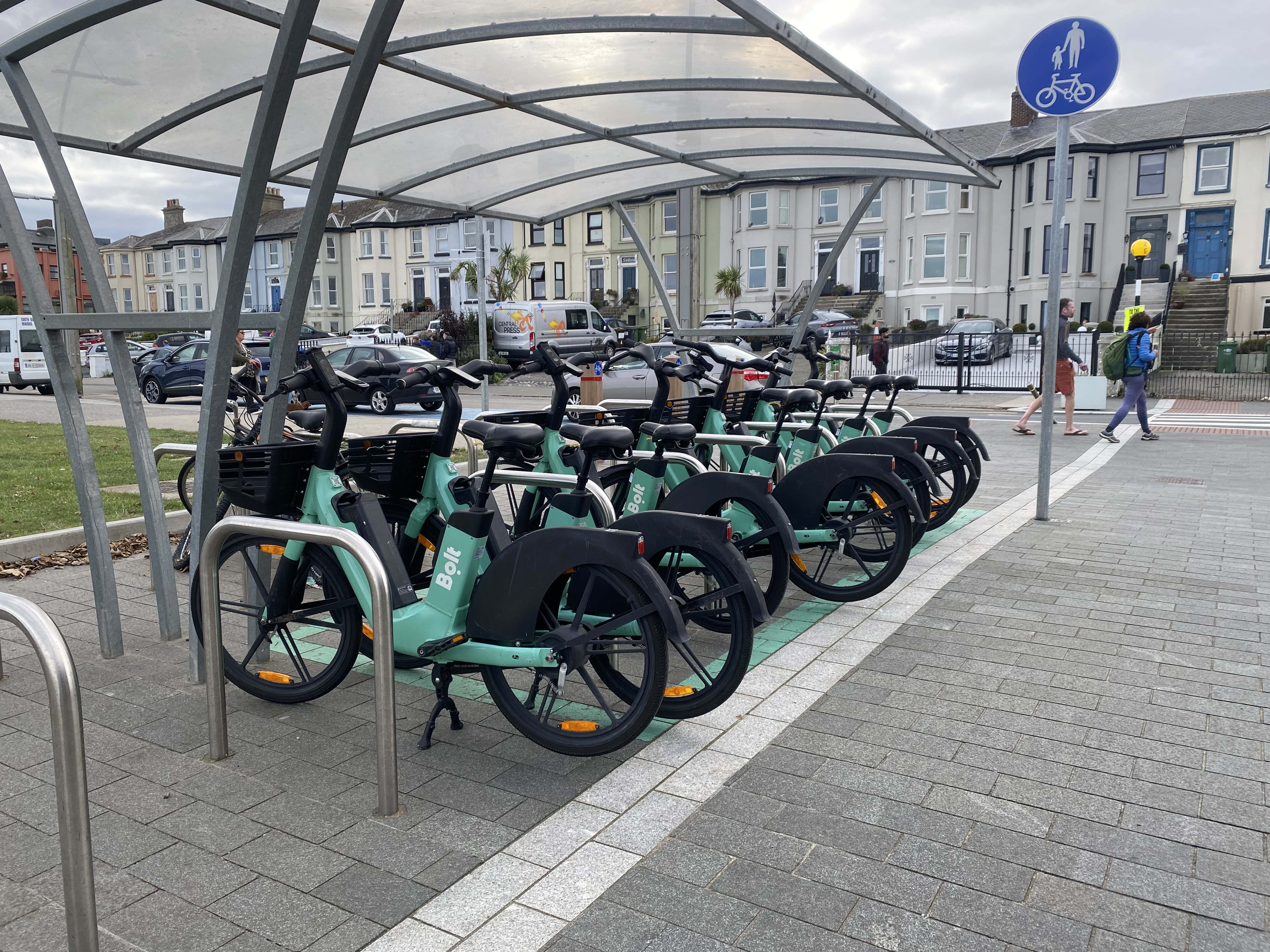
    Once the user completes their journey, they park the bike in one of the ‘park zones’ that can be found on the app or can be identified by a green square on the ground and bike racks.  

    Along with a pay as you use option, there are also a variety of subscription passes available to users too, such as a day pass, weekly passes, monthly passes and ‘unlimited unlocks for 30 days’. 

    The bikes go up to 25 kilometres per hour, but can be capped at 15 kilometres per hours if users wish.

    Bolt Bikes at Little Bray ’Parking Bay’ – Photo Credit: Jamie Ryan 

    Sinn Féin Councillor for Bray West, Dermot O’Brien, speaks highly of the impact that the bikes have had in Bray.  

    “I would say overall there has been a very positive impact from the introduction of Bolt bikes in Bray. The user numbers are a good reflection of this, and the feedback from local people who see them as an alternative to the car, or as an easy option for getting around the town,” he said.  
    “I particularly notice the variety of local users, young and old, as well as tourists and exchange students who benefit from an easy and accessible option to move around the area.” 

    “On a personal level, I would use Bolt bikes very often, and they are a wonderful asset to someone who lives on the edge of being on time for meetings, as I bounce from one venue to another around the town.” 

    The bikes are easily maintainable due to there being no shock absorbers in their frames, and the tyres not containing air.  

    However, although there has been a plethora of extremely positive experiences from Bolt bike users, there have been issues with bikes being damaged, defaced or suffering from wear and tear.  

    Councillor O’Brien himself has fallen victim to this, he explained. 

    “In recent weeks, I changed my bike four times because of malfunctioning and ultimately, I just walked home which was frustrating,” he said. 
    Adam Byrne, 20, regularly uses Bolt bikes to get around the town.  

    “The bikes have made such a difference for me. Getting to and from work has become so much handier and it only costs me maximum €3 per journey which is much better than spending it on petrol – not to mention not having to sit in traffic the whole time,” Byrne said.

    Bolt Bike at Bray Harbour with graffiti at the rear mud guard – Photo Credit: Jamie Ryan 

    “Of course, like anyone else who uses them regularly I’ve had one or two issues, but nothing crazy, more so just maybe a lack of maintenance with the brakes and minor damage to the pedals, but overall, I really can’t say any bad about them. I hope they stay around for a long time.”  

    The contract between Bolt and Bray Municipal Council has recently been extended for a further year, for locals to enjoy and utilise.  

  • Local Opinion Split Regarding Government Plans to Extend Carlingford-Omeath Greenway

    Local Opinion Split Regarding Government Plans to Extend Carlingford-Omeath Greenway

    by Ethan McDonagh

    Despite vocal protestation from locals regarding the proposed extension of the Carlingford-Omeath ‘Greenway’ there are those who are in support of the project. The existing trail in Co. Louth provides residents and tourists with a publicly available trail for both cycling and walking. 

    The proposal to extend the Greenway is part of the National Development Plan (NDP) 2021-2030 which is advertised by our current government as being a major benefit with the announcement document stating, “the investment planned under the NDP will result in increased GDP, employment and wages out to 2030.” 

    However, what these government documents don’t show is the localised impact of projects and the direct effect, whether positive or negative, they have on small communities. 

    Map of existing greenway. Source: Carlingford Tourist Office 

    Built along the old Dundalk Newry & Greenore railway line the Greenway, which opened in 2014, is subject to a government proposal under the NDP whereby the existing route will be extended from Carlingford to Dundalk.  

    The announcement has been met with a lot of vocal opposition from locals who have taken to constructing signs saying ‘No to Greenway’ at several points along the proposed route.  

    As the project would be placed on or near people’s homes and land used for agricultural purposes there has been a lot of resistance from people who believe the extension of the Greenway would only be detrimental to them and their livelihoods.  

    Many of the older residents in the peninsula have bad memories of government involvement in the area when the foot and mouth disease broke out in 2001 leading to the forced killing of farmer’s livestock and eradication of the local wild deer and goat population.  

    One homeowner in the locality, who wished to remain anonymous, is annoyed by the lack of proper consultation with locals surrounding the whole process. They spoke of “farmers who are going to have their fields cut in two, so they won’t be able to get cattle from one side to the other.” 

    “A friend is going to have the greenway going through her already very small garden which she is very upset about. I also don’t understand all of the proposed route and why some of the route can’t be on some of the quieter roads, they said. 

    Sign in resident’s garden opposing the greenway extension: Photo by Ethan McDonagh

    However not all local reaction is negative, with one local shop owner Aaron Farnon saying: “As a local person who has been working in Carlingford for the last six years I believe that the greenway will greatly enhance the business opportunities and the footfall in Carlingford.” 

    With a lot of Carlingford’s businesses being largely tourism- based and thus highly seasonal, Mr. Farnon believes that: ”The greenway gives people more of an initiative to go to Carlingford during the summer months and weekends and see the beauty that the village holds as well as giving local businesses and small shop owners the opportunity to showcase their offerings and bring people in to support them in these hard times.” 

    Optimism and support are a commonly shared sentiment among business owners in the region with David Hanlon, owner of a Carlingford bike hire company, stating: “The new proposed Dundalk to Carlingford Greenway will be the greatest infrastructure investment in Cooley in decades. It will create a safe passage for our kids and families to cycle and walk safely off the busy, truck laden, roads of the Peninsula.  

    “It will have massive health benefits for the people of the peninsula as it will encourage a lot more people to get out for walks and cycles, reducing obesity and mental health problems by building lifelong healthy habits. Finally, the Greenway will create hundreds of ancillary jobs through tourism to the area, just look at places like Waterford and Mayo. Louth County Council needs to work with landowners to find a pragmatic approach to getting a route agreed with minimum impact.” 

    Conversely, what is outlined on the government website for the proposal is that “The R173 Regional Road connecting Dundalk with Carlingford, along with other regional and local roads in the study area have no provision for pedestrians and cyclists.” 

    One of the stated goals of the greenway extension would be to change this with a key goal of the NDP being to “recognise the importance of active travel not only in reducing carbon emissions, but also in achieving other national strategic outcomes such as compact urban growth and balanced regional development.” 

    The website also states that the proposed greenway meets the seven appraisal headings identified in the Department of Transport’s “Transport Appraisal Framework” from June 2023; transport user benefits and other economic impacts, accessibility impacts, social impacts, land use impacts, safety impacts, climate change impacts and local environmental impacts. 


  • Roll out the carpet: Dublin city’s cycle lanes get a scale and polish

    Roll out the carpet: Dublin city’s cycle lanes get a scale and polish

    Double cycle lane along the Grand Canal, photo by Mario Bowden

    Dublin city centre sits still and quiet these days. Traffic is noticeably tamer, with less gridlock traffic at rush-hour. For cyclists, this means less jostling and narrow manoeuvring through buses and cars. A bit of breathing space.

    Certainly there are fewer people cycling in to work too – as people shift to working from home. But the bike is still in-motion. For some it’s a mode of work – takeaway drivers and couriers are still zipping around. For others it’s a form of escapism: people getting out and about in the sunshine, others doing ‘wheelies’.

    Some are opting for the bike in order to avoid public transport too. Indeed, this trend is not unique to the current health crisis – people were encouraged during the 1918 Spanish Flu to get peddling.

    New Cycle Lanes

    With the lack of footfall in the city centre since the first lockdown, space became time. There was time for Dublin City Council (DCC) to implement various new and distinctly designated cycle routes across the city.  

    “I don’t think anyone would say cycling has been well provided for on Dublin city streets”

    Ali Grehan

    Some of the new cycle lanes across the city include the implementation of the the Liffey Cycle Route along the North Quays, contraflow lanes on Nassau Street, and the more recent route up O’Connell Street Upper and North Frederick Street. All of these are provided with bollards and black and white ‘orcas’ to segregate cyclist traffic from cars, buses and trams.

    “The new cycling lanes are still a work in progress,” says Ali Grehan, Dublin City Architect at DCC.

    Grehan continues: “They are much needed. I don’t think anyone would say cycling has been well provided for on Dublin city streets, particularly heavily trafficked ones – so in that sense they are successful in that they’re making necessary improvements.”

    While the quick thinking of DCC has been a positive for the city, it is not without its pitfalls. For instance, the Nassau Street contraflow lane suddenly stops at Dawson Street, forcing cyclists to merge with traffic suddenly – not to mention Luas tracks – at one’s peril, with any false move.

    The implementation of cycle lanes is not exclusive to the city centre either. Griffith Avenue on Dublin’s Northside has seen a fully segregated lane being rolled out across parts of its 4km stretch from Glasnevin to Marino. In May 2020 the Phoenix Park closed off sections of its roads to cars for the summer months – creating more space for people to mill about on their bikes.   

    On the Continent  

    European cities have always been miles ahead of Dublin when it comes to cycling infrastructure. But, we are not alone in terms of cities that took the current opportunity to shift the emphasis to cycling – Paris being the most prominent.

    It’s estimated that Paris’s cycling population grew by 65% in 2020 – significantly decreasing the CO2 emissions normally emitted from traffic.  Paris authorities responded to this increase by constructing more cycle routes, and further expansion of its bike scheme.

    “The problem is, while you can look at Copenhagen or Amsterdam – [which have] great cycling infrastructure – it’s difficult to transpose one city’s approach to another,” Grehan says.

    “Dublin has its own particular physical and cultural context and any initiative has to understand and respect this. It’s a complex issue. An example is Dublinbikes. There was a general expectation among commentators that the system would be vandalised. People were surprised when there was virtually no vandalism and Dublinbikes became very successful, very quickly.”

    The full extent of the success of Dublin’s cycle lanes remains inconclusive as the city remains less active than in normal times, Grehan concedes. But with smarter innovation and progressive steps made by campaign teams and authorities, a change to Dublin’s road culture is being paved.

  • How has the Covid-19 pandemic changed cycling in Dublin City?

    How has the Covid-19 pandemic changed cycling in Dublin City?

    Since the start of the Coronavirus pandemic, people have looked for alternative methods of travelling to avoid busy public transport. Eibhin Kavanagh investigates how the pandemic is affecting cycling in the city.

    Is cycling in Dublin City safe? Photo by Eibhin Kavanagh

    With our movements once again restricted, people in Ireland are limited to travelling within 5km of their homes. Walking and cycling have become a more popular means of exercising as a result of gyms closing and sporting events being cancelled.

    In the last ten years, Dublin has seen an increase in the number of people cycling. A number of bike share schemes have become well established. However, 2020 has seen an exponential increase in cyclists, which Dublin City has had to accommodate. This change, due to social distancing restrictions, means more space is required for both pedestrians and cyclists to make their way around the  city.  

    Councillor Michael Pidgeon talked to The City about the recent changes related to cycling in Dublin City.

    “In some ways I think the people are ahead of where the city is,” Pidgeon said. “We know that outside of peak hours there are now more people cycling than there were at this time of the year last year; there’s been a huge increase.”

    Dublin City Council projected  a 200% increase of cyclists in Dublin City from 2019 to 2020.This would be an increase from 13,131 to 39,000.

     2019 FiguresLikely Future ChangePotential Future Figures
    All Public Transport116,28780% Capacity Reduction30,000
    Car57,985Approx. 30% reduction41,000
    Taxi2,661Assume 30% reduction1,900
    Walk24,691Target 100% increase50,000
    Cycle13,131Target 200% increase39,000
    Goods983No change1,000
    Motorcycles1,485No change1,485
    Total (persons)217,223 164,385
    Source: Dublin City Council 

    Source: Dublin City Council 

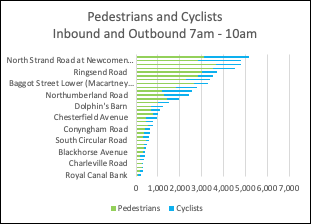
    The Canal Cordon Count was analysed by Dublin City Council to determine where the greatest demand for walking and cycling was recorded. The table below shows the number of people crossing the canal cordon (both directions) during the morning peak period from 7am to 10am in November 2019.

    Source: Dublin City Council 

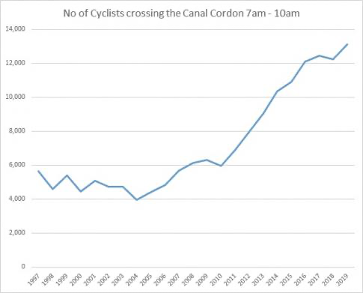
    From 1997 to 2019, the number of cyclists crossing this cordon heading into the city centre between 7 am and 10 am increased by 133%, from 5,628 to 13,125.

    The number of cyclists remained between  4,000 and 6,000 between 1997 and 2010 before increasing by approximately 15% year on year until 2015 when the increase slowed up until 2017.  There was a small decrease in 2018,  but cycling numbers increased by 7.3% in 2018 and 2019. 

    Source: Dublin City Council 

    According to research conducted by the Road Safety Authority, 4 in 5 cyclists are injured on urban roads. More cyclists are  injured during morning and evening commutes. Of all collisions involving another vehicle – 4 in 5 cyclists are injured by cars. 1,056 cyclists were injured in collisions in 2018.

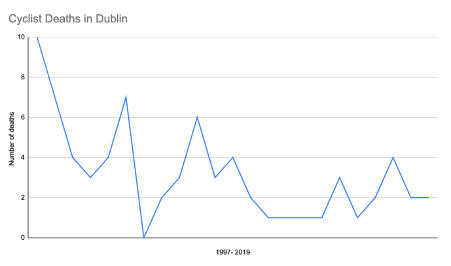
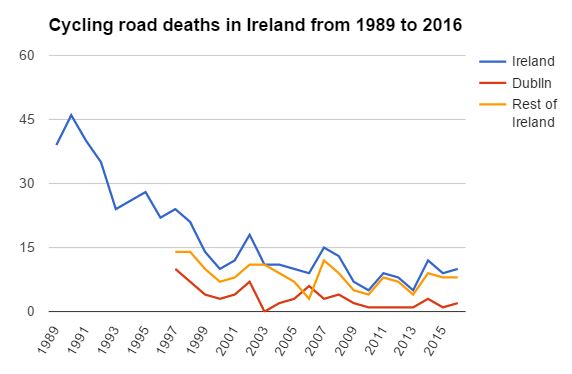
    In Dublin, the number of cyclist deaths since 1997 has remained relatively low with a slight increase in 2017, according to figures collected by the Road Safety Authority.

    Image Source- Irish Cycle.com

    Dublin has over 120 miles of cycle routes. While changes have been ongoing to improve cycling infrastructure in the city, especially since lockdown in the spring, the demand is high for safe and accessible cycling.

    “It felt like at the start of the pandemic there was a real understanding that we needed to take more space for cycling to encourage more people to do it, but it feels like that momentum has dropped a bit,” said Pidgeon. “So, I think that we need to get that going again.

    “In terms of infrastructure, I think the big changes we have seen are some of the temporary measures along the quays, particularly along the northside quays.”

    Some of the Cycle Safety interventions introduced since April include the installation of Nassau Street contra-flow cycle track from Clare Street to Dawson Street, the partial installation of key sections of the Interim Liffey Cycle route, removal of on-street car parking from Inns Quay and Ormond Quay, and a section of work from Church Street to Ha’penny Bridge, according to Dublin City Council.

    Dublin City Council also discussed other plans to ensure safe cycling in the city, including the reduction of the number of traffic lanes to accommodate protected cycling facilities on both sides of the road, while maintaining a balance for other required services. While there have been major changes made within Dublin City Centre to ensure safe cycling, other parts of the city have yet to see changes that will make cycling accessible and safe.

    “One of the things is to start looking at the urban villages, so instead of just focusing on the very core city centre, you would be looking at areas like Inchicore, Rialto, Stoneybatter, Phibsborough, Rathmines,” Pidgeon said in relation to making cycling consistent for everyone.

    “What we seen in the pandemic is that people are happy enough to stay within a few kilometers of where they live, so we shouldn’t just be designing a cycle lane with a view that will just take office workers from the suburbs to the city centre, because that’s not what the demand is right now. That’s important, we should definitely do that, but it will have to also be about making sure that local routes around your home are safe.

    “There’s still a lot to do, but equally I’d like to say that cycling in Dublin City is safe. There’s a perception of danger that I don’t think is entirely there. There’s a lot the city needs to do to feel a lot safer and be safer with segregated lanes, but if anyone’s considering it, I’d say just ask a friend who does cycle regularly and they can show you some good routes give you some tips and you’ll be up and running in no time.”

  • “Stop killing cyclists” – I Bike Dublin protests

    “Stop killing cyclists” – I Bike Dublin protests

    By Andrea Byrne, Padraic Daly and David O’Farrell

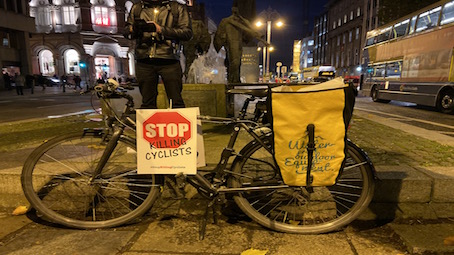
    I Bike Dublin, who are seeking to have safer cycling conditions for all in Dublin, held protests recently in Dublin’s city centre. The protests involved a ‘die-in’ with protestors lying down on the road. These protests came after the tragic death of Neeraj Jain.

    Thecity.ie caught up with two of the volunteers at the protest to find out why they are protesting and what they feel needs to happen to make Dublin City safe for cyclists. 

  • More than 1,600 cyclists fined since 2015

    More than 1,600 cyclists fined since 2015

    A total of 1,660 on the spot fines have been handed out to cyclists in the past two years.
    The fixed charge fines were introduced on the 31st of July 2015 by Paschal Donohue who was the transport minister at the time.

    Cyclists breaking red lights is by far the most frequent infraction with 843 of the 1,660 fines being accounted for by this offence.

    There are seven offences for which cyclists can be fined including: cycling recklessly, failure to have lights, cycling in a pedestrianised area, breaking a red light, failing to stop for a school warden and failing to stop at a railway barrier or bridge crossing.

    So far this year there has been 439 fines issued with 172 of them being for breaking a red light, 106 for not having front and rear lights, 88 for cycling in a pedestrianised area, and 73 for cycling without adequate consideration,

    Cyclists can be ordered to pay a €40 fine which can rise to €2,000 if the fine remains unpaid for more than 56 days.

    By Eoghan McGrane

  • How safe is Dublin for cyclists?

    How safe is Dublin for cyclists?

    Cycling is a cheap and easy way to get around but are Dublin’s roads safe? TheCity asked some cyclists on Grafton Street. By Caroline Ewins, Brendan Kelly and Cormac O Connor.