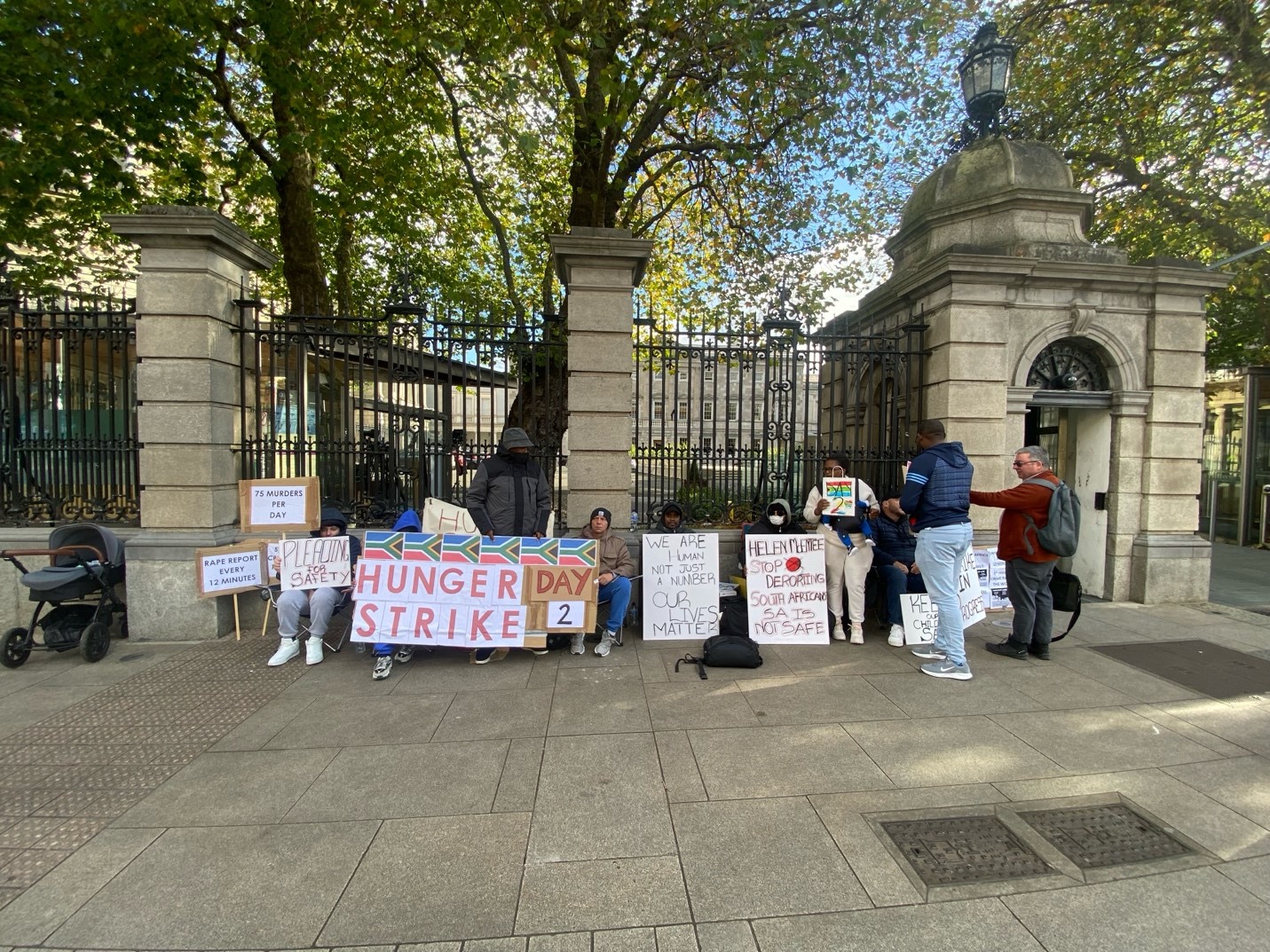
Since Monday 21 October, these South African men and women who are living in Direct Provision have gone on a hunger strike in the hopes that the Irish Government will reconsider having South Africa listed on Ireland’s ‘Safe Countries’ list.
The EU and Irish Government define a ‘safe country of origin’ as a country in which: “there is generally and consistently no persecution, no torture or inhuman or degrading treatment or punishment and no threat by reason of indiscriminate violence in situations of international or internal armed conflict.” Neels Heystek – a South African that are taking part in the hunger strike. Heystek told TheCity.ie his daughter is suffering from PTSD and is having regular panic attacks at school as a result of what has happened to their family in South Africa.
“This is our last resort now.”
Neels Heystek
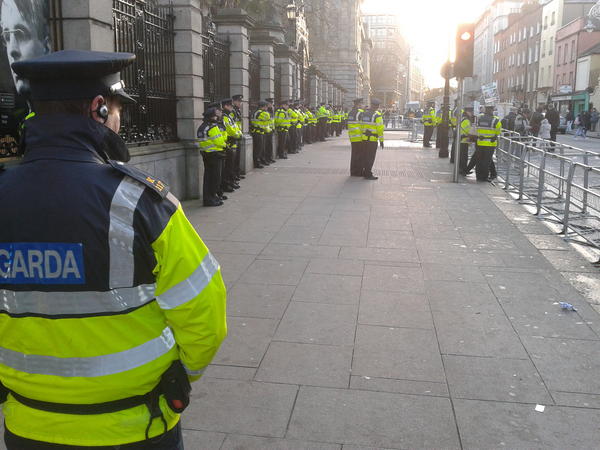
Passersby and sympathisers have donated water to the hunger strikers.On the otherside of Dáil Éireann’s gates, was a protest held by Irish Healthcare Workers for Palestine. Some of these protesters came over to the hunger strikers in support when a far-right agitator arrived.The IrishHealthcare Workers for Palestine lending their megaphone to the South African hunger strikers to drown out the far-right heckler. A collection of the protester’s signs
‘Rape Report every 12 minutes’
‘75 Murders Per Day’
‘Pleading for Safety’
Hunger strikers displaying their respective signs telling those passing by why they are on hunger strike.One of the protesters, down on their knees sticking together another sign for passersby and government officials coming through the gates of Dáil Éireann to see and take notice of.Brian Mogotsi is another of the hunger strikers. He is taking part in this protest in the hopes that the Government will engage in a dialogue with South Africans that are living in Direct Provision to reconsider their position on deeming South Africa as a safe country
Minister for Finance Paschal Donohoe has announced new measures in the 2020 Budget to reduce Ireland’s contribution to the current climate crisis.
In the Dáil on Tuesday morning, Minister for Finance Paschal Donohoe delivered his speech on the package, describing climate change as being “without doubt our defining challenge.”
The Minister announced a €6 increase on the carbon tax, applicable to fuels including petrol and diesel. These changes were implemented from midnight on Tuesday, but the increase to other fuels will follow in May of next year, after the winter heating season. The Government ultimately intends for the tax on carbon to rise from €20 in 2019 to €80 in 2030.
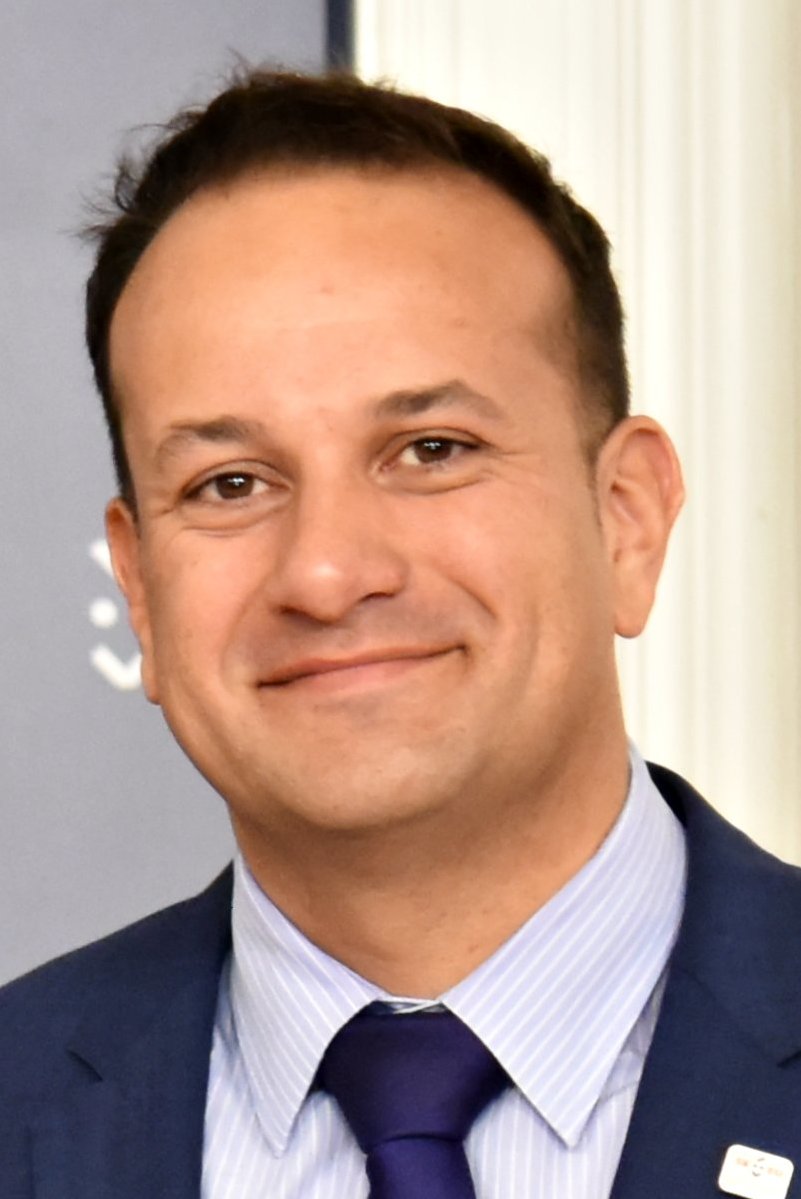
Minister for Finance, Paschal Donohoe Photo Credit: Wikimedia Commons
The Minister said this will raise €90 million, which will be ring-fenced for the funding of “new climate action measures”.
A portion of the revenue gained from the carbon tax will go towards funding a package targeted at the midlands. The Minister said, “€20 Million will be dedicated to the creation of a new energy efficiency scheme targeted initially at the social housing stock in the region. This aims to create new, sustainable employment in the region.”
The €6 million will go towards the Just Transition Fund, targeted at The Midlands to re-skill workers and assist local communities and businesses in The Midlands. €5 million will also be dedicated to restoring bogs to their natural habitat. The bogs will become “carbon sinks”, which will be able to absorb carbon.
Another €5 million will go towards the reduction of greenhouse gas emissions and enhanced biodiversity.
The earnings from the carbon tax increase will also include €11m for electric vehicle grants and charging networks – which will double the number of electric car charging outlets currently available to the public, as well as €9m for greenways.
“little more than a government cash-grab dressed up as a green initiative”
AA Roadwatch has warned that the carbon tax increase will do very little to reduce Ireland’s over-reliance on the private car, criticising the move as “little more than a government cash-grab dressed up as a green initiative.”
Director of Consumer Affairs for the AA, Conor Faughan stated: “Investing in public transport infrastructure, LUAS-like systems across our main cities, quality cycle lanes, all these measures would do far more to get people out of the car than a tax increase ever will.”
The 1% diesel surcharge has been replaced with a nitrogen oxide emissions charge. This will apply to new cars registered from January 1st of next year. The charge will apply on a euro per milligram/kilometre basis with the rate increasing in line with the level of nitrogen oxide emitted. The first 60mg per kilometre of nitrogen oxide emissions will be charged at €5 per milligram. Above 60mg per kilometre, the charge will amount to €15 per milligram. Above 80mg, it will be €25.
This means a new diesel car with emissions of 43mg per kilometre will have a charge of €215 added. A new petrol car with emissions of 23mg per kilometre will have a charge of €115.
“The Government ultimately intends for the tax on carbon to rise from €20 in 2019 to €80 in 2030”
The Government is aiming this charge at older, more polluting cars, which could cost some owners several hundred euros. This charge will not affect electric vehicles, as they do not directly emit nitrogen oxide. €8 million has been reserved for grants awarded to consumers who purchase fully electric cars.
Contrary to this, the Government is scrapping the grant scheme for businesses who purchase electric vehicles.
Richard Bruton, Minister for Communications, Climate Action & Environment said in a statement, “the generous benefit-in-kind tax relief that is available for these vehicles is considered adequate incentive to drive growth in this sector.”
Taoiseach Leo Varadkar spent €877.83 on twelve gifts since his inauguration in June this year.
This is a substantial increase from the same period in 2016 when Enda Kenny was Taoiseach and spent only €98.59 on just four gifts for the Lord Mayor of Liverpool, the governor of Georgia, the mayor of Atlanta and the President of Cyprus Nicos Anastasiades.
Varadkar spent €518.67 alone on the Trudeau family with gifts ranging from €14.99 to €198.78. The most expensive gift was a framed photograph of Skellig Michael given to Canadian Prime Minister Justin Trudeau who also received a rare copy of a book of W.B. Yeats poems along with a pair of Book of Kells socks.
Madame Sophie Gregoire Trudeau received a Salmon of Knowledge brooch and a green wool scarf, which together cost €109.95. The Prime Minister’s youngest son wasn’t forgotten. Hadrien received a W.B. Yeats book for children – The Moon Spun Round.
Varadkar also spent €189.16 on four pairs of spiral cuff links for Philippe Couillard, Premier of Quebec, and the mayors of Montreal, Seattle and San Francisco.
While Varadkar spent much more in the second half of the year in 2017 compared to 2016, the Department of the Taoiseach as a whole spent more than double the amount on gifts in 2017.
St. Patrick’s Day gifts were the main contributors to this increase with over €1,200 being spent on gifts for that day, a significant jump from the previous year where only €382 was spent. Although that was partly because the Shamrock Bowl provided by House of Waterford Crystal didn’t cost the Department of the Taoiseach anything in 2016 when it was given to then President Barack Obama.
However, the Shamrock Bowl designed by Criostal na Rinne in Waterford for President Donald Trump did cost the department €300.
Over the last few months we’ve seen a number of opinion polls showing a spectacular rise in popularity for independent politicians and smaller parties. How Dáil Éireann is going to look after the next election is anybody’s guess.
The latest poll conducted by Ipsos MRBI and published in The Irish Times showed independents and others on 32 per cent, a whole 10 per cent ahead of the next biggest grouping, Sinn Féin.
So how exactly is this going to work? Independents and smaller parties are never going to manage to come up with an agreement to form a government so it looks like a hodge-podge coalition is the only solution.
With Fine Gael on 19 per cent and Fianna Fáil on 21 per cent, even a coalition of these two unlikely bedfellows wouldn’t manage to come up with a majority.
Is a ‘grand coalition’ the only option left? John A. Costello was Taoiseach and head of a government made up of five different parties, as well as a number of independent TDs. That coalition managed three years before collapsing during the fallout from the Mother and Child Scheme.
But would a modern day grouping like Costello’s manage any longer, or even that long?
Following every poll we hear how people are disillusioned with the political system and are desperate for change. Those changes might yet occur, but if they do who is going to get into bed with who?
The City spoke to representatives of the main parties to find out what they think.
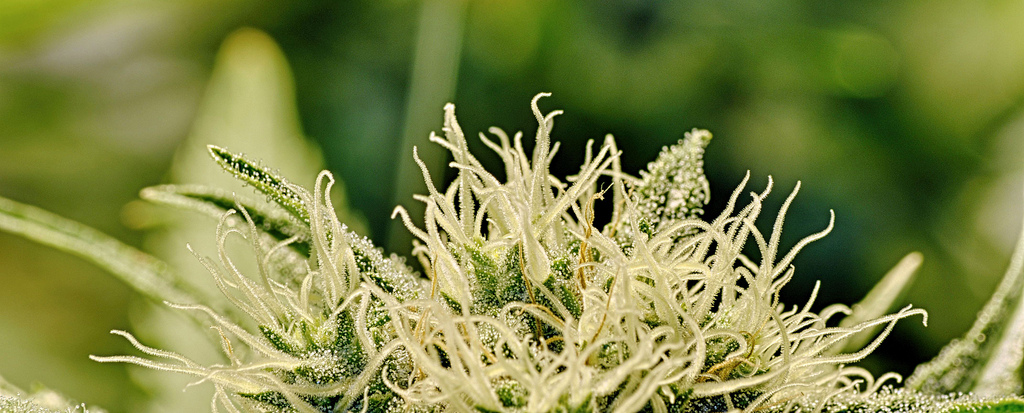
Cannabis has many functional uses besides the most popular form, which is smoking. Image by: mafiosoch
Luke ‘Ming’ Flanagan – TD for Roscommon/South Leitrim – has put forward a private members bill in the Dáil for the decriminalisation of cannabis – similar to the line that many U.S states have taken in recent months.
I took to the streets of Dublin to find out what the general public view on the bill was, and whether they wished to see the law on cannabis amended.



You must be logged in to post a comment.