More and more countries have followed the lead of places like Amsterdam in decriminalising Cannabis in recent years. Is it time for Ireland to take another look at the issue?
Everyone has an opinion on cannabis. Is it harmless fun or an addictive drug? Should it still be a criminal offence to possess it?
People are extremely divided on the effects of cannabis, some argue it is as damaging and addictive as any drug, indeed a lot of its effects on the brain are still being studied. Others argue that it is no more harmful to society than alcohol, and they also have a legitimate argument.
Some may feel a nation as conservative as Ireland would never follow this lead, however even 20 years ago who would have thought we would be on the cusp of a referendum to legalise same sex marriage?
Daniel, Donal and James of TheCity.ie took to the streets to ask people where they stood on the issue. As you may expect the results were divided.
On May 22nd, the country will vote on the same-sex marriage referendum which will decide if gay marriage is voted into law.
If you haven’t heard anything about the referendum, you quite simply must have been living under a rock for the past few months. In recent weeks, the ‘Yes’ and ‘No’ campaigns have been in full flight with both sides vociferous in their criticism of the other.
There has been some controversy, with the ‘No’ side complaining that their banners are being defaced and pulled down. Then there was the mural on the side of the building in Dublin, depicting two men hugging, which was brought to the nation’s attention when Dublin City Council threatened to remove it.
But the vast majority of the referendum debate and news coverage has been focused around Dublin. The capital is obviously of huge importance but we already know that the majority of Dubliners are voting ‘Yes’, what about the rest of the country and how they view the upcoming referendum?
In light of this Donal, Daniel and James took the City.ie on a tour of Wexford to explore people’s opinions on the referendum in the sunny south east and investigate whether there is a rural-urban divide.
The key finding was that the majority of people were firmly in favour of a yes vote. This would appear to be in line with the popular view in the capital. Whatever way the vote goes on May 22nd, it is important not to forget the rest of the country and be sucked into a city only view of the vote.
The Department of Arts, Heritage and the Gaeltacht has announced a €22 million investment in major commemoration projects.
The money will be made available throughout next year in order to ensure that the sites, which are all of historical importance, will be open for the 1916 centenary.
Taoiseach Enda Kenny, Tánaiste Joan Burton, Arts Minister Heather Humphreys and Minister of State Aodhan Ó Riordáin recently visited the National Museum of Ireland at Collins Barracks, Dublin, where a major 1916 exhibition will open in time for the centenary. They were there to announce the programme of commemorative events that will be launched to mark the 100th anniversary of the Rising.
Some of the highlights include:
A major exhibition of 1916 archival material at the National Museum of Ireland, Collins Barracks
‘Proclamation Day’, which will be held in all schools on March 15th 2016
The National Flag and a copy of the Proclamation will be delivered to every school in the country
A series of State commemorative events, including a parade from Dublin Castle to Parnell Square on Easter Sunday 2016 and a special State Reception for relatives
7 new public projects at the GPO, Kilmainham Gaol, Pearse’s Cottage, the Military Archives and other sites
A multi-location public event, to be broadcast on television on Easter Monday 2016, telling the story of Ireland, through music, dance, drama and song
A series of conferences on 1916 through our universities
Cultural events around the globe, to be co-ordinated through our embassies and Culture Ireland, including Irish cultural festivals in Washington and London
But that doesn’t mean we have to wait until next year, there is still plenty to see right now. There is already a 1916 exhibition, as well as other exhibitions from important parts of Irish history, on show at Collins Barracks.
The City recently visited the museum to view the exhibition, which traces the background to the events of 1916, examines the battle itself, considers the aftermath up to 1923, and, finally, explores the ways in which the Rising has been commemorated to the present day.
And we still managed to find time to check out some of the other interesting pieces of history on show!
The direct provision system for asylum seekers is ‘not fit for purpose’ and needs to scrapped or replaced, according to a new report from an Oireachtas committee.
Direct provision was introduced 15 years ago to provide shelter for asylum seekers for just six months, until applicants were either granted refugee status or deported. This new report from the Committee on Public Service Oversight and Petitions has called for a series of changes in the existing regime, but ultimately wants it to be scrapped.
There is around 4,360 asylum seekers currently living in direct provision centres around Ireland. Members of the committee visited four direct provision centres in Dublin, Galway, Limerick and Meath. Based on what they saw, the committee described the current living conditions as “intolerable” and “cramped”, with little private space for parents with children.
Over one third of the asylum seekers in direct provision are children. Many of these children were born in Ireland but do not enjoy the same rights as other Irish children. The committee’s report says people in direct provision should have the right to work. The recommends that the restriction on working must be lifted soon as possible to avoid an long-term difficulties.
The report also notes that the person living in direct provision for the longest time has been there for eleven years but the average stay is 5 years. It also commented on this figure, saying the delay in processing the applications was “inexcusable”.
But haven’t we heard this all before?
These figures and recommendations will not surprise people that are familiar with the conditions in direct provision centres. It has already been widely reported on. Last November, I spoke to a resident in the Birchwood House direct provision centre in Waterford. She had been involved in the recent protests in Waterford and Dublin and wanted people to know what kind of conditions they were being forced to live in. She asked me not to disclose her real name, in fear that it would affect her application for asylum.
“I myself have been waiting nearly nine years. The protest was meant to spread the word that there are people in Waterford who have been abandoned,” Natasha told me.
She told me that the hardest part was trying to raise her children in this environment, after promising herself that they would have a better future in Ireland. At present, asylum-seeking children are entitled to primary and secondary level education but cannot go to third level because they do not qualify for free fees. Apart from his obvious issue, school can be very difficult for her children.
“One day in primary school, my son was asked to write about his house. Everyone was talking about the different rooms in their houses, their own rooms and what colour it was.
When it came around to my son’s turn to talk – he said I don’t have a house. The other children asked him where he lived if he didn’t have a house. He told them that he lived in a hostel and the teacher asked him to describe it. The kids began laughing when he told them that his family all live in one room and have to queue up for food”.
One of the major problems with the current system came from a decision made by the State back in April of 2000. They decided to pay private contractors to provide accommodation for asylum seekers. But the majority of these contractors have backgrounds in property, not hospitality or catering. These contractors receive about €50 million in taxpayers’ funding each year and most are registered as private unlimited companies, which means their financial affairs are not open for public scrutiny. None of these companies come from a health or welfare background and Natasha tells me that they create a very hostile environment to live in.
The chairman of the Public Service Oversight and Petitions Committee has called for direct provision to be scrapped. Speaking to RTÉ’s Morning Ireland, Pádraig Mac Lochlainn said that after visiting asylum centres around the country the committee felt it has to comment on the overall system.
“These centres were only ever intended for residents for six months while some have been there for 11 years, which is outrageous. You can’t work and live on €19 a week. They are living in limbo,” he said.
It also recommends the responsibility for inspections at the centres be carried out by an independent body such as the Health Information and Quality Authority.
Mac Lochlainn also said, in an article he did for thejournal.ie, that those in direct provision felt excluded and isolated because they had nobody to report abuses too.
“Ordinary Irish citizens have access to the Ombudsman to advance concerns on public service delivery, while those in the direct provision system do not. A section of Irish society is being neglected and quite possibly being discriminated against…
So we are saying that, while the current system is in place, the respective jurisdictions of the Ombudsman for Public Service and the Ombudsman for Children must be extended to include the direct provision system. We also call for the FOI Acts to be extended to include the direct provision system and the Reception and Integration Agency.
Given that robust independent oversight is required, the RIA should also establish a pre-Ombudsman independent complaints system for residents.”
But reports and promises have been made before. Back in November, Natasha had told me that she and other residents of Birchwood House had met with Minister for Communities, Culture and Equality Aodhán Ó Ríordáin and had felt positive afterward.
Speaking at the 15th anniversary of direct provision back in April, he said it was not an occasion to be proud of and marks a regrettable period in Irish history. He said that overhaul of the system would follow this committee’s report and that it would represent the biggest change in a generation. He didn’t give any precise details at the time but said speeding up the process was his number one priority.
This is an issue that has had a tendency of dragging on and not being addressed. This is a report from Morning Ireland, over a year ago. Will we be listening to a similar report in a years time?
It does not benefit us as a country to have asylum seekers in the system for 10 or 11 years. This is an issue that has already dragged on for 15 years and the Minister needs to finally address it, for the good of everyone involved.
(Originally published at http://dlditmaj.blogspot.ie)
The reaction to Chelsea’s 1-0 win over Manchester United on Sunday was puzzling to say the least. The backlash began before the final whistle had even sounded, with United and ‘neutral’ fans taking to social media to voice their outrage at the manner of Chelsea’s victory.
While their tactics mightn’t have been pretty, they were extremely effective and helped stretch their lead at the top of the table to 10 points. But somehow, in the midst of all the discussion online, a debate was provoked. People actually began questioning whether this Chelsea side were worthy of the title. Comparisons were being made with the truly awful side that won Alex Ferguson his last league title.
These people seem to have forgotten that there is more than one way to play football. Would they have Mourinho try to emulate Barcelona’s attacking style, putting entertainment ahead of success in the process? You may not like the way Chelsea are seeing out the season but they should be given the credit they deserve. Looking ahead to today’s big clash with Arsenal, let’s take a closer look at what has made Chelsea successful this season.
Tactics
Sunday’s win was every bit the tactical masterclass we were expecting from Mourinho, and don’t let anyone tell you otherwise. It was no surprise to see Kurt Zouma’s name on the teamsheet, with the defender widely tipped to be used to nullify Marouane Fellaini’s attacking threat and he did so very effectively. Fellaini couldn’t move without Zouma tracking, and indeed, challenging him for every ball. If Fellaini attempted to drift out wide, a Chelsea defender would then get to tight to Fellaini with Zouma often acting as cover for them. This allowed Chelsea to keep their shape throughout the game.
After the game Mourinho was quick to champion the efforts of Cezar Azpilicueta, who he said was the best player on the pitch. It’s true that he did a very impressive job of shutting Mata out of the game but it seems that other players roles in the victory were overlooked by some pundits. Many people after the game were left scratching their heads at how Manchester United were able to have 70 per cent of possession but only manage two shots.
Pressure
It wasn’t just a case of Chelsea “parking the bus”, they stopped the threat at the source. Wayne Rooney and Fellaini were deployed by Louis Van Gaal as the forward players in a midfield three, with Ander Herrera sitting deep. Herrera was meant to play that quarterback role, receiving the ball in deep areas and picking out passes to get them moving forward. To counter this, Mourinho had Didier Drogba and Cesc Fabregas diligently try to block Herrera off from his defenders. This forced Herrera to go out wide and into other areas to try and receive the ball. It did allow McNair and Smalling to venture into midfield often but neither are renowned for their passing prowess.
It was Chelsea that looked the more dangerous team. Every time they launched a counter-attack, Fabregas, Oscar and Hazard threatened the United defense with their speed and link up play.
Mourinho made sure of the game as early as the 67th minute when he brought on Ramires for Oscar. Whereas Oscar had left Ivanovic exposed at times during the first half, Ramires was able to keep Luke Shaw from having the same impact as he’d had on the first half.
It was another example of a well-drilled Chelsea side following their game-plan to perfection. How you could even consider Chelsea as being a weak champion is beyond me when they probably have one of the greatest quartet of defenders in recent memory. But I don’t believe you could even call it a safe performance. Mourinho took a calculated risk putting Zouma in that team. If United had scored first, he would have been left with the wrong players out on the field and an uphill battle looking at the attacking options on his bench.
But Mourinho’s team don’t play this defensive brand of football against all teams. At the beginning of the season, Fabregas and Costa were winning rave reviews for their attacking displays. This has been disrupted since Christmas by injuries and suspensions but Costa has still managed 19 goals, with Fabregas chipping in 3 goals and 16 assists. That’s before we even consider the player that should win the Premier League Player of the Year, Eden Hazard. Hazard has scored 13 goals and eight assists but the crucial statistic is that his 13 goals has also gained Chelsea 14 points. Their attacking abilities are there for all to see. Unfortunately for Chelsea, Costa has only been able to start 24 games and a now 37-year-old Drogba doesn’t offer the same focal point in attack.
Big-game mentality
If there is any doubt remaining that Chelsea are not only worthy of the title, or are not a great side, let’s put them to bed now. No team has scored more goals per game than Chelsea, no team has converted a higher percentage of its chances than Chelsea and no team in the top six has conceded less goals than Chelsea. They are set to break the record in terms of days spent at the top of the table, which was previously held by Manchester United from 1993/94.
I’m not a Chelsea fan but I respect how they are able to get results in big games time and time again, and you should do. Their results against the top five this season read: W3, D3, L0. Results against the same sides last season are: W6, D2, L0. Are these the statistics of a side that isn’t worthy the Premier League title?
This has been a season where a lot of fans have been disappointed in their teams performances. It has been easy to criticise English teams, especially given their performances in Europe. It seems watching the likes of Chelsea and Manchester City go down to teams that play a more attacking brand of football has caused a reaction from some fans but that doesn’t cheapen Chelsea’s fourth Premier League title.
They may not always play the brand of football we would like but they have been by far the best team in the league this season and deserve credit for it.
Creating an unreliable narrator with dementia is a risky choice for a first-time author. Well, it would be for those of us who lack British author Emma Healey’s talent. She tells her debut novel’s story through the eyes of Maud Horsham, an 82-year-old woman whose mind is slowly unravelling.
After the success of Gillian Flynn’s domestic thriller ‘Gone Girl’, the publishing industry is awash with missing women. As the title suggests, it’s Maud’s friend Elizabeth who has gone missing in this case. Or at least, Maud thinks so.
She is determined to convince those around her – her daughter, granddaughter, carers, police and anyone else who will listen – that something has happened to her one remaining friend. But not only is Maud desperate to help Elizabeth, she is also reliving the disappearance in 1946 of her older sister Sukey.
The book’s strength is its main character more so than the intrigues of its plot. The pace can be frustratingly slow at points but there is something about this type of story, asking the reader to follow a trail of crumbs and solve a puzzle that the narrator cannot make sense of, that keeps us gripped throughout.
The story behind the novel is an interesting one. It launched a rare and justified bidding war among publishers when Healey submitted sections of the book as her MA thesis. In interviews, Healey has said she based the character of Maud on one of her grandmothers, who was able to read the first draft of the novel before she slipped further into a type of dementia.
This is clearly a meticulously researched work of fiction and it pays off in a very believable, tender portrayal of mental illness. One drawback for me as a reader was the fact that at any point someone could have told Maud the circumstances behind Elizabeth’s disappearance. I found myself quite frustrated by this device. There was also a disappointing lack of twists or surprise. It became apparent to me quite early on what had happened to both Elizabeth and Sukey and unfortunately, I was right in both cases. But it was how Healey got into Maud’s mind that intrigued me. I wanted to know how this woman, with her fading mind, would solve these intertwining mysteries and I think the conclusion was done very well.
With those reservations in mind, I would still recommend this book. This is a commendably well-crafted story with a fantastic main character. It won the Costa First Novel Award last year – and deservedly so, in my opinion.
Noel Gallagher continued his UK and Ireland arena tour Wednesday night with a 90 minute performance at Dublin’s 3Arena. Ireland’s largest indoor music venue saw the singer-songwriter and his High Flying Birds play a string of songs from his two solo albums as well as some Oasis classics.
Arriving onstage at about 9pm, Gallagher opened with two tracks from his first solo album ‘Noel Gallagher’s High Flying Birds’. ‘(Stranded On) The Wrong Beach’ and, in particular, ‘Everybody’s on the Run’ injected energy into a crowd that had been relatively static during the Black Rivers support performance. He brought the mood back down with the first Oasis track of the night, a slow acoustic version of ‘Fade Away’. A nice touch during this song was a series of nostalgic photographs on the screens behind Noel and the band.
“What about you Dublin?” Gallagher says, addressing the audience for the first time. “I don’t say this many places but it’s truly great to be back. Thank you very much”.
Three tracks from new album ‘Chasing Yesterday’ followed as the band played ‘In the Heat of the Moment’, ‘Lock All the Doors’ and ‘Riverman’. One of the highlights of the night was when Noel, backed by a choir, invited the crowd to sing along to Oasis classic ‘Champagne Supernova’.
Last week on The Saturday Night Show we all got a good laugh at Kathryn Thomas’ expense and we were treated to some more Gallagher humour when an assistant attempted to hand Gallagher the wrong guitar before ‘The Dying Of The Light’. “You just can’t get the staff,” he laughed.
Noel later played back-to-back Oasis tracks – a rocking version of ‘Shout It Out Loud’ and ‘Digsy’s Dinner’ – before closing with his new album’s final track, ‘Ballad of a Mighty I’. But Gallagher had saved the best for last and re-emerged for a four track encore that blew the crowd away. In particular, ‘Don’t Look Back in Anger’ sparked another huge sing along with the crowd, with the vast majority of the seated fans brought to their feet.
‘AKA… What a Life!’ and Oasis anthem ‘The Masterplan’, backed by brass section and choir, closed a great show. Next up for the #NGHFBTour is a trip to Nottingham playing the Capital FM arena on March 6th.
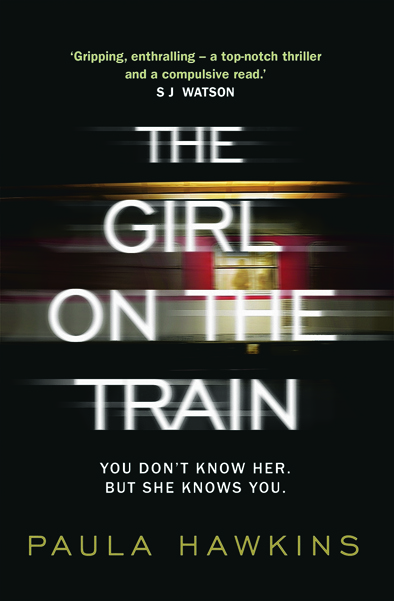
Front Cover for Paula Hawkin’s novel, The Girl On The Train
This could be the year of the domestic noir thriller. After the amazing success of Gillian Flynn’s Gone Girl, both book and film, there was bound to be a reaction in the publishing industry. There is nothing truly new in the world of commercial fiction and there was inevitably going to be a scramble to find the next great tale of poisonous relationships.
Enter Paula Hawkins, journalist turned author, and her first novel The Girl on the Train. Her book is already top of the New York Times bestsellers chart and is on its 10th re-printing. As if that isn’t enough, the book rights have been sold to 33 countries and has already been optioned by Dreamworks.
Like Gone Girl, The Girl on the Train also has an unreliable female narrator – in fact, it has three. The most prominent of these being Rachel, a miserable alcoholic who spends the majority of her days commuting to London. Rachel rides the same commuter train into London every day and when we meet her on a return journey, she has four cans of pre-mixed gin and tonic in her bag.
“I take another sip, and another; the can’s already half empty but it’s OK, I have three more in the plastic bag at my feet. It’s Friday, so I don’t have to feel guilty about drinking on the train.”
It isn’t long before we get a sense that this is a woman with serious problems. Like many of us who commute on a daily basis, from her train seat she looks into the same home which backs on to the railway line, each day. Unlike most of us, however, Rachel creates a fantasy world for the couple who live in the house – dubbing them “Jess” and “Jason”. Our second viewpoint comes from Megan, the real-life woman who lives in the house – she, of course, isn’t as perfect as Rachel imagines and has a terrible secret of her own.
The story gathers pace when Megan goes missing from her house and Rachel believes she has information that could help her husband Scott and the police in their enquiries. She was there the Saturday night Megan went missing, but being an alcoholic, with a habit of blacking out, she isn’t the most reliable witness and struggles with her own memory. The plot thickens even more when we discover Megan’s house is on the same street where Rachel used to live with her ex-husband Tom, who still lives there with the woman he left her for (Anna the third narrator) and their baby.
It’s difficult to say too much more about the plot of The Girl on the Train; like all thrillers, it’s best for readers to dive in spoiler-free. Alternating points of view can be tricky but Hawkins uses the technique very well, giving away just enough in each chapter to keep us on our toes. The tension builds steadily as we nibble away at Rachel’s muddled memories. The best thing about this novel, as about any good thriller, is that we are drip-fed subtle revelations about each character. Hawkins has a real talent for revealing inconsequential details that suddenly take on huge importance and give us a piece of the puzzle.
Sometimes I think authors get carried away with these thrillers, spending too much time picturing what they would look like on the big screen. However, when I say Hawkins’ writing is cinematic, I mean it as a compliment.
One negative thing I could say about the book is that I solved the puzzle a little bit before the big reveal and I felt the climax didn’t deliver the same satisfaction that some better books in the genre can give you. Is it the new Gone Girl? No. Gillian Flynn’s prose is on another level, in my opinion, and Hawkins’ characters fall a little flat. They are bland compared to the ones we have met in the likes of Gone Girl or Sharp Objects but it is great debut, a timely one and an enjoyable read. I would recommend it to fans of the genre.
Damon Lindelof has done it again! Almost five years ago we said goodbye to hit series Lost, but now Lindelof is back with a new mystery that is bound to have people pulling their hair out looking for answers, meaning and intent all over again.
Based on Tom Perrotta’s novel of the same name, The Leftovers covers the aftermath of the “Sudden Departure”, an unexplained rapture-like event in which 2% of the world’s population mysteriously vanish. Three years later and the residents of Mapleton, New York, are still coming to terms with the aftermath of this event.
This show is not for everyone. In fact, it could well be the most divisive tv series of the year. The tone throughout the first season is an overwhelming sense of suffering and misery, unlike any other show you will have seen. But if you like mysteries and morose performances this will appeal to you. If you have lost loved ones and been afforded no closure, no doubt this series will have an effect on you and certainly move you!
Much of the story centres on the Garvey family. Police Chief Kevin Garvey, played by Justin Theroux, is a fascinating character who is struggling to keep the peace in the town while dealing with his own failing sanity. He has the added responsibility of looking after his moody teenage daughter Jill (Margaret Qualley) alone because his wife Laurie (Amy Brenneman) has left him to join the “Guilty Remnant”.
The Guilty Remnant, and in particular Anne O’Dowd as their silent leader, remain an ominous presence throughout the first season. Dressed in white and constantly smoking, their motives remain a mystery to us as they stalk the rest of the town. Across the country, a man called Holy Wayne (Paterson Joseph) provides further mystery as a cult leader who promises relief from suffering with restorative hugs.
The first two episodes of the season are intense, slow and moody. They require some patience to get through but it is worth it in the end. I would compare it to True Detective, in that sense. Episode three ‘Two Boats and a Helicopter’ is one of the best of the season and this is when the show really hits its stride. It focuses solely on Reverend Matt Jamison (Christopher Eccleston) and his struggles with his faith. Another standout performance comes in Episode six ‘Guest’ as we watch Nora Durst (Carrie Coon) come to terms with losing her husband and two children. With these numerous character arcs going on simultaneously, it was inevitable that some would be neglected somewhat – Liv Tyler’s Meg being a prime example.
We could talk about how impressive the writing or cinematography is, or how interesting Lindelof’s use of odd images and animal tropes is but one of the most remarkable things about the first season is the score. Max Richter’s score was a constant highlight and was instrumental in creating the tremendous emotion in some of the scenes.
My Verdict
The Leftovers won’t be for everyone but it is a uniquely unsettling piece of television and I mean that as a compliment. The show’s emphasis on the characters rather than the mystery surrounding the “Great Departure” is what makes it great, not the big, sweeping premise. Rarely has being emotionally invested in a show been so affecting.
We know what we’re getting into with Lindelof. Season two has been given the green light and that means we are guaranteed more mysteries and further unanswered questions. But while this may put off certain people, when it comes to mysteries – some of us are gluttons for punishment.




You must be logged in to post a comment.