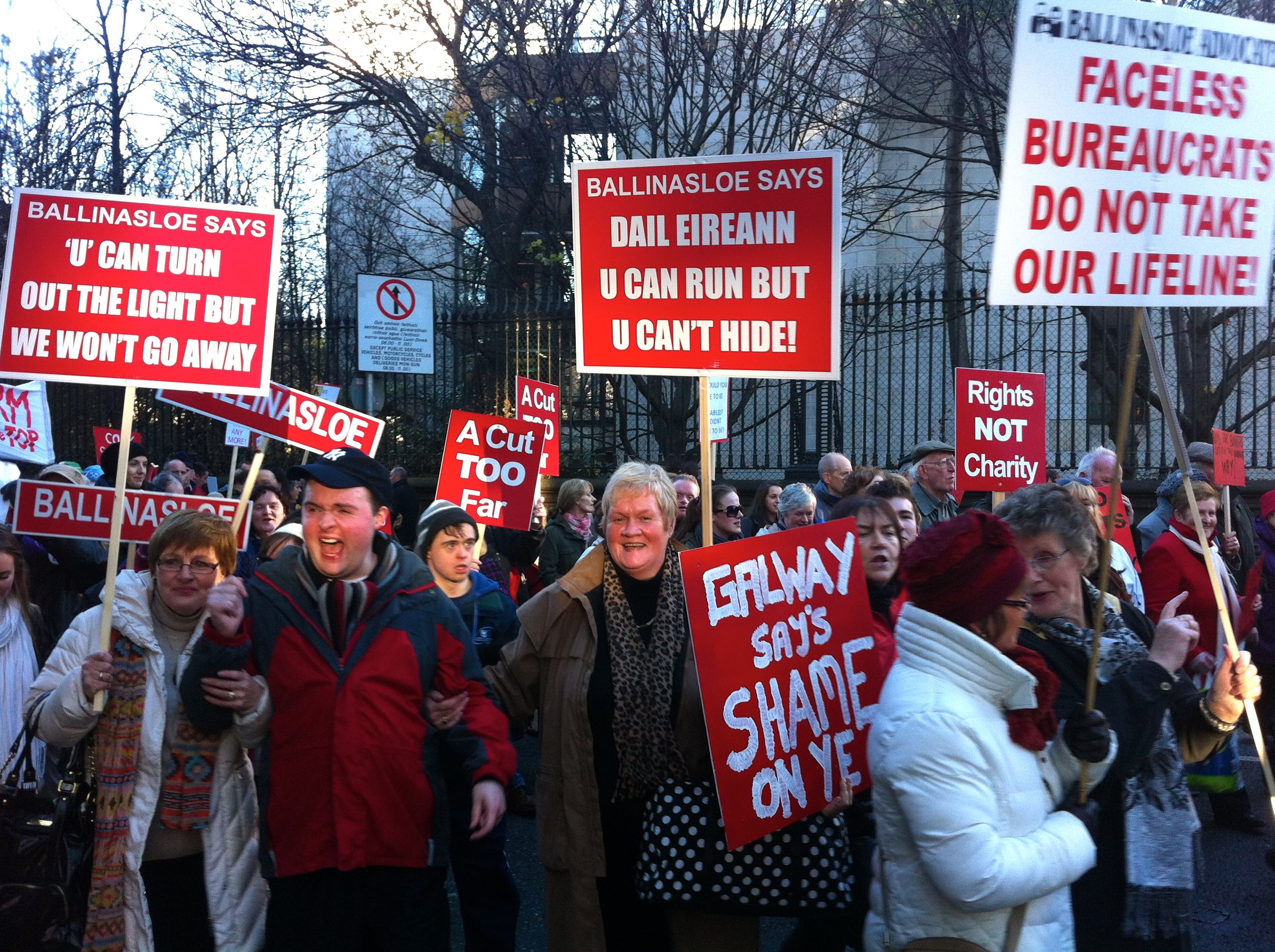
Last Wednesday thousands took to the streets of Dublin to protest proposed cuts to disability payments. The crowds marched to Leinster House where they chanted in unison “No ifs, no buts, no disability cuts.”
The march was held to urge the Government to fully implement the promises made in the 2011 Programme for Government. The programme published in March 2011 contained the Government’s key promises to people with disabilities including, “tackling Ireland’s economic crisis in a way that is fair, balanced, and which recognises the need for social solidarity”.
Other promises included the maintenance of social welfare rates and the introduction of independent inspection of disability services.
The protest was organised by the Disability Rights Coalition Ireland (DRCI). Speaking to the crowds on Wednesday, DRCI spokeswoman Suzy Byrne said, “We should not be relying on rattling buckets to provide us with our human rights.” Protestors who attended on the day were asked by the DRC not to bring political banners in order to make the protest as inclusive as possible.
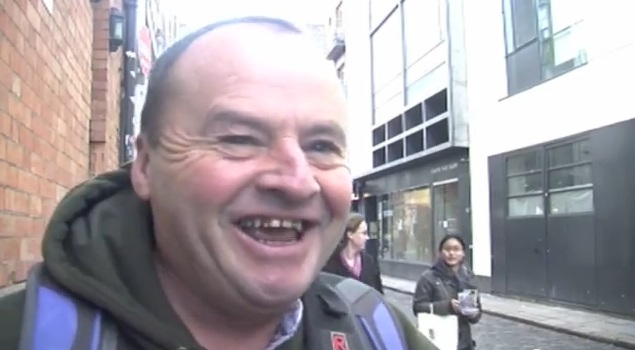
TheCity.ie went out on the streets of Dublin to find out what piece of technology people can’t live without and whether they think technology is a good or bad thing.
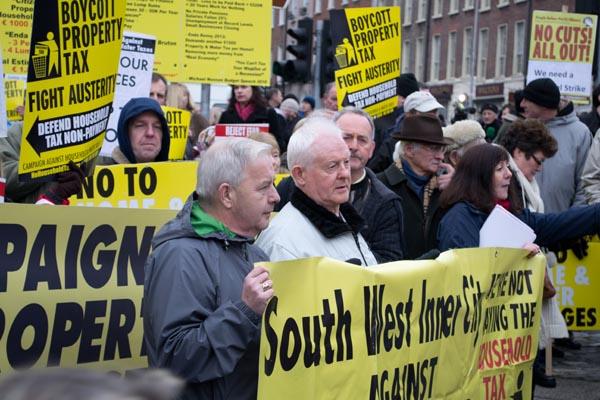
Saturday’s anti-austerity march brought thousands out on the streets of Dublin City.
The march, organised by the Dublin Council of Trade Unions, saw people from all corners of the country come to capital to demonstrate against austerity measures and taxes.
Gathering at Parnell Square, live traditional Irish music – well known songs like the ‘Rare Old Times’ and ‘Dirty Old Town’ – kept participants entertained while waiting patiently in the cold for the demonstration to take off.
When the time came, approximately 10,000 strong left from the Garden Remembrance, with chants and banners at the ready.
Despite the colds, spirits were high and all aspects of society marched side by side – the young, old, students, unemployed and employed alike.
Accompanying the marchers was a wide range of lively music and dramatics – including marching bands, singers, costumed performers and creative floats.
Led by a deathly cloaked figure on a horse – demonstrators left from Parnell Square, making their way down O’ Connell Street and across College Green, before proceeding back across the O’ Connell Street bridge for a special assembly in front of the GPO.
So many turned out for the event that tail end of the march had barely left Parnell Square while those way ahead in the lead were almost at the end point.
This made for a parallel meeting of marchers travelling across both directions of the O’ Connell Street bridge. Here, the sound of uilleann pipes mixed with enthusiastic shouts and a lively sing along of Bob Marley’s ‘Stand Up For Your Rights’.
Meanwhile, unified chants of “You cut, we bleed” bellowed across the Liffey. These chants echoed the general theme and feeling of the march – many hurt and worried by budget cuts and taxes to come.
But whether marcher’s cries were heard all the way over in the offices of Kildare Street remains to be seen.
While elsewhere in the city, anti-austerity demonstrators were preparing to march on Dáil Éireann, here in Wolfe Tone Square austerity and thrift were the watchwords of the day.
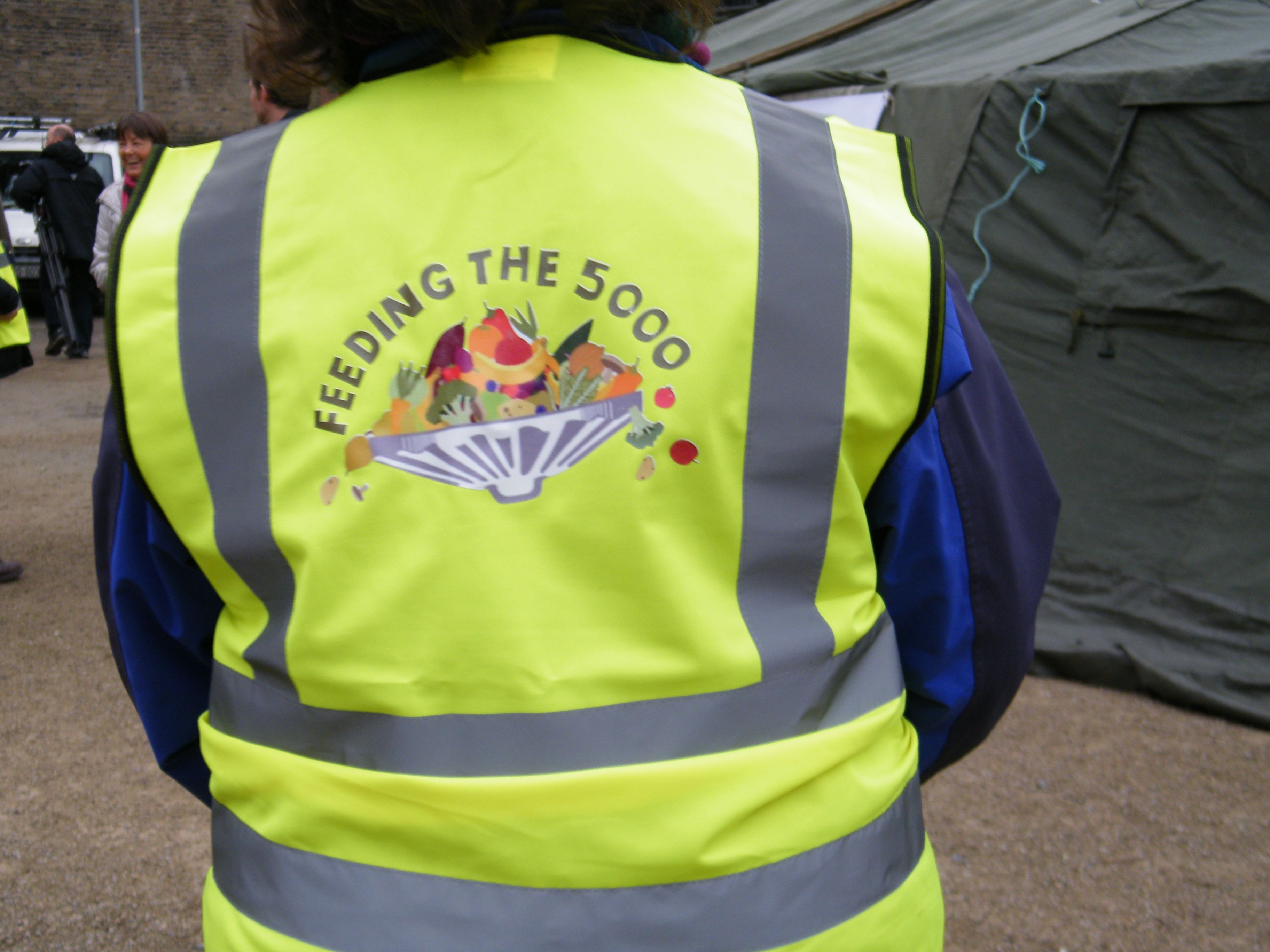
Army tents, mobile kitchens and fridges lined the square, in preparation for Dublin’s first “Feeding the 5000” event – where “ugly” fruit and vegetables would be recycled to make free meals for everyone for the day.
“Shops and shoppers often reject perfectly good fruit,” said Clíona, a volunteer, observing that in the UK, people were more pragmatic and happy to take leftovers at the end of the day, whereas in Ireland, there was a reluctance to do so. “It would be a good thing if that changed,” she added.
Tristram Stuart, author of Waste, Uncovering the Global Food Scandal, and organizer of the first such events in Bristol and London, was on hand to help the Dublin organizers. He stood at the end of Mary Street, encouraging shoppers to come sample the free food.
The pace was slower than expected, but steady throughout the day.
The Dublin “Feeding the 5000” event was held as part of the European Week for Waste Reduction which ran from November 17th-25th.
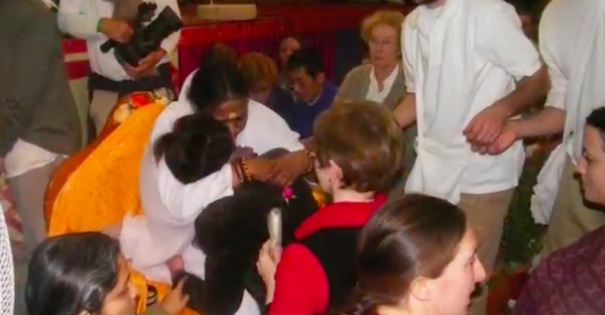
The ‘Hugging Saint’, Amma, recently ran a two-day “Embracing the World” programme in Dublin.
The event was held in the National Show Centre, Swords from 17th – 18th November 2012.
It was last month that I first caught sight of the promotional-posters, advertising Amma’s planned visit to Dublin and despite my initial skepticism, I decided to attend the event.
Intrigued by what her visit might entail, I wasted no time in contacting Amma’s press-team to get permission to take photographs and carry out interviews at the event. Many of the images I captured at the event can be seen in the slide-show below.
To kick-start my visit, I took a few minutes just observing the National Show Centre turned Buddhist-haven.
I soon got chatting to volunteers working on the many different stalls. Some appeared suspicious, and questioned my intentions. This is something I was taken aback by, considering that the event was very much a public one.
After a while, the volunteers warmed to me and opened up in relation to their various tasks.
Karma Thubten, a strict Buddhist and musician with the Dublin Satsang group, was one of those volunteers. “The Satsang group gathers regularly and we focus on Amma’s message of love, through music and meditation. I have been involved with Amma-Ireland the past few years. My life is governed by being compassionate,” he said.
The event was marketed as ‘free’, yet one could not help but notice the countless huge donations boxes which were scattered around the hall. Food was far from free or cheap for that matter, and everywhere I looked money was exchanging hands for one thing or another.
The event was also marketed as being all about “giving”, in which case I couldn’t help but question why so many items were on sale. Atulita Walkden Browne, who was volunteering on a traditional Indian clothes stand said, “All these beautiful pieces were brought over from India. They were given as gifts to Amma from Indian women and are being sold on today to raise money for her various charities”.
Other gifts that Amma had decided to sell on at the event were items of jewellery. Praveena Pichini, who was volunteering on one of the jewellery stands said, “The pieces featured here were worn by the statues in Amma’s temple in Kerala, South India. They are very valuable to Amma devotees”.
Namitha Schaefer was selling Indian Yantra cards. Each card cost 12 euro. Ms. Schaefer described the images on the Yantra cards as “traditional symbols” which are thousands of years old. “They are as they are and cannot be changed. All the symbols each hold different meanings. The Lakshmi Yantra for example, symbolises prosperity, love and beauty”, she said.
Volunteering on the handcraft stand, was Swaminc Krishna. “These handicrafts were made by Indian-natives whilst they said the Mantra, so the vibration they put in whilst making them adds positive energy. The people who buy these items are happy because their money is going to charity. All in all it is a beautiful cycle of giving”.
Also on-sale at Ms. Krishna’s stall, were items marketed as having been previously worn by Amma herself. But when asked no-one could tell me the price at which one of the key pieces, a heavy silver bracelet, was being sold for.
Sugandhi Brown was in charge of the Tulasi-tea stall. “Tulasi-tea is highly medicinal. It is considered a sacred plant in India and Amma recommends it for its healing properties”, she said.
Volunteer usher, Hillary Bodell explained, “I love Amma. Through following her, I have met a lot of people who are very loving and very kind and I’m really happy to be helping out this weekend.” Ms. Bodell first heard of Amma a few years ago. “I was very ill with a Multiple Sclerosis type condition and was wheelchair bound. Some friends of mine knew about Amma and told me about her healing power. I really believe Amma helped to cure me”.
It wouldn’t be far off the mark to describe Amma’s volunteers and followers as ‘disciples’, though they are obviously sincere in their beliefs. The highlight of the event for many Amma followers was the free hug or ‘Darshan’ as Amma refers to it.
Niamh Gallagher explained how she had received her first hug from Amma in 1994 and has been a keen follower ever since. “Volunteering at this event doesn’t feel like work. The weekend is going great,” she said.
There were alternative therapy and massage booths set up, with volunteer specialists carrying out the treatments. This acted as yet another fundraising method and the therapy booths were consistently booked out over the duration of the two days. Her supporters will point to the money that Amma donates to charitable causes. Her detractors will point to the ‘impressive portofolio of property’ amassed by her organisation as American magazine Rolling Stone pointed out in an article earlier this year.
As for me, while I have no qualms in supporting worthy causes, I remain more sceptical than ever in relation to such ‘spiritual’ organisations. Amma, whose real name is Mātā Amṛtānandamayī Devī, has ingeniously become a highly marketable and very powerful product.
National Library Day took place last week.The City crew (Jenny and Blaithin) took to the oldest library in Ireland – Marsh’s library to ask passersby if they have a library card?
For many years Ireland has set the scene for many of Hollywood’s great movies. Ireland has a wonderful history with the silver screen, let’s not forget John Waynes ‘The Quiet Man’ or what about the opening twenty minutes of ‘Saving Private Ryan’, which was shot in Wexford.
The beautiful green fields of the Curragh, Kildare famously set the scene for Mel Gibson’s ‘Braveheart’. Of course these big budget productions need plenty of land to film so Dublin isn’t always first choice, however lately Dublin is slowly but surely becoming a filming hub for Hollywood and beyond.
Only recently Trinity College Dublin became the movie set for Ireland’s first ever Bollywood movie. It’s hard to imagine Dublin as the location for the latest Bollywood blockbuster. Even harder still to picture actors dressed to look like Gardai strutting about in those elaborate dance sequences. The ‘Ek The Tiger’ preview shows dance scenes taking place in Trinity College, Grafton Street and Temple Bar.
In September Harry Potter’s Daniel Radcliffe came to Dublin for the filming of his latest movie ‘The F Word’, a romantic chic flick.
Maybe one day Dublin will have its very own Hollywood style andmark city tour? This might allow cinema goers the chance to retrace scenes from their favourite movies. Possible tour stops for The Commitments’, frequently cited as the best Irish film of all time might include The Guide Hall Synge St where the band are shown playing, or Sheriff St where Jimmy Rabbitte is shown selling cassettes. Include ‘Adam and Paul’ on the tour and your trip will include Ballymun and St Stephens Green. And of course let’s not forget the Academy Award winning ‘Once’ The film takes us on a trip around modern Dublin from Howth Head to Mountjoy Square to Grafton Street all accompanied by a lilting soundtrack.
Another movie associated with Dublin is of course, Neil Jordan’s ‘Michael Collins’. Dublin (including Dame Street; Grafton Street; Fitzwilliam Square; the Dining Room of Mansion House. and the Members’ Room of City Hall) forms a backdrop to most of the film. Collins meetsup with the subversive double agent Ned Broy (Stephen Rea) in the Marshes Library, St Patrick’s Crescent, the oldest public library in Ireland, and is given clandestine access to the centre of British rule, Dublin Castle (www.dublincastle.ie), where he realises the full extent of British intelligence. In the morning, he cycles back across the famous Ha’penny Bridge over the Liffey (the first iron bridge in Ireland, there was, as the name suggests, once a toll to cross it).
So step outside of your cinema and walk the streets of Hollywood, right at your Dublin doorstep!
A schoolboy, who ought to have been in school begged his Dad to buy him a watermelon,one so big that he struggled to lift it. “Please Da can I have it, they’re lovely so they are.” My heart went out to the young lad when his Dad said “not today son.” Even though I suspected he only wanted it because it matched the colour of his uniform.
“Cigarettes for sale” was the brazen bellow to be heard from the street corners. Loud and clear so all could hear.
“Come here to me love and I’ll do your hair for you” pleaded a woman with a handful of hair extensions.
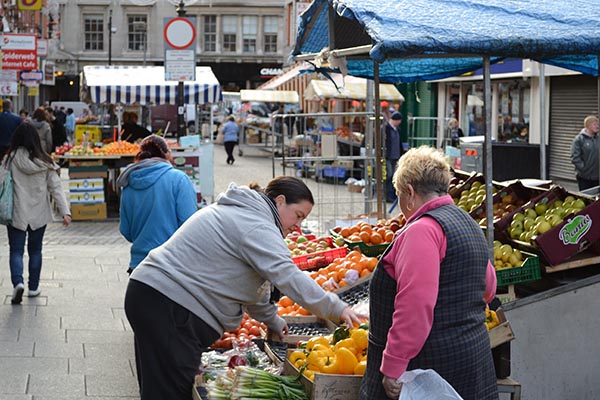
A mother and daughter sat side-by-side at their fruit stall and exchanged tips of the trade. Breakfast for the street merchants consisted of their own produce. One man munched on a banana and a woman crunched on an apple.
The pigeons wanted in on the action too, a flock gathered around chunks of naan bread retrieved from the nearby refuse bin.
A waft of freshly baked bread lingered in the air. The source was a Parisian baker and an actual real bakery.
Across the street stood a lady haggling with the fishmongers; she wanted eight fish but onlyif the price was right. She tried her luck but the experienced trader wasn’t having any of it.
Five minutes later, the customer returned and did a deal. The merchant emerged the happier from that trade-off. Her face lit up, in marked contrast to her earlier scowl.
Neon lights signalled phone repair shops in competition for custom. One such shop had an on-site hairdresser to offer haircuts to ‘shorten’ the wait. Beat that.
A toddler stood enrapt looking skywards; a toy sized toy shop and its turban- wearing ower had captured her attention. She was lost in her own world until her father hurried her along.
A Polish store big enough to take on the Tesco giant complemented the kitsch polish cafe a few doors away. On a fruit stall, Chinese pears took pride of place alongside Irish pears.
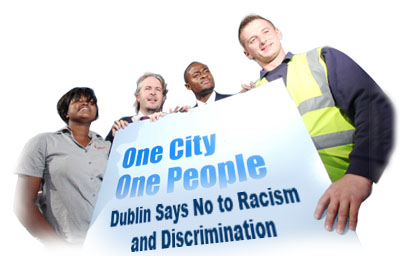
With over 15 per cent of Dublin’s population of immigrant origin and over 120 different nationalities now calling the city home, Dublin clearly embraces its multi-ethnicity. However statistics from Dublin City Council reveal that the problem of racism is very much an issue in the capital, with over 35 per cent of migrants reporting harassment on the street or on public transport and over 32 per cent of migrants questioned reporting discrimination at work. The City reporter Patrick Gormley, spoke with David O’Donovan from the ‘One City One People’ campaign and Helena Clarke from The Integration Centre to see if enough is being done to combat this growing issue.
Running throughout October the ‘One City One People’, held a number of different events across the city to promote inclusion, integration and to combat racism and discrimination, David explained his role in the project. “My role is the support of the overall project from minor projects, to major conferences held as standalone Dublin City Council ventures or indeed working with national governing bodies with similar interests regarding a multi ethnic city.” He added “Every day was different, one day I could be answering emails in my office, the next day I had my shoes off and having a meeting in a mosque, some meetings had translators and also the chance to travel to different cities to compare how they do things compared to “our way” can lead to very interesting discussions.”
When asked if he thought the issue of racism was on the rise in Dublin, David surprisingly answered “In my own personal opinion the issue of racism is not getting worse, this maybe contrary to a lot of consensus out there. But if you think about it, the level of crime is pretty much the same as it ever was, but it’s the type of crime now that would be concerning. We live (and have been living) in a multi- cultural city for the best part of 30 years, it’s the current 20 something’s from all backgrounds who are streets ahead already of the “experts” yet we fail to properly acknowledge this. I believe in 15 years time, the younger kids of today won’t discriminate between the colour of one’s skin, the accent, the traditions, it will be the norm for many at that stage, but the one commonality they will have is that they are all Irish.”
However, Helena Clarke at The Integration Centre, an NGO (Non- Governmental Organisation) committed to the integration and inclusion of people from immigrant backgrounds, argues the contrary saying “racism is the type of issue that, when it is not dealt with properly, it progressively worsens. Racism in Dublin is getting worse and will continue to do so until policy makers take it seriously and legislate for racist crime.” When asked if she felt there was enough being done to highlight the issue she stated “In a word no. The Integration Centre would like to see racism legislated for. This means that racism would be made an aggravating factor in sentencing. We believe that if it was legislated for properly it would be taken more seriously as a crime.”
Both organisations believe that the continuing promotion of an anti-racism message in the city is an important statement of commitment and acknowledge some work still needs to be done. David explained “Dublin’s cultural outlook towards migrants we have found has in general been very positive, with an open acceptance and welcome for the new diversity of population as an asset for the city. A recent Euro barometer survey of attitudes to immigrants in over 70 cities ranked Dublin 18th as a city which is welcome to foreigners but needs to achieve more on integration.”







You must be logged in to post a comment.