
Tag: Education

  • The Cearta protest – thousands march to save the Gaeltacht

    The Cearta protest – thousands march to save the Gaeltacht

    Over the last 15 years, the number of daily Irish speakers has fallen by 13%, from 83,000 to 72,000. With the government investing only 0.1% of state expenditure into the Department of the Gaeltacht, it’s not difficult to see why numbers are dropping so drastically. On Saturday, September 20, thousands of people took to the streets to protest and campaign for the Irish Language and Gaeltacht investment plan 2024-2029. We spoke to attendees and two top level members of Conradh na Gaeilge about their demands. 

  • When is it ‘too late’ to change your college course?

    When is it ‘too late’ to change your college course?

    A study conducted by the Higher Education Authority (HEA) in 2024, found that 92% of college applicants who entered during the 2022/23 academic year progress into the third year of their course, and subsequently their final year as well.

    The study indicates that gender also plays a part in the statistics on who is more likely to remain in college throughout their programme.

    Those who identified as female aged 25-34, and those aged 35-44 years were the age ranges of students who maintained the highest college completion rates at 68% and 66%.

    Those who identified as male, however, had a lower percentage than their female counterparts. Male students aged 25-34 had a college completion rate of 60%, while the age group of 35-45 had one of 55%.

    The gap between gender in third-level education does play a role, whether we acknowledge it or not. This is especially prevalent in the older aged groups, with their rates of completing college being 5-10% lower than their younger counterparts.

    Age and gender do play a factor in college dropout rates, but so does those who aren’t as financially well off. The HEA did a study on the progression rates of students who receive the SUSI (Student Universal Support Ireland) Grant from 2012-2022.

    But what happens to the remaining 8% of students that either drop out of their chosen course, or change their course entirely?

    Scott McDonald was a third-year mechanical engineering student in TU Dublin before deciding to change from his heavily maths-based course to a new option, culinary arts. He became a first year again this September.

    “I realised I didn’t enjoy my degree anymore when I was struggling to get up in the morning for lectures and spending extra hours doing studying for topics I no longer understood,” said McDonald.

    “I was becoming a lot more unhappy and miserable in my course. I’m pretty sure you could see it in the way I did my assignments too. The biggest for me was I began to dread what my future might be someday, working in an industry I clearly didn’t enjoy anymore. I just didn’t want to continue being unhappy to force myself to finish a degree I began to hate.”

    According to the HEA report, degrees with the highest dropout rateswere in the services degrees, which include social care, at a high of 28%.

    This is followed by any engineering, manufacturing or construction degrees at a dropout rate of 20%.

    Scott continued: “When I switched to culinary arts, it was a completely different ball game. When I was in engineering, everything had to be so exact, to the T. But with my new course, I can be more creative and have more sense of freedom to explore things how I want in the kitchen. All my friends and family can see how much happier I am. I’m really glad I got over my fear and switched,” he said.

    Students often feel pressure to continue with courses they decided to do when they’re 18 or 19, with parents often adding to the stress of students continuing courses they aren’t happy in.

    “My advice for others going through a similar thought process is that you’ll be much happier once you take that leap of faith. You’ll see how much happier you can be when you start focusing on yourself, and what you really want to do now. You have the time,” Scott said.

    Stories like Scott’s serve as a reminder to everyone pursuing degrees that no matter the year or age, that you aren’t limited on what you can do. But the most important being, there isn’t any shame on starting again.

  • SITTING THE LEAVING CERTIFICATE AS AN ADULT- PODCAST

    SITTING THE LEAVING CERTIFICATE AS AN ADULT- PODCAST

    By Oscar Lawlor Plazas

    Today’s episode dives into a topic that is relevant to many people, but often goes under the radar—taking the Leaving Certificate outside of the traditional school setting. 

    Did you know that every year, around 5 to 10% of the 60,000 students sitting the Leaving Cert in Ireland are adult learners or external candidates? That means approximately 3,000 to 6,000 people are taking these important exams after leaving the conventional school system. Many do it through alternative pathways, like the Back to Education Initiative or Vocational Training Opportunities Scheme, but some, like our guest today, are navigating this journey independently. 

    Joining me is Séamus O’ Riordan, a 19-year-old who has decided to take on the Leaving Cert outside of school. We’ll be hearing about his motivations, the challenges he’s faced, and his unique perspective on preparing for such a significant exam without the traditional classroom structure. 

  • Students in Ireland Struggling with Rising Rent and Limited Accommodation 

    Students in Ireland Struggling with Rising Rent and Limited Accommodation 

    By Jamie Ryan 

    Yugo Student Accommodation – Photo Credit: Jamie Ryan 

    The student accommodation crisis in Ireland has been an on-going issue for the past few years. 

    Every year, a new batch of students from across Ireland are accepted into universities, in which it is not an option for them to commute – along with returning students who are also actively seeking out accommodation for their upcoming academic year.  

    Kerry Ann-Darcy, 22, a recent graduate of Maynooth University, but originally from Dundalk in Louth, struggled each year during her time in university to seek accommodation.  

    “It’s not easy to find student accommodation in general, especially when there is a ‘first come, first serve’ general booking forum for on-campus accommodation,” Darcy explained.  

    “The university was not helpful and suggested that alternative accommodation could be found on a website called ‘Student Pad’ but that was it. But on Student Pad, the landlords are extremely picky with terms such as gender specific, academic year specific, course specific, degree specific and so on. 

    “Even once I did get accommodation, there were issues with it. My landlord had a table and chair for us in the dining room at the house viewing but had it removed for when I moved in and he told me that I ‘was imagining that there had been one there’. 

    Yugo Student Accommodation – Photo Credit: Jamie Ryan 

    “He complained and gave out to me because we had access to a bedroom, bathroom and kitchen – although that’s what I was paying him for but that’s the bare minimum. In third year, my landlady said that I had to be finished in the kitchen before 6pm but some of my classes only finished at that time,” Darcy added. 

    Back in 2022, the Minister for Further and Higher Education at the time, Simon Harris, made calls to homeowners living nearby to universities to rent out any spare rooms that they may have in their house to students – as a result of the severe lack of student accommodation to supply the high demands.  

    This alternative, however, does not necessarily end up costing students less as research carried out by the USI (Union of Students in Ireland) in February found that students are paying an average of €660 across the country to live in digs, with just 43% of those students given full access to the room, seven days per week. 

    This same study also found that of those surveyed, 59% said that they chose to live in digs as a result of being unable to find an alternative.  

    Antrim native Caitlin Procter, 19, was unable to attend university this year due to the lack of student accommodation available.  

    “After being accepted into multiple courses, I wasn’t even able to accept any of them because I couldn’t find anywhere to live,” she explained.  

    “I was really annoyed and frustrated about it so I sought elsewhere for digs but was still unsuccessful and unfortunately I can’t afford to commute two and a half or three hours per day to and from Belfast and Sligo,” she said.  

    This is a situation that unfortunately, too many students and university hopefuls find themselves in each year and it appears to be getting worse and worse.  

    Ardcairn House Student Accommodation – Photo Credit: Jamie Ryan 

    Dylan Downes, 22, a former student at the University of Limerick, originally from Wicklow, was living in digs for his first year in third level education as the commute between Wicklow and Limerick twice each week was unfeasible.  

    “I felt that living in digs was my only choice to be honest. I got an apartment with some of my friends for the following year, but I really felt that I probably lost out on the social aspect of college in first year,” Downes explained. 

    “My commute to and from college each day was around forty-five minutes, which is obviously better than three hours but even still, when you’re paying €700 per month for a room, it is disheartening, and I sometimes felt pretty isolated. 

    “Thankfully, my accommodation search in second year was far less stressful because one of my friends had already reserved an apartment for the following year and offered me the other room with him, in many cases looking for accommodation is more about who you know than anything else in my experience,” he said.  

    The student accommodation crisis is a direct result of the greater housing crisis that Ireland has been dealing with for the last decade. 

  • “Five percent for the future of Ireland”: Students rally for affordable living 

    “Five percent for the future of Ireland”: Students rally for affordable living 

    By Leonardo Parada Borda

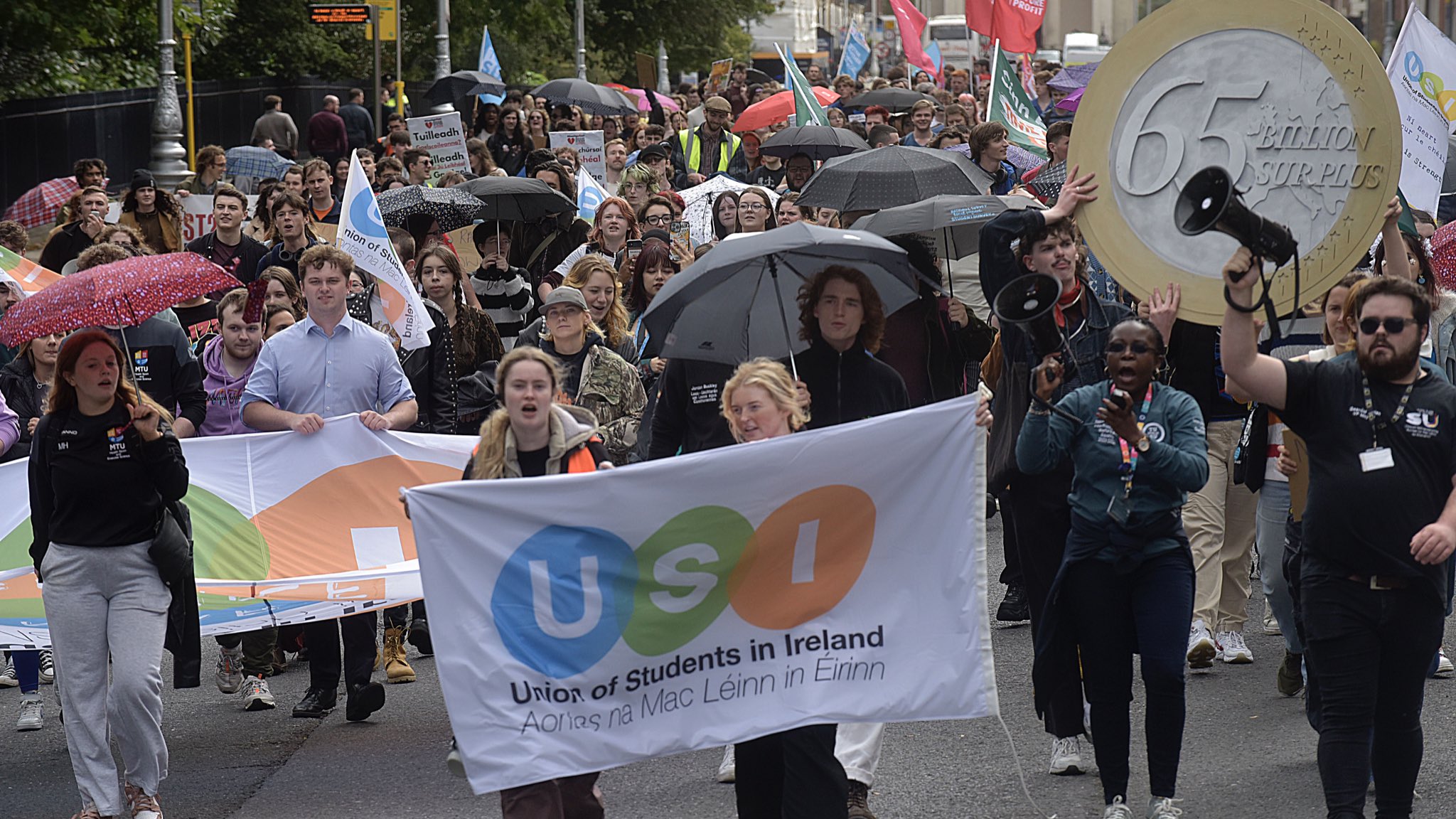
    University students took part in a national demonstration, organised by the Union of Students in Ireland (USI) last Wednesday, where they protested the €65 billion budget surplus the Government is said to accumulate over the next three years. Students nationwide were outraged to hear the surplus would be used for a ‘rainy-day’ fund instead of the cost-of-living crisis. 

    The protest began at the Garden of Remembrance and made its way down to the Dáil with students chanting and singing about the issues they face while studying in higher education. 

    The student-led demonstration was organised to highlight the issues surrounding third-level education and to offer the Government solutions to fix these problems. 

    Brian Jordan, president of the Technological University Dublin’s Student Union said, “This is a national demonstration organised by USI […] The reason we’re protesting is because we’ve seen a lack of student accommodation. The Government has failed to give [students] capital investments, even though that is a clear solution.” 

    “We have a huge amount of private rented accommodation all over Grangegorman. Students are paying up to €1,100 [monthly], and that’s because the university hasn’t built their own accommodation,” he added.


    Brian Jordan and the TU Dublin SU at the Garden of Remembrance. Image: @theusi/X

    Environmental science student, Megan Tynan described how stressful it was to find accommodation closer to college. 

    “For my second year, I was commuting an hour and a half from college. By the time you get home, you’re wrecked,” she said. 

    “I was staying at a hostel for a few days during exams because my landlord decided to sell [the accommodation].” 

    “I was staying in a room with nine people, who were all strangers. It affected me negatively because it’s embarrassing to admit that you are struggling to find a place,” she added.

    “It didn’t just fall out of the sky; it did not just happen. It was caused by Government policy.” 

    Dr Rory Hearne, Assistant Professor of Social Policy at Maynooth

    According to the Pre-Budget Submission for the Budget 2024, submitted by USI, 33% of the total student population says they are experiencing serious financial issues. In 2019, that percentage sat at 26%. 

    President of Maynooth University Student Union, Alex Balfe said that “hundreds of students”, many of whom come from Donegal and Cork, are struggling to find accommodation on campus which is not “sustainable” for students. 

    “Students are waking up at five o’clock in the morning for their commute and they’re not getting home until very late in the evening,” Balfe said. 

    “There’s absolutely no accommodation in Maynooth, considering we’re a university town with more students than residents at the moment,” she added. 

    Third-level students march to the Dáil in protest of the accommodation crisis. Image: @rosspjboyd/X

    The latest figures on Funding the Future — a document released by the Government in August 2023, mentioned that full-time student numbers are increasing and are expected to “peak” at 233,000 in 2030. It is also mentioned that there are currently 29,773 “oversubscribed” students who will not get accommodation in the 2023/2024 academic year. 

    The document mentioned that Minister Simon Harris confirmed “Government approval” for a new policy to be introduced that will provide “state assistance” to the “development of new and additional student accommodation for higher education institutions”. 

    The Government also “approved €62 million in additional funding” for 1,072 additional beds in universities like the University of Limerick (UL), Maynooth University (MU), University of Galway (UG), and Dublin City University (DCU). Assessment is still ongoing for all five Technological Universities (TUs). 

    Dr Rory Hearne, an assistant social policy professor at Maynooth said, “The housing crisis is forcing students to drop out of college, forcing them to pay unaffordable rents and to live in hidden homelessness. College days are supposed to be the best days of your life, but now, it’s a nightmare for many students.” 

    “It didn’t just fall out of the sky; it did not just happen. It was caused by Government policy.” 

    “Rents have increased by 100% since 2011, and 60% since 2020. Here’s a radical idea, in Berlin, in 2020, they reduced rents and put a five-year rent freeze in place. Why doesn’t the Government reduce all rents by 20%, back to the level they were in 2020?” Hearne said. 

    In 2021, Berlin’s Mietendeckle — a rent control law in Berlin, was declared ‘unconstitutional’ and was replaced with Mietpreisbremse — a new rent control law that limits how much rent the landlord can ask for. It is also possible to claim money that was overpaid for rent.

    Video: Elio Bonelli

    President of USI, Chris Clifford said, “How far away from reality is our Taoiseach when students and graduates are leaving the country by the plane load, when students have to decide between food and printing, and when a student’s room is the front seat of their car? That is the reality that this country has created for students.” 

    “We’re looking for the Government to fund the future of this country […] There’s a ‘rainy day’ fund of €65 billion and we’re asking for five percent of that. That five percent reduces waiting lists in hospitals, that five percent means that there’s enough childcare practitioners in this country, and it also means that there are enough civil engineers out there to get these houses, that not only students, but the public are crying out for.” 

    “Five percent for the future of Ireland,” Clifford added.

  • From likes to learning: Irish university launches new social media ‘influencing’ course 

    From likes to learning: Irish university launches new social media ‘influencing’ course 

    By Leonardo Parada Borda

    A new university course in content creation and social media was introduced last week by the South East Technological University (SETU) for people looking to become ‘influencers’.

    The programme (bachelor of arts content creation and social media) will begin in Carlow next September, with applications opening in November this year. 

    Although courses in social media and content creation already exist in Ireland, this course is slightly different. It is the first full-time bachelor’s degree (NFQ Level 7) course in Ireland, with a course duration of three years. 

    Other courses, like the social media marketing courses at University College Dublin (UCD) or the Atlantic Technological University (ATU), offer part-time courses in which you receive a diploma (not on the NFQ) or a certificate (NFQ Level 6) and runs for a duration of three months. 

    So, what makes it different to other courses like social media marketing or journalism? 

    Dr Eleanor O’Leary, the programme director of the course, said that the programme focuses a lot more on practical skills like creative writing, creative video and audio skills, journalism, and crisis management.  

    “The bachelor in content creation and social media is designed to provide students with a broad education to work in front of and behind the camera in digital environments,” she said. 

    Dr O’Leary mentions that the course intends to develop “students’ creativity and individual aesthetic”. 

    “We are also very focused on preparing students for working online and understanding the risks and challenges of operating in this space and the impact on mental health and wellbeing,” she added. 

    “Influencing has grown, and I think it will continue to grow as a form of marketing.”

    Alan Kelly, Social Media Marketing Coordinator at ATU

    With its ever-changing nature, social media poses another obstacle. Influencers must learn how to adapt to the latest trends within the industry to succeed. It’s a way for them to maintain authenticity and address cultural and societal issues. 

    “We stay up to date by working with industry experts, supporting and undertaking research, co-creating our educational offerings with students and industry leaders and reviewing what we offer every year,” Dr O’Leary said.

    Photo by: Carlos Muza/ unsplash.com

    “Having worked in media education for over a decade, you are attuned to the aspects of media industries that change and those that stay the same. Core skills are often consistent over time, and it’s about paying attention to how audiences respond to, utilise, and communicate through new media technologies,” she added. 

    Mr Alan Kelly, the course coordinator for social media marketing at ATU, mentioned that the new course integrates all aspects of marketing, business, and technology into the programme. 

    “I think the degree itself isn’t focused only on influencing, so I think it’s sustainable because it has many aspects,” Kelly said. 

    “Fair play to them. They’re trying to be seen, and by including the words ‘influencer’, they’ve managed to market the programme really well based on that.” 

    “Influencing has grown, and I think it will continue to grow as a form of marketing,” he added. 

    Kelly said the course has a promising future and will ‘continue to evolve and grow’ if there is more emphasis on marketing and business rather than influencing. 

    “I don’t think there will be that many sustainable jobs, I think a lot of people are already there, but I think the course itself offers a lot more than influencing, which I do think is really important.” 

    “You can go out there and be an influencer without doing a course. If you have some decent technical skills, you can look up a YouTube video, but people don’t know enough about the ethical issues and the legal aspects that come with it.” 

    Kelly mentioned that Meta and the virtual world will also help social media influencers stay active and have an additional platform to market themselves. 

    “It will evolve. New platforms have come out. We can look at Meta and the virtual world as an example. Marketing will migrate there, and so will influencers,” he said. 

    “I think there is still that ethical and legal minefield out there […] There will also be people who want to fight with you on social media, and the way they communicate that with you can be terrible. There are going to be problems going forward.”

  • How Online College Has Affected Students

    How Online College Has Affected Students

    woman writing on a notebook beside teacup and tablet computer
    Photo by Tirachard Kumtanom on Pexels.com

    Emily Goss Guildea

    Another year of online studies, a handful of in-person classes and the college “social life” still different from how it used to be. 

    Students around the country have been affected immensely due to their studies being taught online, taking away the constant in-classroom learning and the classes that are in person are now only permitted to 45-minute learning time, due to government regulations. So, how are students finding college this semester?

    An Instagram survey was set out to investigate whether students prefer college online or in-person and how the pandemic has affected their studies. One student from Technology University Dublin, who wishes to remain anonymous stated, “I used to be a very good student until online college and covid shattered my mental health,” they then went on to say that they were not receiving their money’s worth within their education. “My course needs a lot of communication from lecturers and that collapsed this year.”

    When asked on an Instagram poll conducted by a student from TUD whether or not students preferred online college or in person, 25% of students who took part in the poll voted for online and 75% voted for in person. This poll consisted of 99 students, and it is evident that the majority voted in favour of in person college. Following this question, students were asked if they believed that students should still pay full tuition fees although classes are still online, 96% of students voted “no”, and 4% voted “yes”. With “no” being the majority vote, it is clear that students feel they should not have to pay full tuition fees when their course is being held online. 110 students participated in this poll.

    Visual Merchandising and Display student from Technology University Dublin explained how the pandemic has affected her studies. “My first year of college was online, we were lucky enough to have one day on campus as it is a very hands-on practical course, but I feel like the online aspect made me somewhat lazy and less interested in my course.” When asked how she felt about this semester of college she explained that they have online and in-person classes, but the online classes are not for her. “I would much rather college to be completely in-person, I understand the severity of the pandemic, but I feel my course is at a loss as it is very practical and being in person is beneficial for our projects and hand-on learning.”

    Many students agreed that they shouldn’t have to pay full tuition fees due to college being partly online and not completely in person. Psychology student from IADT stated, “no we shouldn’t have to pay full fees, I’m only in person two days a week, with a class being cancelled nearly every week.” Other students explained how lecturers aren’t as attentive as they should be and that facilities being closed within colleges does affect their studies. From shorter opening library times, too little to no hands-on use of college equipment, students aren’t getting the full college experience. DCU Students Union Officer Ross Boyd stated, “students shouldn’t have to pay full fees full stop and should be purely government funded.”

    The Instagram survey concluded that students are not happy with how the pandemic has affected their studies, most students with the same response, that full fees should not have to be paid and the “college experience” not living up to expectation. Numerous students explained how their mental health has also been affected by this, and that they are less motivated to pursue their studies when classes are online.

  • Teachers worry among rising COVID-19 cases

    Teachers worry among rising COVID-19 cases

    By Katie Ward

    Creative Commons License on Pixabay.

    With covid-19 cases surpassing 5,000 per day, many teachers are concerned about how the number of cases could affect their health.

    Student primary school teacher, Niamh Daly, said ‘I am quite worried about returning to placement. The cases in schools are so high at the moment, and I know lots of teachers who have gotten Covid in school.’

    ‘I think the government needs to recognise that schools are not safe environments in terms of spreading Covid. Lots of precautions are being taken in schools in terms of PPE, sanitisation routines and ventilation However, it is clear that there are still improvements that could be made in these areas’ she added.

    The Government has implemented mandatory guidelines that children aged nine and older must wear masks while in school. Primary school teacher, Maeve O’Donnell* (name changed to protect identity), from Dublin said: “I do not think it will make much of a difference. Children play and mix in the yard and it’s hard enough to get them to keep coats on outside. I think masks would be hard.”

    “If it helps the spread of the virus, it will be great but that will only work if children are wearing them properly, which I think will be hard to police.”

    New restrictions announced 3 December states that a maximum of four households should mix. O’Donnell said: “I feel pressure around having many close contacts. I am a young teacher, and it is my first year teaching full time. However, I would like to keep some sort of a social life, but it has been difficult in the pandemic. I have been trying to limit my number of contacts by seeing the same people and frequent antigen testing.”

    Daly was of a similar mindset. “At the moment I am still in college, so I am not really able to cut my social contacts. We have big lectures with up to 400 people. From next week, I will cut my social contacts down for when I start teaching again.”

    Public health advice states that children and teachers who have any symptoms of Covid-19 should isolate at home and get a PCR test. 

    “I know many teachers where they would have the same guilt around calling in sick as myself. It is a profession where a lot of the time calling in sick isn’t an option for a lot of people. The expectation has been that teachers come in no matter what. Covid has changed how they expect us to react to being sick, but I don’t think the mentality has caught up,” said O’Donnell.

    Schools all over Ireland are struggling with a teacher shortage due to Covid-19 and there is a lack of substitute teachers available. Fellow EU state Belgium closed schools a week early in the hope to bring down cases. “It is hard to know if we will follow in the same footsteps’ said Daly ‘I hope we don’t but with the rising case numbers everything is up in the air.”

  • Struggling with homeschooling? The ‘Maths Eyes’ initiative combines nature trails with education

    Struggling with homeschooling? The ‘Maths Eyes’ initiative combines nature trails with education

    With schools closed, TheCity.ie’s Kate Brayden looks an innovative solution which could help parents cope with teaching maths in everyday settings.

    The Coronavirus pandemic has undoubtedly changed every aspect of our lives, but as self-isolation is leaving much of Ireland stuck indoors the household is particularly affected.

    On top of trying to work from home, many families are expected to educate their children at the same time as holding down a job. It’s a burden that is weighing heavily on some parent’s shoulders.

    While teachers themselves have assigned homework to schoolchildren to keep them busy during the pandemic, one initiative may have the answer for families seeking to balance their daily walks with learning.

    Maths Eyes was created in 2011 by Dr Theresa Maguire – whose motto is ‘everyone has maths eyes, they just need to be opened’. Dr Maguire developed the programme to support the continuous professional development of adult maths tutors in Ireland, and extended the concept of Maths Eyes’ to build confidence in parents within local Irish communities.

    The idea is that people can discover the maths surrounding them in their everyday life. Maths’ Eyes aims to facilitate learning for every type of child, adolescent and adult; especially those who struggle with the standardised curriculum of textbook learning.

    Dr Theresa Maguire (Left), Dr Sheila Donegan (Centre) presenting awards at Maths Week.
    (Photo: Maths Eyes website)

    Their website contains an extensive resource pack for parents, tutors and teachers, filled with ideas on how to allow maths to be expressed creatively using innovative solutions. Building a positive image of the subject is the most important thing to these educators, according to Ciaran O’Sullivan, mathematics lecturer in IT Tallaght’s Department of Mechanical Engineering. Having been a maths educator for 27 years, O’Sullivan was the perfect person to join the Maths Eyes team.

    “The idea is to awaken people to the fact that they use and they know and they’re more comfortable with maths than they might actually first allow,” O’Sullivan told TheCity.ie

    “There was a curiosity campaign, there were just posters put up with queries and questions just to get people thinking. It’s trying to move away from the idea that maths is only in a textbook in primary school.”

    Ciaran O’Sullivan, mathematics lecturer in IT Tallaght’s Mechanical Engineering Dept.
    (Photo: Ciaran O’Sullivan)

    Mental health issues are expected to skyrocket during the next few months, stress levels are set to peak alongside the number of Covid-19 cases, and many will be too busy with caring for family members to focus on their child’s homework Protecting the wellbeing of children is hugely important, as well as aiding their education, but Maths Eyes could be the perfect way to help the family take their daily walk while learning.

    “Firstly, it is very difficult to be at home with children – their parents aren’t their teachers, so that’s always going to make it challenging,” O’Sullivan adds.

    Maypark Maths Trail, supported by TU Dublin and Dublin City Council (Photo: Maths Eyes)

    “I think the way that Maths Eyes can help parents at home is through the development of maths trails and the poster competition. Those resources on the website are there so that the parents could download them and think, ‘Okay, we’re stuck around the house or the garden, but maybe I could do a little maths trail around the house’. All they need for that are Post-it notes,” according to O’Sullivan. 

    The scheme began in Tallaght, and is now supported by Technological University Dublin (IT Tallaght) and the Dublin West Education Centre. Within Ireland, Maths Eyes has active projects in around 200 schools and education centres with nature trails in numerous public parks. It has since been replicated internationally, beginning in Austria. Similar initiatives have also sprung up in England, Scotland, New Zealand, Australia and Washington DC.

    “It’s gained a bit of momentum there, so it must have some benefit for that,” O’Sullivan mentions.

    Community Maths Eyes nature trail (Photo: Maths Eyes)

    “I know myself from doing Maths Eyes sections in various primary schools that the children that engage aren’t necessarily the children that love the textbook type of maths. Once they realise that they can see some kind of normality to it in the sense that there isn’t really a right or wrong answer to a lot of questions, it’s more about the discussion.

    “People can get a way into maths that they hadn’t seen or noticed before. It’s also used in adult education settings as well, and it’s been a very useful tool there for getting people to come back from the idea that they’re not maths people. Once they gain a bit of confidence and success, they’re prepared to push on with their education,” said O’Sullivan.

    The link between socio-economic status, academic attainment, and future earning levels remains worryingly deep. Young people from wealthier backgrounds are more likely to go to college, carry out post-graduate education courses and earn 30% more than their comparator from a disadvantaged background, according to the Higher Education Authority.

    The creativity which the initiative inspires could also have huge benefits for the current generation of kids, as well as the next, who must grow up with the burden of climate breakdown on their shoulders. With highly innovative solutions needed, programmes like Maths Eyes could be the ideal change to our education system to foster ways of thinking outside the box.

    “I view maths as being much more creative than what normal people see it as,” O’Sullivan comments.

    “Even right now – with this horrible pandemic going on – it’s the ability for people to look at what the numbers are, what the numbers mean, what we should be doing, when is the right time to be social distancing; it involves us having to think about much bigger problems than ever before.”

  • “Education is life-changing, it gives us opportunities”

    “Education is life-changing, it gives us opportunities”

    By: Ana Novais

    Travellers’ unique status as an ethnic group within Irish Society was recognised by the Irish Government in 2017.

    In 2018, the Traveller History and Culture Bill, was passed by the Seanad, encouraging schools to teach Traveller History and Culture and include it in the curriculum.

    Senator Colette Kelleher, Chair of the Joint Oireachtas Committee, was one of the people involved in the process of getting this Bill through the Seanad.

    Speaking to TheCity.ie, she recounted one of the individuals who gave a testament about why this is an important element of Irish history.

    “Young historian and traveller, Patrick McDonagh, during a briefing for this bill told us how nomadic groups have lived in Ireland for centuries. They are part of Ireland, part of its history and part of its culture, but travellers already know this. It is the wider population that need to be taught the importance and richness of traveller history and culture”.

     Patrick McDonagh
    Credit: Ana Novais

    Travellers have a deep and rich culture. They have a long musical history, a language, a deep love of animals and a strong tradition of metal and tin smithing.

    Persistent discrimination is still, sadly, the reality for Irish travellers.

    According to the higher education seminary report issued by Maynooth University, Irish Travellers are a distinct ethnic group.

    Patrick McDonagh is an Irish traveller from Omagh Co. Tyrone, a neighbourhood in Northern Ireland. He is currently undertaking a PhD in Trinity College.

    “I did a history and economics degree, and I’m currently doing a PhD in medieval history, essentially about late medieval imperialism in Britain and Ireland.

    “I would never have the opportunity of studying medieval history if I hadn’t gone through the education system and even the way I see the world is quite shaped by what I read and by what I study,” he added.

    According to the 2017 Economic and Social Research Institute (ESRI) report: “A Social Portrait of Irish Travellers and the educational disadvantage experienced by Travellers means that specific additional supports will be required in order for them to participate in mainstream education on equal terms with their settled peers.”

    Christy Moorehouse (Daish Manager) and Paddy Moorehouse (Community employment placement) at Bray Bray Travellers Community Development Group.
    Photo Credit: Ana Novais

    Jim O’Brien, manager of Bray Travellers Community Development group said: “Our education at the minute is not really positive, but we are starting to make changes.”

    “Education is now just as important for our community as it is for any community because what else is it for them when they become an adult or late in their teens if they don’t have certificates in their back pockets what hope have we got?” he added.

    According to the Irish Census 2016, the level of education among travellers remained well below that of the general population, showed in Figure 2.1.

    Only 13.3% of traveller females were educated to upper secondary compared with 69.1% of the general population.

    Source: Central Statistics Office (CSO)

    O’Brien said: “change comes from everyone, anyone who stays fixed to one spot falls behind, change won’t destroy the community.”

    Jim describes his experience in education through mainstream school as bleak or non-existent. He recalls that he could never understand why in a class of 30 plus students, he was put behind the teacher instead of in front of the teacher, all the time.

    “From a traveller perspective a good change for the traveller community would be a better focus and appreciation of education but change also has to come from the other side, and one of the issues is racism.”

    “If we have children coming back from school saying someone called me a gipsy or a knacker, we are going to be less keen to send them to school. Sometimes children don’t feel welcomed, they feel like an outsider,” he continued.

    According to the National Traveller Survey funded by The Community Foundation for Ireland, 4 out of 10 travellers have experienced bullying in school while, many have been put on reduced hour timetables. There is also an 80% drop out rate before the Leaving Cert.

    Senator Colette Kelleher finished up by saying: “I have recently begun saying pushed out rather than drop out, as it more accurately reflects the situation. Schools should be open places for all, and everyone has a right to an education.”