
Tag: Education

  • Budget 2015: A student’s guide

    Budget 2015: A student’s guide

    The rise in the contribution charge announced in the budget leaves a bad taste in the mouth for many students. Fees are up €250 making it an even €3,000 to pay most college registration fees next year.

    The Back To Education Allowance and the Student Grant scheme however have been left unaffected.

    There has been no reversal of the government’s position on post-grad students who will continue to receive no assistance.

    This budget has been seen by many as the government giving something back after the many years of austerity. In that vein there are other areas where small improvements have been made that may make life a little easier.

    The USC rate has cut from the 2% rate to 1.5% and the 4% rate to 3.5%. If you earn below €12,000 a year you will be exempt from the charge. This means a little bit more money in the pocket of those that support themselves with part-time work

    An Investment of €10m in college facilities for Institutes of Technology has also been announced. This will be spent on improving facilities and equipment.

    If you live in the city and attend college while receiving the grant of Back To Education Allowance you will not be able to avail of the €500 tax relief on offer to those already receiving social protection.

    The minister for education Jan O’Sullivan said “This Budget is set against the background of an improving economic situation…These are positive developments that will be built upon in the coming Budgets. “

    The old faithful rise in cigarette prices has continued. A 20 pack will now be 40c more expensive, while large rolling tobacco pouches have gone up by 25c. Alcohol and fuel are unaffected by this year’s budget.

    While many other people in the population have seen a more positive affect from the budget, the student population has a more subdued outlook from Tuesday’s news. The President of the Union of Students in Ireland Laura Harmon said: “Whilst we’re glad that no new cuts to student supports will be introduced in this budget, we’re not exactly breathing sighs of relief. The escalator on student contribution fees adds €250 more on to fees which are the second highest student fees in Europe, placing enormous financial pressure on students and families.”

  • Part time work, the new slave labour?

    Workers rights are something that have been challenged over and over again. Throughout the last few decades it’s been inspiring to see people stand up everywhere and fight for their rights.

    There are a lot of different groups that can say they were treated unfairly for a particular reason. Women have usually always been at the forefront of the workers rights issues. But now, maybe it’s time for the students to stand up and claim equal rights.

    College students struggle as their rights are being taken for granted
    College students struggle as their rights are being taken for granted

    Under current law, those who work part-time have to be treated equal to those who are full time, if the job that they do is interchangeable. This applies to most people who work in the service industry such as restaurants, hotels, bars and supermarkets.

    There’s a lot of stress put on students that work part time through college. The lecturers want them to put their college work first and their employers want them to put their jobs first. It’s a difficult situation when you need both in your life. A college degree will further your career later in life, but your current part time job is what puts the food on the table and a roof over your head.

    Talking to one student, who wishes to remain anonymous, they discussed what kind of pressure they were put under in their job at a large supermarket chain;

    “As an employee in a large retailer, I found that I was constantly having to defend myself to ensure even the most basic rights. If there was a problem, like for example I wasn’t paid correctly, I would have to spend days chasing down various people to try to sort it out, only to be met with an attitude that made me feel like I was the one in the wrong. Managers frequently talked down to me and belittled me. I was expected to go above and beyond my duties daily and my tiniest mistakes were blown wildly out of proportion. My requests for days off to allow me to sit exams were ignored. The message is very clear: “you are lucky to even be here, so shut up and get on with it.”

    2014-10-12 16.11.32

    Unfortunately, this is not the only incident where a student has felt like they were being pushed to forgo their college work in favour of their part time job.

    Another student from Dublin Institute of Technology spoke about how their employer would over work them and expect them to be able to deal with it. The student said that they were meant to be on 20-25 hours a week, but after signing the contract that’s not how it worked out.

    They put me on flexi-time which meant they put me in for hours I was in work when I should have been in college. It made education very difficult. On top of that I was given hours way above my contract with threats of losing my job if I made complaints about it. The argument was made that my job should always come ahead of my education.”

    So what’s there to do if you are a college student and can’t seem to find the right words to speak up against exploitation? It seems like a doomed hope sometimes. You don’t want to keep working in an unfair environment, but you need the money to live.

    Fortunately there is hope.

    Femi Bankole, the Welfare Officer in DIT offers his help to students when it comes to standing up for your rights. He encourages every person who is having difficulties to come talk to him for advice.

    “I’d usually advise firstly by asking what steps they’ve taken with regards to resolving the situation if any . Sometimes these conflicts can usually be sorted by just having a chat with your manager / supervisor … If not I’d be referring them on to NERA.”

    2014-10-12 16.16.56

    NERA, is the National Employment Rights Authority in Ireland. Established in 2007 they deal with coomplaints and queries in the workplace. They’re there for support if you feel that your workplace isn’t adhering to the laws. If you need more information you can visit www.citizensinformation.ie for more details on your entitlements as an employee.

    KNOW YOUR RIGHTS!

    The Organisation of Working Time Act 1997 states the laws in relation to breaks and rest periods. The law goes as follows;

    • You are entitled to a break of 15 mins if you have worked four and a half hours.
    • You are entitled to an additional 30 mins if you work over six hours
    • For those who work in shops, if you work more then six hours, some of which are worked during 11.30-14.30pm, you are then entitled to a one hour (consecutive) break
    • You are meant to have a rest period of minimum 11 hours inbetween any shift
    • The maximum you are legally allowed work is seven days in a row before having to be given 24 hours off
    • Split shifts are not covered by the Act
    • The only ones exempt from the Act are Gardai, the Defense Forces, Family employees on farms/in private homes, employees who are in control of their own working hours
  • Irish Students Unite in Pre-Budget Rally

    Irish Students Unite in Pre-Budget Rally


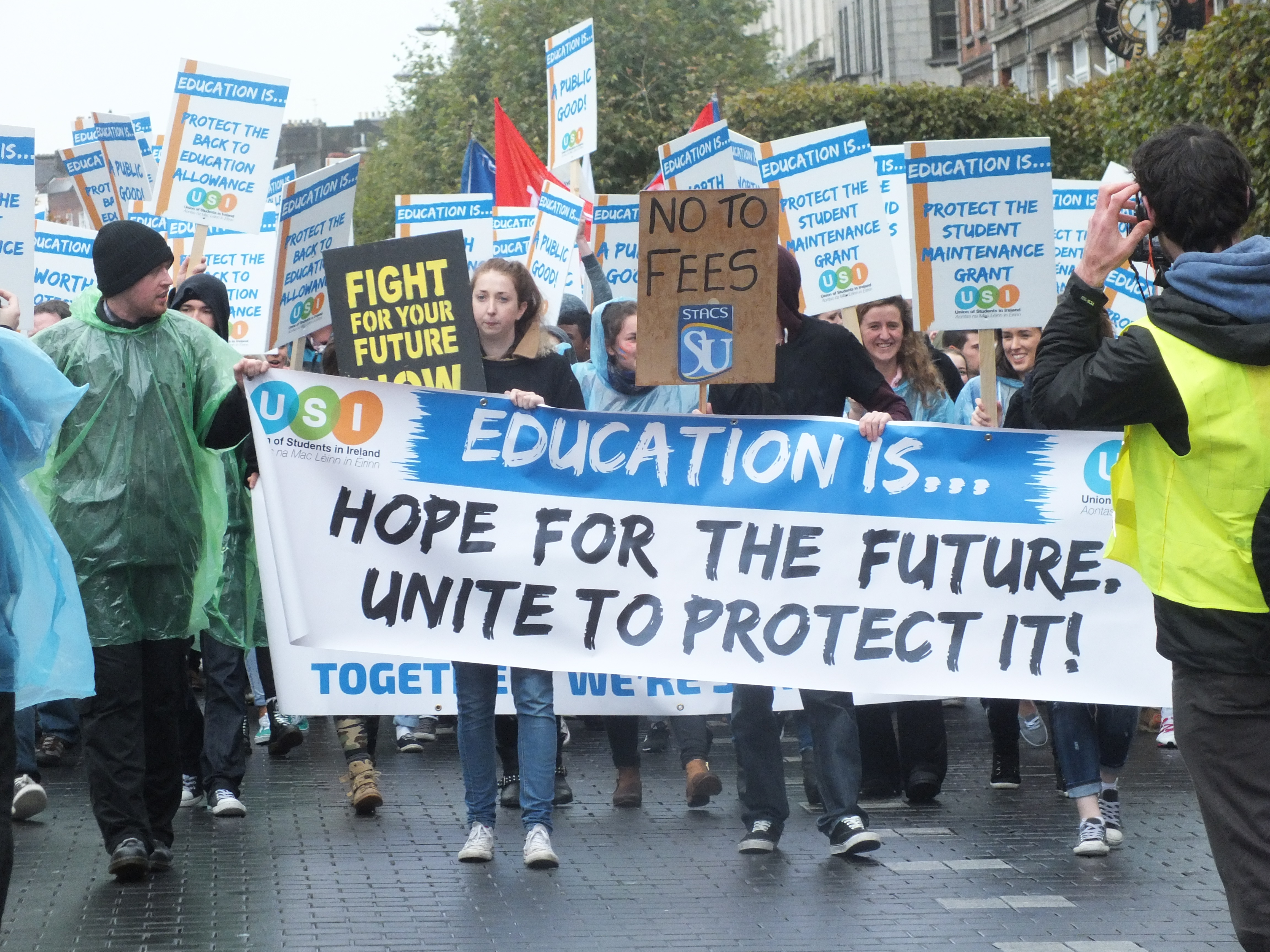
    Third level students from all over Ireland took to the streets of Dublin yesterday for the USI March for Education.

    The protest commenced at the Garden of Remembrance and the students marched to the Dáil in torrential rain, calling on the Government to protect essential student services in next month’s budget.

    Speaking at yesterday’s rally, NCI student Rebecca Caulfield (20) said, “If we didn’t protest and costs go up in the budget, it’s going to hold a lot of people back and less people are going to go on to third level education.”

    USI president Laura Harmon said that the main goal of the rally was to protect the existing State financial support services for third level students:

    “The main thing we hope to achieve is to highlight the fact that student supports need to be protected in Budget 2015.  The student maintenance grant and the Back to Education Allowance must be protected.”

    According to DIT Student Union President Fiachrá Duffy the march was the beginning of the USI’s #EducationIs campaign which aims to show the Government that education is a very positive thing for our society.

    “It is to get people behind us”, said Mr Duffy, “It isn’t just students; it is everyone coming together to say that education is positive and it should be made more accessible and more affordable for as many as possible.”

    Mr Duffy also added that around 45% of students studying in DIT are on some sort of State financial support.

    “It is essential that we call for those financial supports to be protected for our students” he said.

    Despite the weather it was estimated that 1,500 students from throughout the country took part in yesterday’s rally, and were joined by lecturers and trade unions.

    This was a low turnout compared to previous national scale protests in 2010 and 2011, in which around 40,000 students took part. However Fiachrá Duffy said that numbers weren’t an issue.

    “I think it was important that there were people there,” said the DITSU President.

    “It was to show that students from all over Ireland are united on the same issue, and I think that it is a representation that we are all calling for the same thing,” he added.

    This slideshow requires JavaScript.


  • A mature road to recovery

    A mature road to recovery

    It’s 6am on a brisk Saturday morning in November, and George Fitzgerald is about to embark on his weekly journey down to Cork from his home in Kinsealy, north county Dublin.

    “When I’ve an assignment due it usually takes up to three or four hours in coursework a night. That’s all on top of the day job, and it’s by no means a 9-5 job either. The hours tend to be very long” says George, as he wrenches open the door of his Audi A4 ahead of another monumental trek south to Cork IT’s Bishopstown campus.

    He’s one of a legion of middle-aged students across the country who are choosing to further their education by enrolling in third-level courses. According to latest Higher Education Authority (HEA) figures, full-time mature entrants now account for 14% of the student body in third-level institutions- nearly 10% more than in 1998.

    DSCF2157
    George attending to some of his college work

    “I could see the need to progress. I was with the same company for 23 years and I’d plenty of in-house training, but for me to progress outside of that I knew I had to get a degree” says George, a customer service manager at Network International Cargo.

    Having completed a diploma in Supervisory Management at Dublin’s IBAT college earlier this year, his workplace is now fully subsidising his current part-time Bachelor of Business in Supply Chain degree course in Cork.

    And he’s not alone.

    According to HEA statistics for the 2011/2012 academic year, 17% of all participants in college courses were classified as mature students (over the age of 23). Of that number, an increasing amount fit George’s description, a fact illustrated by the massive 20% increase in 35-44 year-olds engaged in higher education from 2000 to 2010.

    hea-logo_1

    The accompanying report states that increasing unemployment and vulnerability of employment during recent recessionary times has led to many people who may not fit the profile of a conventional college student to either return to or take up third-level education as a means of bettering their career prospects. That’s definitely how George sees it.

    “It definitely gives you an edge for your career prospects.

    “Not only that, but it’s the stuff you pick up on the course. A lecturer might say something and you can see how that might slot into your own business. Those you’re working for see that you’re not afraid of hard work and putting the extra effort in as well as it being for your own progression.”

    It’s a sentiment echoed by the employers union IBEC, whose recent survey found that 86% of employers involved are providing financial support to staff who are pursuing further education. This is a welcome development as Ireland looks to further solidify its position as a knowledge-based economy, according to Tony Donoghue, IBEC’s Head of Education and Innovation Policy.

    “The only way that Irish standards of living can be maintained into the future is through the development and production of higher quality and more innovative products and services,” said Mr. Donoghue.

    “By 2025, mature students are expected to account for a quarter of all students. The recent economic downturn has highlighted the importance of lifelong learning and workforce development. Jobs are becoming increasingly skill-intensive and this trend is certain to continue.”

    Latest estimates put Ireland 6% above the OECD average of 25-64 year-olds with 3rd level qualifications. HEA Chief Executive Tom Boland said in the organisation’s 2012 report that our colleges are adapting to reflect their changing student body, which George Fitzgerald is most certainly glad to be a part of.

    “I’d definitely recommend for others to do the same as me,” says George. “It’s very intense because I often have assignments due on successive weekends so it’s a difficult workload, but when you know you’re reaching a conclusion and seeing the light at the end of the tunnel, it’s definitely worth it. Just for a personal feeling of achievement if nothing else.”

  • Budget Day met with lacklustre protest

    Budget Day met with lacklustre protest

    By Greg Synnott, Michael Coleman and Saoirse Ivory

    A series of tax adjustments and cuts were announced by Minister Michael Noonan in yesterday’s budget. The City were outside government buildings when the announcement was made.

    The €2.5 billion plan included €900 million in additional revenue and €1.6 billion in cuts.

    Some of the measures announced by Minister Noonan and Minister Brendan Howlin include:

    • A reduction in jobseekers allowance to €100 per week for under 25s
    • An increase to the price of beers, spirits and cigarettes of 10 cent, and an increase to the price of wine of 50 cent
    • Funding to third level institutions will be cut by €25 million
    • The abolishment of the phone allowance for pensioners
    • The banking sector will now pay €150 million to the  exchequer annually
    • Free GP care will be provided for all children under five
    • Additional jobs will be added in hospitals, schools and An Garda Síochána starting next year, but overall pay will be reduced by €500 million
    • Prescription charges on individual items is to increase to €2.50
    • Tax relief for single parents (who could previously both claim the credit) will be changed to a Single Person Child Carer credit, which only the primary carer will claim
    • A new unified DIRT rate of 42% was introduced
    • Tax relief for medical insurance will be capped at €500 for children and €1000 for adults

    Minister Noonan concluded his speech by saying that Ireland is still facing some tough times, but is on the road to recovery.

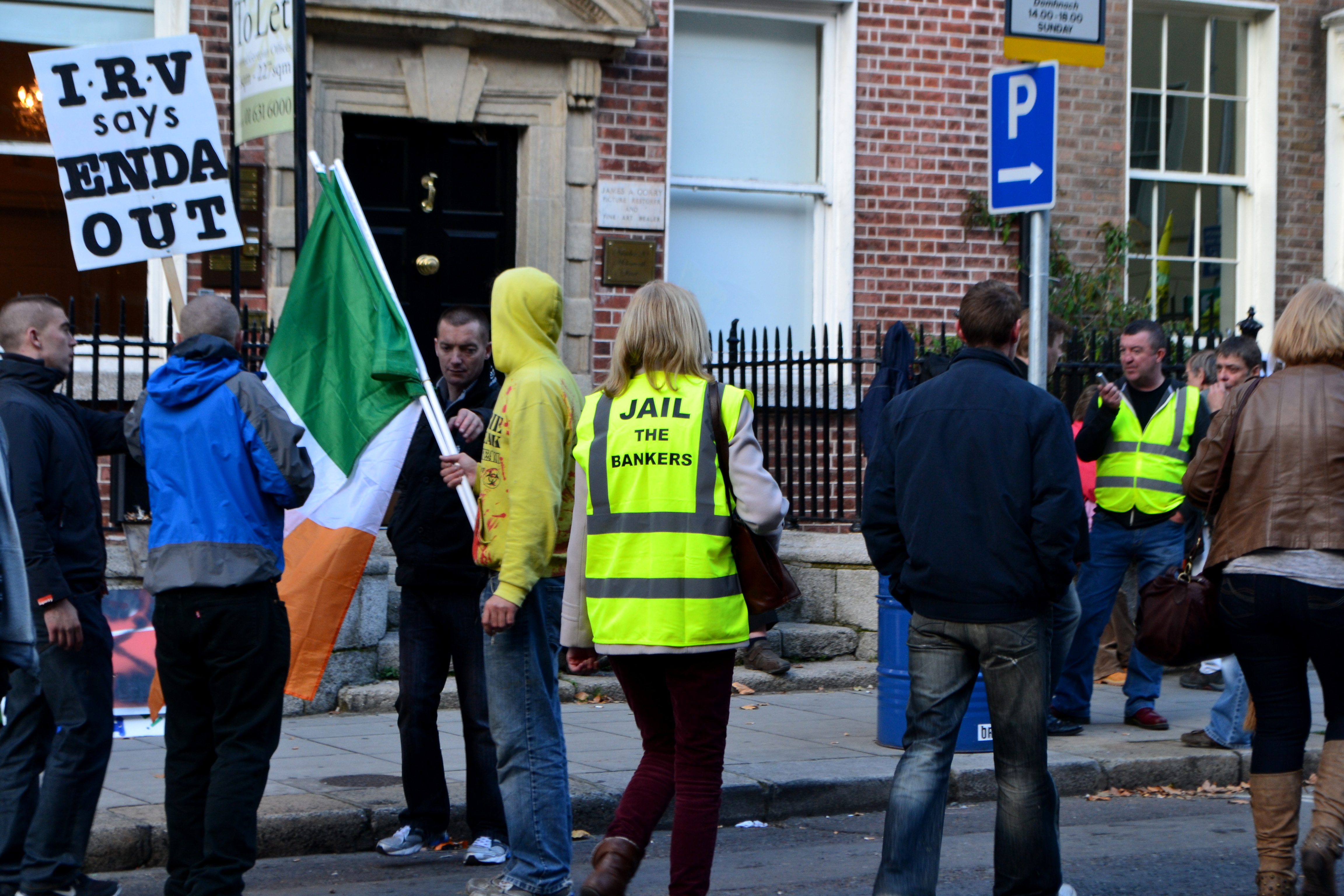
    Meanwhile, outside the Dáil, a surprisingly small number of protesters turned out despite an enormous Garda presence.

    Many protesters, who felt the government were targeting the weakest in society, were disappointed by the turnout.

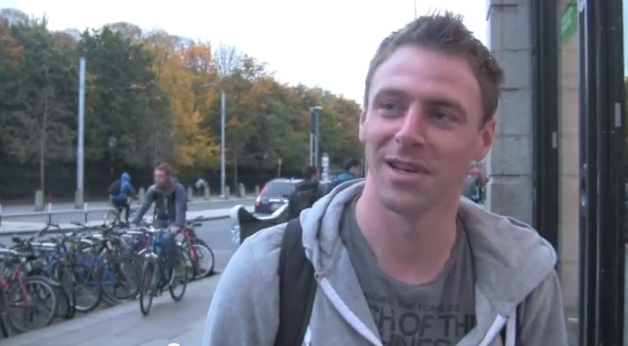
    Protester Pamela Hackett gives her view on the Budget
    Protester Pamela Hackett gives her view on the Budget

    “I’m very disappointed,” said Pamela Hackett, “I thought there’d be a load of people out here.”

    Photos: Michael Coleman

    Video and Editing: Greg Synnott

    Report: Saoirse Ivory

  • Budget 2014 Illustrated: What does it mean for you?

    Budget 2014 Illustrated: What does it mean for you?

    There is no doubt that Budget 2014 will have implications for every person living in Ireland. However, students and jobseekers are bearing the brunt of these cuts. Dole payments for under-25s, hiked student fees, prescription charges and a 10 cent hike on cigarettes and alcohol are just some of the cutbacks facing young people.

    Alcohol

    Student Fees

    Dole Payment

    Cigarettes

  • Find your future path

    Find your future path

    After a visit to yesterday’s Grad Fair in Simmonscourt, The City have made a list of just some of the many opportunities available for soon to be or recent graduates.

    Graduation

    Graduate programmes

    Monaghan Mushrooms

    For an excellent graduate work programme, look at Monaghan mushrooms for two year long work placements in different areas of the business. The second year of placement is spent in one of their overseas offices.

    Monaghan Mushrooms

    Abbott Ireland

    If your area is engineering, quality systems, science or medical technologies, press the link above to visit Abbott Ireland’s website for graduate opportunities.

    Boston Scientific

    If your background is medical and you are interested in the manufacturing of medical equipment visit Boston Scientific for work placements.

    Jameson graduate programme

    Apply to be the Jameson brand ambassador for an amazing opportunity to work abroad. There are 10-15 vacancies for people from areas such as languages, management, business, marketing, sales, events and PR.

    A&L Goodbody

    If your degree is in law visit A&L’s website for graduate and trainee programmes.

    Microsoft

    Microsoft are offering 30 places for several different graduate opportunities and internships in a vast range of areas.

    microsoft

    Deloitte

    There are 200 graduate placements available this year with Deloitte. There are opportunities for people with degrees in accountancy, finance, banking, insurance, law , management and more.

    IBEC Export orientation programme

    IBEC is Ireland’s longest running graduate placement programme. IBEC are offering between 150-200 job placements this year. It doesn’t matter what your degree is in, IBEC are offering a large range of placements for every education background.

    Kerry Group

    Kerry group are offering two yearlong placements for graduates from a large range of areas including food science, food technology, science, chemistry, microbiology and many more.

    Kerry Group

    Aryzta

    The global bakery Aryzta are looking for recent graduates in many areas such as finance, research development, food technology, sales and marketing, human resources and many more.  There are 30 places available for their graduate develoment programme.

    Internships

    Accenture

    Accenture have many internships which range from periods of seven, five and three months.  Accenture recruit people from many areas of education including, engineering, finance, human resources, science, mathematics and more.

    Enterprise rent a car

    Enterprise  provide internships for periods of six to nine months for people with a background in hospitality, sport, tourism, transport, management, business, retail, sales and customer services visit

    Aiesec

    Finding an internship abroad can be difficult but Aiesec aid in this issue by helping people find paid internships or volunteering opportunities abroad.

    Glanbia

    Glanbia provide six to nine month long internships for people with backgrounds in agricultural science, food science, marketing, business, finance, accounting, IT and chemical and mechanical engineering. Glanbia also provide graduate programmes which last two to three years.

    Glanbia

    AOL Global Operations

    Computing, engineering and IT skills are being sought for by AOL for 6 month long internships.

    Education

    Tefl

    Discover the world by teaching English as a foreign language. Follow the link for i-to-i Tefl courses, there are a range to choose from and you can do the courses online, in class or a combination of both.

    The undergraduate awards

    Writing a thesis for your degree? Register your thesis for the undergraduate awards and give your academic work the chance to win a prestigious and international academic award.

    Campus France

    Interested in studying in France? Check out Campus France for third level courses in both English and French.

    Fulbright commission of Ireland

    If you wish to teach or do research in America then apply to the Fulbright commision. Apply soon as the deadline is November 13th.

     Fulbright

    Volunteering

    Taisce

    Taisce are seeking graudates for volunter work regarding environmental issues. All the degree areas are being sought after by Taisce for different volunteering needs.

    For more information on internships, graduate programmes and postgraduate courses visit Grad Fair

    Social media note-

    Twitter

    Fulbright

    Deloitte

    Accenture

    Enterprise

    Aiesec

    Aol

    Tefl

    Undergraduateawards

    CampusFrance

    Facebook

    Fulbright

    Boston scientific

    Jameson

    A&L Goodbody

    Microsoft

     Deloitte

    Kerry group

    aryzta

    accenture

    Enterprise

    Aiesec

    Glanbia

    Aol

    TEFL

    Undergraduateawards

    Campusfrance

    Taisce

    Abbott Ireland

  • Student Teachers and NQT’s stage Leinster House protest

    Student Teachers and NQT’s stage Leinster House protest

    Student Teachers protest Education Cuts

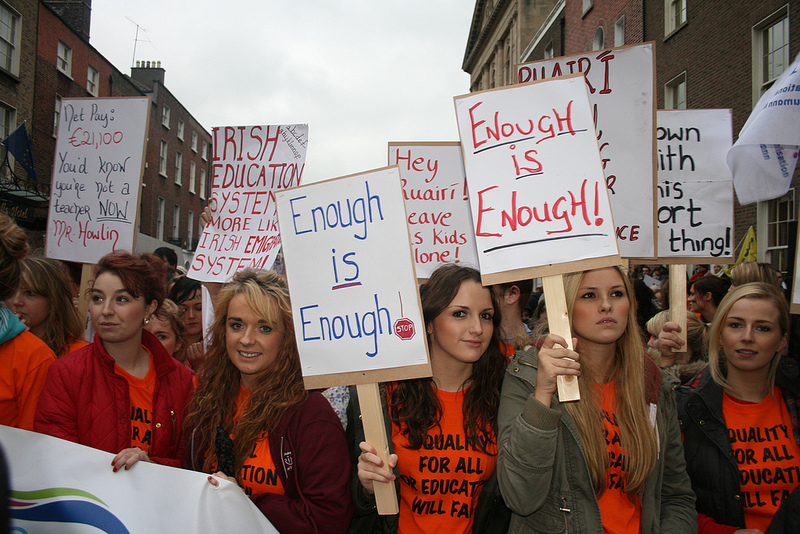
    Student Teachers want their say- equal work for equal pay” was the battle cry of an estimated 2,000 trainee teachers and Newly Qualified Teachers (NQT’s)

    Student teacher’s NQT’s and their colleagues marched in solidarity from O Connell Street to the gates of Leinster House in protest against education cuts and Separate Salary Scales for NQT’s.

    Ann Fay president of the Irish National Teachers Organisation (INTO) was MC for the event. She began the rally by urging the crowd to do what they do best and “Educate the Government-Education Cuts do not heal.”

    Several high profile speakers were in attendance including Gerry Breslin president of the Association of Secondary Teachers in Ireland (ASTI) and Gerry Craughwell president of the Teacher’s Union of Ireland (TUI). They led the crowd in heartfelt, poignant and passionate speeches praising the ongoing work of Student Teachers and NQT’s and lambasting the Irish Government for its decision to cut education budgets.

    Breslin labelled Education Minister Ruairí Quinn the “Minister for Shrinking Resources”  and warned that it will be the vulnerable children who suffer as a result of education cutbacks.

    Schools lose teachers, classes are amalgamated and classes become bigger. Schools have dropped subjects like Physics, Chemistry, Economics and Languages- Students need these subjects, they need them to compete in the foreign markets and to get a good job.

    He also made the point that permanent teaching jobs are relatively nonexistent and hundreds of young NQT’s are forced to emigrate overseas to secure a stable job position.

    TUI President Gerry Craughwell

    TUI president Gerry Craughwell began his speech by acknowledging the various placards held by the protesting students. Craughwell then wished to remind Minister Quinn that his party (Labour) was founded on the backs of Workers and Trade Unionists in this country.

    The Minister well knows that the basic principle of Trade Unionism is Equal Pay for Equal Work. This principle has been abandoned in our republic, we now have colleagues working side by side on different pay scales- the minister must stand up for the basic principles his party was founded on – Equal Pay for Equal Work.

    Each impassioned speech was met with cheers of approval from the crowd. Ann Fay of the INTO closed the rally with the words

    And finally please please do not litter the place with your posters- you’re going to need them again, bring them home. Go raibh maith agat agus Slán Abhaile.”

    A section of the estimated 2,000 strong crowd

    Click on the following link to listen to snippets of audio and speeches from the protest: protest-against-education-cuts

  • Ireland: embarrassed by sex education?

    Ireland: embarrassed by sex education?

    Almost a third of Irish people aged 20-29 have received no sex education in their teenage years, according to the Durex Sexual Wellbeing Global Survey.

    TheCity.ie asks the people of Dublin about their views and experiences.

    [youtube.com=https://www.youtube.com/watch?v=4b69yNg-Tv0]

    By Cormac O’Connor and Liam Keegan