Tag: environment

  • Sustainability is not a trend

    Sustainability is not a trend

    By Andrea Byrne

    Viewing sustainability as a trend is hindering its potential success as when reflecting on similar product-based trends in Ireland, the push for sustainability looks to be following a very familiar path.

    Pat Kane, an advocate for sustainability and winner of the Inspiration in Environmental Change 2019, has shown the public there are simple ways to be sustainable, through her shop Reuzi.

    When setting up Reuzi, Kane had one driving factor: “My two little boys, Thomas and Conor. Every day, I’d read the papers, watch the news and then think to myself, I need to find a way to contribute to a better world for my kids, I had to do something about it… and so, Reuzi was born.”

    Reuzi in Foxrock Village. Credit: Andrea Byrne

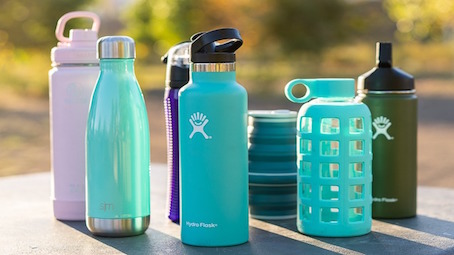
    Pat said: “Sustainable living can be affordable. As I like to say, we all have lunch boxes, tupperware, bottles and cutlery – that’s a start. Carry a little minimal waste living set around everywhere you go, you will be surprised by how much waste you will avoid. Carry a shopper bag – I am sure by now we all have at least one sitting at home – and avoid extra bags.”

    “Learn how to say no and only buy what you need. Start small, set yourself three to five goals and master them. You don’t have to spend money to live a more sustainable life. Use your own cutlery on-the-go, carry a water bottle and a mug, items you most likely already have at home, to avoid single-use products,” she said.

    Kane’s motto is “sustainable living made simple”, which she tries to reflect in Reuzi. The store stocks over 500 products and tools to help “get your eco on”. Customers can try products before bringing them home, and are encouraged to ask questions and find solutions to the sustainability issues they are facing. Kane also tries to help customers find ways to influence others that might not be quite there yet when it comes to sustainability.

    “On top of that, we have partnered with Minimal Waste Grocery to introduce customers to refill stations, which offer anything from snacks to cleaning products. Bring your own containers and have fun,” she said.

    “Each detail has been carefully put together, from our store scent, to the plants we have used around the store. Everything is there to create a balanced, welcoming ambience. Customers are invited to join our free talks and workshops, as we go through subjects such as food waste and recycling, all the way to DIY Body Butter or Nappy Creams.”

    Reuzi also offers lunch and learn sessions to businesses and schools, as well as sustainability audits. “We run House Parties where small groups of friends and family members can come together and learn about sustainability and also purchase products they may have heard of but have never had the chance to see,” Kane added.

    The world is changing, and as a society when buying, we can’t only think of now, we need to be thinking with longevity in mind. As shoppers, we need to learn to be mindful. Our choices need to outlive not just a season, but last for a lifetime.

  • The Green Schools initiative 20 years on

    The Green Schools initiative 20 years on

    By Evin Grant

    With environmental issues and protests at the forefront of the agenda in recent years, an emphasis is being placed on Irish schools and their role in environmental learning and action.

    One school leading the way in this area is Forge Integrated Primary School in Belfast, where an eco-council was set up in 2013. An internationally recognised green flag is held by the school.

    The work of the eco-council is taught in the school’s curriculum, ensuring that its students adopt an early thinking that protects and doesn’t hinder the environment. The latest environmental action taken by the council was to introduce the re-using of junk in classrooms to make crafts.

    “More schools in Ireland hold a green flag than ever before”

    “Their work, and many other schools across the country, should be commended. More schools in Ireland hold a green flag than ever before,” Gráinne Maguire of An Taisce’s Green Schools initiative told TheCity.ie.

    “The Green School initiative began over 20 years ago, so the first generation that were educated under it are now older. They are informed about the environment and know the right action we should take to be conscious.”

    Over 97,000 students and 8,000 teachers will be undertaking the Green Schools’ water theme this month, according to the Leinster Leader. The programme is in its seventh year and is made in partnership with Irish Water.

    “Over 75% of Irish schools currently hold a green flag, with 93% of schools registered for one. The importance of early education on environmental action cannot be underestimated,” said Darragh Stanley, Lecturer in Ecology and Biodiversity at UCD.

    “Over 75% of Irish schools currently hold a green flag, with 93% of schools registered for one”

    “The recent protests in Dublin showcase the increase in the levels of education we have seen on environmental issues in this country. I personally don’t think, 20 years ago, we’d have had the same turnout.”

    The ultimate aim of the Green Schools initiative is to eventually have every school in Ireland holding a green flag. With over three quarters of schools in Ireland achieving that standard, their goal is well within reach.

  • Sustainable sparkle – M&S ditch the glitter this christmas

    Sustainable sparkle – M&S ditch the glitter this christmas

    By Jade Carpenter

    We all know the moment on Christmas day; all the presents are opened and dinner is finished, so you sit down to relax … and that’s when you spot it, the explosion of glitter covering your hands, clothes, hair and furniture. That’s when you know your life is going to look like one big Christmas sparkle for the foreseeable future.

    Even though it looks pretty for the short lifespan it has on the actual decoration, card or wrapping paper, glitter can be a bit of a pain to get rid of from every other surface of your home. Not only this, but it’s not so environmentally friendly.

    According to a recent report, microplastics are contaminating the “most remote and deepest places on the planet”. Glitter adds to this problem as when it’s washed down the sink, it will end up in the ocean. It causes detrimental damage to marine life who suffer contamination and starvation when such materials end up in their digestive systems.

    “The retailer said it strives to have its cards and wrapping paper 100% glitter free by the end of 2020”

    This year supermarket chain, Marks & Spencer’s have taken action to ensure their ‘greeting cards, wrapping paper, tags, gift bags, calendars and crackers’ are all glitter free, “in a bid to improve recyclability and reduce the impact of microplastics on the environment”, according to a press release received by thecity.ie.

    The now recyclable products will maintain their festive sparkle by using “innovative paper patterns or minimal foils”. The retailer said it strives to have its cards and wrapping paper 100% glitter free by the end of 2020.

    Paul Willgoss, Director of Food Technology at M&S, said: “We know reducing single-use plastics is as important to our customers as it is to our business, so removing glitter from our cards and wrap range will make it easier for them to celebrate Christmas in a more sustainable way.

    “Their Christmas cards have switched from plastic to card packaging, saving 50 tonnes of plastic with this act alone”

    He continued: “This is a step in the right direction as we continue working on our plans to completely remove glitter from the range next year.”

    Their Christmas cards have switched from plastic to card packaging, saving 50 tonnes of plastic with this act alone.

    More and more shops are making an effort to be more environmentally friendly this Christmas with UK stores, John Lewis and Waitrose announcing they will stop selling Christmas crackers containing single use plastic prizes in 2020.

    We expect to see most major chains following this trend in the months to come, so we can all enjoy Christmas time without the environmental expense.

  • Environment week – thecity.ie goes green

    Environment week – thecity.ie goes green

    Thecity.ie is going green and celebrating Environment Week from 25-30 November.

    From cycling and recycling to the businesses that are making a difference, all this week we’ll be bringing you our best environmental content, coinciding with Global Climate Action Day 2019 on Saturday 30 November.

  • “Our right to survive” – rebellion week rages on

    “Our right to survive” – rebellion week rages on

    By Jade Carpenter and Paula Bowden

    “Our future, our lives, our right to survive.” This was the chant coming from the crowd gathered outside Leinster House on Tuesday evening, as Minister for Finance, Paschal Donohoe’s environmental provisions for budget 2020 were met with a lukewarm reaction from climate activists and members of Extinction Rebellion.

    “Our future, our lives, our right to survive” Credit: Jade Carpenter

    As part of #RebellionWeek, the so-called rebels took to the streets of Dublin to stage sit-ins and protests, calling for action on the climate crisis —but exactly what action are protestors calling for?

    “Reducing cars, reducing traffic, even more bins. We need more recycling bins,” said protestor Sian Conway. “I live out in Kilbarrack and we had a bottle bank bin for ages and now it’s just gone. It’s just not there anymore. I think the government really need to be facilitating people to recycle with more resources.”

    Protestor, Brendan McGlynn, believes the government needs to think big to combat the crisis and halt climate change.

    “I think there has to be a massive active involvement to change the systematic problem that we have in place,” said Brendan. “It has to be across the board a massive change that makes people feel uncomfortable. You have to make people feel uneasy because everyone needs to change, and change a lot.

    “I think at the minute the government aren’t really putting all their cards on the table and really going for it, but they need to, because it is an emergency now and it isn’t enough to just push recycling as an incentive we need a massive systematic change otherwise things will just stay the same,” he added.

    “The workers, united, will never be defeated” Credit: JadeCarpenter

    Iryna, a member of Extinction Rebellion, was manning a refreshment tent at Merrion Square providing drinks and snacks for protestors. She told us about their aims for the protest and what action they want to see.

    “Extinction Rebellion’s main goals are; to tell the truth, organise a citizen’s response, reduce fossil fuels and to reduce our emissions completely by 2025,” Iryna said. “Every single person we’ve seen at the sight so far has been so friendly and so supportive and I think they really appreciate what we’re doing. I do believe we’re doing the right thing.”

    Outside Leinster House the focus was very much on a peaceful protest as activists held banners and sang songs late into the evening, taking turns at the megaphone to explain their own reasons for being there. As the Garda barrier around the entrance to government buildings eventually dispersed, protestors cheered and clapped, serenading members of the force with a chorus of “Gardai we love you, we’re doing this for your children too.”

    “Gardai we love you, we’re doing this for your children too” Credit: Jade Carpenter
  • Government responds to ranking of Ireland as worst performing European nation for climate change

    Government responds to ranking of Ireland as worst performing European nation for climate change

    The government is set to invest €4.5 million in tackling climate change after it was revealed that Ireland is the worst performing European country for climate action.

    The UN Climate Conference took place in Poland on Monday, where Ireland was ranked as the 48th out of 56 worldwide countries when it comes to addressing climate issues.

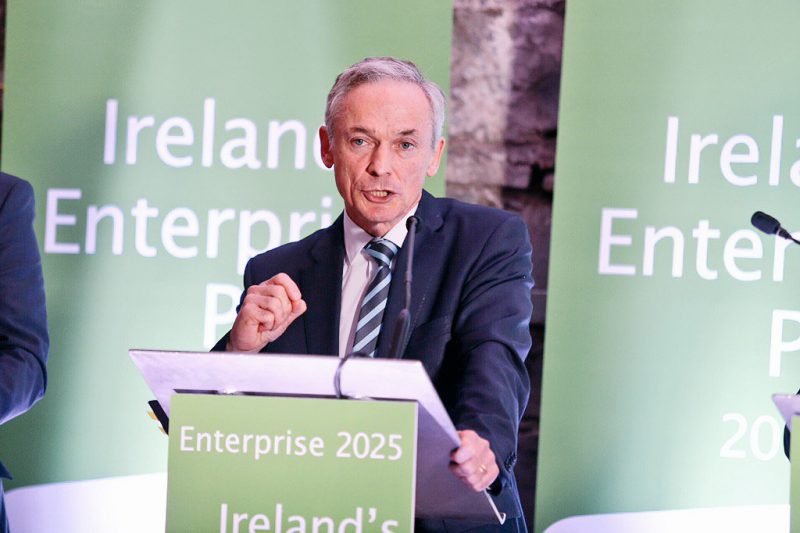
    In response to this revelation, Richard Bruton, Minister for Climate Action and Environment has announced significant funding to make Ireland a ‘leader’ in the battle to halt climate change.

    It is thought that the funding will go towards a number of projects, including the Green Climate Fund, and the Great Green Wall Initiative.

    The Great Green Wall project aims to reduce the impacts of climate change and will increase the resilience of a number of developing countries involved in the scheme.

    When completed, it is expected to improve food security, resilience to droughts, and will abate an estimated 250 million tonnes of CO2 annually.

    It will also generate an estimated ten million land-based green jobs across Burkina Faso, Cameroon, Chad, Djibouti, Eritrea, Ethiopia, Ghana, Mali, Mauritania, Niger, Nigeria, Senegal and Sudan.

    In a statement released to thecity.ie, Minister Bruton said: “Ireland is fully committed to the implementation of the Paris Agreement.

    “This conference is about making those commitments stick by agreeing a rule book among all countries so that we are all making progress in a consistent, transparent manner.

    “It is the foundation for moving on in the coming months to see how, acting in solidarity, we can stretch our ambitions beyond what we have committed to. We need to be honest with where we are at so that we get to where we need to be.”

    The statement said: “Multilateral action is the only way to tackle the global challenge of climate change. This funding is crucial if we are all to meet our global ambition.

    “We must support developing countries to adapt and to mitigate against the costs associated with the effects of climate change.

    “This funding is in addition to the supports provided by the other Government Departments involved in international climate action this year and represents a further scaling-up of climate finance provided by Ireland.”

  • Fingal outspend neighbouring county councils in public art

    Fingal outspend neighbouring county councils in public art

    Fingal County Council has spent more on commissioned works of art under the Per Cent for Art scheme than any other suburban county council in Dublin in the past five years.

    From 2012 to 2017, Fingal County Council spent exactly €327,474 on funding for commissioned works of art under the Per Cent for Art scheme, according to recently released figures.

    Dún Laoghaire/Rathdown County Council, in comparison, spent €154,384 while South Dublin County Council spent only €34,260 during the same period.

    Under the Per Cent for Art scheme, 1% of the cost of any publicly funded capital, infrastructure and building development can be allocated to the commissioning of a work of art.

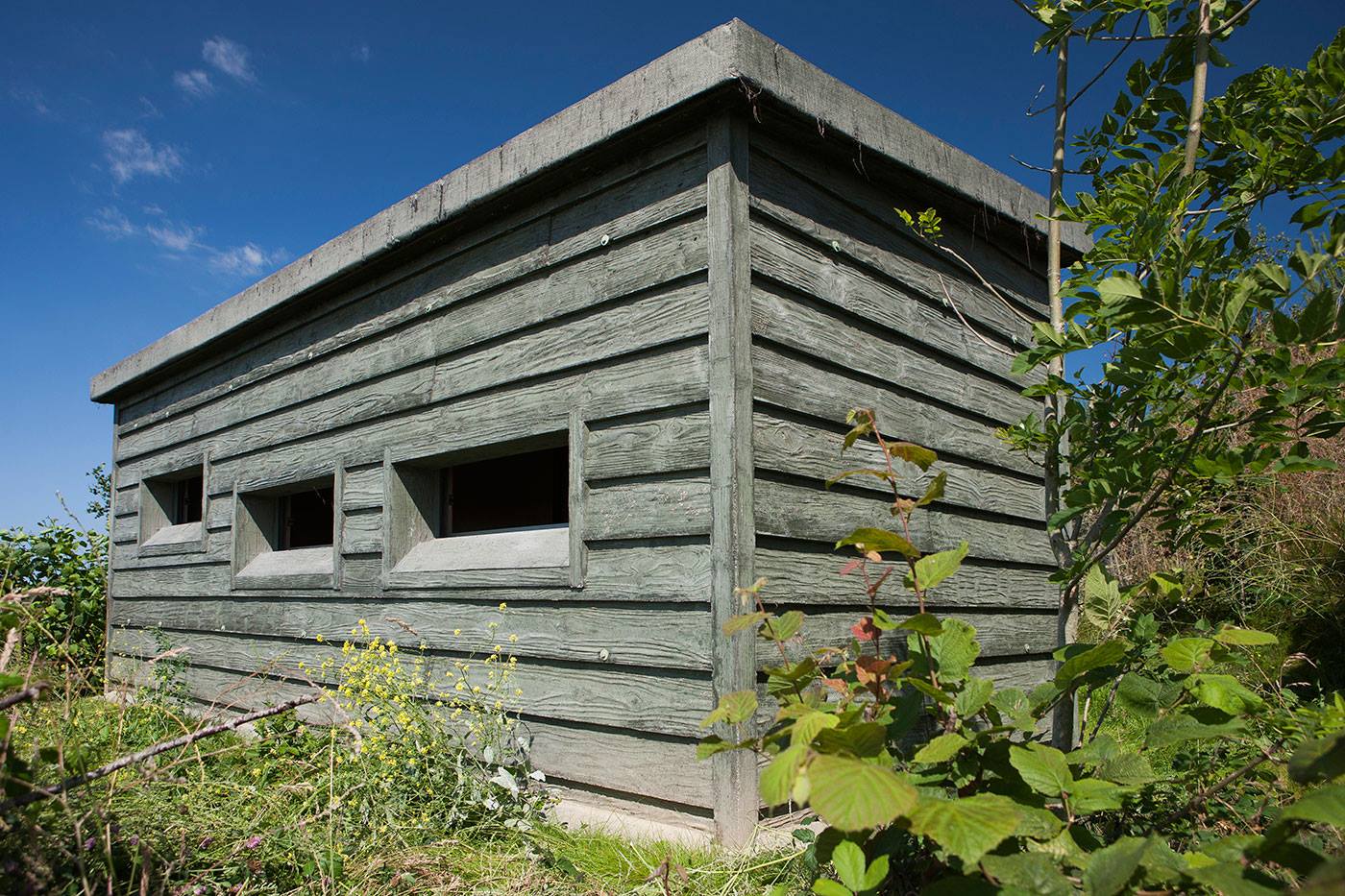
    According to recently released information, the most expensive installation, which was funded by Fingal County Council, was a permanent sculpture located at Balleally Landfill in Lusk as part of The Hide Project. The installation as a whole cost €174,640.

    The sculpture (pictured above) functions as both public art and as a fully functional bird-viewing tower.

    Records released by Fingal County Council also showed that a total of €85,000 was allocated to the commissioning of various 1916 Remembrance installations. This included a statue of Thomas Ashe, a founding member of the Irish Volunteers.

    The most expensive piece of art commissioned by Dún Laoghaire/Rathdown County Council cost €55,500. The same records also showed that a further €12,864 was spent in additional costs including selection processes, events, curation and management costs.

    Records released by South Dublin County Council failed to show individual allocation amounts. However, they did note that no works of art were commissioned between 2013 and 2015.

    By Conor Shields

  • Video: What will be the impact of a coffee cup levy?

    Video: What will be the impact of a coffee cup levy?

    Environment minister Denis Naughten is considering proposals to place a 15c levy on disposable coffee cups. Louise Burne & Gavin Hyland find out what this will mean for coffee lovers and coffee shop owners

  • Ireland’s greenhouse gas emissions continue to rise

    Ireland’s greenhouse gas emissions continue to rise

    The Environmental Protection Agency (EPA) has estimated that greenhouse gas emissions in 2016 were 3.5 percent higher than in 2015.

    A report by the EPA shows that Ireland is one of four countries in Europe in which greenhouse gas emissions are still above 1990 levels.

    The report states that in the last two years greenhouse gas emissions have increased by 7.3 percent. The EPA attributed this increase to economic and employment growth, particularly in the energy industries, agriculture and transport sectors.

    Agriculture is the single largest contributor to overall emissions at 32 percent of the total. Emissions in this sector grew by 2.7 percent in 2016, with the main reason for this being higher dairy cow numbers (6.2 percent increase).

    The transport sector has shown an increase of 3.7 percent, with 2016 being the fourth consecutive year that emissions have increased in this sector.

    EPA
    Provisional Greenhouse Gas emissions in Ireland for 2015 and 2016. Source: EPA.

    Greenhouse gas emissions in the energy industries sector has shown an increase of 6.1 percent between 2015 and 2016. The EPA said that this increase is due to natural gas use for electricity generation increasing by 27.7 percent and a reduction in electricity generated from wind and hydro renewables.

    The figures in the report show that Ireland was in compliance with its 2016 annual limit set under the EU’s Effort Sharing Decision (ESD), however the EPA’s projections indicate that Ireland will exceed its annual target in 2017.

    Dr. Eimear Cotter, Director of the EPA’s Office of Environmental Sustainability, said: “Achieving Ireland’s long-term decarbonisation objective can only take place with a transformation of our energy, agriculture and transport systems. We need to adopt a much greater sense of urgency about reducing our dependence on fossil fuels while radically improving energy efficiency. In relation to agriculture, Ireland must optimise agricultural production to ensure long term environmental integrity and sustainability. The growth in this sector, particularly for dairy and other cattle, points to very significant risks in relation to meeting our decarbonisation objectives.”

    EU member states have agreed to reduce their greenhouse gas emissions by at least 40 percent by 2030 under the Paris Agreement. Ireland will also face a fine of €75 million per year if 16 percent of its energy doesn’t come from renewable energy sources by 2020.

    Dr Cara Augustenborg, Chairperson of Friends of the Earth Ireland took to Twitter today to express her embarrassment at the release of the figures. She said: “Most EU member states have decreased emissions by 10 to 14 percent while Ireland continues to rise. So utterly embarrassing.”

    By Cara Croke

  • Dublin’s Urban Farm

    Dublin’s Urban Farm

    It used to be an actual chocolate factory a long time ago. “The Chocolate Factory”, is now the name of this tall, solid building on Kings Inn Street. and the community of businesses inside that are rejuvenating it.

    There’s a dojo, several photographers, an upcycling furniture shop, a graffiti artist and a café that is planned to open in February. Last week 2,000 people attended a vintage market there. I’m here to take a look at the “Urban Farm” developing on the roof. Paddy O’Kearney is waiting to show me and some urban planning students around on the huge ground floor, which dwarfs the café that is taking shape in the corner.

    Paddy is enthusiastic and animated when we finally get up to the fifth storey, the workstation just below Ireland’s first rooftop farm. You could call the space up here a shell, but there’s a lot happening. There are several workstations, plant nurseries, what looks like a pen for animals, bags of soil, and an aquarium with plants above nestled in old plastic bottles. Most strikingly though, is what looks like a slaughterhouse for wooden pallets.

    Image

    “It takes about 2-3 pallets, and a day’s work to make one of these”. Paddy brings us over to a “multi-tier raised bed”, which is a solid looking wooden construction, with different levels of shelves to house plants. “We coat them in yacht varnish, they’re pretty sturdy. It allows us to grow on several different levels. Blueberries, blackberries, all your granules, but you can still plant in your annuals as well and your bi-annuals.” Paddy says that when he looked online he saw these things selling for about 180euro and he’s not lying.

    Image

    This floor, which Paddy plans to make into a nursery, could be described as chaotic, but it doesn’t feel messy when you look at it in detail. It’s well organised, with safety equipment and fire extinguishers on the wall. More than that, you get the sense that everything in it, the rubble, the soil, the fish, the workstations, is being put to good use. Paddy has a plan to upcycle any material you can think of. That’s what the Urban Farm is all about.

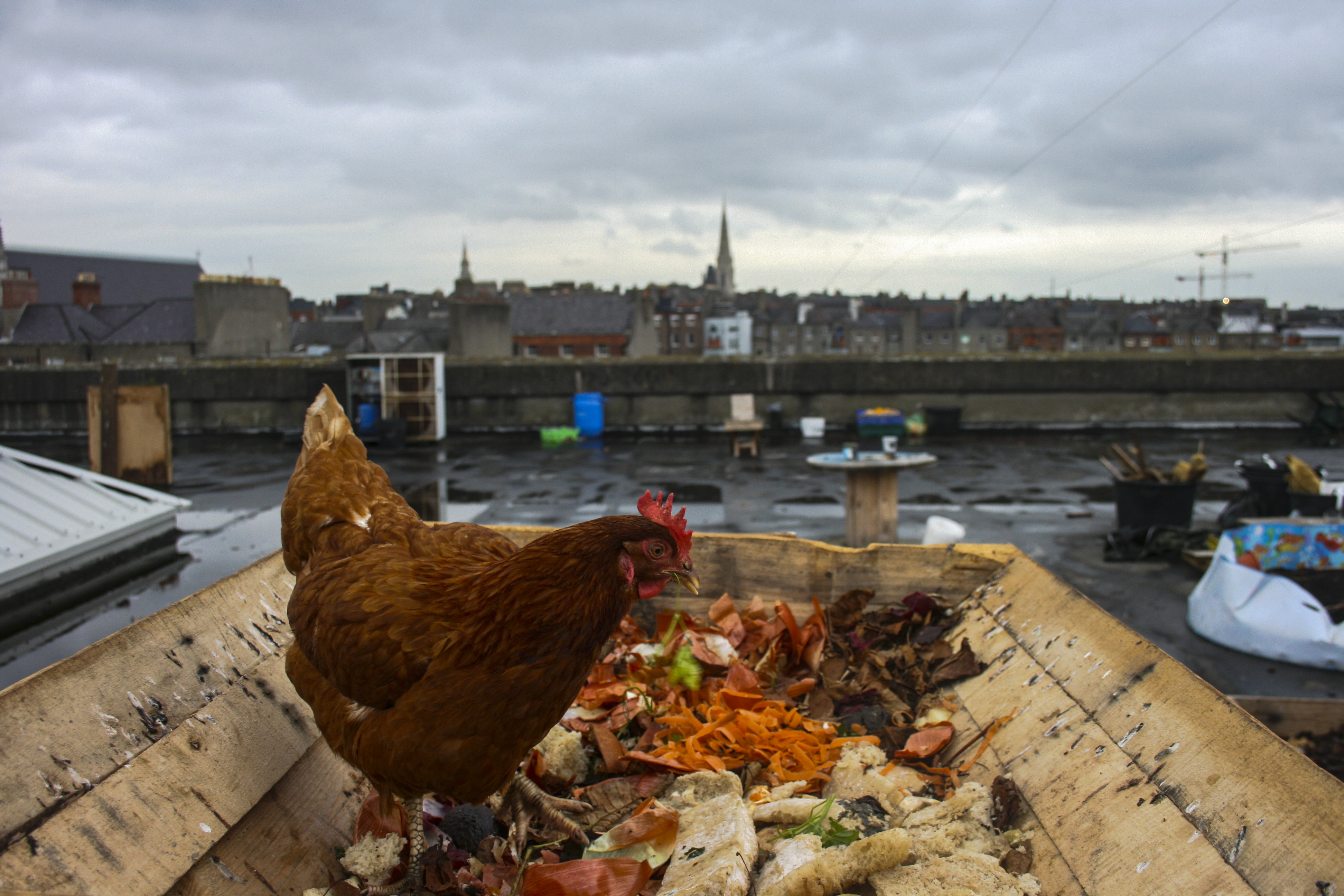
    “So we go up”.  We’re led up onto the roof, and are greeted by six friendly, well-fed chickens. Paddy asks them  not to drink his coffee as he places it on the ground. If the chickens are puzzled about being up above Dublin City on the roof of an old chocolate factory, they don’t show it, happily pecking away at the soil and compost.

    Image

    Paddy describes the roof as “stunning”, and it is and not just in its views. The work that’s taken place on it over the last four months is impressive, but only confined to one corner of the roof so far. Still, it’s exciting to look at what’s happened so far and imagine it multiplying five or six times. It’s exciting because what has happened has worked. I never thought of a roof going to waste before, but I guess they can, not this one though.

    Nothing at the Urban Farm is going unused. “It’s all about upcycling. Figuring out how we can use what we have” says Paddy. The slanted roof covering the doorway to the roof is being put to use housing plants. The chicken coop which Paddy and the rest of the urban farmers built themselves, has a plastic roof made from tiles they found. At the back of the chicken coop is a greenhouse.Image

    Now you see the end result of the pallet slaughterhouse. The multi-tier raised beds are all over the roof housing all sorts of plants and vegetables.

    “We’re trying to build a forest floor here”, Paddy takes us down a corridor, with around ten wooden boxes on either side, all filled with multi-coloured compost. Some of which the chickens, who Paddy is happy to report are producing a lot of eggs, are feeding out of. The floor is made from pallets, but between the wood is actual soil and as Paddy shows us, a lot of worms. “It’s a worm highway essentially. We’re trying to figure out how to use every space.”

    Image
    The compost comes from various café’s around Dublin, like Cornucopia and Mother Hubbard’s that mostly serve vegetarian food. “We just layer it up with some soil and the chickens get at it”

    “We’re not 100% sure yet to what our plan is, it’s a bit of a work in progress at the moment ,” Paddy admits. “What we want to do is optimise the space itself, so we can work out different things to do with the space. it needs to be in a sense a classroom, but also aesthetically pleasing so people want to hang out here.”

    Image

    The urban farming students, who are quite impressed, are keen to ask about plans “Plans, there are plans, there’s talks of building a geodesic dome for example, whether or not that’s going to happen though…There are a lot of questions”.

    The roof, we’re assured, can take a lot of weight. “It used to be a chocolate factory. They’d store huge barrels up here. The roof can take at least 200 tonnes.”

    Image

    Paddy himself has a fine art background  and five years garden experience. He described the Urban Farm as being “five minutes from the Spire, fifteen minutes from Grafton St.”, not unlike a businessman, and he is, having started City Composting Ltd. two years ago. Like the Urban Farm, City Composting is all about sustainability. The Urban Farm is a great idea, it puts a space that would otherwise be going to waste to good use, it puts a lot of waste to good use, but it’s also sustainable as a business. The Urban Farm pays a “very fair rent” to the lease-holder of the Chocolate Factory, and they’re exploring ways to generate money.

    Before finding the Chocolate Factory, Paddy tried to go through Dublin City Council to show how empty spaces can be put to good use. It was in that process that he met his fellow two fellow urban farmers, and they started the Chocolate Factory. “There a lot of supportive people in the Council. But we got a bit sick of the bureaucracy. The Chocolate Factory understands what we’re doing. Now we can go to the Council and go ‘Here, this is what can be done. This is how easy it is’.

    “In ten years or whatever, there might be offices here. Fine. We can pack up and go easily enough.” The idea being they could lease a space easily, put it to use before maybe a business wants to move in. “We approached a few letting agencies about spaces and tried to explain the idea. They said sure ‘you can buy it for 2 or 3 million euros. They didn’t really get it. Meanwhile those spaces are still empty”

    Image

    “We’re a business with an ethos.” explains Paddy after the urban planning students are gone. “It’s about sustainability. We get transition year students doing their work experience here. We get volunteers. They help us out building things, but they also learn a lot. If they want to use some of our nails and varnish and throw us so money to cover them, that’s fine”.

    On King’s Inn Street, you wouldn’t think there’s an urban farm taking place above your head, but there is. As an eco-concious business , upcycling all the materials they can get their hands on, it’s a great idea. I asked Paddy if there was a lot of old junk in the space when they moved in. “Yeah, a lot of old wood, plastic tiles. It was great”. But in Dublin especially, upcycling what would be another vacant space in the city centre into a useful, living area, is a brilliant initiative.