With consumer demand growing, many people are looking for a chance to get a look at the latest cars on sale.
The NEVO Electric Vehicle show was held in the RDS on November 8th and drew a crowd of around twenty thousand people across the day.
The show was an exhibition of the latest electric and hybrid-electric vehicles on sale in Ireland, offering customers a chance to get up close with the cars.
But they weren’t just to be looked at, as customers could also book a test drive with a car of their choice.
There were also demonstrations, talks, and information available to people about financing, home charging, and solar power.
2024 has been a disappointing year for the electric vehicle market, so far.
Latest figures from The Society of the Irish Motor Industry (SIMI) revealed that in September 1010 new electric cars were registered which was a massive 30.8% lower than the 1,460 that were registered in September 2023.
16,133 new electric cars have been registered so far, this year, as of the end of September. This is a 25.8% decrease compared to the same period in 2023 when 21,726 electric cars were registered.
Brian Cooke the Director General of SIMI commented: “The new electric vehicle segment has experienced another month of decline in registrations, marking the eighth consecutive month of this trend.”
“It is vital that we see positive measures from the Government to support the EV project and help reverse this drop in demand for EVs. Reinstating and extending EV supports, as well as investing in a reliable charging infrastructure, can help regain lost momentum in the electric vehicle project. The industry remains committed to supporting the transition to electrification,” he said.
An electric car charging at a charging station. Credit: Pixabay
So why has there been such a steep decline this year?
In January 2022, the Irish Government got rid of the €2,500 grant for new plug-in-hybrid-electric vehicles (PHEVs). This resulted in a reduction in PHEV sales and an increase in battery electric vehicle sales (BEVs), which was the intention.
In July 2023, the Government reduced the grant for new BEVs from €5,000 to €3,500. Although there wasn’t a sudden impact, there is now a slowdown in sales of BEVs, whereas PHEV sales are increasing again.
Many people in the EV scene find that it is harder to get the mass market to make the switch to electric compared to the early adopters.
The early adopters tend to be more comfortable with risks like range anxiety or queuing at charging points – whereas the mainstream adopters are less likely to be wealthy and are not as comfortable with the same risks.
Luke Donnellan, a mechanic for Renault spoke to The City. “A lot of the cars we sell are either hybrid electric or petrol. Not a lot of people are ready to make that change to fully electric yet.
“A lot of people are still very reliant on diesel and are very unsure of the range of electric cars, as well, because with a petrol or diesel cars, when they run out of fuel, it’s not a big deal, you can just fill it up and away you go but with an electric car you’re almost stranded.
“A lot of people do have that range anxiety and It’s also made harder when there isn’t the infrastructure there to charge all these cars.
“A big thing that we’re seeing as well is people trading in their brand-new electric vehicles because they buy the electrics and realise there’s nowhere to charge them and how much it is to charge them. A lot of them realise they can’t charge the cars at work, so then they’re left with these cars where they have to plan everything. You can’t just go do something; you have to plan your entire trip from start to finish and it’s a lot,” he said.
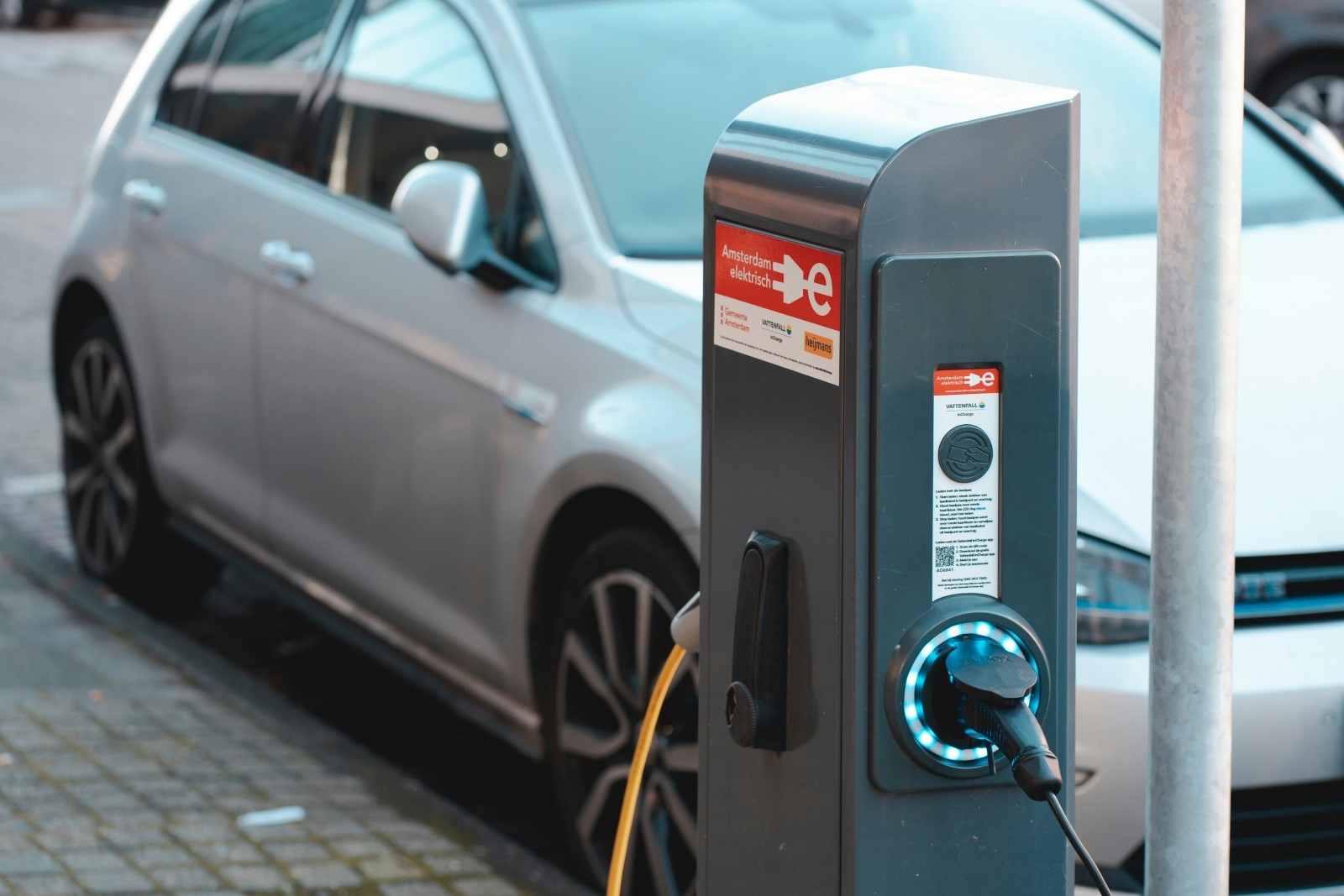
An electric car plugged in at an integrated charging station parking space. Credit: Unsplash
EVs can also provide different mechanical problems to that of a petrol or diesel car.
“One thing that we are noticing is because all these electric cars use regenerative braking systems, where they don’t actually use their brakes and they use the slowing down of the wheels to try to charge the battery up – the brakes are getting completely rusted out,” said Donnellan.
“Even though they’ve only used 20% of their brake pads, their brake discs are so badly corroded, they need to change their brake pads and discs more frequently than a petrol car, so there’s more maintenance in that sense,” Donnellan added.
Hybrid vehicles, however, are rising in popularity. There has been a 12% increase in regular hybrid sales this year, totaling 26,079 new registrations at the end of September.
Similarly, there has been growth in plug-in hybrid sales, now amounting to 10% of total sales with 11,766 registrations.
Petrol remains the most popular choice for Irish buyers, with 36,339 registrations, followed by diesel with 26,947.
More support and infrastructure are needed if the Government has any hope of reaching their target of 845,000 EVs by 2030.
The latest Tesla product announcement saw the company reveal their new self-driving car dubbed ‘Robotaxi’, a vehicle capable of transporting 20 people nicknamed ‘Robovan’ as well the latest iteration of Tesla’s humanoid robot given the moniker ‘Optimus’.
Reaction to the announcements made at the ‘We, Robot’ event has been mixed with consumers and experts displaying a combination of excitement and scepticism.
Tesla’s new robot on display at ‘We, Robot’ event. Picture credit: Tesla website
One thing that has not been mixed however, is the Tesla share price. At the time of writing the stock sits at $219.57, which is 9.94% lower than what it was on the day of the ‘We, Robot’ event.
The market has not responded favourably to the lack of clarity shown at the event with one major criticism being that the event was more a showcase of what Tesla dreams to be, rather than what it can currently deliver.
There was a serious lack of short-term opportunities on display – with the self-driving car not entering production until 2026 or 2027, the ‘Robovan’ not having a price point or time frame for availability and ‘Optimus’ being remote controlled by humans which would indicate the product being years away from commercial viability.
All of this leads to investors being cautious about Tesla’s ability to turn annual profits over the next few years, especially given that the company had less than 50% of the American electric vehicle market for the second consecutive quarter.
Despite this, there is reason to be optimistic regarding electric vehicles in Ireland specifically with the Minister for Transport Eamon Ryan announced on October17th, a new National Road Grant scheme to improve the electric vehicle charging infrastructure across the country.
This is good news for companies like Tesla as electric vehicles will become more desirable as the environment surrounding their usage becomes more appealing. Minister Ryan stated that: “Electric vehicles are an important part of our transport mix going forward and we want to make it easier for people to make the switch. Providing comfort of mind with more choice and availability of charging infrastructure is key to this.”
The international view though is not so optimistic with one of Tesla’s most famous investors, Ross Gerber, CEO of a wealth management fund expects the stock to decline from current levels stating that: “I see the stock as really overvalued right now because I don’t think they make any of their numbers.”
“I just thought that their basic strategy is flawed, and I think that became pretty glaringly evident last night by completely pivoting to robots and trying to basically shun their EV sales business, which is really 95% of their revenue.”
With market experts such as Gerber pessimistic and public reactions mixed, the upcoming quarterly earnings report expected to be released on October 23rd is going to be crucial for the future of Tesla’s place in the stock market.
However, this is not the first time the company’s stock has gone down in 2024, with April being the low for this year at $142.05. This fall came after price reductions to the company’s vehicles as well as a voluntary recall on the Cybertruck.
But given how the share price has rebounded since then it would not come as a surprise to anyone should this latest slide be reversed over the next fiscal quarter.





You must be logged in to post a comment.