De Profundis – a story of love, loss, anger and acceptance
What an opportunity to feel the depth and sorrow of the love of one man for another.
To celebrate 125 years since Oscar Wilde’s death, the Museum of Literature Ireland (MOLI), has produced in film key passages of the letter described as a love letter called De Profundis – written by Wilde to his lover ‘Bosie’ while Wilde was in prison from 1892 to 1895.
Photo: Mary Phelan
Luke Fallon, Visitor Experience Assistant in the museum says “although primarily people will come to the museum for James Joyce, there has also been a great interest to learn more about Oscar Wilde”.
He says that apart from celebrating 125 years since Wilde’s death this year “most people will relate only to his witticisms, whereas this piece shows a very profound and different side to the man”.
The background story is that Wilde and Lord Alfred Douglas (Bosie) were in a relationship together, much to the disgust of Bosie’s father, the powerful Marquess of Queensbury, who was a very cruel man and was determined to ruin Wilde, which he succeeded in doing, by taking him to court for gross indecency. He won his case. Wilde was sent to Reading Gaol for two years.
The film consists of the reading of some passages of his letter written to Bosie by a number of artists, writers and activists from the LGBTQ+ community.
In the reading we learn how Wilde, after his conviction in London, was brought in shackles on a train from Reading Gaol where he spent two long years in prison. The conditions were rough.
In prison he goes through a whole gamut of emotions, including anger, sadness, and incomprehension as to why Bosie never wrote to him all the time he was incarcerated. He realises that he made a huge psychological error in going with Bosie’s suggestion to press criminal libel charges against his father. He contemplates the affection he had for Bosie, and how little it was returned. In hindsight he realises he should have got rid of him before his own ruination. He recalls the bills that Bosie ran up during his stay in a Brighton hotel with a friend and which were so onerous that Wilde could not pay them. As a result he could not leave the hotel, and was ultimately arrested.
As the letter continues, he concludes that hate was always stronger than love with Bosie. He says hate blinds people, and Bosie was blinded by hate. He questions if Bosie had ever known what love was, and also why Bosie never wrote to him, not even once while he was in prison. However, he realised Bosie was also suffering, and that he had to forgive him, and wanted to turn what happened to him into a spiritual experience. He makes references to God and of learning the meaning of sorrow and beauty.
He writes “beauty and sorrow is all that interests me now. I used to live purely for pleasure and lived a selfish life. I no longer want this life.” He writes that “pain unlike pleasure wears no mask.” Prison had given him new spirit. He used to say to himself “what an ending, now I think what a beginning.” He longs to be in nature again, seeing the flowers and trees bloom again. He looks forward to meeting Bosie when he is finally liberated from prison.
The film is approximately 50 minutes long and is in a quiet room, away from the main exhibition area on the 3rd floor.
The film runs until early October.
MOLI is open 7 days a week, and also has a café and outdoor dining area.
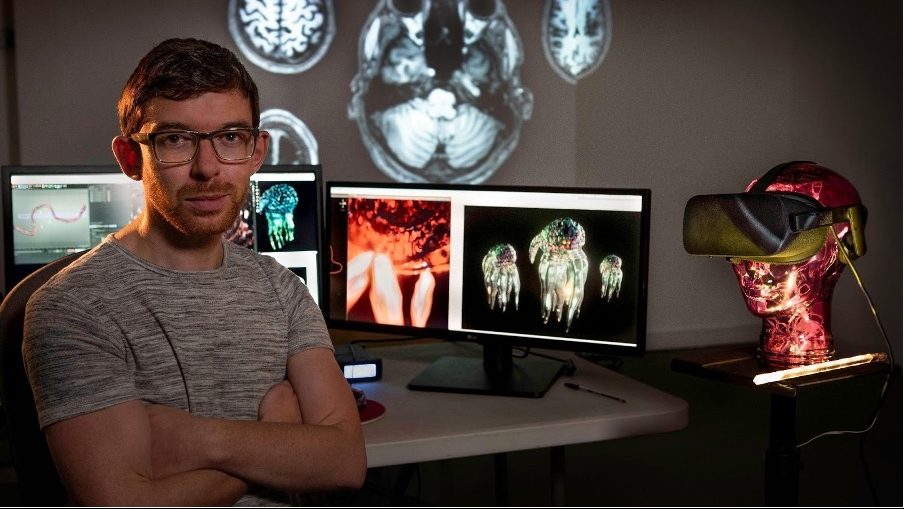
Alan James Burns in his studio. Photo courtesy of Trevor Whelan
Alan James Burns
“I’ve had to move a lot of work online, which is quite interesting because it’s something that I never thought would be possible,” says Cavan-born visual artist Alan James Burns. “I usually create large events with up to 50 people attending, so that went completely out the window. Moving online has opened me up to be able to work from my bedroom, or work with international partners because you kind of break down the idea of having to be in the studio together.”
Burns says he “can’t work now without putting in the context of the pandemic somehow.”
“When I’m writing up my ideas and developing new works, it’s all with the context and background of this last year.
“Everyone’s gone a lot more digital now, and the idea of the human machine – the digital world and our interconnectedness with that – has started feeding into a lot of new works I’m creating. I’m working with brain computer interfaces – looking at the idea of the human machine and what possible futures are like when we become more integrated with technology, which the pandemic has forced us all into.”
Along with Sinead McCann, Burns is currently collaborating with users of intellectual disability services at St John of God Hospital in Dublin, as part of an artist in the community project. Participants are receiving training in audio recording and editing, and the piece they’ll create together will be exhibited on Culture Night in September.
“That came about because of the pandemic. With everyone being at home, we decided to create a work, and the one medium we could think of that people would have access to tools, like a phone and stuff, was sound. So we’re all recording sounds and editing them together remotely online.”
Tonally, Burns says his latest output has been “actually more hopeful than what it probably had been before the pandemic. The works that I’m creating have more joy within the production and also within what they’re trying to achieve for an audience when they do engage with it. So rather than looking negatively outward, they’re looking positively outward.”
Burns says the Irish government’s Pandemic Unemployment Payment (PUP) has been a lifeline in compensating for cancelled projects.
“Actually, I’m better off [than before the pandemic] thanks to the PUP. As an artist, you have no regular income, you live on minimal amounts of money, so the PUP was the first time many of us got a living wage that you could rely on.”
Upcoming work: “Open Mind, Closed System”, Carlow Arts Festival, Co Carlow (June 2021)
Ella Bertilsson
Ella Bertilsson. Photo by Ella Bertilsson
For Swedish multidisciplinary artist Ella Bertilsson, the initial lockdown last March was a case of life imitating art.
“In the month before lockdown,” she tells The City, “I was working on a piece where I did a performance from inside a cardboard box, which was all about being trapped in a domestic space. That opening was I think two weeks before [the first] lockdown. So that was a super-odd coincidence.”
In terms of concepts, Bertilsson feels the pandemic “will probably feed into my art at some point, but I think at the moment I find it hard to tell.”
In terms of practice, however, her studio’s closure forced a rethink, as her workspace became “a tiny sewing machine table in a tiny room” at home.
“I was like, ‘What do I do now?’ So, that was nice because it really brought me back into drawing a lot. I ended up illustrating a book cover and went back and sold a lot of prints, and I did a lot of photography. So the circumstances had an impact on my practice. It definitely had a creative impact. I’m now working with 35mm photographs I took around my neighbourhood every day for six months, and I’m turning them into digital collages with written text. That will be in my solo exhibition in Ballina next year.
LOOPING SQUIRREL by Ella Bertilsson, music by Economusic
“I hadn’t been doing drawings since my BA really,” continues Bertilsson, who’s been based in Ireland for the better part of two decades. “Now I’m drawing, and I’m printing and I’m doing things that I would have done a long time ago, so I think that’s kind of nice because I’ve done a bit of a circle and now it’s part of my practice again.”
Bertilsson says she has “really enjoyed” the slower pace of the last year, in which she’s had “time to reflect on the work, and not have the pressure of exhibitions”.
She counts herself fortunate to have been funded by the Arts Council for a number of projects in the lead up to and during the pandemic.
“I think I was kind of lucky that I had that time to apply for awards,” she says, “and didn’t really have to use the PUP at all.”
Upcoming works: Solo Exhibition, Ballina Art Centre, Co Mayo (2022), Solo Exhibition, The Complex, Co Dublin (2022)
Marcel Vidal
Marcel Vidal. Photo by Marta Faye
Sculptor and painter Marcel Vidal came into 2020 having picked up three prestigious awards in the previous year and landed a partnership with a commercial gallery.
“I was in the midst of making work for a solo show,” Vidal says, “so that work had been established and the ideas were in place of how that might manifest itself. In a way, the work, as it’s developed, it’s changed in terms of what the overall show might have or potentially could have appeared like. It has a lighter tone.
“Some of my work would be large-scale cultural installations that are predominantly black, with paintings hung around the sculptural objects, whereas now the show is going to take on a lighter tone. The weight of [the work he is known for], its energy, is at this time unnecessary. So that all left my brain, and then it became about being in the studio [to focus on painting].
“But it’s also maybe just that, as an artist,” continues the Wicklow native, “you find a way to manage the work. So for me, painting has been the easiest form to work in, in terms of just the practicalities of getting into the studio and being motivated. So in that way, [the pandemic] has influenced my art, in that I haven’t thought about sculpture, or that overall idea of making sculpture. But in conceptual or thematic elements, it wouldn’t play in that way. The type of art I make is never trying to speak on current or topical issues in that way.”
The possibility of exhibiting Vidal’s show online was mooted, which he found “quite difficult, because it’s imagery that has a materiality, a physicality and a present. If it goes digital, the viewer is not having their own personal experience with it in a space.
“You come to a gallery or exhibition space with a set of criteria or a set of expectations as a viewer. And for me, the image and how it’s displayed and how you navigate that space – that brings out something else and that’s personal to that viewer. But if it goes into a digital format, you lose that context and it becomes something that could be viewed in distraction while doing something else. The subtlety of the work would be diminished and it could be misrepresented too.”
Abderrahmen Ben Chouchane presents the artist Nelson Jamal, an ex-MMA champion who decided to retire to pursue his artistic career. From a young age he was involved with art and sports. In his latest exhibition called “Vale Tudo”, which means everything counts, he demonstrates how sports and art work perfectly together to describe us.
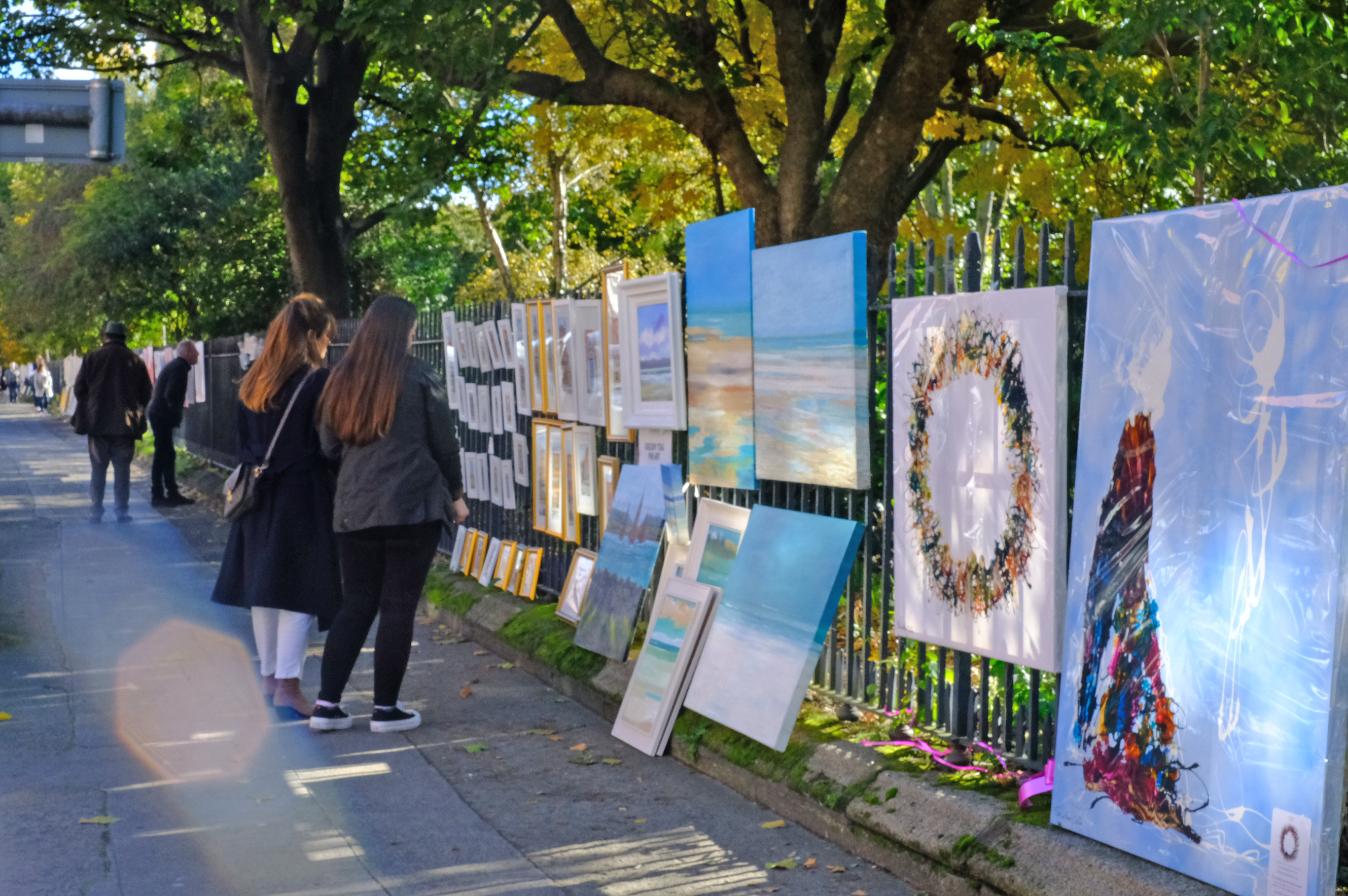
With Level 3 restrictions ordering galleries to close, Eibhin Kavanagh talks to the artists still able to display their work at the Merrion Square Open-Air Art Gallery.
Artists display their work at Merrion Square every Sunday from 10am until 5pm. Photo by Eibhin Kavanagh
With the introduction of Level 3 restrictions in Dublin last month, art galleries and other cultural institutions have been forced to close.
Despite this, the Merrion Square Open-Air Art Gallery has weathered Level 3 restrictions, and every Sunday artists gather in this Georgian garden square to sell their work and bring colour to Dublin City Centre.
Brendan Higgins has been displaying his art at Merrion Square for over ten years. He talked to The City about the changes experienced since artists started exhibiting again in the Summer.
Brendan Higgins at Merrion Square with his artwork. Photo by Eibhin Kavanagh
“There was a huge drop in footfall,” he said. “It is a business area Monday-Friday and on the weekends, there were a lot of tourists.” he continued: “But business hasn’t been too bad, because people are coming in just to buy paintings.”
In regard to the level 3 restrictions, Brendan said: “We’re one of the only open-air events, when the galleries were open as well, they were also attracting people, so the last three weeks with the galleries closed we did notice a drop in footfall.”
Kevin Sharkey, who has been exhibiting for around five years now, said: “An open-air art market is perfectly suited to deal with the coronavirus because it’s not close contact. I find most people are very relaxed about it when they’re outside and they have space.”
“The main thing I noticed was that people who before would’ve done things like go to the cinema or go for a meal or whatever, are instead looking for outdoor activities. Merrion Square suits this perfectly.”
“For the last lockdown, most people were doing two things. They were staying home, and they were decorating. You can only paint so many rooms in your house but at some stage when you want to finish off your design you think, ‘ah we need a nice painting.’ In Ireland, there’s very few places where you can see such a wide breadth of different artistic talents in one sitting, and that is something people who are looking for art want; choice,” Kevin said.
Artist Kevin Sharkey with his work. Taken by Eibhin Kavanagh
Peadar Sheerin, who has been displaying his work at Merrion Square for nine years now, said: “Since this is an open-air exhibition it is reasonably safe Covid-wise.”
Peadar also reflected on how the exhibition used to be: “I miss the American tourists, they were great customers. ‘I like those three honey. Wrap em up’. Also the Germans, French, Japanese, Chinese, and good ole UK, to mention a few.”
Councillor Cat O’Driscoll, chair of the City Council Arts, Culture, Recreation and Leisure Strategic Policy Committee commented on the importance of the open-air gallery with restrictions limiting arts and culture in Dublin City.
“I’ve been inspired by how innovative so many have been to bring arts and culture to everyone safely,” Cat O’Driscoll said.
“The Merrion Square Open-Air Art Gallery is an institution and it is wonderful to have it while so many other spaces are closed.”
“It’s important we still get out and about in a safe way to keep well physically and mentally. Weather permitting, a social distanced stroll around the Merrion Square Gallery on a Sunday with a take away hot beverage is highly recommended.”
She also noted: “Don’t forget your mask.”
“With Merrion Square, you’re dealing with the artist directly. If I was going out to get a painting, I’d go to Merrion Square before I’d go to a gallery,” Brendan Higgins said.
“In Ireland there are very few things that you can bring your whole family to that doesn’t cost you anything,” Kevin Sharkey said.
The Merrion Square Open-Air Art Gallery takes place every Sunday from 10am until 5pm.
On November 2013, Ukrainians took to the streets to claim a better future. In Maidan, the central square of Kiev, protesters expressed their indignation and outrage at the lack of economic growth, mismanagement and corruption. The wave of violent protest that ensued left injured bodies scattered on the streets and resulted in the deposing of the President, Viktor Yanukovych. Thus, the Euromaidan Revolution, also known as Revolution of Dignity, was established to give back hope and dignity to the citizens.
Between the 12th and 20th of March, the Ukrainian Connection Society organized the photographic exhibition “Ukraine: Inspiring Dignity”, which took place at European Union House. Most of the pictures portrayed people on the streets who were fighting for freedom and identity which were devastated by corrupted government. Spend a few minutes walking around the hall, it is enough for anyone to realize that dignity was the word so well represented in several photographs displayed on the stand board.
For Andriy Vysidalko, dignity is a word which carries a lot of meanings and it would be impossible to express in just a few sentences. Andriy has lived in Ireland for 13 years and he could not turn a blind eye to what is happening in Ukraine. He states: “Concept of Ukraine inspiring dignity…”. After Andriy had taken a deep breath, he continued: “The revolution itself was called Revolution of Dignity. Simply because people rose up against a corrupted regime, which ruled Ukraine a number of years. It represents a struggle for better life. It represents Ukraine identity… at a different level. It represents a culture struggling for a better future.”
The name of the event had real importance. Padraig Purcell, project coach of the Ukrainian Connection Society, stated that the name should represent the brave and values based stand the people of Ukraine took. Padraig pointed out: “When discussing the most appropriate name for the exhibition I initially proposed ‘Ukraine Inspiring Freedom’. Anya [founder of the event] considered dignity was appropriate. So, the two of us came up with ‘Ukraine Inspiring Dignity’.” He adds:“Dignity means the way in which the people in Ukraine went about winning freedom from a very corrupt terror regime. They are very gentle, very calm, very musical and very wise about the way they changed their world and took a dignified step towards freedom. It was not violent in mentality or in actuality. It was a totally different way to do things; a lesson to the people of our world that there is always hope and there is always a better way to achieve goals if people work together for good and each other.”
Far from home since her early twenties, Anya Kozak was one of the founders of the Ukrainian Connection Society. She has lived in Ireland for eight years after being a resident in several countries such as Russia, United States and Sweden. Anya stated that the main purpose of this event was to spread the truth of what happened in Ukraine. She said: “Our main agenda of this exhibition is to spread the truth and tell people, Irish people, foreigners who come to Ireland that Ukrainians got fed up with corruption, went to streets for dignity and they were not leave until their voices were heard by the government.” Anya added : “ It could be seen in history that they had to stay on streets for three or four months in very bitter cold and they stood up for their rights.”
The events had support from the Ukrainian church community, Lithuanian embassy and Ukrainian embassy in Ireland. In addition to this, Anya considered that they also had a lot of support from Irish and Ukrainian people in general. The founder pointed out: “ The Lithuanian embassy got on board with us, they were very interested in sharing this exhibition and spreading the truth and awareness in Europe of what really happened because they went through it a few years back and they understand the situation that the Ukraine is going through now.”
“Ukraine: Inspiring Dignity” represents for Anya an “immense will of power of Ukrainian people”. She remarked: “I am impressed to see my people stand up for their own rights. I have never seen such persistence in any other country. They are ready to lose the most precious gift, which is their lives, to stand up for the rights, to stand up for the rights of their children and to eliminate post-Soviet corruption in Ukraine.”
All these members of Ukrainian Connection Society expressed what many Ukrainians long for their future: a better life. A life in which they can live with dignity, free from violence, fear and corruption.
“Blood Vessels” by Charlie Murphy, made of borosilicate glass filled with red and blue toluene that’s used in thermometers.
As soon as you walk in through the glass door of the Science Gallery, you are greeted by the large sign that says “Blood: Not for the faint-hearted”. It really isn’t.
If you’re prone to getting squeamish at the sight of the tiniest trickle of blood, you might want to miss this one. However, if you’re fascinated by the crimson red liquid that runs through your veins and want to learn more about it, you need to see this exhibition.
25 different installations and artworks in the Science Gallery incorporate the main theme of blood, exploring its nature, its scientific use and its perceptions in our society.
The whole atmosphere in the gallery space is eerie in the evening, with dimmed lights illuminating the intriguing installations: a baby sculpture made out of freeze-dried animal blood; a vampire killing kit with four different sizes of wooden stakes; various one-man cinema quarters with videos of stem-cell extractions and blood transfusions; a machine that lets you feel the blood pressure through the aorta by holding the aortic arch simulator; and many more.
If you have some time to kill, you can even stand in the pitch dark corner to watch as luminol drops down onto a sculpture made of blood and resin, slowly revealing the structure made by Beatrice Haines. Luminol is the substance that’s used in TV criminal dramas like CSI, where the cops are looking for evidence of blood residue in crime scenes.
You see, blood on its own doesn’t really show up under fluorescent light. First, forensic scientists would pour luminol over the area and then illuminate it with the bluish-green light. When luminol comes into contact with the haemoglobin in the blood, it glows under the light.
This is one of the more fascinating installations, however it does take time to truly see the structure in its full form. Apparently, it’s approximately 20 minutes, though it does take a lot of patience to stand still in pitch dark while concentrating on one spot.
Another interesting installation is the work of an electronic artist, Rafael Lozano-Hemmer. It’s called “Pulse Index”, and it is an interactive installation where you can scan your finger on a sensor located in a small tube-shaped digital reader. The scanned image instantly pops up on the screen and keeps moving sideways.
All of the participants’ fingerprint scans are accumulated into a digital gallery and displayed onto a huge monitor, divided into hundreds of smaller screens – each person’s finger scan travels along the screens and gets smaller and smaller until it reaches the end of the installation. Finally, the picture completely disappears into the maize of finger scans. The scanner is so precise that it even picks up the tiniest sweat droplets off your finger.
This slideshow requires JavaScript.
“Blood Jukebox” is yet another interactive installation that catches people’s attention. There was even a queue to this intriguing device. This machine, made by the art collective, Robot Versus Future, reads your pulse and tries to estimate your age, generating tracks from your teenage years.
Additionally, it reads the tempo of your pulse and picks a song that matches the beat – the faster your pulse, the more upbeat song the machine generates.
“Blood Jukebox” by Robot Versus Future.
Finger is inserted into the pulse-reader.
The exhibition at the Science Gallery runs until 25 January and is open to the general public, though it is recommended for over 15s due to its gory and bloody nature. (No sign prohibiting vampires from entering, though. Mind you, that would get quite messy, what with the free buffet of blood installations and curious mortals lurking in the dark corners of the Science Gallery.)
Damnation will make you question every choice you are about to make
As a huge adrenaline junkie, horror movies have always been a quick fix for me. Nothing gets me more buzzed then that familiar feeling of listening to the blood pumping in your ears while your heart tries to burst out of your chest as you contemplate every outcome in flashes in your mind. So when I heard that the RDS was hosting a live horror event called Damnation, I jumped at the opportunity to go.
Unfortunately, over many years of watching horror films my sensitivity has somewhat decreased. Stepping in to the show, my friend and I were definitely cynical about the experience. However, to my delight I found that Damnation is a night that will exploit your worst fears, and even better, bring new ones to light that you never knew you had.
Damnation is based on the story of Samuel Page, a blacksmith who mysteriously disappeared around the 1800s. Along with his wife and two daughters, Page was very well-known in the community. However at night he apparently operated a Satanic Cult in his basement. When his terrifying practises were found out, the community burned his house down to the ground with Page and his family inside. Page was the only one whose body was never found.
Damnation plays out the horrors that were suspected to have happened in that satanic house, with many surprises that will play with your mind. The actors take you through a maze of horrors that not only play on your fears in a physical and visual manner, but also aim to disorientate you to make you more vulnerable. You start off cautiously walking through the rooms, and by the end you will be running!
These terrifying faces will haunt you afterwards!
However, this attraction is not for everyone; those who have photosensitive epilepsy are advised to not enter Damnation. There are also “chicken out”doors for those who can’t handle the fear. In some parts you do have to get on your hands and knees and crawl, so people who suffer claustrophobia are allowed to skip this part and go through a door. As my friend suffers from this we went through the door, but take heed and remember that this does not give you a free pass from getting scared half to death! We contemplated that maybe the doorway was the worst part!
The prices are a little steep, €19 for a general pass, but there are discount tickets too, and the event only lasts around half an hour. But for those looking for something very different from the usual weekend bores this is the place for you! Even though it seems like a quick scare for a big price it is definitely an unmissable experience. Take it from me, the person who involuntarily recoiled in fear after opening the bathroom door.
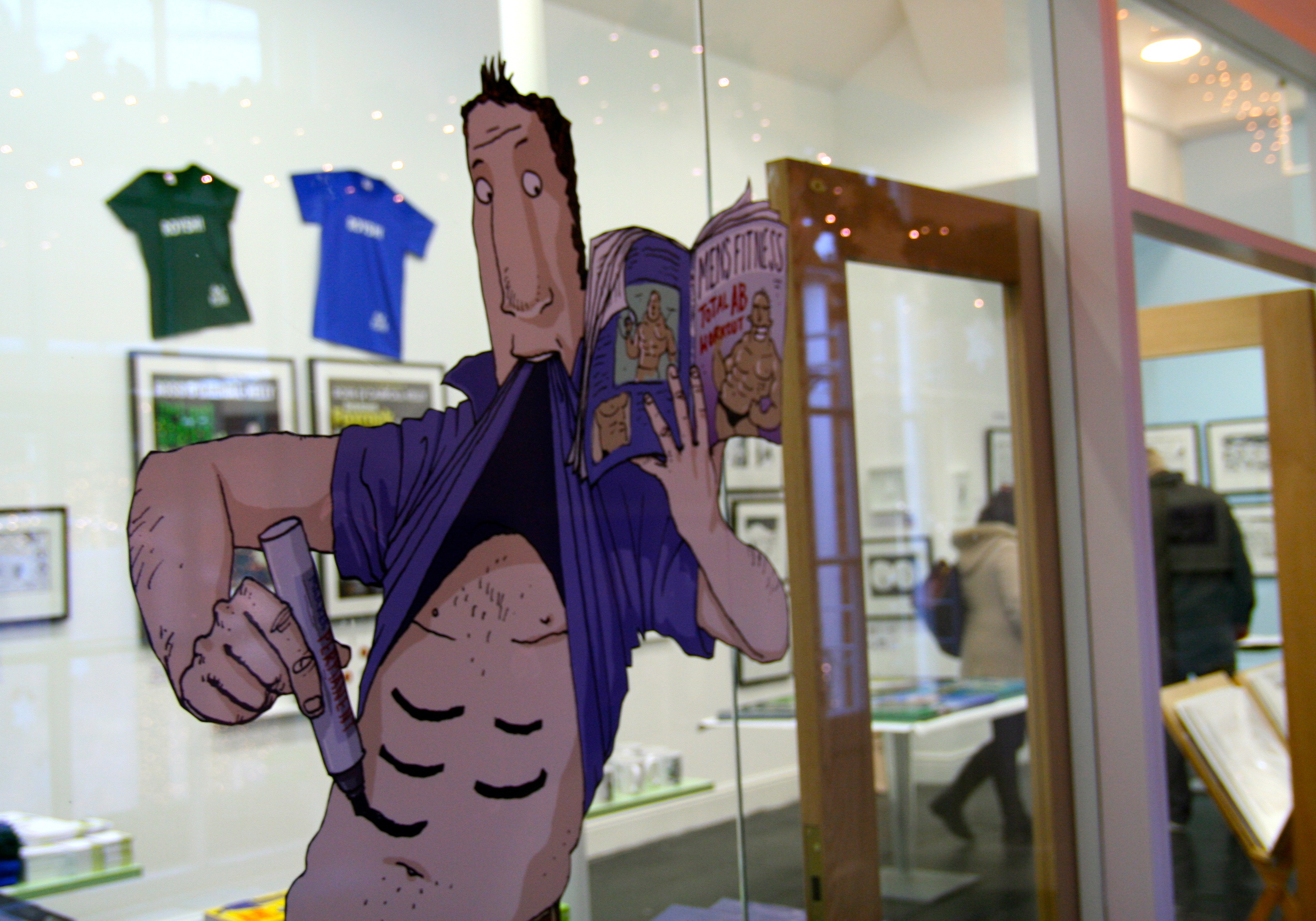
The ‘Ort’ of Ross O’ Carroll-Kelly is like no other art exhibition that you’ve ever been to. The exhibition features images from the world of Paul Howard’s ‘Southsoide’-based creation, Ross O’ Carroll Kelly. Ross was first introduced to all of our lives in January 1998 in the Sunday Tribune when journalist, Paul Howard, decided to start writing a column about a fictional amalgamation of the southside youth that the Celtic Tiger seemed to have spawned. This ‘affluent’ young generation made for hilarious reading and was soon turned into a book series. Now on an impressive fourteen books, two plays and a CD not forgetting the numerous newspaper columns where it all began! Ross’ creator has decided to open an art exhibition displaying the very humorous artwork and never before seen memorabilia by illustrator, Alan Clarke, featured throughout the book series.
The City took a trip to Powerscourt townhouse to see what it was all about! As well as the images featured above, which are just a taster of what’s on display, the exhibition also gives its visitors an opportunity to purchase Ross-emblazoned gift such as mugs, badges and posters. The exhibition opens at 10am daily, is entirely free and will be on display until December 24th.
For its 2012 Christmas exhibition, the Talbot Gallery in Dublin has invited over 40 artists to create a new artwork using items purchased from discount shops.
The fun exhibition is called “Fast Moving Consumer Goods” and was launched yesterday.
With the recently released details of Budget 2013, the exhibition couldn’t have been better timed.
Artist Myra Jago produced a model of semi detached ghost houses made from card, matchsticks, cocktail sticks and pegs. The overall concept is eye catching and precisely illustrates the eerie atmosphere of the many ghost estates left behind in the aftermath of the Celtic Tiger. “I didn’t want to go down the plastic route. Boxes of huge matches kept jumping at me. My piece is based on actual ghost-houses in a ghost-estate in Balgriffin, County Dublin”, said Ms. Jago.
“Nobody’s Home”, By Myra Jago
Exhibition curator Elaine Grainger described the exhibition as a “huge success”. She said, “All of the artists really took to the idea and pushed the boundaries. Every piece of work is truly inspirational”.
An interesting take on one of this year’s best-selling books is Madeleine Hellier’s artwork titled “Fifty Shades of Grey”. Ms. Hellier produced a beautifully finished piece, using a humerous and quirky concept which was influenced by everyday family life. The piece is a wonderful abstract-style collection of used laundry colour-catchers which are displayed in two euro photo-frames. Describing her piece she said, “The colour-catchers were the two euro shop’s best-seller this year, while ‘Fifty Shades of Grey’ was a best-seller in the bookshops. I have four children, so the only fifty shades of grey in my life are the ones illustrated on these colour-catchers”.
Madeline Hellier with her piece, “Fifty Shades of Grey”
Nicky Hooper produced a piece titled ‘Tea and Symphony’, which was made from portable speakers, tights and china teacups. Ms. Hooper said, “It was a challenge because when you’re surrounded by a shop full of trash, it’s really hard to choose just one or two things”.
Curator and participant Claire Halpin described the exhibition as being “strongly influenced by the recession”. “Despite the materials used, none of the pieces being exhibited are tacky. All participating artists really had to push the boundaries with this one”, she said. One of her pieces, titled ‘1120 attempts to make one ice-cube’, humorously illustrates how the new-age round shaped ice-bag seems to be replacing the old fashioned ice-cube.
“1120 Attempts to make one cube”, By Claire Halpin
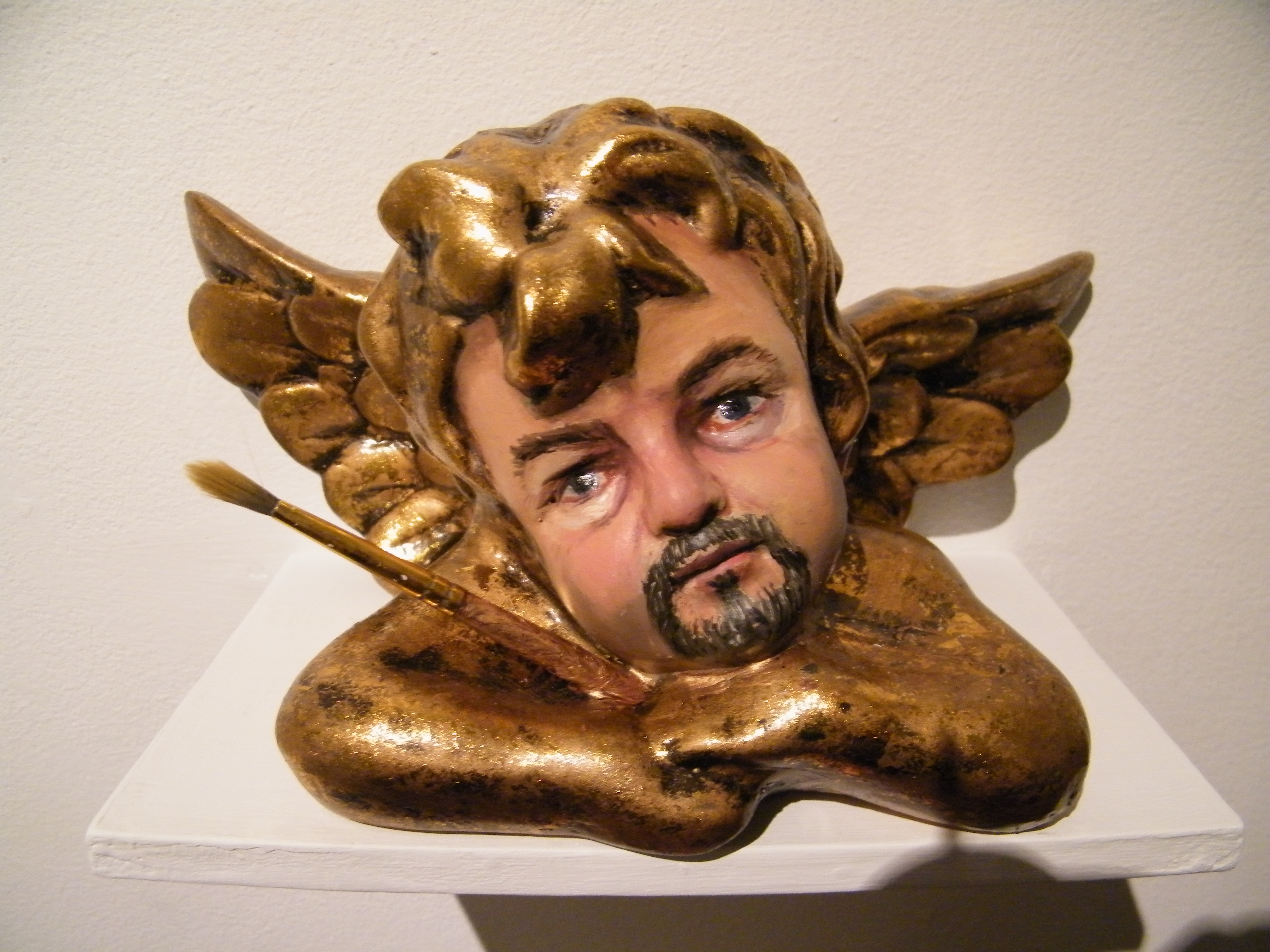
Artist Paul Mc Cormack’s work really stands out in this exhibition. He produced a striking and entertaining self-portrait, using an ornamental Cherub which he bought in a two euro shop. “It was such great fun. I realised that my facial features were very like that of the cherub. All I did was strip the gold paint off the face and repainted that part. The brush in the cherub’s hand is telling you that I am an artist”.
Paul Mc Cormack with his creation, titled “Self Portrait 2012”
Mr. Mc Cormack is also exhibiting a piece titled, ‘It’s always the strap that breaks on a €5.99 watch’. “This one is about my relationship with cheap shops. I have a habit of buying my watches in these discount shops, no matter how often they break. Funny enough, the actual piece that tells the time rarely breaks but the straps seem to rip like paper. The straps are so expensive to get repaired so it makes sense to just buy another cheap one…until the next time that is. Maybe it’s time I invested in a good one actually”, he said.
“It’s always the strap that breaks on a €5.99 watch”, By Paul Mc Cormack
Bláth Ní Mhurchu’s initial plan was to produce a collage. However, when she first went into the two euro shop, she just took lots of photographs and went home to contemplate. Ms. Ní Mhurcu said, “It was only when I went home and looked at the photos that I realised every product in the shop was marketed with tags saying ‘WOW’. There are lots of subliminal messages in this type of marketing. The piece I decided to do in the end represents the reality that many of the items bought in such discount stores are disposed of very quickly, which makes the ‘WOW’ theme quite ironic.”
“Homo Consumericus”, By: Bláth Ní Mhurchu
The materials used in Claire Mc Cluskey’s piece include glass from picture frames, doilies, road map and tinfoil. Her piece is titled ‘Resources, Origins and Culture’. “There were a couple of late nights but it was great fun working on this project. My pieces are about how people’s identities are shaped by resources, where they are from and social mannerisms”, she said.
Daria Privalko used a fibre optic lamp, fairy lights and foam board to create an exquisite, technologically driven piece titled ‘6,094’. She describes the ‘Fast Moving Consumer Goods’ exhibition as “exciting” and said, “It was great to work outside the box”.
“6,094”, By: Dario Privalko
Considering the work that has been put into the pieces exhibited, the selling-prices really do not do them justice. Prices range from just €2 to €250.
The exhibition runs from December 6th to 22nd at The Talbot Gallery 51 Talbot St, phone (01) 8556599.
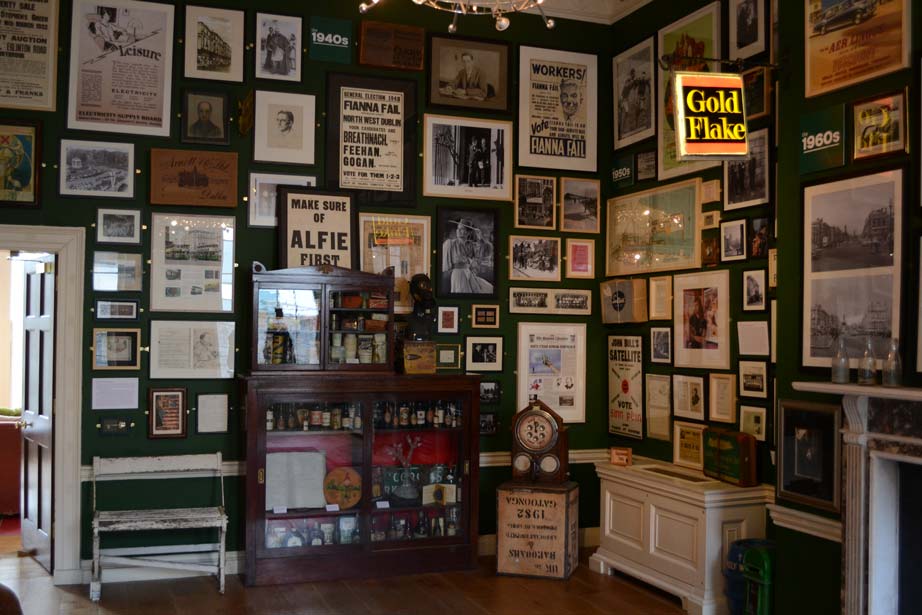
WHERE ELSE in the capital city can you be in the same room as objects such as Nelson’s Pillar, War of Independence Documents and a ‘I’ve Been To Switzer’s Santa’ badge? The Little Museum of Dublin, of course.
Just over a year old, this new museum – housed inside a beautiful Georgian building on St Stephens Green – brings the rare ‘aul times to life.
Spread over just two rooms, the Little Museum’s tall walls are packed floor to ceiling with artefacts telling stories of Dublin in the last century.
Displayed chronologically, the artefacts are an eclectic mix of specialist and general interest objects: from original documents, photos and publications to furniture, food stuff and quirky domestic items.
Some objects give you a glimpse of domestic Dublin – harking back to a time of Gold Flake cigarettes, elephant rides at Dublin Zoo and when Aerlingus offered a return “Rolls Royce powered” service across the pond for just £12.
While other memorabilia – recalling famous visitors to the capital, such as Pope John Paul II to John F Kennedy – appears alongside belongings of legandary Dubliner James Joyce and politician and former President Eamon De Valera.
There is also political artefacts – like Bertie Ahern’s first election poster, and a dated Green Party poster from the 80s which claims “Others promise the moon, we only guarantee the earth”.
The Little Museum of Dublin even has a couple of items from our not so distant past – a membership card from Renards Nightclub or a Ryanair ‘business class’ sticker will raise a few smirks.
Meanwhile, downstairs there is a rotating exhibition space – which currently houses an excellent display on the life of Dubliner Bram Stoker.
One gripe visitors may have when visiting the museum is there is scarce contextual information provided on the collection. Additionally, space constraints mean that some artefacts are placed very high up on the building’s tall walls, making them difficult to see up close without a ladder or a stiff neck.
Fortunately, tours are run regularly by the staff and are included in the admission price. Experiencing the museum through a tour is definitely preferable; as discovering the story behind the objects on display can really bring the collection to life.
Visiting this place won’t break the bank either – tickets are surprisingly affordable. On the door tickets are priced at €5, where concessions are available for students and senior citizens. Additionally, children under 10 and jobseekers can visit free.
As an added bonus – if you visit the museum on a Wednesday between 1pm and 6pm – admission to the museum is free to all, courtesy of Johnston Mooney and O’Brien.
At just two rooms – the Little Museum of Dublin certainly deserves its title, but regardless of its small size, this eccentric and unique mix of Irish memories is well worth a visit.
After all, great nostalgia comes in small doses.
All Pictures courtesy of the Little Museum of Dublin









You must be logged in to post a comment.