Tag: fines

  • Dublin City Council car clamping yields €2.6 million in fines

    Dublin City Council car clamping yields €2.6 million in fines

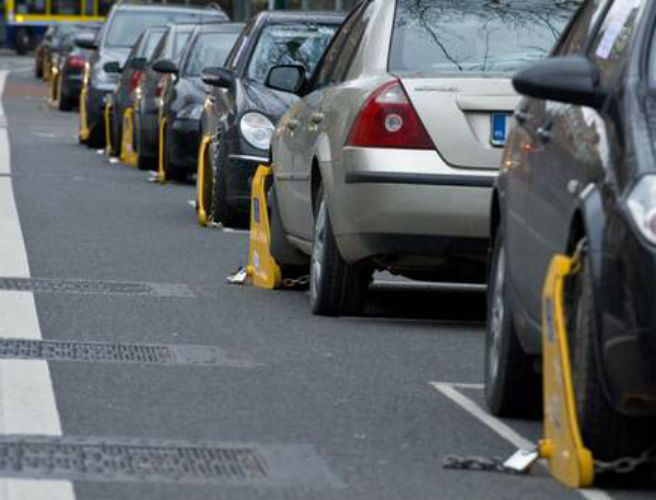
    Dublin City Council (DCC) earned over €2.6 million from clamping release fees during the first nine months of 2018, it has emerged.

    Figures released to thecity.ie show that DCC handed out 33,799 parking fines between January 1st and September 1st, 2018.

    With the standard fine for illegal parking in Dublin City set at €80, the council collected an estimated €2,647,840 but offered refunds or partial refunds on 929 occasions leaving the total sum of fines collected for the period at 2,629,600.

    The southside features more prominently within the top ten clamping hotspots in the capital, with the council keeping a watchful eye on the city’s busiest streets.

    Merrion Square is the city centre location where vehicles are most likely to be clamped, with 1,062 fines issued in this area, totalling to a sum collected of €84,960.

    Fitzwilliam Square proves to be the second most notorious clamping hotspot, with 625 offences committed and €50,000 claimed in fines.

    Mespill Road
    Mespill Road // Google Maps

    Other busy southside spots include Mespil Road (595), South Circular Road (544), Burlington Road (407), Waterloo Road (433) and Hatch Street (376).

    Across the Liffey, Gardiner Street Upper and Lower (426) proved to be the hotbed of northside clamping.

    Ormond Quay (297) and Parnell Square and Street (combined 393) make up the remainder of the top ten.

    Gardiner Street
    Gardiner Street // Google Maps

    Clamping appears to be rare on some of Dublin’s best-known streets, with O’Connell Street (0), Grafton Street (19), Dame Street (12) and Henry Street (5), registering few offences.

    The most common reasons for fines include: no valid paid parking (7,638), pay and display tickets expired by more than ten minutes (6,178), parking in permit-only areas (4,755), loading bay offences (2,440), parking on footpaths (1,874), parking within five metres of a road junction, (1,245), and parking on a double yellow line (1,035).

    Medical emergencies and compassionate cases make up the bulk of successful appeals, many of these in Parnell Square, which is adjacent to the Rotunda Hospital, one of Europe’s busiest maternity hospitals.

    On four occasions, gardaí on duty appealed fines and were successful in three of these appeals. One officer was clamped and fined for not displaying a parking ticket at Seafort Terrace in Sandymount.

    Top ten clamping hotspots in Dublin City – the number of fines

    Merrion Square – 1,062, North (182), South (412), East (86), West (382)

    Fitzwilliam Square – 625, North (317), South (182), East (53), West (73)

    Mespil Road – 595

    South Circular Road – 544

    Waterloo Road – 433

    Gardiner Street Upper (90) and Lower (335) – 426

    Burlington Road – 407

    Parnell Square (288) and Street (105) – 393

    Hatch Street– 376

    Ormond Quay – 297

    Appeals

    Total – 1764                                           Refund (50%) – 456

    Refund (Full) – 473                              Unsuccessful appeals – 835

     

  • More than 1,600 cyclists fined since 2015

    More than 1,600 cyclists fined since 2015

    A total of 1,660 on the spot fines have been handed out to cyclists in the past two years.
    The fixed charge fines were introduced on the 31st of July 2015 by Paschal Donohue who was the transport minister at the time.

    Cyclists breaking red lights is by far the most frequent infraction with 843 of the 1,660 fines being accounted for by this offence.

    There are seven offences for which cyclists can be fined including: cycling recklessly, failure to have lights, cycling in a pedestrianised area, breaking a red light, failing to stop for a school warden and failing to stop at a railway barrier or bridge crossing.

    So far this year there has been 439 fines issued with 172 of them being for breaking a red light, 106 for not having front and rear lights, 88 for cycling in a pedestrianised area, and 73 for cycling without adequate consideration,

    Cyclists can be ordered to pay a €40 fine which can rise to €2,000 if the fine remains unpaid for more than 56 days.

    By Eoghan McGrane

  • Litter louts still a problem in Dublin city

    Litter louts still a problem in Dublin city

    James Carroll sniffs around the dirty business of illegal dumping in Dublin.


    The law is being flouted in Dublin by some businesses, as two-thirds of litter fines are going unpaid.

    Anti-litter campaigner Cieran Perry, a member of Dublin City Council, said that rubbish is being dumped and littered on the streets of Dublin at a distressing rate. “The number one reason is, the will is not there to enforce it,” he said.

    “We have a litter problem in Dublin,” Perry adds. “If you go to a lot of places in and around the city, you see a lot of dumped bags.”

    2017-02-27-12-16-27
    Litter on the streets of Dublin, image by James Carroll

    The figures of unpaid fines, and the lack of will behind them, are distinctly clear to see. “There is no detailed breakdown as to why those fines were not paid,” Perry said.

    “If management were serious about tackling the litter and illegal dumping, they would have gone through the figures and seen where it is happening. They haven’t done the basic analysis to see where the fall down is.”

    On the spot fines for littering is €150 and the council spends €300,000 cleaning chewing gum and another €500,000 a year on cleaning graffiti.

    2017-02-22-13-55-07-hdr
    Litter on the streets of Dublin, image by James Carroll.

    An example of the law being disregarded and the council not being on top of matters was in 2015, when, according to Perry, 70 fines were issued to a pop-up shop, Halloween HQ, for illegal postering. “None of the fines were paid,” he said.

    2017-02-27 10.29.53.jpg
    Rubbish on the streets of Dublin, image by James Carroll

    “No other legislation would be breached like that. If you were towed for illegal parking, you would not write to the council saying I do not respect your authority, it just does not happen.”

    According to Perry, Halloween HQ last year again put up posters illegally. The council knew the premises, identified the offender but did not pursue the fines.

    “I regularly asked about how the progress of the 70 fines was going,” Perry says. He says the council has responded by saying “they could no longer release that info because of data protection”. 

    Perry says Halloween HQ is not the biggest offender, but is an example of the lack of interest in tackling the problem.

    The main problem for the council is businesses leave their waste outside, at the wrong time of the day, so waste sits idle on the streets outside the premises. Waste must be off the street between 10am and 5pm.

    2017-02-22-14-02-55
    Litter on the streets of Dublin, image by James Carroll

    “Usually how the council find illegal dumpers is by finding letters with their addresses in the bags but recently dumpers have become more canny,” Perry said.

    Initiatives that the council have installed to deter the public from illegal dumping have generally worked.“When there is an initiative started, the figures stand out a mile,” he said.

    CCTV have been installed in areas such as Glenvale in Lucan, Church Lane in Rathfarnham and Russel Square in Tallaght.

    Audio messages have also been installed in areas to tell dog owners to clean up after their pets in parks in Palmerstown, Tallaght, Walkinstown, Wellington and Greenhills park.

    In a road that is local to councillor Perry, bags are dumped in the exact same spot every day and collected, unofficially, every day.

    2017-02-27-10-29-27
    Litter on the streets of Dublin, image by James Carroll.

    “What has become the norm on this road, in particular, is as new people move in, they see what is happening and assume it is a collection service,” he said.

    “I’ve seen people do this in broad daylight and clearly they must feel that they are not illegally dumping.”

    Perry believes there is no incentive not to dump because there is little chance of being caught: “If you are caught, there is a one in three chance of being fined.”

    2017-02-27-12-15-44-1
    Litter on the streets of Dublin, image by James Carroll.

    In Dublin Central 691 fines were issued by five litter wardens in 2015. That’s fewer than 140 fines per warden, approximately one fine every second working day.

    Some 465 prosecutions were taken, but there were only 47 convictions.