Tag: GAA

  • Reilly ready for second test in Hurling/Shinty International Series

    Reilly ready for second test in Hurling/Shinty International Series

    Laois Goalkeeper Eoin Reilly in action during the All-Ireland Senior Championship. Picture credit: Diarmuid Greene/SPORTSFILE
    Laois Goalkeeper Eoin Reilly in action during the All-Ireland Senior Championship. Photo: Diarmuid Greene/SPORTSFILE

    Scotland shocked Ireland with a 3-14 to 2-8 win in the first test of the Senior Hurling/Shinty International Series this weekend. However, the Irish team have won the series for the past four years in a row and remain hopeful ahead of the second test. Goalkeeper Eoin Reilly talks to The City’s Áine Hennessy about this minority sport and what it involves.

    “I got involved in hurling/shinty when I was 19 years old back in 2009. I was selected as first-choice goalkeeper for the Irish U21 team ahead of three others from across the country,” he said.

    The Laois native is representing Ireland for his sixth year running in the International Series, a game which combines hurling with the traditional Scottish sport of shinty.

    The 24 year old, who is the current senior hurling goalkeeper for Laois, explains the basic rules of hurling/shinty.

    “The main difference between hurling and shinty is that you can’t catch or kick the ball. A player usually scores goals only, but the International Series uses a scoring system consisting of both goals and points.

    “We use hurls and the Scottish boys use shinty sticks. Their game is very skillful on the ground, whereas hurling is more skillful with high balls,” he said.

    The International Series is played on a home and away basis. The Irish team travelled to Scotland on Friday October 17, where they had a training session that day, followed by the game in Bught Park in Inverness on Saturday October 18 which was aired live on TG4.

    Eoin said that it was a great honour to play for his country, and is hopeful that Ireland will win their home game in Newry on October 25.

    “We have a strong team this year and all the lads are very skillful. The Scottish boys take it very seriously too. We’ve won it (the International Series) the past four years in a row but it has always been very close.

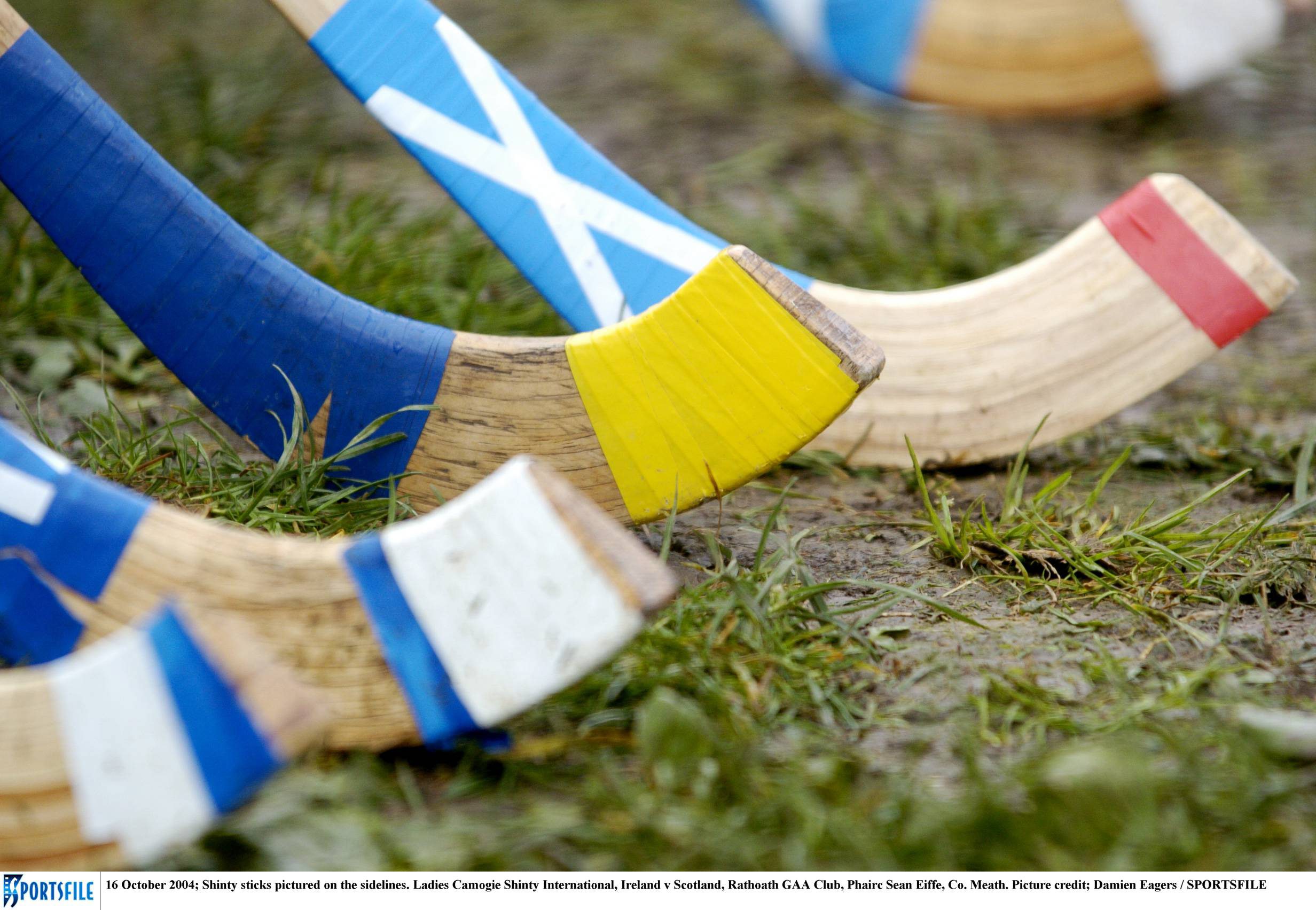
    Shinty sticks pictured on the sidelines. Picture credit: Damien Eagers/SPORTSFILE
    Shinty sticks pictured on the sidelines. Photo: Damien Eagers/SPORTSFILE

    “It’s not often that you get to play for Ireland, so it’s a great honour. The series is a date in my calendar that I look forward to every year,” he added.

    The Hurling/Shinty International Series gets little publicity in comparison to the Australian Rules Series. Eoin says the reason for this is probably centred around a lack of funding.

    “Shinty is a minority sport in Scotland. It’s only played in the Highlands. Aussie Rules on the other hand is a professional sport in Australia, so the funding for it is incredible.

    “As well as that the Irish Aussie Rules team is made up of an All-Star selection. In hurling/shinty, the team is made up of players from the so-called weaker hurling counties. Only a few players would come from the likes of Cork, Clare, Kilkenny and Tipperary,” he said,

    Around 2,000 spectators attended the first test of last year’s series in Scotland, a big crowd for shinty supporters in Scotland, and up to 3,000 attended the second test in Croke Park before last year’s Aussie Rules game.

    This year’s return game will take place in Newry on October 25 and will also be shown live on TG4. It kicks off at 5pm.
  • Fairytale in New York

    Fairytale in New York

    This slideshow requires JavaScript.

    With the recent trend of emigration and the resulting need for young people to feel connected to home, GAA can provide a vital and much needed foothold in a new country. Last month, Damien O’Connor was part of the Kerry team that won an unlikely New York championship, and the Laois footballer gives a unique insight into Gaelic Games overseas.

    Damien O'Connor in action for Laois against Mayo in this years Allianz National League
    Damien O’Connor in action for Laois against Mayo in this years Allianz National League

    “It’s a surreal experience going training. We’re living in a kind of Irish street, McClean Avenue it’s called, and around six or half-six in the evening, the street would be full of Irish just standing around with football boots, everyone waiting for a lift to go training.”

    “Where we were training was about 15 minutes away. There could be about 10 of us in the back of the car, and if the traffic was really bad you could be sitting on the highway for an hour or two hours without moving before you got to training.”

    O’Connor was joined at the Kerry New York club by Down senior footballer Keith Quinn, the only other inter-county player on the team. “We had no really big names, but a lot of good, strong footballers; a lot of Kerry boys who played under-age with Kerry and had been on Kerry senior panels before moving to New York but hadn’t made the breakthrough.”

    Down's Keith Quinn shakes hands with the referee before the match
    Down’s Keith Quinn shakes hands with the referee before the match [credit: Peter Marney]
    “We had one Irish-American lad on the team as well, James Huvane at cornerback. He wasn’t bad at all.”

    “The facilities wouldn’t be as good as at home; we trained on an astro-turf field looking into Manhattan, there were 10 or 12 big pitches but all we had was soccer goals which you can’t really play proper football in. Some of the coaching styles would be completely different to what you’d see over here as well.”

    Unfancied Kerry managed to advance to the final where they played Leitrim, who were on course to win their fourth title in a row. “It was like a proper county final day” says O’Connor, “we had a parade and the national anthem, a good crowd; it was a good experience. The game itself was great, it was tough, there were three or four lads sent off in it.”

    Kerry's Paul O'Donoghue, who scored 0-7 in the final
    Kerry’s Paul O’Donoghue, who scored 0-7 in the final [credit: Peter Marney]
    “It wouldn’t compare to winning anything with Timahoe [O’Connor’s home club] or Laois, but at the time it was a great feeling because going into the game, no-one really gave us a chance. Leitrim had about ten inter-county lads, boys on inter-county transfers who had played with their counties this year, everybody just overlooked Kerry.”

    O'Connor competes with Laois team-mate and Leitrim sanction Kevin Meaney.
    O’Connor competes with Laois team-mate and Leitrim sanction Kevin Meaney. [credit: Peter Marney]
    O’Connor, who featured for Laois against Louth in the Leinster Championship earlier this year before moving to New York, is also quick to praise the quality of football on show in the city; “There’s a good standard of players. You don’t see too many lads standing out; the heat is the real killer. During the summer you could be playing in 35/36 degrees, and on an astro-turf pitch where it’s a couple of degrees warmer.”

    “Coming down to the latter stages of the Championship the standard is very high; there are a lot of good footballers. You’d want to be at the top of your game to play well out there.”

    Monaghan forward Rory Woods (Leitrim).
    Monaghan forward Rory Woods (Leitrim). [credit: Peter Marney]
    “It’s something I’ve always wanted to do and it just felt like the right time to do it,” says O’Connor on leaving home and going to America. When asked what advice he’d give to anyone thinking of making the same decision, the 21-year-old has no hesitation; “Make the most of the experience, have the craic and do as much as you can while you can. It really is something to remember and something you can always say you did”.

    Full credit and thanks to Peter Marney for all images.

  • Festive fun lights up Grafton Street

    Festive fun lights up Grafton Street

    Spirits were high on Thursday as crowds from all over came out to see the annual turning on of Grafton Street’s Christmas lights.

    This year saw X Factor star Melanie McCabe, along with the Dublin football team lend a hand as the lights were switched on at 5.30pm outside St. Stephen’s Green shopping centre.

    Jack White MC’d the event, while the Hallelujah gospel choir led the crowds in some festive singing.

    A popular tradition among Irish people, previous years have seen Canadian popstar Michael Bublé and Downton Abbey actor Allen Leech do the honors of lighting up one of Ireland’s most iconic streets.

    This occasion marks the beginning of the illumination of Dublin City as Henry Street is set to be lit up on the 17th of November, while O’ Connell Street’s lights will be turned on next Sunday.

    Reporter: Claire Mc Quaid

    Video: Jonathan Crean

    Production: Kay Cairns

  • Why save Andy Merrigan?

    Why save Andy Merrigan?

    Every year after the dust settles and the All-Ireland has been won, the attention quickly turns to the Club game.  Local pride, playing with family and friends, the parish team are all at the core of club football, but unfortunately our game’s biggest prize is flawed.

    There are lots of reasons, out of the GAA’s control, that don’t allow the club model to function as well as the county one.  I will look into some of the main reasons why the Andy Merrigan cup is over shadowed by Sam MaGuire.

    Karl Lacey played every single game for club and county in 2012 but only played once in 2013 due to injury .ie
    Karl Lacey played every single game for club and county in 2012 but only played once in 2013 due to injury credit gaa.ie

    1. Staggered championships

    The County Championships are all staggered, depending on when your county exits the race for Sam.  The Louth championship could start in early June whilst the Dublin equivalent won’t begin until late September.  With no fixed start date but a fixed final date it can lead to too many games in short spaces.  When Donegal won the 2012 All-Ireland their club championship was ran off in five weeks, champions St. Eunan’s played eight games in that period.  ‘‘I remember going to games on Tuesday’s and Wednesday’s in the middle of November’’ said Mark Boyle of Ardra.

    2. Bad Conditions

    The club championships are usually played over the winter months, especially the provincial series’.  By playing these games on soft pitches and in desperately cold conditions players don’t get to express themselves as they would do over the summer.  Due to the conditions games are much slower and more players get injured. Leg injuries are ripe in the Provincial Club Championships.

    3. External Commitments

    Should you be lucky enough to prevail in your county and have county players or students on your team, it is nearly a burden.  County players are wrecked after a tough seven months, at least, and both the colleges and schools are just beginning their campaigns.  Also, the selection to play with your province and country are problems as both the Railway cup and the Cormac McAnallen cup squads are being finalised.

    The distraction of playing for your country is hurting the club game. [image: zimbio.com]
    The distraction of playing for your country is hurting the club game. [image: zimbio.com]
    4. Burnout

    A professional Rugby player and/or a professional soccer player gets six weeks off at the end of a season, this time is used to recover and allow the body to relax after a tough season.  The most a club player gets due to one commitment or another is, at the very most, three weeks.  Training for county and clubs starts the first Tuesday in January.  Harry Dawson of Skerries Harps says that he feels mentally and physically wrecked all the time ‘’I find it hard to go training and all I want to do is sleep’’.

    I don’t know whether its a coincidence or a fact,  but if you look at the counties and provinces winning the All-Ireland’s you’ll very quickly see that the club football in those counties is struggling and vice versa.

    The All-Ireland club championship is the pinnacle of every single player’s career but due to the above reasons we are endangering of ruining our game.  The GAA need to reform their fixtures and get a more coherent agenda put in place.

    I have taken the first step by giving GAA president nominee Aogan Farrell a copy of this article.

  • 5 who made it in the AFL…. and 5 who didn’t

    5 who made it in the AFL…. and 5 who didn’t

    With the news this week that Cork’s Ciaran Sheehan will join AFL side Carlton Blues in January, TheCity.ie looks at some of the top Gaelic footballers who made it down under, as well as some of those who didn’t adapt to the new game.

    Those who made it

    This slideshow requires JavaScript.

    And those that didn’t

    This slideshow requires JavaScript.

    Sheehan (22) becomes Carlton’s third Irish player, joining Zach Touhy and 19-year-old Ciaran Byrne of Louth, who only signed for the AFL side in August. The Eire Og mans abdication is yet another blow for Cork’s senior footballers, who having already lost manager Conor Counihan earlier this year will be without stalwarts Graham Canty and Pearse O’Neill for the 2014 season after both announced their retirements last week.

  • “It’s not amateur anymore”: Colm Begley on Gaelic Football’s increasing professionalism

    “It’s not amateur anymore”: Colm Begley on Gaelic Football’s increasing professionalism

    “An amateur game played at a professional level” was how Colm Begley described Gaelic football this week.

    “The gap has been closed” between GAA and AFL in recent seasons stated the former Brisbane Lions Rookie of the Year, speaking ahead of last weekends second International Rules test.

    Echoing Ireland captain Michael Murphy’s comments last week, Begley believes that the only real difference between football and professional sport is that while GAA players are “focused on work or college, anything like that”, professionals can concentrate on rest and recovery.

    The 2011 Laois senior captain also warned that if the GAA don’t address the problem of burnout in their players, the recent upward trend in physical preparation will result in long-term damage to the game.

    “If they don’t look at it in the next few years, they’ll see a lot of players retiring at a younger age. Players love playing, but it’s just a massive, massive effort, and very mentally draining for those who don’t get a break”.

    Begley, who in addition to Ireland and Laois will also represent DCU and Dublin club Parnells this year, pointed to a recent change in AFL preseason training where players will only be allowed train three days a week to prevent burnout as”something the GAA will maybe have to look into”.

    The rise in strength and fitness levels has aided Ireland in the International Rules series however, Colm pointing to the fact that “we’re not being physically out-matched”, players endurance and speed levels on par with their professional opponents.

    This increase in training has led to a more competitive domestic game as well; “In the past, the top six or seven teams in Ireland would be fitter or stronger, whereas now teams are realising if we cant match them skillfully, we’ll try and surpass them in training, in strength or endurance. We’ll outrun them, out-tackle them. If you can control a players playing ability, skills etc, you can control how fit or strong they are”.

    “Whatever people say, it is professional”, continues Begley, “The game is getting faster and faster, all the small details are being looked at; Body Mass Index, GPS, stats, all the things that really, in an amateur game, you wouldn’t have to look at,  but it’s not amateur anymore, it’s run in a professional way”.

    While he stops short of calling for professionalism in GAA, Begley does admit he would like to see some rewards for inter-county players. “I’m not sure how they’re going to do it, even its just some form of tax benefit or even expenses being increased a little more. Players don’t want alot, just a bit of a benefit for the effort they put in during the year”.

    Begley 2 image INPHQDan Sheridan
    Colm Begley ahead of Saturday’s second test match [image: INPHQ: Dan Sheridan]
    After being nominated for man-of-the-match in the first test match, the Laois man is convinced that the indigenous Australian side will improve in Saturday’s up-coming second round. “They learn very fast. I think they’ll carry the ball, work it into the danger zone and try work off the breaks. I also expect a bit more physicality from them as well”.

    Ireland carry a 57-35 lead into the second test, to be played in Croke Park at 7PM on Saturday.

  • International Rules at the crossroads

    International Rules at the crossroads

    With the latest set of International Rules tests between Ireland and Australia now in full swing, many people are wondering whether or not the compromise rules concept has a viable future.

    Given its former reputation of being a hard-hitting and fiercely-contested battle between two proud sporting cultures, the appetite for future installments of the hybrid game between Gaelic and Australian rules football appears to be waning.

    Growing Apathy

    Although Ireland’s 57-35 victory over the Australian select was regarded as an enthralling spectacle by some, there appears to be a growing apathy amongst the sporting public in both countries which is beginning to be reflected in the attitude of the associations involved.

    By and large the mass brawls of earlier years have been confined to the history books (Photo credit Jimmy Harris on Flickr)
    By and large the mass brawls of earlier years have been confined to the history books (Photo credit Jimmy Harris on Flickr)

    Australia caused controversy this year with the announcement of an all-indigenous selection for the first time in series history. Labelled by some as ‘reverse racism’, the Australian Football League wanted to honour the contribution of Aboriginal players to the country’s national sport, and picked what they believed to be a more agile and skilful selection in the process.

    However, despite the best intentions in the world, the fact remains that not one member of Australia’s 33-man panel was part of this year’s All-Australian team lineup. Ireland, in stark contrast, had five members of last year’s equivalent All-Star side included in the home squad, with many more set to be named in the 2013 selection later this month.

    Declining player standards on one side at least has led to a predictable fall-off in support.

    From capacity crowds in both countries during the series’ reinstatement during the late ’90s and early 2000s, the average attendance figure of just 17’000 recorded during the 2011 test series in Australia was compounded by the sight of a half-full Breffni Park for Ireland’s victory at the weekend.

    Attendances for the rules matches have been dwindling Down Under (Photo credit Michael Spencer on Flickr)
    Attendances for the rules matches have been dwindling Down Under (Photo credit Michael Spencer on Flickr)

    Indicative of this decline was the Australian media’s complete lack of interest in the event. With not one major national broadcaster providing coverage of this latest series, the press Down Under generally seems to have gotten fed up with the sanitised version of what was once regarded as all-out warfare with a ball (merely incidental, of course) involved.

    Hope Remains

    However far it’s fallen from grace, the International Rules series does still retain some of its merits.

    From what started as a tenuous association during the two sports at the time of the series’ inauguration in 1984, relations have blossomed between the AFL and GAA in recent times, with intercounty luminaries such as Jim Stynes, Tadhg Kennelly and Marty Clarke swapping the round ball for an oval version in their quest to make it big in the Aussies’ premier indigenous sport.

    With many school and college teams from both codes now traipsing around the planet to test their skills against their compromise rules counterparts, it’s also initiated a valuable cultural exchange between the young peoples of two countries with a lot in common.

    But the fact remains that at its highest level, the series is plagued by a diverse set of problems. Speaking in Melbourne in 2011, GAA Árd Stiúrthór Páraic Duffy stated that unless series interest and attendances picked up in Australia, the Irish audience wouldn’t maintain a reciprocal interest.

    It appears that, following a sad and gradual decline, we’ve finally reached that crossroads. It’s now down to the GAA and AFL to pull their formerly proud combined sporting tradition back from the brink, or risk losing it forever.

    (Featured image credit Michael Spencer on Flickr)

    SOCIAL MEDIA NOTE

    @officialgaa

    @irfsofficial

    @gaaclub

  • An All-Star popularity contest?

    An All-Star popularity contest?

    The eagerly awaited nominations for the 2013 GAA GPA All-Stars were announced this month, with the awards ceremony to be held, for the first time, in Croke Park on 8th November.

    The awards process has always been subject to criticism, but in recent years have seen enough highly controversial decisions to bring the validity of the process into question.

    This year especially was a vital one for the All-Stars credibility. After a footballing year that saw Monaghan come from nowhere to claim an Ulster title, Cavan shock the country on a run to Croke Park and London appear in their first ever Connacht final (not to mention a resurgent Tyrone team), it was a vintage year for the sport.

    If football enjoyed a good year, it was nothing compared to the renaissance that gripped hurling this season. Clare’s fourth All-Ireland victory was just the tip of an iceberg that included Limerick bridging a 17-year gap to the Munster title, Dublin winning their first Leinster final in 52 years and an overthrowing of the traditional powers that saw Kilkenny, Galway and Tipperary fail to advance past the quarter-finals.

    However, the nomination of Clare hero Shane O’Donnell for a place on the team of the year highlights one of the main problems afflicting the All Stars in previous seasons. While O’Donnell was unarguably the main factor in Clare’s victory over Cork in the All-Ireland replay and deservedly awarded the Man-of-the-Match, this does not warrant an All Star.

    O'Donnell celebrates in the wake of Clare's All-Ireland victory [credit: rte.ie]
    O’Donnell celebrates in the wake of Clare’s All-Ireland victory [credit: rte.ie]
    To be placed on the short-list for the team of the year after 65 minutes of playing time (O’Donnell was replaced by Darach Honan with five minutes remaining) undermines the entire nomination process, not to mention robbing those players who performed consistently over the year the opportunity to be recognised.

    The failure of O’Donnell to be included on the Bord Gais Under-21 team of year, and yet still be nominated for its senior counterpart speaks volumes as to the lack of thought given to his selection.

    This sentimentality and willingness to accommodate big names was also apparent in the football selections with the nominations of Cian O’Sullivan (Dublin) and Sean Cavanagh (Tyrone). Despite both players spending the vast majority of their years at midfield, O’Sullivan received his nomination in the half-backs and Cavanagh in the half-forwards.

    Under the current rules, players are nominated in the positions they lined out in for the majority of the year, with the nominations being grouped into differing lines of the field (e.g. 3 keepers, 9 fullbacks, 9 halfbacks, 6 midfielders, etc.). While O’Sullivan and Cavanagh both had an outstanding year, the performances en route to the All-Ireland final of Aiden O’Shea and Michael Darragh MacAuley make the selection of the two midfield slots a mere formality.

    While both players had stints in their nominated positions, this is more an excuse to shoe-horn O’Sullivan and Cavanagh into the team rather than a legitimate reason.

    Situations such as these have arisen in the past, most notably in 2010. That year several questions were raised over Graham Canty’s inclusion at centre-back over Downs Kevin McKernan, despite the Corkmans year being plagued by injury. Add that to the fact that not one of the All-Ireland winning Cork forwards received an award compared to three from the Down side they defeated and the inconsistencies begin to pile up.

    Last year, Bernard Brogan’s nomination ahead of the likes of Paddy McBrearty and Michael Conroy was seen as an example of the ‘big name bias’ many feel influences the All Star selection committee. Brogan had, by all accounts, a disappointing 2012 season, hampered as it was by injury and bad form, while McBrearty and Conroy were both pivotal in helping their respective side’s advance to the final.

    The announcement of Kerry stalwart Tomas O’Se’s retirement from inter-county football last week threw up a remarkable statistic. Despite redefining the wing-back position, one of the greatest defenders of the modern era received only five All-Star awards during his 15-year career.

    [credit: irishmirror.ie]
    Kerry legend Tomas O’Se in action [credit: irishmirror.ie]
    While the All Stars garner great publicity for the GAA both here and over-seas, as well as affording players from so-called ‘weaker counties’ well-deserved recognition for their accomplishments, steps must be taken to improve the selection process before the scheme becomes a joke or, even worse, descends into Railway Cup levels of non-interest.

  • How Dublin won the treble

    How Dublin won the treble

    Dublin claimed the treble in 2013, the National league, Another Leinster crown and the coveted Sam Ma Guire.

    How and why did the Dubs have such a fine season, after Mayo exposed them in last summer’s All-Ireland semi-final?

    Jim Gavin took over from Pat Gilroy and introduced lots of youth into the metropolitan’s side.  Jack McCaffery, Paul Manion and Ciaran Kilkenny to name but a few.

    Dublin topped the league table and set up a league final meeting with Tyrone.  In a magnificent game of football Dublin won by the minimum, 0-16 to 0-15.

    Five weeks later Gavin’s boys overcame Westmeath quite easily on a score line of 1-22 to 0-09.

    Kildare and Kieran Mc Geeney were next to challenge; a goal from Tomas O Connor inside the first minute gave the Lillywhites a great platform but Dublin hit back with four goals of their own to hammer Kildare by 16 points, 4-16 to 1-09.

    Bernard Brogan is a hero for the Dubs. credit liberty.ie
    Bernard Brogan is a hero for the Dubs. credit liberty.ie

    For the third year in a row Meath were in the Leinster final, having only been outdone by a Bernard Brogan goal in 2012 the Royals were full of confidence.  And after an excellent first half Meath looked to be on their way as they lead by four at the break.

    Second half goals from Paul Manion and Bernard brogan, however, ended Meath hopes as Dublin won their 52nd title.

    In the All-Ireland quarter final Dublin had 85% of the possession, six clear cut goal chances and hit the post on a couple of occasions and still only managed to beat Cork by five points, 1-16 to 0-09.  It was in this game that the Dubs showed their real strength as a force in Gaelic games.

    In the semi-final Colm Cooper showed why he is the greatest player of all time with a virtuoso display.  However the great man’s efforts couldn’t stop the champions elect as they ran out winners by seven points, 3-18 to 3-11.

    Dublin before the All-Ireland final. credit the liberty.ie
    Dublin before the All-Ireland final. credit john mulhollandbookmaker

    In the final, the biggest in history if you believe the hype, Mayo were hoping to bridge a 62 year wait for Sam.  In the first 25 minutes Mayo were sharper, hungrier, fitter and more coherent but their failure to convert their chances in scores coupled with Bernard Brogan’s first goal eight minutes before the break shattered James Horans’ side.

    Another Brogan goal in the second half cancelled out Andy Moran’s earlier strike and the Dub’s were celebrating their second title in three seasons and 24th in total.