Issues have been raised about the lack of standardisation across catering companies under the Government’s School Meals Scheme.
By Rebecca Reilly
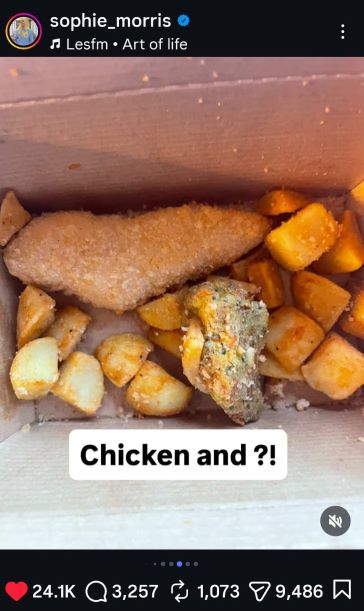
Nutrition coach Sophie Morris has posted images on social media reflecting parents’ concerns about the quality of meals being served in some schools.
In the post Sophie has said what she is “advocating for is improving the standard of the food that’s currently being served to our children.”
She also references the photos below saying that “this is what’s happening on the ground.” We reached out to Sophie, but she was unavailable for comment at this time.

A pilot for hot meals was introduced by the Department of Social Protection in 2019 to a select number of schools.
The scheme has been expanding since April 2025, with 3,149 schools awarded funding under the programme for the 2025/26 academic year.
There are approximately 100 schools with applications for funding pending, awaiting further information. The Department continues to receive applications as schools finalise their procurement process.
The budget for the scheme in 2026 is €286 million, with the aim of catering to all primary schools across Ireland on a phased basis.
The meals are provided by a number of suppliers such as The Lunch Bag, Freshtoday and Glanmore Foods.
TheCity.ie spoke to a number of parents about the scheme. They spoke to us on condition of anonymity.
“I personally believe it is a disappointing service. My children don’t like the meals, and I don’t believe they are nutritious. We have since opted out and send our kids to school with a packed lunch daily,” said one parent.
Another parent alleged that their 10-year-old child received undercooked chicken. “When I raised the issue at school, I was told to contact the supplier directly.”
According to the parent, the supplier told them that they could opt out of the meal again, apologised that their child did not enjoy it, and they hoped the following day’s meal would be better.
Speaking to TheCity.ie, one primary school teacher in Louth said: “Although the premise in theory is good, over a third of parents have stopped ordering lunch in my class. A handful of kids are now eating them.”
“I can only speak about what I see in my class, but meals are a far cry from the samples we received last year for staff to try and are not consistent week to week – the kids have commented on that.”
The teacher said they also questioned how nutritious the meals are.
“The ingredient list is extremely long. Some labels don’t show the percentage of meat content; some do. Some meals contain added preservatives, stabilisers, sulphites, raising agents, and more. Is there a way to reduce those extra ingredients that you wouldn’t typically put into a home-cooked meal?”
Waste has also become a growing concern in this teacher’s school.
“Parents don’t get to see how much or little their child is eating, as the food is placed into the insulated box it arrived in for the company to collect the next day to dispose of. It is a lot of waste – a waste of food and a waste of taxpayers’ money. Money that could surely be spent better.”

A spokesperson for the Minister for Social Protection Dara Calleary said: “The nutritional standards for school meals have been in place since its inception and were developed by a technical nutrition subgroup.”
This group included dieticians from the Irish Nutrition and Dietetic Institute of Ireland, the HSE, Safefood, and the Food Safety Authority of Ireland.
“Nutritional standards are a priority,” they said.
“Last September, the Department seconded a CORU-registered dietitian from the Department of Health to strengthen oversight of the School Meals Programme and conduct a review of the nutritional guidelines and the compliance of the main suppliers with the current guidelines.”
Since September 2025, foods high in saturated fat, sugar and salt have been removed from school menus.

Although calls for higher quality food echo many parents’ sentiments, some say there are many positive results from the scheme.
“My son is really happy with the food,” Pamela Lee, a mother-of -two from Galway told TheCity.ie.
“I do think there could be more variety – but I do think I could change it up for my son also in terms of my ordering.”
“My son eats everything and has never complained to me about the meals yet,” said Paula Madden from Galway, whose son avails of the programme.
Sinéad Crowe, a nutritional therapist and intuitive eating counsellor, praised the scheme for encouraging independence among children, but said regulation needs to be reviewed.
“My kids go on to the app every week and see what new specials are out and they like going through what to order. I think that encourages some autonomy and agency and promote decision making skills around what they are going to eat themselves,” she said.
“The providers are all different, so it isn’t standardised. Companies are going to vary in terms of what they are offering. I think that would need to be addressed and looked at. The companies need to be more direct with what ingredients are in the food – we need complete transparency.”
Crowe, who co-founded the Intuitive Eating Hub, has also raised concerns about how we frame this conversation.
“We need to be careful about the exposure that our children might have to this conversation… it could negatively affect a child’s relationship with food. We can talk about balanced and optimised nutrition without coming from a place of fear or scaremongering.”
Fine Gael is currently running a public survey on the scheme to inform the next phase of improvements and rollouts.











You must be logged in to post a comment.