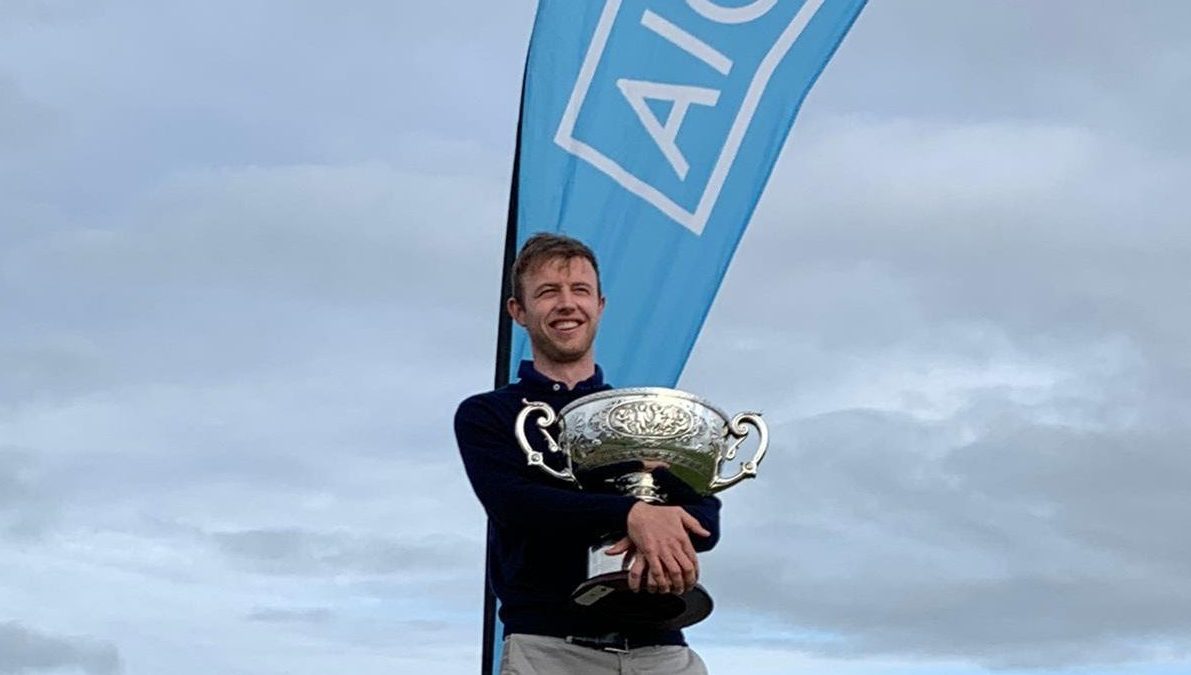
Hugh Foley embraces his AIG 2020 Irish Amateur Close Championship Trophy which he won at Sandy Hills Links, Rosapenna GC, County Donegal. Image courtesy of Hugh Foley
Listen to Liam Daly in conversation with Hugh Foley
The past year has been difficult for everyone, and the world of amateur sport has unfortunately been put on hold. Many of us have felt bereft losing our favourite past times – something that is hugely important for both physical and mental health.
For those battling tooth and nail to make their sport a source of income, the prolonged wait has been a huge blow.
With the courses closed for a huge portion of the year, golfers like Hugh Foley of the Royal Dublin Golf Club on Dollymount Strand have had to bide their time, and try to maintain a high level of mentality and physicality for the approaching season.
Watch Katy Brennan and Nicole Kidd discuss how Covid-19 has been handled in Vancouver, British Columbia
As Canada begin to ease its restrictions , Katy Brennan speaks to Nicole Kidd, who gives an account of the country’s dealings with the Covid-19 pandemic over the past year
The first community transmitted case of coronavirus in Canada occurred on 5 March 2020. Cases grew rapidly, and by mid-March, all provinces had declared a state of emergency.
In response to the growing number of cases, Canada severely restricted its borders, banning all non-essential travellers and forcing any exceptions to self-isolate for 14 days.
Each province implemented varying degrees of restrictions and has continued to do so as case numbers rise and fall.
Some provinces, such as Ontario and Quebec, introduced heavy restrictions like school closures, shutting down non essential retail, and curfews. Other areas, like British Columbia, have taken a lighter approach.
Nicole Kidd left Ireland for Vancouver, British Columbia, three years ago.
We feel really spoiled over here because we have never not been able to go eat food, or go out for lunch, and our bars are open
Nicole Kidd
She explains that social gatherings are banned and most people work from home, but stores, cafes and bars have remained open throughout – offering people some sense of normality.
People are expected to socialise exclusively with people from their own household, but exceptions are made for those who live alone, who are permitted to have a ‘bubble’ of two other people.
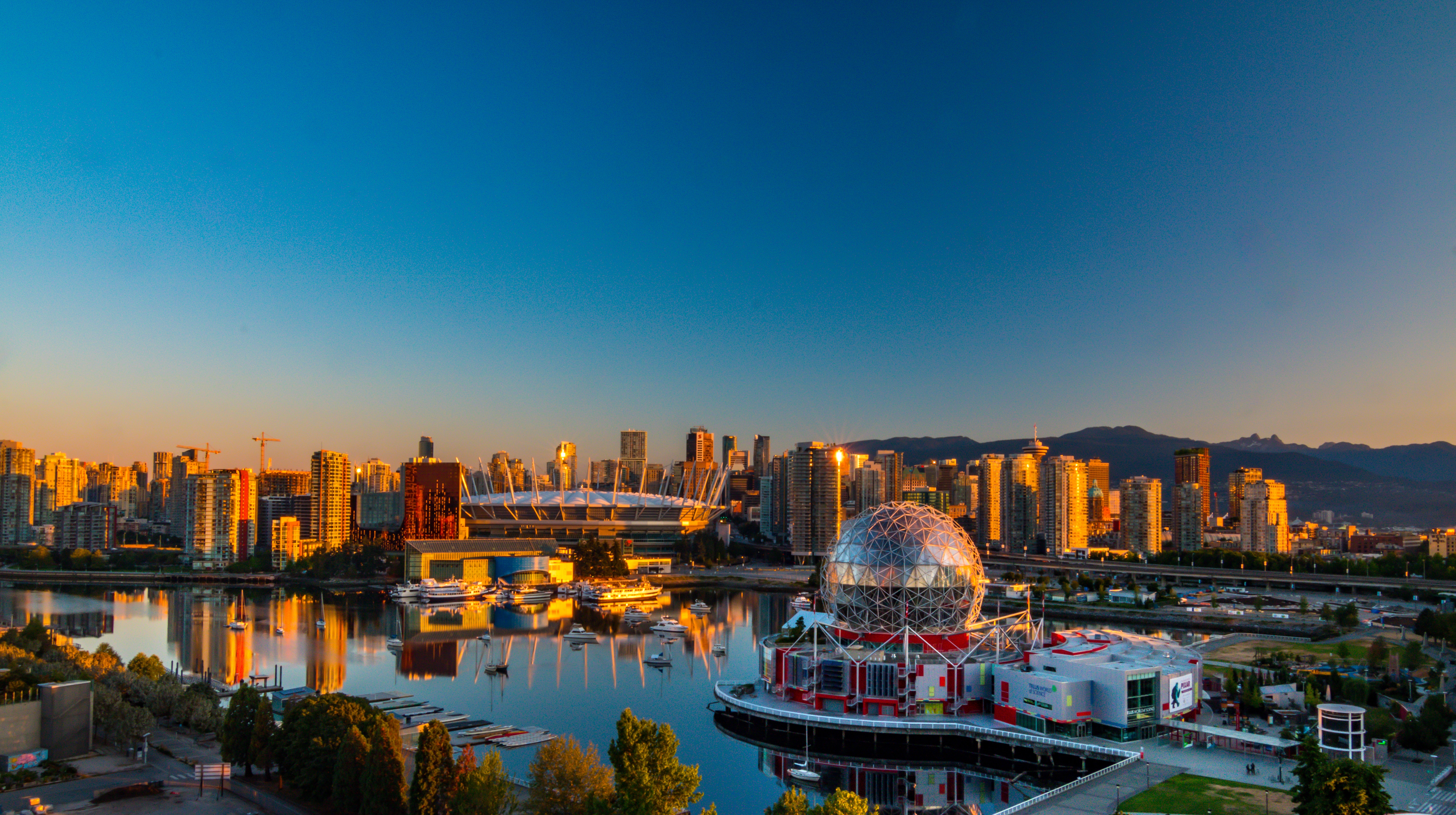
A shot overlooking Vancouver. Photo by Adi Kavazovic on Pexels
Kidd is grateful to have maintained a decent social life – something she thinks is important for mental health and hard for those back home in Ireland.
“We feel really spoiled over here because we have never not been able to go eat food, or go out for lunch, and our bars are open,” she says.
Kidd is a qualified yoga teacher and while she is eager to get the vaccine and return to normal life, she is happy the pandemic has allowed her to devote more time to her yoga.
Canada’s vaccine rollout began on 14 December, and since then the country has vaccinated 1.1 million people. The rollout consists of three stages, working its way down from most vulnerable to least vulnerable.
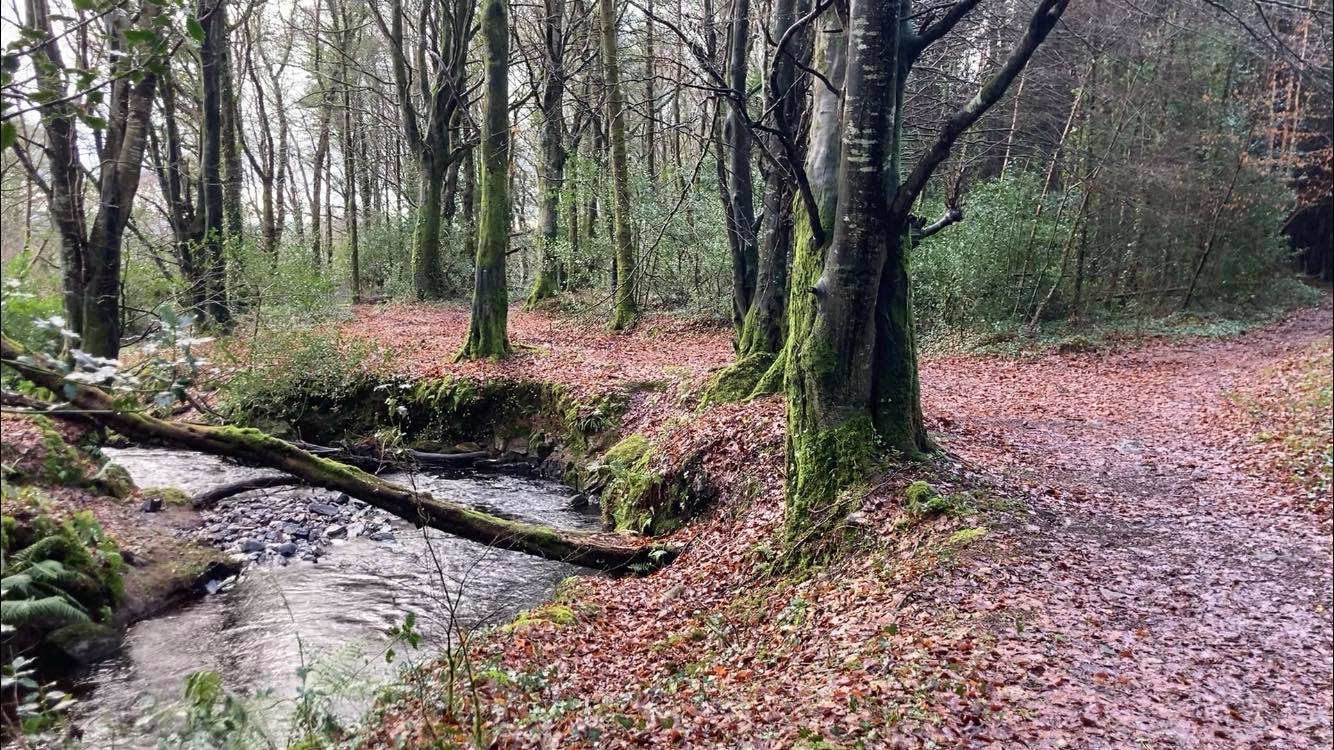
Monellan Woods in County Donegal. Photo by Niamh Alexander
“We’re all in the same boat.”
We have all heard this saying in some shape or form since lockdown began. It has been repeated over and over as a way of reassuring the masses that we are all in this together – that we need to present a united front to beat the virus.
Which is true – to an extent.
It might be more accurate to say we are all in the same ocean, but different boats.
Every one of us will have a different experience of lockdown to tell. Do you live with your family or housemates or even alone? Maybe you have not left the house since last March or maybe you are a key worker and haven’t actually stayed at home at all. Do you live on the top floor of an apartment building or in a spacious house with a garden?
The River Liffey in Dublin city. Photo by Stephen Hylands via Pexels.com
This is especially true in the case of quarantining in the countryside versus in a city. I have experienced both country and city living, and I can attest to the vastly different experiences.
“I spent the first lockdown at home, and I live in quite a rural area,” says Arlene Bonner, a student from Donegal who has since moved to Dublin.
“We were lucky that the weather was really good, so I actually spent a lot of it outside, you know going for walks or just sitting in the garden. I think that maybe lessened the feeling of anxiousness or claustrophobia that a lot of other people talked about. There’s a woods near my house so I spent a lot of time there which was nice,” she says.
For Dublin resident Jennifer Carleton, the experience was very different:
“I would definitely love to be quarantining in the countryside instead of the city. I live in a housing estate so there isn’t a lot of green spaces that I can really enjoy. I’m beside a really busy road so I don’t have a lot of options. I kind of just have the one route if I want to go for a walk or anything. I spend most of my time indoors,” she tells me.
Georgian houses in Dublin. Photo by Skitterphoto via Pexels.com
For a lot of people, this is the main draw for living in more rural areas, especially during lockdown. Having the option to explore more open spaces and scenic countryside can make for a more pleasant lockdown experience.
“I think lockdown is going to be pretty lonely no matter where you are”
Jennifer Carleton
However, countryside living can also have its drawbacks.
“I do think being in lockdown in Donegal was a lot more isolating than Dublin. I didn’t really see anyone except my family for the full six weeks, but in Dublin I live in an apartment complex, so I have lots of neighbours that I see most days. There’s always people around,” says Bonner.
When asked if she found lockdown in a city to be isolating, Carleton said that lockdown is difficult regardless of where you spend it:
“I think lockdown is going to be pretty lonely no matter where you are, but yeah I do think being in a city is easier in that sense. I know most of my neighbours so we’re able to meet up outside as long as we stay far apart.”
Most people assume that the isolation of the countryside would be relatively safer than a crowded city. However, this has not rung true for Ireland’s Covid-19 statistics. Rural areas have reported some of the highest number of cases per 100,000 of the population since the pandemic began.
For a while, Donegal had the highest 14-day incidence rate in the country. Other rural areas have been particularly high – Co Offaly currently has a 14-day incidence rate of 369.4, higher even than Dublin.
In contrast, some urban areas such as Blackrock or Dun Laoghaire in Dublin have experienced a considerably low number of cases per 100,000.
It is difficult to know exactly why cases in some rural areas have been so high, and health officials have yet to pinpoint an exact reason.
“I do think it’s a case of letting your guard down. I think people expect rural areas to be safer and they might not be as good at sticking to some of the restrictions. It’s a lot harder to forget about (the pandemic) in a busy city,” says Bonner.
Whatever the reason, it is important to remember that not everyone’s experience of the lockdown has been equal.
In particular, minority groups have been disproportionately affected by Covid, with “Black, Black Irish, Asian, Asian Irish and Traveller groups [being] more likely to contract Covid-19 than those who are white Irish”, which can be attributed to occupation and housing conditions, according to a recent report by The National and Economic Social Council (NESC).
The report shows that groups such as migrants, Irish Travellers, and those living in Direct Provision centres live in circumstances that leave them more susceptible to the virus.
Issues such as poor renting conditions, house-sharing with non-family members, and overcrowding has led to significant Covid-19 outbreaks within these groups.
The virtual ‘new normal’, a screenshot of Eve Belle over Zoom. Photo by Izzy Rowley
Although Eve Belle and I live in the same city, we do not live within the same five-kilometre distance, and lockdown restrictions have demanded a Zoom call. Thankfully, Belle’s charm easily translates through a WiFi connection.
Releasing her debut album during a global pandemic cannot have been an easy choice – with touring off the table, it’s harder than ever to promote your music.
“If I had waited for the right moment, four months on, I’d still be waiting, so I just decided to make the right moment,” she tells me.
Luckily, there was an upside: “It’s an unusually good time to release music because there are people who are really reliant on having a new thing to focus on and a new thing to listen to.”
In-lieu of the stage, Belle diligently performed over Instagram live – a platform many musicians have relied on during the pandemic. When I tell her I once heard another musician describe it as the fat-free version of gigging, she laughs and says “that sounds about right”.
“I saw a boy I liked. He didn’t want to talk to me, so I went home and wrote a song about it as if it was the end of the world”
Eve Belle
Performing as part of the Other Voices #Courage seriesalongside Neil Hannon and Cathy Davey gave her a chance to escape the virtual world. “It was the first time I’d gotten to do anything resembling a gig since March. So, I was literally beside myself to be at anything even remotely in the shape of a gig,” she says.
She’s just released this performance as an EP of paired-back, acoustic versions of three songs on her album.
Other Voices has been a constant in Belle’s career – performing on the Other Voices stage at Electric Picnic when she was 16, and then playing the musical trail in Dingle later. “It was a lovely way to continue the trajectory of that, so it was definitely close to my heart to be back,” she says.
How did Belle see herself as an artist when she first started out?
“I wanted to be in emo bands in school, but my mum said no. I’m very glad she said no – I would’ve absolutely wrecked my voice, but at the time I was like ‘oh my god, why are you doing this to me?!’” She laughs.
Belle’s lyric-driven songwriting style comes naturally to her – holding on to her emo roots by writing what she calls “sad bops”.
“I remember, I was like 13, and went to some event where I saw a boy I liked. He didn’t want to talk to me, so I went home and wrote a song about it as if it was the end of the world.
“I’ve changed in no way – everything that happens to me I write a song about… But it was cringier and worse back then,” she laughs.
Coming back to the present, I ask Belle how she made the move from acoustic guitar to a fully produced, popified album.
“I was just lucky enough to have somebody in the studio who, when I would say ‘this might sound really weird, but I want to try this’ he was saying ‘I’m already there, I’m already doing it.’”
“It was a lovely way to continue the trajectory of that, so it was definitely close to my heart to be back”
Belle
This “somebody” is Fred Cox, who has also worked with Rag‘n’Bone Man and Grace Carter. Belle credits her confidence in the studio to their creative relationship – one built on trust and sonic experimentation. This, she says, was all part of the creative journey she was on at the time – and the album is a snapshot of that journey.
“There is a distinct difference between what I’m writing now and what I was writing before, because there is such a distinct difference in how I exist now,” she says, referring to her life in lockdown.
“It’s just had an effect on how I view the world, myself, and the things that are happening. In the same way I have grown and changed, my music has also grown and changed.
“In the past six months I’ve started writing more with the piano, which definitely feeds into a more lyrical style.
“With guitar, you’ve got it in your hands, which is grand, but you’re driving the process completely along on lyrics. I feel like with piano, it’s more atmospheric, which feeds back into writing.”
Unfortunately, we’ll have to wait until the world opens back up to hear this exciting new material, and Belle can’t wait for that to happen, “I keep telling everyone, I’ll even go to the opening of an envelope.”
Catch Eve Belle at her gig in Whelan’s in April and stream In Between Moments and Other Voices Courage (Live Acoustic Sessions) on Spotify now.
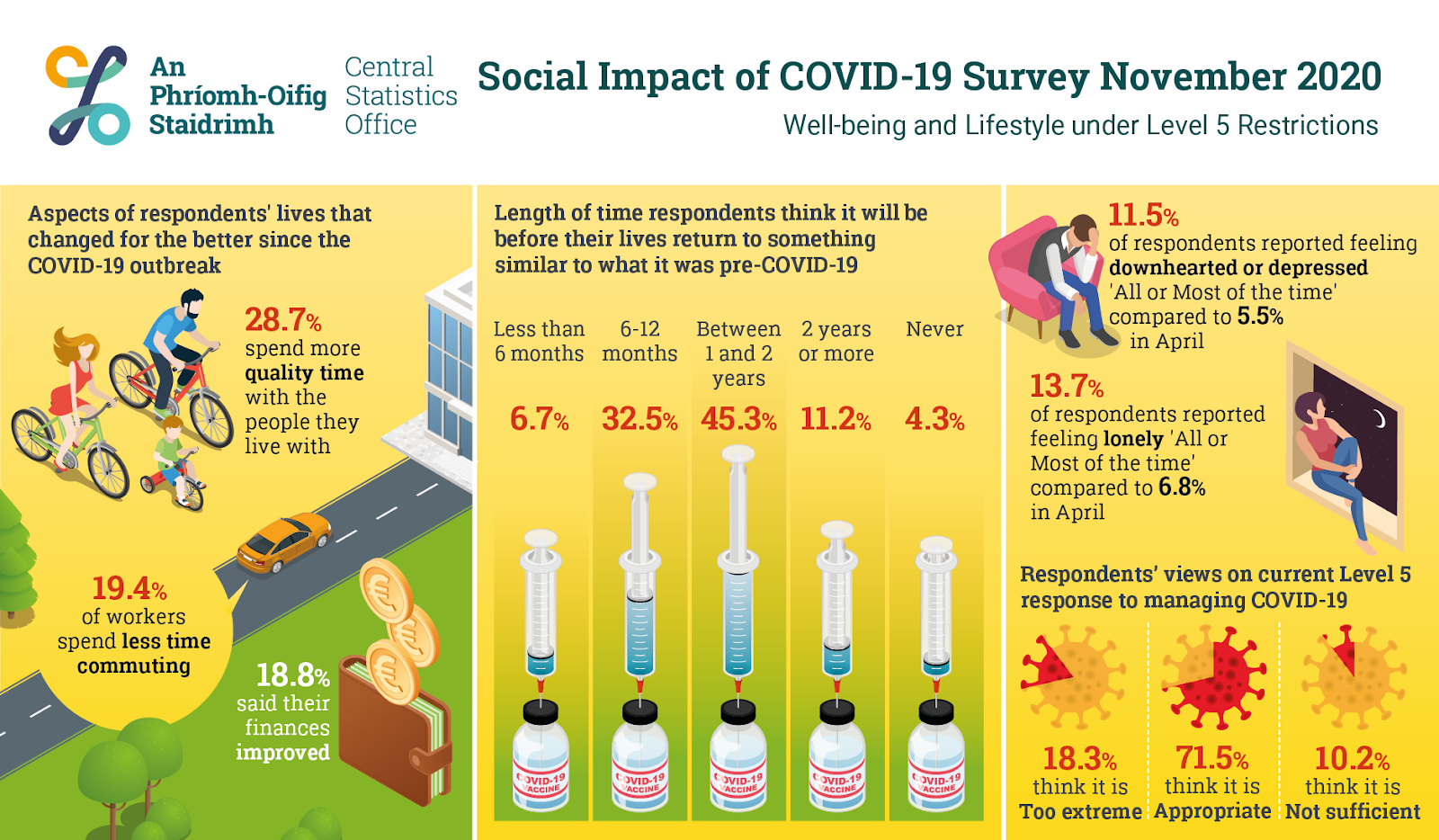
The Central Statistics Office has released findings of a survey in relation to ‘well being and lifestyle under level 5 restrictions’– a survey relative to the social impact of Covid-19 for the month of November 2020. Gavin Dalton examines the results of this survey.
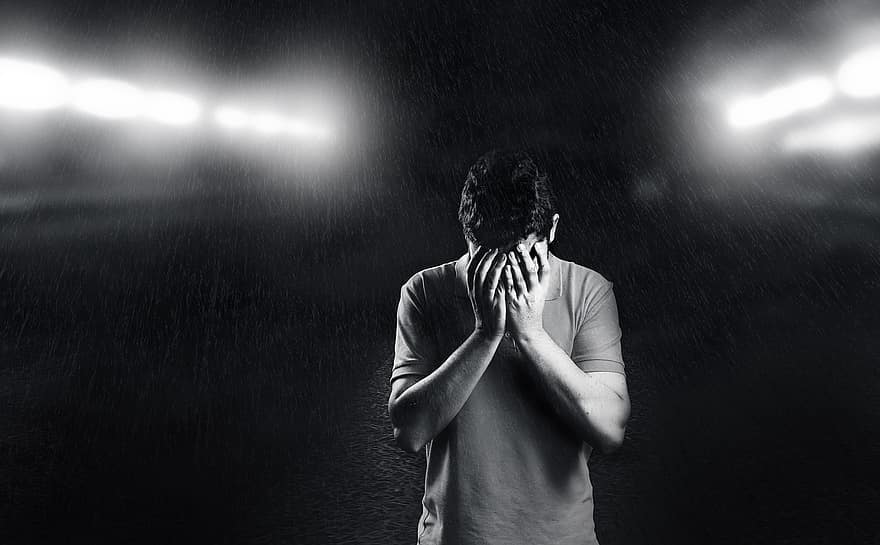
Image source: Pikist
Published on the morning of the 30th of November, the Central Statistics Office (CSO) well-being survey shows some eye catching findings. 19.4% of workers spend less time commuting, which was an aspect of repondants’ lives that have changed for the better during the pandemic, whereas in contrast 11.5% of respondants reported feeling downhearted or depressed ‘all or most of the time’.
The survey, which was carried out between Thursday November 12th and Wednesday November 18th, was based on a sample of 5,105 persons aged 18 and over. The survey availed of an online questionnaire to produce an achieved sample size of 1,585 individuals.
There were some findings that arose in relation to the appropriateness of the implementation of Level 5 to Covid-19 risk, in which one could argue were rather expected results. Over 71% of those who responded to the survey indicated that the level 5 response was appropriate, 18.3% were of the impression it was Too extreme, with 10.2% feeling it was not sufficient. Analysing the findings by age shows the likelihood of a respondent feeling that the Level 5 response was Appropriate increased with age, with 63.2% of respondents aged 18-34 agreeing that the Level 5 response was appropriate rising to 88.2% for those 70 and over.
Some of the findings from the survey may raise cause for concern: The percentage of respondents that felt lonely All or Most of the time in the four-week period prior to interview doubled between April, when a similar survey was carried out and November 2020, from 6.8% to 13.7%, whilst the percentage of respondents that felt downhearted or depressed All or Most of the time in the four-week period prior to interview doubled between April and November 2020, from 5.5% to 11.5%.
Speaking of these specific increases, councillor Mairin McGrath isn’t overly surprised but remains hopeful for the year to come. Speaking to The City, she said: “When we look at the first lockdown compared to the 6 week lockdown we’ve just come out of, there’s been a huge difference. There was probably a novelty to the first lockdown and although we were kind of facing into the unknown, it was genuinely a very scary time for the country, people being at home, having the long days and the good weather to do your few DIY jobs around the house and spend time like it was Christmas with family, was probably something a lot of people enjoyed.
“And then when you compare the last 6 weeks we had in level 5 lockdown, it’s just been totally different. Much more grim in a sense. It wasn’t as much of a lockdown, life was still going on as normal for some people but I suppose the whole aspect of not being able to have that whole social outlet to look forward to, but I think people have grown more wary of the whole situation.
“It has been very challenging. I’m not one bit surprised that the figures are as they are. As a young councillor, I for one can see it first hand through my job, I can feel the struggles myself. Working hard all week and then having nothing to look forward to at the weekend, no place to go, no plans to look forward to as we head into Christmas especially. So look it’s been a challenging year for all, it has been difficult.”
Remaining positive for the approaching year, McGrath said: “The increase in figures doesn’t surprise me, but hopefully we can look forward to a better 2021 with lots of plans and get togethers with our friends.”
CSO statistical publication, 30 November 2020, 11am. Taken from the CSO website.
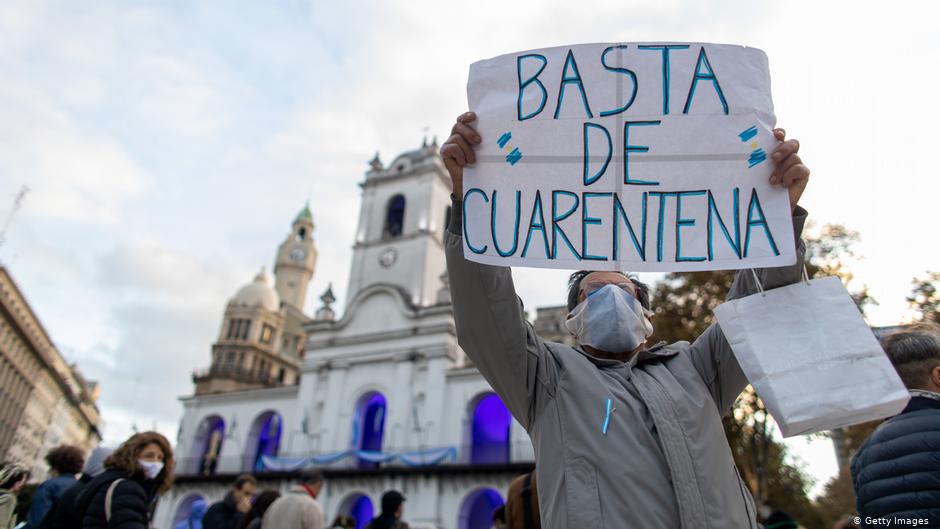
On March 7, Argentina became the first Latin American country to announce a coronavirus-related death, four days after confirming the country’s first case. The president reacted quickly announcing, on March 12, a state of national health emergency. Eight days later, with the backing of all 23 local provincial governments, he imposed a mandatory and nationwide quarantine through the end of that month.
Argentina began what would be one of the world’s longest quarantines. Despite that move, the country is among the world’s top 10 when it comes to confirmed COVID-19 cases. Abderrahmen Ben Chouchane spoke with Juan Pablo Miassi, a civil engineer living in Buenos Aires.
With support ramping up to shop local this Christmas, Eibhin Kavanagh looked at the use of Instagram to promote Irish businesses and buy Irish.
People are using the popular platform to promote Buy Irish. Image source: PickPic
Since the coronavirus pandemic began last March, companies have fumbled to set up an online presence to keep in touch with their customers and continue to get sales, even when their shutters are down.
Social media has become the key to customer engagement for businesses, especially smaller businesses. Platforms like Instagram that provide business tools such as profile shops and insights into engagements have become essential for them.
In Ireland, there are 1,895,000 Instagram users as of March 2020. This accounts for 38.5% of the entire population, according to statistics by Napoleon Cat stats.
Coming up to Christmas, most media platforms are pushing people in Ireland to buy Irish. With Instagram being a widely used platform, it is without a doubt being used to promote this message.
With the ability to reshare posts as stories and tag friends and family in posts, many buy Irish accounts and gift guides for Christmas have been shared around and have gained a lot of popularity.
Rebekah Caulfield created a post on Instagram with an Irish gift guide containing over 250 Irish businesses to support this Christmas. As of writing, the post has gained 107k likes and 962 comments.
Rebekah Caulfied talked to the City about her gift guide and how it got popular.
“So, I wasn’t even necessarily planning on doing it. Basically, I just made a personal decision that this year that I wanted to support Irish businesses when I was getting my Christmas presents for my friends and family. I was just trying to get organised and on my notes on my phone I was keeping track of businesses that I liked or came across to go back on,” Caulfield said.
After taking note of Irish businesses she saw on Instagram, Rebekah created the original post which contained 17 categories including kids, fashion, lifestyle, and art.
“Obviously a lot of people are interested in buying Irish and supporting small businesses, so my friends were like ‘oh it would be great if you posted it’, so I posted it and it blew up,” she said.
“First all my friends and family were commenting and sharing it on their pages and then I started getting new followers coming in and businesses would start reposting it. Then some influencers with big followings started reposting it, so for a solid week it was just growing with reshares constantly coming,” she said.
Caulfield was able to use her platform after the initial post to continue to add to the gift guide through Instagram stories and highlights. She has since added over 200 businesses to the original post.
With lockdown starting last March, Caulfied noticed more businesses using their social media accounts to engage with their customers.
“With everything going on, it was just being more aware of businesses on Instagram and tuned into that and I think a lot of brands were putting more work and time into their social media so that way I was getting to see them more, whereas normally you weren’t as focused on that pre-lockdown,” she said.
Fiona O’ Raw runs the account @buyirish. The account was set up on the 14th of March, the date the schools closed. The account aims to highlight and draw attention to Irish businesses.
Fiona O’ Raw talked to theCity about how she used Instagram to provide people with the resources to buy Irish.
“I thought if we don’t help people find small Irish businesses, especially online, then we’ll end up losing a whole chunk of businesses,” O’Raw said.
Since starting the account in March, O’ Raw has gained over 8,000 followers and has made over 2,500 posts, all related to buying Irish.
“Instagram has its good and bad elements. It suits itself. It does help you find other businesses but to really make momentum you need that bit of promotion. A huge impact takes a post from somebody with huge numbers of followers,” O’ Raw said.
Fiona O’ Raw was recently contacted by The Late Late show about her work, which showed how a share can benefit an account on Instagram.
“I was contacted by Ryan Tubridy, who has something like 150,000 followers. Within 15 hours I had 300 new followers and within five days I had 1,000.”
However, some of the ways Instagram operates has had a negative impact on her account, as well as on business accounts. The use of algorithms within the feed has created issues with post visibility and has resulted in posts being missed by followers.
“The change to the feed not being chronological is an absolute pain and it’s definitely going to affect business. People are not necessarily seeing the post. It even interfered with how I do my work because it means that sometimes I might not see someone’s weekend giveaway until Monday so I couldn’t post it up for them,” O’ Raw said.
“Instagram has a different way of getting to people, sometimes I click and think how did you find me, you know? I think on a website you nearly have to know the website’s there or have some advertising to get people to your website, where Instagram seems to kind of find its own way,” she said.
While O’ Raw has been running the account since March, she commented on the recent increase in support for buying Irish as Christmas approaches.
“The increase in followers has really been ramping up since getting near Christmas, I’d say since October, so the message is starting to get out there that we need to be supporting local,” she said.
“Buying Irish and Local is not just for Christmas, these businesses will be slumped in January otherwise.”
Fiona O’ Raw
While the support for buying Irish and support local has increased, both Rebekah Caulfield and Fiona O’ Raw agreed that buying Irish is something that continues to be important all year round, and not just at Christmas.
“I definitely do think it’s something that’s important all year round, it’s such a topical thing,” Caulfield said.
Facebook Group Old Dublin Pubs is a place to share nostalgic memories of wet pubs that are long-gone. Rebecca Daly spoke to members of the group to find out what the group offers and why it is so relevant today.
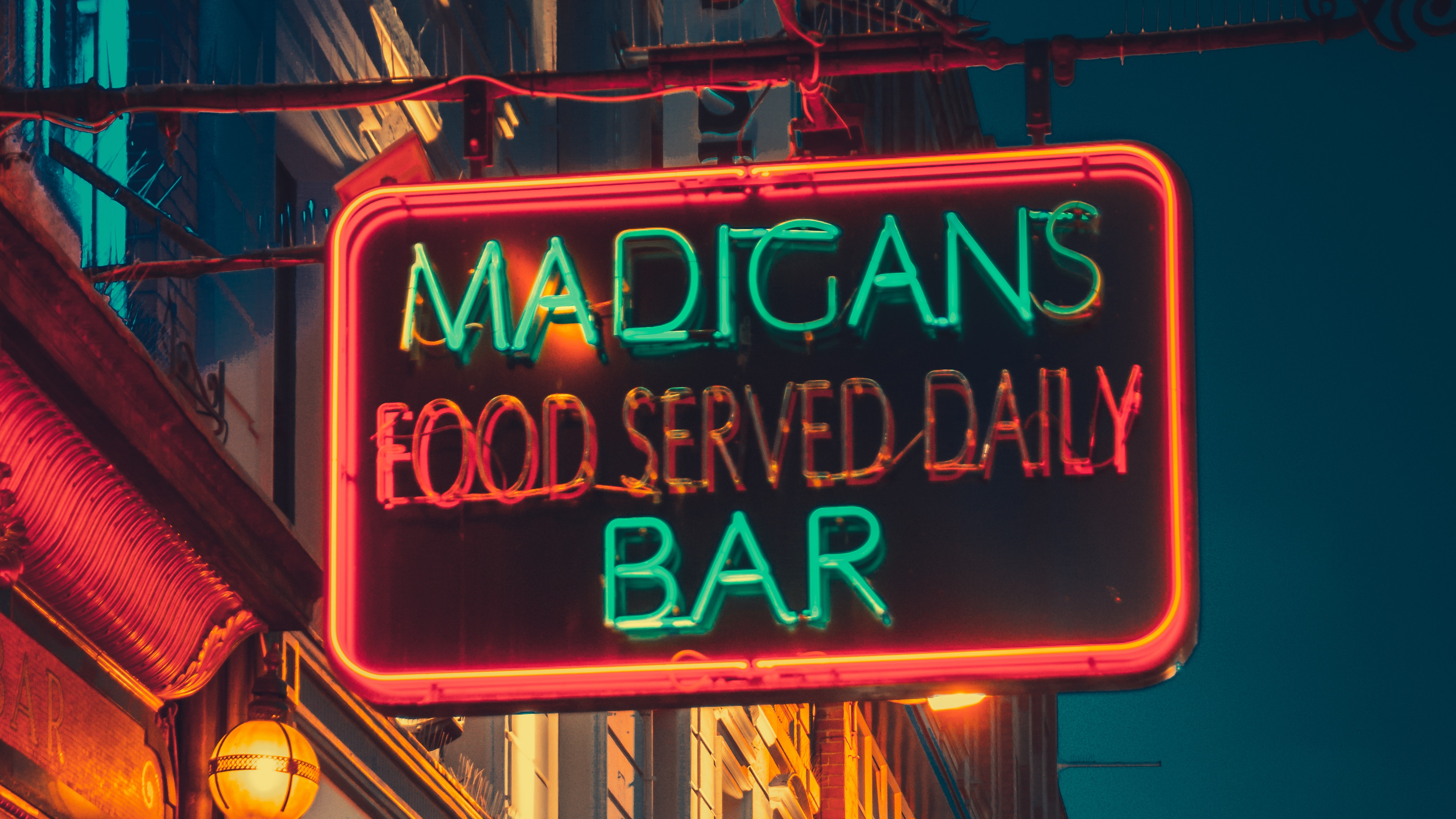
Madigans Bar on Amiens Street. Photo by Lucian Petronel Potlog via Pexels.com
The 15th of March brought with it the closure of all pubs in the country as a result of concerns over the then-new virus COVID-19.
While wet pubs in other counties were given the green light to re-open on the 21st of September, Dublin’s pubs were told to remain shut due to a rise in positive coronavirus cases. Now with the introduction of Level 5, it will be another four weeks at least before they can even consider welcoming patrons in again.
Eager pub-goers in the capital have certainly been missing the act of heading to their local for a few rounds with their friends.
However, one Facebook group has come together to recall times spent in their favourite pubs over the years and share retro photos of long-gone spots.
Set up in 2014 by a group of Dubliners, Old Dublin Pubs looks to bring nostalgic memories of popular watering holes together. Some of the charming images shared there are of pubs that shut their doors before the new millennium, while others only shut their doors in March.
Regardless of if the pubs have still traded up until the pandemic, the group asks members to focus on pre-2000s images and stories.
Throughout the hundreds of photos on their page, you’ll find familiar places such as the Brazen Head, The Liberty Belle and Toners, as well as pubs that have long since shut down or changed their name. Some of the images even go back as far as the 1900s.
Under each photo are comments from strangers around the county. They recount memories of lively nights filled with song, dance and conversation
Some photos feature famous faces in their local pubs such as The Dubliners, Phil Lynott and even Christy Brown.
Pub adverts are also featured on the page, which can bring a whole new level of nostalgia to the group members. One 1967 ad for The Embankment in Tallaght reads, “There you can leave behind congested city streets, park your car in the roomy car park, take a seat in the spacious Lounge, and relax over your drinks to the best of entertainment.”
Tony Carey from Tallaght had his first pint of Guinness in the Tap Pub in Chapelizod in 1964. Four years later, he became a distillery delivery driver until 1986. Carey would deliver to pubs across the country as well as in Dublin City. He recalls that in those days, bartenders would offer free pints to their delivery drivers.
For Carey, going to the pub was not about alcohol. It was more a social event than an opportunity to drink.
Joining the Old Dublin Pubs group allowed him and many others like him to recall the golden days in their favourite spots.
“It’s like going down memory lane of one’s social life of the past.” He said.
The group helps people to relive the joy of heading to the pub in pre-Covid times. Carey said, “It’s important to remember the Dublin culture of socialising in different ways, and of the enjoyment of being part of that and remembering friends present and past who were part of your life.”
Old Dublin Pubs now has 5,100 members and will allow anyone with an interest in getting nostalgic over some of Dublin’s greatest pubs to join.
All local sports clubs and gyms are completely closed now, taking away a necessary outlet for exercise and mental health from many nationwide. Conn McGillion investigates whether sports activities were spreading the Covid-19 virus.
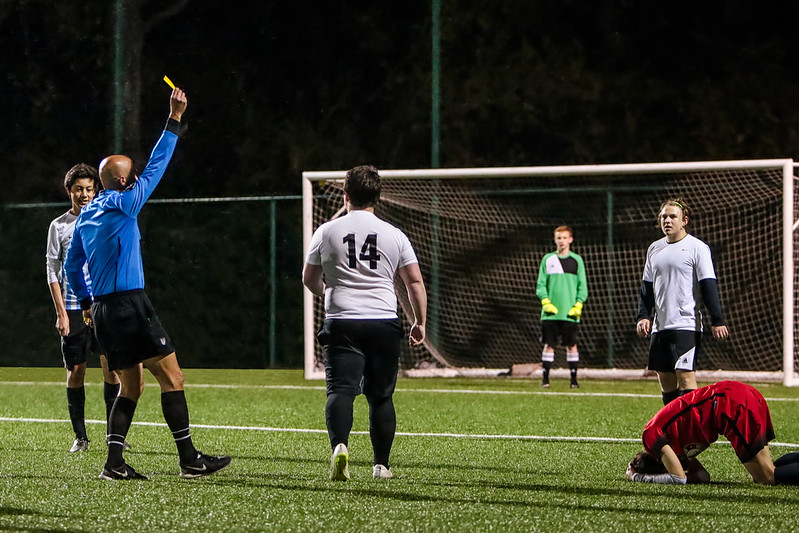
Photo taken by TLC Photography. Sourced from Flickr.
From June to August, there have been only fourteen positive cases reported nationwide across all sports clubs within GAA, rugby and football, according to documents received by the HSE in accordance with the FOI (Freedom of Information) act. According to the documents, under five of these cases were reported from within Dublin, and the other nine cases were scattered around the rest of the country. These cases came after all sports clubs had restrictions lifted in June to train in a controlled environment.
Prior to the second lockdown, diagnosed cases were at an all time high. 1000+ case daily have become the norm from August to September. Only fourteen cases nationwide across three months is indicative that sports clubs, and gyms, are not a primary spreader at all in comparison to the likes of restaurants and factories. In fact, many of those cases come from one isolated incident.
An example of this would be in the GAA. Claughan United in Limerick had tested a player positive in mid-August, and the safety precautions were immediately taken. The player, who was asymptomatic, was instantly placed in quarantine, along with the entire club and the local rugby club, Shannon RFC. Claughan released a statement at the time, suspending all club activities indefinitely, after careful consideration was given to correct procedures regarding self-isolation and efficient testing.
The majority of the cases came from a club in Clare, Cratloe. Cratloe had six players who tested positive for Covid on the 7th of August. While they quarantined those initial positive cases on the day, they initially continued their activities – as the virus began to spread, they were forced to abruptly put a stop to their training.
While cases such as these are reckless, they are not indicative of how the majority of sports clubs react – many of the sports clubs are happy to abide by the government guidelines, and adhere to them properly. Sports-related case numbers are not comparable to large outbreaks in the likes of meat factories and pubs.
The Health Protection Surveillance Centre (HPSC) has recorded 2,736 outbreaks in other settings such as nursing homes, workplaces and private houses. It is also reported 1,500 cases alone were reported from meat factories. Clusters, which involve more than one outbreak case, are commonplace in these more social areas.
With restrictions now in place once again across the country, many third level students are struggling with the effects of working from home. According to research by the Commission for Communications Regulation, 3 in 5 people are seeing an increase in their home broadband use since March 1st, showing that internet connections and computer software are some of the issues facing students this semester, not to mention the social side of starting college. Amber Baxter spoke to a number of students about their challenges.
Photo taken by Bonjkarn Thanyakij. Sourced from Pexels.
Emily Ní Aogáin, a first year NCAD student, spoke about her bad connection and how it is affecting her. “Personally, I have found my internet connection has not been the best recently, typically, as soon as I need it most.
“Sometimes on Zoom call lectures it might buffer briefly, but I will have missed out on something the lecturer may have said that could have been important. I feel like we’re all at a disadvantage working from home and online rather than physically on campus. It’s very different and not as beneficial especially for practical courses because you can’t do your work as well at home as you would on campus.”
Ní Aogáin also mentioned how the Level 5 restrictions will further this: “Level 5 restrictions are going to affect my college experience quite drastically as I’ve only started in first year at NCAD, in a practical course.
“It’s been hard settling in and trying to make friends while socially distanced with masks on, because you can’t see their faces and the conversation is so muffled. I feel like we’re missing out on so many opportunities that come up in the first year of college – it’s not the same and it’s understandable but it still sucks.”
Isobel Lord, a final year Technological University Dublin student said: “In regard to Wi-Fi connection, my one has held up so far. I haven’t actually had any issues with it surprisingly. There was a girl in my course last year who did not have a computer so she literally couldn’t do online college.
“There are some people in my course and my friends who share bedrooms with people, and both of them could be doing college work at the same time, which can be very stressful. Then there are people who have family members who are working from home as well so when they’re all on the same Wi-Fi box at the same time they’re going to be running slow.”
Lord also mentioned how online work is affecting her studies on a practical course. “I’m doing an arts degree which is 99% practical work,” she explained. “We did hands on stuff in class such as how to manipulate fabric and stuff like that which is not really something you can teach through a computer screen.
“I also had to complete window displays which usually would be all practical, but we had to move online to Sketch Up, which is a graphic design program and became a huge part of our course working from home. I cannot even tell you how difficult, stressful and pressurizing that was. My grades went down so much [working from home] because I’m someone who is terrible with computers and tech.”
“My grades went down so much because I’m someone who is terrible with computers and tech.”
Teresa Walsh, a third-year student, spoke about how her mandatory attendance is being affected as a result of working from home. “I’d say overall my internet connection is fairly average but because I live slightly out of the town it’s not always the best,” she said. “If there are many people at home working from home or doing schoolwork, I find then the internet wont work. This is obviously very annoying if my class won’t load as I have mandatory attendance so at times, I feel like I’m at more of a disadvantage than my friends.”












You must be logged in to post a comment.