
Tag: lockdown

  • ‘NaTakallam has been my window to the world’ – The refugee language service ideal for lockdown learning

    ‘NaTakallam has been my window to the world’ – The refugee language service ideal for lockdown learning

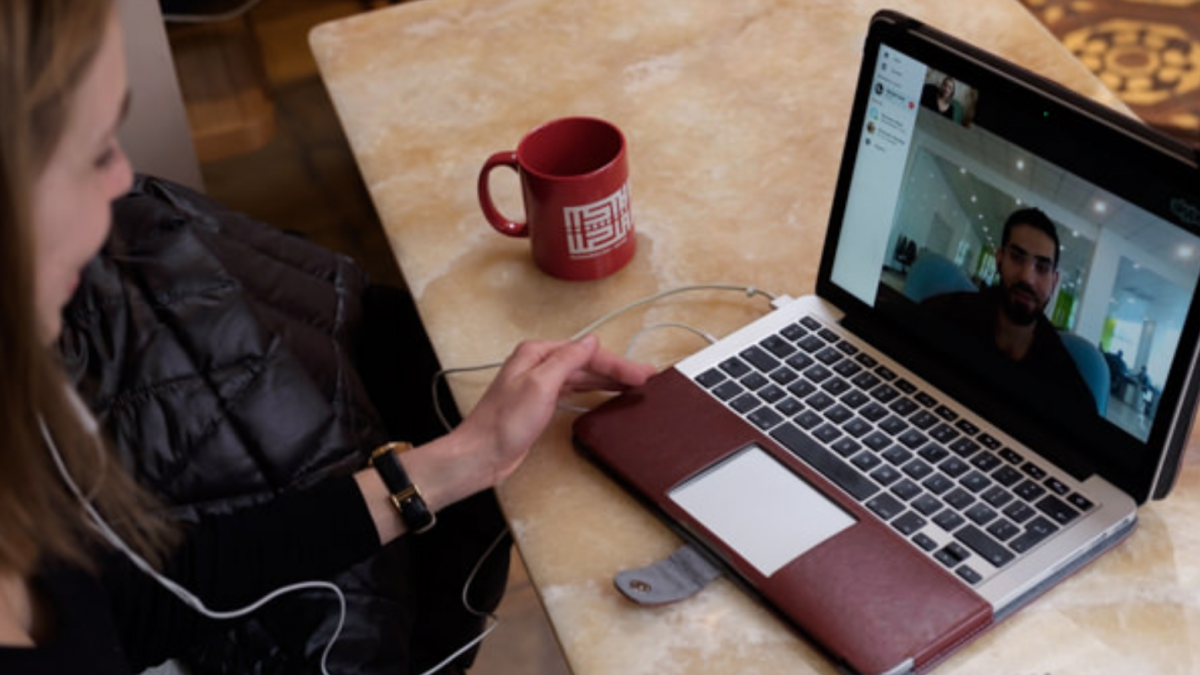
    Learners and conversation partners connect online
     (Photo: NaTakallam)

    The City’s Cameron Weymes examines the work of NaTakallam, a business that hires displaced people as language teachers online.

    NaTakallam, which means “We Speak” in Arabic, was launched in 2016 by Aline Sara, a Lebanese-American woman who was looking for an affordable way to improve her native Levantine dialect of Arabic while living in New York.

    At this time, millions of Syrians were fleeing the brutal civil war in their country, mostly to neighbouring countries such as Lebanon, Turkey, Iraq and Jordan. 

    Sara saw an opportunity to provide an income to displaced people through an online teaching service that would connect Syrians with learners from around the world, and decided to establish NaTakallam.

    The company now works with over 100 conversation teachers and provides Arabic language courses in partnership with Cornell University in the US.

    NaTakallam has subsequently expanded to include Persian, Spanish and French, hiring displaced people from Iran, Afghanistan, Venezuela and Central America.

    Shadi Khaled is one of NaTakallam’s dozens of refugee employees.

    Shadi was a music teacher in northern Syria when the war forced him and his family to seek refuge in neighbouring Iraq in 2013.

    Despite this, Shadi found his teaching qualifications were not recognized by authorities in northern Iraq. 

    Shadi Khaled at his home in northern Iraq
    Photo: Shadi Khaled

    After almost four years of working in a variety of jobs, including carpentry, he was hired by NaTakallam in 2017 as a language teacher.

    Shadi now conducts online conversation classes in Arabic to students around the world from his home in a refugee camp near the Iraqi-Kurdish city of Erbil.

    “The best thing about the programme is that it gives students an opportunity to practice their language skills and allows teachers to provide for themselves and their families,” he said.

    “At the moment I currently have ten students, some of who are now fluent in Arabic. We do grammar and vocabulary along with discussions about various topics like politics, economics and history.”

    Many displaced Syrians in the Middle East are unable to work due to a lack of work permits and other impediments.

    As a result, millions of people, often highly educated, are reduced to handouts and cash in hand labour jobs. 

    NaTakallam allows displaced Syrians to overcome some of these obstacles by providing them with an income.

    For example, Shadi is unable to send and receive bank transfers due to his refugee status in Iraq, but can now get paid by NaTakallam through the local Western Union.

    According to Shadi, the coronavirus crisis has increased demand for classes, as learners seek to make use of their free time.

    “The situation here in Northern Iraq is the same as other countries, we’ve been partially on lockdown, giving us more free time. 

    “Since the coronavirus crisis began many of my students are calling me from around the world and saying ‘we have extra time now, it’s a good opportunity for us to do extra practice’,” he added.

    NaTakallam founder Aline Sara
    Photo: NaTakallam

    Shadi uses his income from NaTakallam to provide for his wife and two children, who have also gotten to know some of the Arabic learners.

    “My students speak with my family and I with theirs. Our lessons are an exchange in cultures and traditions,” Shadi added.

    “We are not just teachers and students, our bond is greater than that. I tell my students not to be shy in asking anything from me, we are like family and it’s common to keep in touch after a course has come to an end.

    “Natakallam has been my window to the world, each program allows me to travel the globe.”

  • World Book Night 2020 — rediscover the power of words during lockdown

    World Book Night 2020 — rediscover the power of words during lockdown

    April 23 marks World Book and Copyright Day – an annual event created by the United Nations Educational, Scientific and Cultural Organisation. TheCity.ie’s Ayumi Miyano took advantage of lockdown to rediscover the power of reading, using solitude as an opportunity.

    In Paris in 1995, UNESCO selected April 23 as World Book and Copyright Day. This date also marks the deaths of prominent authors William Shakespeare, Miguel Cervantes and Inca Garcilaso de la Vega. In Ireland and Britain, ‘World Book Day’ is held on the first Thursday of every March. This year, UNESCO selected Kuala Lumpur as the World Book Capital to maintain the impetus of the Day’s celebrations through its own initiatives. 

    In Britain, World Book Night — run by The Reading Agency — takes place on the same day. Their #ReadingHour event occurs between 7pm and 8pm on the day, used to motivate audiences to read a book at home. 

    “It’s all about encouraging people to slow down, take some time out and just focus on reading, and reading for pleasure — just reading anything that you want to and enjoying the process,” Kathryn Rose, assistant programme manager of The Reading Agency, tells TheCity.ie. 

    Under the current coronavirus lockdown, the inspiration of World Book Night sounds as persuasive as ever. Although it is currently impossible to physically attend the book events due to the pandemic, why not join online book clubs instead? Buy books on virtual bookshops, show support for small businesses in Ireland, or use an Amazon Kindle and you’ll have plenty of time to read by yourself at home during the lockdown. 

    I have been preparing myself for April 23 — I readied some books on my Kindle, and prepared stacks of back-up options in my room. I forced myself to read them. However, at first, my stay-at-home reading trial was not easy. Notifications from social media, online media publications, emails, calendar, to-do lists, banks, and app updates endlessly pull my concentration away from the pages of my books.

    I admit that I used to be a bookworm — it reminds me of commuting to work, back when I was living in my hometown. The metro in Tokyo is normally overcrowded, and quiet. People pretend they are fine when minor or major disasters happen: somebody’s umbrella hits you, a train suddenly stops because the train hit a person at the platform, or a drunk woman suddenly gives you a big hug. No matter what happens, you have to keep yourself cool and relaxed — that is the way of the Tokyo commute.

    To follow this unwritten rule, I always tended to keep a book with me as a shield. Looking at my bookshelf, choosing the one with which I thought I could kick-off my day, was part of my everyday routine. With a book, I could easily distance myself from the outside world and dive into my imaginary world — a different kind of social distancing.

    However, my routine changed after I changed my old mobile phone to a brand-new smartphone. The impact of that transformation was life-changing. I could listen to music from my playlists, read newspapers from all over the world, observe the lives on my friends on social media, and even work from the phone. I knew that all books I loved were always on my shelf, but I no longer starting off my day with five minutes of “book selection” time. My biggest excuse for not reading books was that I could read anything on my phone, despite never actually following through. 

    Photo: Unsplash

    Even before the current version of isolation began, The Irish Times reported last year that Irish people were using their phones for four-and-a-half hours every day, including 64 minutes on social media, 53 minutes on video platforms like YouTube, 32 minutes on browsing the internet, and 20 minutes on sending and reading emails.  

    I think part of it is the distractions we have; from games and phone apps to constant social media attention. One of the main tips we would offer people is to put your phone on silent, or even put it in another room for full solitude.

    Of course, most of the time when we are browsing something on the phone, we are reading — reading newspaper articles, emails, posts and comments on social media — but in a speedy and spontaneous manner. When a notification pings, we tend to multitask checking on our social feed with whatever else we were doing so that we’re never quite apart from what’s going on with the digital world. Twitter, Facebook, Snapchat, TikTok and Instagram notifications plagues us with updates from acquaintances we haven’t spoken to in years, or from total strangers with filtered lives. We are unconsciously and endlessly consuming random information.

    “One of the main tips we would give people is to put your phone on silent, put it in another room,” Kathryn Rose says. “It doesn’t have to be for a long amount of time just maybe 10, 15 minutes, and just set yourself like small goals, say I’m going to read a chapter, I’m going to read five pages — and you can gradually build that up.”

    World Book Night was a great chance to get back to my reading routine. The challenging part was to create spare time without any distractions. Moreover, even when I am reading a book with my phone turned off, a voice is urging me to check the news, to exercise, to open my emails, to observe what my friends are doing online. The biggest distraction was always within my own head.

    “If you’re reading fiction, then that can definitely be an escape from your life. If you’re reading a news article, it’s very much about what’s going on, making yourself think about the world,” says Rose.  

    I have decided to indulge myself in just reading a book on April 23, with no phone notifications, zero work-related worries and no pressure to catch up on information in the digital world. I will allow myself to spend my entire day enjoying the simple act of reading. World Book Night will definitely indulge my rediscovery of words, and their endless power.

    Reading a book is a simple way to escape from the monotonous daily life of quarantine, and maybe even from yourself. You can be somebody else for World Book Night — embodying the true power of books.

  • What to read in isolation: ‘Ariana: The Unauthorised Biography’ by Danny White

    What to read in isolation: ‘Ariana: The Unauthorised Biography’ by Danny White

    Ariana Grande on stage at the Capital FM Summertime Ball at London’s Wembley Stadium in June 2016 (Photo: YouTube)

    With a dearth of celebrity news during the pandemic, TheCity.ie’s Paul Caffrey offers up a taste of pop icon Ariana Grande’s (short) life thus far instead — and it’s endlessly entertaining

    Last. week, the brother of the suicide bomber who targeted Ariana Grande’s May 2017 gig at the Manchester Arena — killing children, teenagers and parents — was convicted by a jury for his role in planning and executing the shocking attack. Poignantly, each victim’s name was read to the court as the guilty verdict was announced.

    For the then 23-year-old Grammy award-winning superstar, the night of May 22, 2017 was an incredibly frightening experience. She’d just stepped off stage when a deadly home-made bomb was detonated at the exit of the venue at 10.31pm, killing 22 people and injuring over 200. 

    The singing sensation and former Nickelodeon star was backstage when she heard the explosion and “fell to pieces”, according to Ariana: The Unauthorised Biography, by Danny White. 

    Danny White’s unofficial biography of Ariana Grande. (Photo: Amazon)

    Having initially flown back to the US to recover from her own shock, she impressed even the toughest of cynics by returning to Manchester less than a fortnight later to stage a benefit concert to raise money for the victims of the attack and their families.

    “Even with the concert merely announced, it felt like a healing process had begun,” writes White. 

    But the singer’s first priority on her return was to spend time comforting young victims of the atrocity, both at the Royal Manchester Children’s Hospital and at the homes of some of the affected families. 

    “Her visit touched them deeply, it left one father in tears,” White writes.

    Despite a London Bridge terrorist attack the night before the One Love Manchester concert, the show went ahead on June 4 at Emirates Old Trafford cricket ground — just a 15-minute drive from the Manchester Arena — albeit with heightened security.

    The highly memorable show attended by 50,000 people, with well-known names of British pop performing, earned Ariana praise from highbrow publications around the world, as White outlines.

    Ariana Grande performing at the One Love Manchester concert in 2017 (Photo: YouTube)

    Forbes magazine lauded the pop princess for “so quickly” getting back on stage after the terrorist attack, and for organising a concert that was “a strong testament that the human spirit will endure”, while British newspaper The Independent said the concert was the “proper way to respond to hate”. Even journalist Piers Morgan called her an “admirable young woman”, the book recounts. 

    “A strong testament that the human spirit will endure”

    Forbes magazine’s description of Ariana’s One Love Manchester concert

    Perhaps the most interesting part of this biography is its account of Ariana’s early life. Growing up, she played the French horn and was inspired by artists who were popular well before her time like Whitney Houston and even Judy Garland.

    WATCH: Ariana performs her hit ‘My Everything’ with a school choir at One Love Manchester

    White also details her first “star quality” public performance aged eight as Annie in a community theatre group musical. We’re told how her mother Joan joined the production as a co-star because she felt Ariana was too young to be left alone at rehearsals. 

    At 210 pages, this book is an excellently researched, comprehensive and easy to read overview of Ariana Grande’s life so far, drawn from multiple newspaper reports, books and other sources. The only possible disappointment for fans is that it doesn’t reveal anything new.

    While indeed “packed with fascinating details about the real Ariana” as its blurb boasts, none of these facts were uncovered by the writer himself. Still, a must-have reference book for any fan with a generous additional 16 pages of colour photography thrown in.