Tag: Luas

  • A tight squeeze: Public transport in Dublin severely congested at peak times and on popular routes 

    A tight squeeze: Public transport in Dublin severely congested at peak times and on popular routes 

    By Gary Petrov

    A display of photos from the point of view of a commuter using public transport in Dublin. Examples of overcrowding can be seen here on Dublin Bus, Luas and Irish Rail services in densely populated or heavily visited areas in Ireland’s capital – in which the photos below were taken during peak times of travel, on-board and at stops and stations. 

    Nevertheless, the photos pose the question: Do Dublin commuters need more frequent services of existing public transport, or do they need more modes of public transport? Or both

    Whether the answer is a swift underground metro system, or more frequency on existing services – or both, the population is growing and commuting access in and around Dublin is becoming more of an issue and needs urgent attention. 

    All photos present the same problem – Dublin’s public transport system is overwhelmed. 

    The photos also present how this overcrowding issue can prove difficult for accessibility on public transport for wheelchair users, mobility aid users and parents with children. Even in busy times, not everyone can just squeeze on and stand. People are inevitably being left behind – hoping that the next bus, train or tram will have room. 

    Commuters joining a lengthy queue for Blanchardstown Shopping Centre’s busiest bus route to Dublin City Centre, the 39a – hoping to get on as it fills very fast. 
    The standard sight at this shopping centre bus stop at peak morning and evening times, as commuters fight for a spot on the 39a service. 
    The 39a route journeys down the Navan Road, in which sections of the journey lack bus corridors in both directions, leaving passengers stuck in traffic at peak times. 
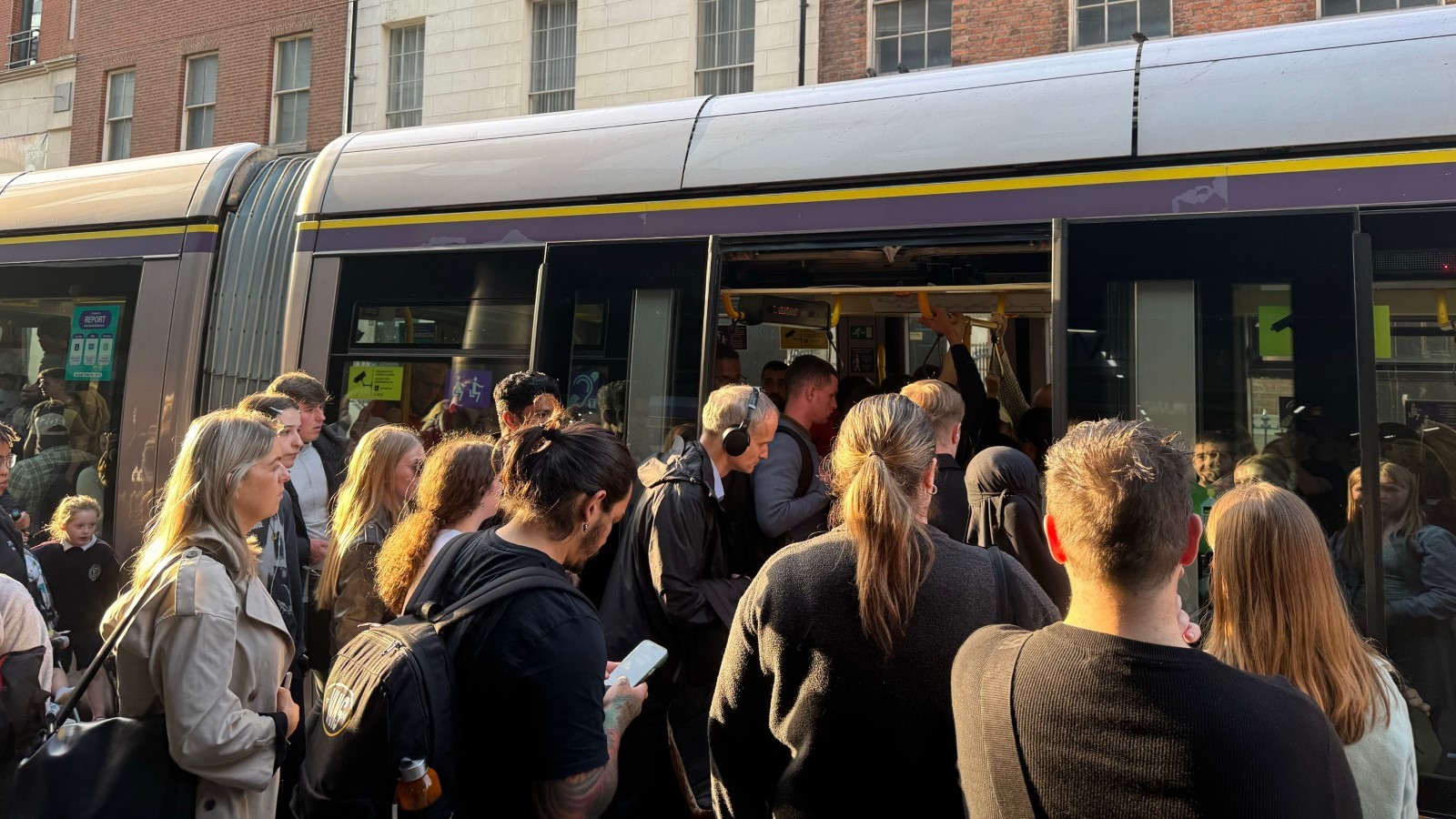
    Meanwhile at the Jervis Luas stop in Dublin City Centre, peak times result in commuters pushing themselves on-board to very packed carriages, with just about enough room to stand, for the few at the busy stop that manage to squeeze on. 
    Finished work and want to hop on the Luas Red Line home? You’re not the only one – and that’s not even including commuters already on-board. 
    A Luas has arrived, and the carriages are evidently full. With some commuters possibly disembarking, maybe there will be room for some intending to board. 
    “Oh my God, let us get off first,” said a young woman as commuters tried to get off while commuters on the platform scurry towards the doors for a spot on the mostly full Luas carriages. 
    “Oh, there’s another one coming in three minutes, maybe we’ll get on that one,” said one woman as disgruntled commuters accepted not being able to get on-board – but hopeful they remained, as another Luas was due in a few short minutes. 
    The next Luas has arrived at the Jervis Luas stop and like the previous one, it’s almost full and the next round of commuters on the platform attempt to get a spot on-board.  
    Three Luas trams later and the platform begins to clear as the Luas carriages begin to have more space than the previous trams – but was there space for commuters who have accessibility issues? How many trams must pass for there to be room for a person in a wheelchair or with a mobility aid, or a person with a baby pram to board comfortably and safely? 

    Getting on a train at peak times is no different. Commuters at Broombridge Station queue at every door, wondering if they will fit on-board as the train arrives full from the city centre – in which it will remain like that until it reaches the outskirts of Dublin. 

    If a commuter manages to squeeze on-board, there is only room to stand, and it gets quite uncomfortable. Like the Luas, accessibility issues are present here. 
    Dublin’s only service that has flow is Irish Rail, due to no road traffic, but commuters experience peak times with traffic by foot – if you stay on-board until disembarking in a Dublin suburb. 
    Traffic standstill mayhem: The need for more efficient modes of public transport is hiding in plain sight here. Modes of transport that aren’t subjected to peak time road traffic. Commuters using an underground metro system around Dublin would go from A to B in an instant, in comparison to this.
    A bus stop and rain: Commuters already report it to be a struggle to get on-board popular routes, but adding bad weather to the equation does not make for a comfortable experience – when all a person wants to do is start their day commuting with ease or commute home swiftly, after a long day. 

    _____________________________________________________

    Everyone understands that peak times will always be busy for public transport users, that’s why it’s referred to as ‘peak times’ – but that doesn’t mean it’s acceptable for Ireland’s capital city and its surrounding areas’ public transport network to be severely overwhelmed, at a constant. 

    In a day and age where people are being encouraged to use public transport instead of private transport, as a means of reducing carbon emissions through minimising their individual carbon footprint – it’s worth noting that the correct infrastructure is vital for that to be sustainable, otherwise, people who can won’t use public transport, if it becomes more and more overcrowded, uncomfortable and unreliable. 

    A popular route having frequency in its service isn’t good enough, as it can be seen in the photos above that the demand is too high at peak times for ‘frequency’ to be enough. Ireland’s capital needs an expansion of public transport services across the board, not statements to brush the issues under the mat. 

    Dublin’s public transport congestion is clearly failing people with accessibility issues, despite the designated accessible areas on-board services – as abled people are filling up the designated areas at peak times. 

    Dublin needs more efficient public transport that facilitates everyone, and these photos are prime examples why improvement is needed – the only question now is, when will anything be done? 
  • Luas platforms left inaccessible for disabled commuters for more than a 1,000 hours

    Luas platforms left inaccessible for disabled commuters for more than a 1,000 hours

    Luas elevators have been out of order for the equivalent of up to 82 days in the last two years.  Lifts at the Dundrum stop have been out of service for a combined time of 1,966 hours since 2016, according to data obtained through the Freedom of Information Act.

    Three out of the eight stops were out of order for the equivalent of a month or more from 2016 to 2018.

    The Phibsborough stop which opened last December as part of the new Cross City service has been broken down for the equivalent of 17 days.

    Dervla Brophy, a spokesperson for the Luas, said: “All the lifts on the system are checked daily … regrettably lifts do break down and one of the main reasons is vandalism … there is currently a case before the court in relation to vandalism.”

    In cases when an elevator is out of service the Luas will recommend that members of the public who require the lifts use the next accessible stop. In the most extreme circumstances this could lead to individuals having to travel 2.1 kilometres between Cabra and Broombridge and vice versa.

    James Cawley, the policy officer for the Independent Living Movement Ireland (ILMI) understands personally the setbacks out of order lifts can have on people with disabilities.

    “When elevators are out of service this makes the transport system inaccessible immediately [for people with disabilities],” Mr Cawley said. “In instances where this occurs over a long period of time it can contribute to social isolation within the disabled community,” he continued.

    Cawley voiced ILMI’s concern on the measurements being taken by the Luas transport system to maintain a reliable service for those dependent on the lifts. “It is important that we just don’t focus on the repairing of these elevators but what could be done to prevent [vandalism] happening on a regular basis?”

    According to the ILMI, disabled people are significantly more likely to be at high risk of social isolation. The research, carried out by the National Disability Authority, found that 32% of disabled people are at risk of being socially isolated.

  • Luas living on the rise once again

    Luas living on the rise once again

    ‘Housing crisis’, two words which are a bit sensitive for most Irish people in 2018.

    It wouldn’t be wrong to say that buying or renting in this day and age in Ireland is an utter mess. Demand far exceeds supply, and as a result, we have house prices rocketing. Rents have risen for a 25th consecutive quarter, with house prices up 6.6 percent from the third quarter of 2017.

    But what are people to do? Some have no option but to pay the excessively high prices, with landlords and vendors alike more than happy to see the prices rise; it is a business for them in reality.

    With news of the BusConnects revamp and the altering of some bus routes, living by the Luas has become an even bigger convenience for those who don’t drive, and even those that do. Do you really enjoy sitting in city centre traffic?

    With this, it’s no surprise that purchasers are paying an extra 15 percent to live within 1km of the Luas line, according to a recent Daft report.

    Beechwood is the most expensive area along both Luas lines to buy a property, which may not come as too much of a shock.

    Picture1
    Source // Daft.ie

    On average, it will cost someone looking in the Beechwood area €778,000 to buy a property, with the least expensive on the green line being the newly added Broombridge, which comes in at an average of €323,000.

    The green line actually boasts the four most expensive areas, with Ranelagh, Milltown and Cowper coming in after Beechwood on the list.

    The twelve least expensive areas can be found along the red line, the furthest twelve from the city centre. You probably still would save money buying in these areas, even with the more expensive ticket.

    Cheeverstown is the cheapest at €197,000, with others like Kingswood, Bluebell and the self-proclaimed fastest growing village in Ireland, Saggart, among the lowest.

    Picture1.png2
    Source // Daft.ie

    Conor Clarke, a Senior Negotiator with Ray Cooke Auctioneers understands the stress it can have on people looking specifically to buy along the Luas line.

    “Prices have increased massively in areas along the Luas line including some of the outskirts like Saggart and Citywest. It’s a tough predicament for people and families, particularly those who need the Luas to commute to school, college and work.

    “The increase in house prices over the last few years is massive. Some areas like Dublin 8 for example have nearly doubled in some cases which would have been hard to believe not too long ago.”

    Mr Clarke, who has been in the sales business for six years, feels there are alternatives for those looking to buy near the Luas.

    “Some areas are good for parking, you can leave your car and hop on the Luas. Citywest Shopping Centre is an example where they offer free parking. If you are looking to get near to a Luas stop, do your research. Some bus routes, especially with the changes, tend to drop you near Luas stops and even offer feeder services. Check with agents who will know the amenities available in areas which may be of benefit to you.”

    And if you think saving for a house in one of these areas is tough, rental property prices have not slowed down either, so it may be time to tell your parents you’ll be staying with them for a little while longer.

    The average price for a two and three bed property in Dublin along the Luas line rose by 5 percent from this year to the last, with prices in the county now a staggering 30 percent higher than their 2008 peak.

    No surprises come when it comes to the most expensive areas to rent along the Luas, all close to or in the city, with the average for both Spencer Dock and Charlemont coming in at €2,739 and €2,464 per month respectively.

    Picture1.png3
    Source // Daft.ie

    Properties along both lines cost higher than the Dublin average of €1,884, with the green line coming in €412 more and the red line coming in higher by €197.

    Areas like Dublin 8, 14 and 24, all of which are along one of the Luas lines, increased from this time last year by 11.4, 11 and 10.8 percent respectively, so it may be time to ask your boss for that raise you’ve been thinking about.

    Shane O’Driscoll, a fourth year apprentice actively looking for accommodation feels the current situation in Dublin is “disgraceful”.

    “Dublin is one of the highest rates of rent in Europe and the city isn’t near the size of other countries. I drive but I feel for people who need to use public transport, as the rents in some areas near the Luas and bus [routes] are madness.”


  • Cyclist safety uncertain as Luas Cross City prepares to launch

    Cyclist safety uncertain as Luas Cross City prepares to launch

    With the Luas Cross City project almost launched, Lee Shields explores the dangers to the city’s cyclists as Luas tracks have been extended across the city.

    The new Luas Cross City line is due for it’s official start of service on Saturday at 2pm.  The service is an extension of the Green Line through the City Centre to Broombridge.

    The project was started back in June 2013 and has produced an additional 5.9km of track through countless hours of costly construction to deliver a more efficient travel for cross city commuters.

    This new line, although a welcomed change to a somewhat primitive city in public transport as compared to our European counterparts, has come with some backlash.  That being the safety of cyclists, where problems arose even during the construction of the tracks.

    Areas which have proved problematic are those which are heavily congested with traffic, with luas tracks on the road and it’s difficult to manoeuvre with cars tailgating.  The affected areas include Dawson Street, Nassau Street, Lower Grafton Street and College Street on the south side and Parnell Square, Dominick Street and Marlborough Street on the north side.

    These areas were included in a report by the National Transport Association (NTA).  The report called ‘Assessment of cycling feasibility on the Luas Cross City route’, was published in mid-October. However, Colm Ryder, the chairperson from the Dublin Cycling Campaign (DCC), stated that although the report issued a variety of warnings on safety for cyclists at these locations, “There has been a deal of confusion over this report and its recommendations.”

    Mr. Ryder informed me that over the past year DCC had been engaging with Transport Infrastructure Ireland (TII), the agency responsible for cyclists’ safety.  However, although discussions were progressing they have ceased, and he said, “no developments have taken place since early this year, which, to say the least, is very disappointing and we could even say negligent on the part of TII.”

    One safety precautioned that had been discussed was a rubber infill along the tracks that would be mostly dangerous towards cyclists.  These rubber infills deemed to be quite expensive, ranging to €800,000 per kilometre.  However, the engineering consultants, Jacobs, deemed that it would only be necessary in high risk areas.  But, the trams would end up tearing the rubber, and would need replacing regularly.

    IMG_3174
    Image: Lee Shields


    Colm Ryder stated, “Rubberised track inserts have been discussed, and initially recommended in the 2012 Jacobs Report.  But, TII state that the replacement cost of these is too prohibitive.  Dublin Cycling Campaign say that not enough investigation has been done in terms of their efficacy, but also how many locations would they be required in? We have been told that they would have to be replaced regularly, but that should not be the issue. If they have to be replaced so be it, if they improve safety.”

    I got in contact with TII and the LuasPR returned somewhat contradictory statements.  They said, “Regarding the rubber infill, it is deemed better practice to not have infill in the track areas once trams are running to schedule which has been the case now for 3 months.”

    As regards to their concern about cyclist safety, they said that a final review has been carried out on the design of traffic arrangements at busy junctions such as College Green.  They state that signage will be erected in these areas advising cyclists to dismount before entering the area and remount when it is safe to do so.  However, Colm Ryder added to this point saying, “to be clear cyclists are not banned from using any part of the on-street LUAS lines on the new route.”

    In addition to the signage, LuasPR said, “In parallel with the erection of the new signage NTA are also working with Dublin City Council to provide a two-way cycle lane through College Green (on the Bank of Ireland side) which will link College Street to Dame Street (for westbound cyclists) and link Dame Street to Westmoreland Street (for northbound cyclists). This cycle-way does not form part of the Luas Cross City project.”  Obviously new specific cycle lanes would increase safety, but how long this will take remains unclear.

    As regards to complaints put forward on this matter they said, “There have been a relatively small number of complaints during the project which have been dealt with on an individual basis by our team.”  Colm Ryder contradicts this claim however saying that, “In relation to cyclists’ complaints, we in Dublin Cycling Campaign have received numerous stories and reports of cycling accidents/incidents over the past months, some of them quite serious.”

    “We recommend that cyclists proceed with the greatest caution when riding parallel to the tracks, and ideally keep their speed at a safe level, to ensure that they can make any required manoeuvres easily and safely.  But in the case of the Dublin track layout, an awful lot is being asked of the cyclist, in terms of trying to stay safe!”

  • Luas accidents down in 2015

    Luas accidents down in 2015

    Luas accidents have decreased this year as Gardaí have targeted drivers breaking red lights. To date in 2015, 14 incidents of Luas trams colliding with cars have been recorded.

    Some five collisions between pedestrians and Luas trams also took place. The vast majority of these incidents have been minor with few injuries recorded.

    The figures are far lower than those for similar light rail systems in other parts of the world. The main cause of accidents and Luas collisions is vehicles breaking red lights.

    The majority of accidents are concentrated in the city centre, where the tram lines are situated closer to traffic and higher numbers of pedestrians.

    There is a statistically higher concentration of incidents on the Red line, which runs from Saggart to The Point. The biggest hotspot for accidents is the junction between Benburb Street and Queen Street.

    A new initiative began at the junction earlier this year which consisted of the installation of traffic cameras around Blackhall Place which picks out and photographs cars breaking red lights. These photographs are then passed on to Gardaí. This initiative, along with a hugely successful YouTube campaign released last year, has been heralded as the main cause of the decrease.

    “The Luas is one of the safest transports systems of its kind, and one of the safest ways to travel, and accidents and road traffic collisions are statistically extremely unlikely,” said Dervla Brophy, Communications Manager for Transdev, the company responsible for the Luas.

    Some 32.4 million people used the Luas system in 2014, and Luas operators expect to see an increase to this when the 2015 figures are released.

    This along with the hugely successful YouTube campaign released last year has been attributed to the decrease.

    There have been four fatal incidents involving the Luas since its launch in 2004.

  • In praise of the Luas


    Luas map 2015
    Luas map 2012

    By Aoife Lawless

    The Luas Cross City is the name given to the new extensions planned for the Luas by the year 2017. The plans include extending the Luas line across the city from Stephens Green to Broomfield and are proposed to include the much anticipated ‘missing link’ between the red line and the green line.

    In 2014, the Luas had been in operation for ten years. This June marks it’s eleventh year as a main feature of Dublin’s transport services. The Luas was first proposed in April 1994 and would not launch for a further ten years.

    Construction began on the Luas in October 2000. Ten years on the Luas continues to expand across the city and has already added numerous new stops either side of it’s two lines, the Green Line and the Red Line. In 2008 the red line extended as far as the Point depot on Dublin’s northside.

    In October 2010 The Green line extended by 11km with 9 new Stops to Brides Glen.In july 2011 The Red Line was extended by 4.5km with 5 new stops taking passengers as far as Saggart.

    Future extensions plan to bridge the gap between the two current lines and join them both. The new lines are planned to extend from St Stephen’s green as far as Broomfield and boast a mere “21 minutes to travel the 5.6Km from St. Stephen’s Green to Broombridge”.

    https://www.luascrosscity.ie/about/

  • 5 People you meet on the Luas

    5 People you meet on the Luas

    I, like countless other people living, working, and studying in the capital, use the Luas fairly regularly. Cheap, reliable, and convenient, the light rail service is invaluable for many commuters. However, use the Luas for any length of time and you can’t help but notice certain recurring stereotypes in your fellow passengers; some disruptive, most a mere nuisance, and a few that can even be entertaining.

    Here are some of the culprits:

    The Fare-dodger

    [Credit: Phil Guest}
    [Credit: Phil Guest}
    Invariably young and male, the Fare-dodger is usually a college fresher, (newly relocated from the country and released into the big smoke) attempting to travel to his destination without the advantage of a ticket. Instantly recognisable by his rucksack and head-on-a-swivel body language, the Fare-dodger’s natural enemy is the ticket-inspector. While definitely not the only passenger without a valid ticket, he will be by far the most obvious offender.

    The Talker

    Luas photoshopped

    While there is nothing wrong with engaging other passengers in conversation, The Talker has no interest in conversing and only wishes to inflict their opinion on as many of their fellow travellers as humanly possible. Aggressively-mannered and seemingly oblivious to personal space, The Talker may pick one individual to educate, or (just as likely) decide to inflict their views on the whole tram.

    The Busy Man

    [credit: louiseisawesome.wordpress.com]
    [credit: louiseisawesome.wordpress.com]
    Obviously in a great hurry to get somewhere very important, and do equally important things when he gets there, The Busy Man can be distinguished from other well-dressed commuters by how he enters and exits the Luas. Strategically positioning himself to be directly in front of the door when the tram stops, he clears disembarking passengers in the same manner as Paul O’Connell clearing rucks. Arriving at his destination bouncing on the balls of his feet, Usain Bolt would be jealous of this man’s take-offs as he slips through the smallest possible opening of the doors and disappears into the hustle and bustle of his busy life.

    The Nightmare

    [credit: politics.ie]
    [credit: politics.ie]
    The whole mood on the Luas changes when these individuals enter. Always intoxicated and usually nursing a can of Druids, these pillars of their communities seem unaware that they are actually on public transport. Domestic disputes, personal histories, and *ahem* pharmaceutical discussions are all fair game, while the rest of the passengers are left awkwardly trying not to make eye contact. Universally clad in worn tracksuits (blood and/or vomit optional), if you don’t see them coming don’t worry, it won’t take too long for them to announce themselves (loudly).

    The “Room for a Small One”

    We’ve all been there, rush-hour in the city centre, packed carriages becoming more and more claustrophobic with every stop, until eventually there is simply no room left. That’s when this particular pest will surface, just to make everyone’s journey even more enjoyable. While most people will see the lack of available space and decide to wait for another Luas, Room-for-a-Small-One has no time for that nonsense and is adamant on embarking, regardless of what passengers already on board think. If The Busy Man is reminiscent of Paul O’Connell, this commuter is more in the Cian Healy-mould, putting the head down and driving forward, scattering fellow travellers and making sardines of those ahead of them.

    Cian Healy entering the Luas [credit: stuckinthescrum.wordpress.com]
    Cian Healy entering the Luas [credit: stuckinthescrum.wordpress.com]

  • City commuters reach deep into pockets to pay increased transport fares

    City commuters reach deep into pockets to pay increased transport fares

    By: Aidan Knowles

    Photo courtesy: Flickr/Steve A

    AFTER SATURDAY, 1st December 2012 – cash and leap card fares for Dublin Bus, Luas, Iarnród Éireann and Bus Éireann services will increase.

    Prepaid tickets prices will also increase, but this change will not come into affect until early 2013.

    The move, approved by the National Transport Authority, was made due to Ireland’s “difficult economic circumstances” and increasing fuel costs – despite cost cutting measures in the industry.

    For Dublin Bus, the last fare increases were introduced in January 2012.

    What does this mean for the city’s commuters?

    Cash paying commuters are the worst affected by the increase. While those using Leap Card and prepaid tickets will still suffer price increases, these options still offer better value over cash fares.

    On Dublin bus – the new price adjustment will see cash fares increase by an average of 11%. Meanwhile, leap card fares will be increased by an average of 7%.

    For example, a cash paying adult travelling 8 to 13 stages on Dublin Bus previously had to pay €2.15. After December 1st 2012, this same journey will now cost €2.40.

    Dubliners availing of the Dublin Bus’  ‘City Fare’ to get around the capital are also affected – with their cash paying fare increasing from €0.60 to €0.65 cent.

    How do these new fares compare with nearby European capitals?

    Across the pond – London’s bus service charges passengers a flat cash fee of £2.30, or at a discounted fare of £1.35 if using the Oyster Card (similar to Dublin’s Leap Card).

    Meanwhile in Paris, the French pay a flat fee of €1.70 per bus journey.

    Further South, commuters in Madrid pay a flat cash fare of €1.50 per bus journey.

    What adult passengers paid Dublin Bus before the fare increase

    What adult passengers are paying Dublin Bus after the fare increase