
Tag: Miley Cyrus

  • Are females exploited by the music industry?

    Are females exploited by the music industry?

    Robin Thicke and Miley Cyrus performing at the 2013 VMA's.

    Robin Thicke and Miley Cyrus performing at the 2013 VMA’s.

    It is a well-known fact that the music industry’s sole purpose is to generate one thing and one thing only, and it is not music.

    Music is merely the by-product of the industry’s ravaging thirst to generate money. An industry whereby female sexuality – and sexuality in general – is one of the tools that the industry uses to increase potential profits. However, to say that females are exploited by the industry is a step to far.

    Exploitation is the unruly use of a person or a group of people in a cruel and unjust manner

    The vast majority of females who are “exploited” by the music industry receive (quite handsome remunerations for their services.

    Just like in advertising, the music industry employs the idea that “sex sells”. Miley Cyrus is not the first, nor will she be the last female artist to use her sexuality, her figure or her desirability in an attempt to increase her profile within celebrity culture.

    Cyrus is merely just the newest recruit to enlist into the sexuality culture to which the music industry has adopted – not created.

    Men find women desirable, women find other women desirable. These human elements are used to help generate profit in whatever manner possible.

    In 1981, Duran Duran hired female actresses to wrestle one another in mud, topless, in the video for ‘Girls on Film’.

    Madonna has been infamous for her use of sexuality throughout her music career – be it in her music videos or during her stage performances.

    The use of sexuality is not confined to just female artists.

    The gesture of crotch-grabbing is synonymous which Michael Jackson, while R’n’B artist D’Angelo starred completely naked, and oiled, in his video “Untitled (How Does It Feel)”.

    Females are not portrayed favourably in some sections of the music industry – especially in hip-hop or rap –  there is a strong case to claim that there is a high levels of misogyny in the aforementioned genres of music, but the females are not exploited. They are paid. If they are comfortable with flaunting what god gave them for the world to see in music videos, or gyrate in a sexual manner, that is their prerogative as professional female adults earning a living.

  • No blurred lines here.

    Are females exploited by the music industry? This writer would have to say; yes, females are routinely exploited by (and in) the modern music industry.

    Female exploitation has become such an orthodox in pop music culture that most casual listeners aren’t even aware of it until you shove it in their face and scream “What’s wrong with this? What’s wrong with you that you don’t see what’s wrong with this?”

    Take, for example, arguably the song of the Summer of 2013; ‘Blurred Lines’ by Californian singer/songwriter Robin Thicke.

    A still of Robin Thicke in the 'Blurred Lines' video. Copyright Diane Martel 2013.
    A still of Robin Thicke in the ‘Blurred Lines’ video.                   Copyright Diane Martel 2013.

    Since 26th March ‘Blurred Lines’ has been pumping out of every piece of equipment even remotely capable of broadcasting a radio signal, to the delight of both men and women alike. With a catchy hook and infectious chorus the single soon became the soundtrack of the summer, dominating both the airwaves and charts.

    In interviews, Thicke has claimed that the song is about “addressing the grey area between consensual sex and assault”- I’m sorry, what?

    Who gets confused about the difference between consensual sex and assault? Do you? Robin Thicke does apparently.

    Once you examine the (uncensored) lyrics of ‘Blurred Lines’ and it’s music video you begin to realise just how extensive the exploitation of women can be in a number one pop song.

    “The way you grab me,
    Must wanna get nasty,
    Nothing like your last guy, he too square for you
    He don’t smack your ass and pull your hair like that.
    I’ll give you something to tear your ass in two.”

    Grammar mistakes and misogynistic fantasising aside, the idea of tearing a girls ass in two with your ‘something’ probably falls under the categorisation of ‘assault’ as opposed to ‘consensual sex’, Robin.

    The music video just serves to strengthen the concept that women are no more than living sex dolls, who exist only for the pleasure of men.

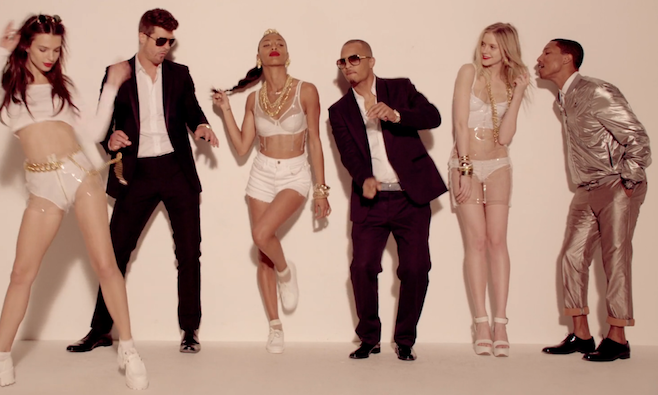
    In the music video, Thicke, singer/songwriter/producer Pharrell Williams and rapper ‘T.I.’ (born Cifford Joseph Harris Jr.) are surrounded by scantily clad, topless women gyrating and humping like dogs in hot weather.

    Thicke and Williams are of course dressed in fine suits, chasing and handling these poor girls like they’re browsing through magazines in Eurospar.

    A still from the 'Blurred Lines' video. Copyright Diane Martel 2013.
    A still from the ‘Blurred Lines’ video.                              Copyright Diane Martel 2013.

    In case viewers found it hard to decipher the deep philosophical meaning of the video, the statement ‘Robin Thicke has a big dick’ can be seen emblazoned on a wall while a topless blonde girl flounders around in front of it like a trout on a dry riverbed.

    Robin Thicke is not the only star guilty of this objectifying portrayal of women in music videos however; just look at any rapper or hip-hop star in the history of I don’t know, forever and you are 99% guaranteed to see some kind of sexist portrayal of women as mere objects for mens sexual amusement.

    Finally, we have the infamous MTV VMA’s performance with Miley Cyrus.

    If there was ever a personification of the extremely negative social effects of this misogynistic, derogatory attitude towards women in pop culture, it’s Miley Cyrus.

    Miley Cyrus and Robin Thicke performing at the 2013 VMA's. Copyright MTV 2013.
    Miley Cyrus and Robin Thicke performing at the 2013 VMA’s. Copyright MTV 2013.

    The former Disney television child star shocked the VMA audience with her overtly suggestive sexual behavior onstage, most notably ‘twerking’ (the “rhythmic gyrating of the lower fleshy extremities”, as explained by http://www.urbandictionary.com/) on Thicke’s presumably well-endowed crotch.

    What’s even worse about the misogynistic attitude prevalent in pop culture is when female pop stars conform to this mindset and further embed it into social consciousness as ‘acceptable’ treatment of women.

    Miley Cyrus’s latest video for her single “Wrecking Ball” features her posing naked on a wrecking ball and performing fellatio on a sledgehammer for God’s sake.

    Sex may sell, but it’s a sad world when not only are there both men and women conforming to the misogynistic pop culture mindset; the public are more than happy to reinforce it through accepting it as an orthodox of music culture.

  • Sinead O’Connor, Miley Cyrus spat continues

    Sinead O’Connor, Miley Cyrus spat continues

    Sinead O’Connor and Miley Cyrus have continued in their cyber tit-for-tat argument.

    The feud began with a seemingly good-willed letter, drafted by O’Connor, and posted on her personal website addressed to Miley Cyrus, in relation to the young American popstar’s recent sexaully-provacative antics. However the fourth, most recent letter, has moved onto the topic of mental health – more pertinently, Miley Cyrus’ derogatory attitude towards the issue.

    Sinead O'Connor was less than thrilled to hear she was the inspiration of Miley Cyrus' new video. Image by: Pieter Morlion
    Sinead O’Connor was less than thrilled to hear she was the inspiration of Miley Cyrus’ new video. Image by: Pieter Morlion

    The first letter was drafted in response to comments Cyrus made to Rolling Stones magazine in relation to her new video, Wreaking Ball, being “like Sinead O’Connor’s video [for Nothing Compares to You] but, like, the most modern version.”

    Cyrus responded in kind with a crass twitter response saying, “before Amanda Bynes there was Sinead O’Connor,” making light of both Bynes current, and O’Connor previous struggles with mental illness.

    In the most recent letter O’Connor called for Cyrus to issue “an apology to all sufferers of mental health difficulties and all those who have had experience of suicidal feelings or who have been affected by suicide”.

    She goes on to state that “a lot of these deaths [suicide] would not take place if it were not the case that stigmatisation and bullying and buffooning of those perceived mistakenly or otherwise to have mental health issues.”

    The 20-year-old US singer is finding support hard to come by.

    Sue Baker, Director of Time to Change, a mental health anti-stigma programme has also publicly commented on the Cyrus’ ignorant statement.

    “It’s really disappointing to see Miley Cyrus mocking Sinead O’Connor’s mental health problems”, said Baker, “and this only serves to fuel stigma.

    She continued, “one in four of us will experience a mental health problem and there are times when we need to speak out and seek help. We would encourage Miley to apologise to Sinead.”

    Social counsellor Thereseanne McCormack understands the “sense of naivety” shown on Cyrus’ behalf.

    “She has been sheltered from a young age, which has clearly warped her judgement,” said McCormack.

    “I would be worried about Cyrus’ ability to lay blame upon everyone else, as it is a sign of her own worries and sub-conscious issues.”