Tag: painting

  • The 70-year wait: Dublin embraces the birth of abstract art with Hilma Af Klint: Artist and Visionary

    The 70-year wait: Dublin embraces the birth of abstract art with Hilma Af Klint: Artist and Visionary

    For decades, the origins of abstract art have been heavily credited to an abundance of male artists. However, Swedish artist Hilma Af Klint (1862-1944) predates these painters as she had completed a collection of visionary works long before her male counterpart had even began experimenting with abstraction.   

    Now considered one of Europe’s most renowned abstract painters, Af Klint’s talent has made its way to the National Gallery of Ireland for its first major exhibition dedicated to her work. The six-week-long display is titled Hilma Af Klint: Artist and Visionary and is set to run from 15 October 2026 to 7 February 2027. It also features early portraits and landscapes, some of which have never been publicly exhibited before. In fact, at her own request, Af Klint’s works were sealed away from the public eye during her lifetime and for 20 years following her death. Her distinctly vibrant works were profoundly ahead of her time as they tested the boundaries between art, science, and spirituality and were largely unknown outside of Sweden.

    Photo credit: Emma Jones

    The Dublin-based exhibition, developed in collaboration with the Hilma Af Klint Foundation, unfolds less like a traditional exposition and more like a navigation into a visual system of a vibrant mind. Upon entry to the gallery,  visitors are met with a custom painted staircase painted in a vivid homage to Af Klint’s Altarpiece No. 1.


    Photo credit: Emma Jones

    Initially, rooms 6-10 displayed her early works of landscapes and botanical illustrations, the safe and conventional pieces that paid her Stockholm rent. Once you turn that corner, the rooms are now suddenly illuminated with massive vibrant masterpieces such as The Swan (1914) or The Altarpieces (1915). Suddenly, you are confronted with the concealed birth of abstract art, which was once locked away in the dark as Af Klint felt as though the world wasn’t ready to experience her spiritual work just yet.  

    Photo credit: Emma Jones

    The exhibitions curator Janet McLean told TheCity that she has been in discussion with the Hilma Af Klint Foundation regarding an Irish collaboration since 2021. Five years on, that persistence has grown into a confidence that Irish audiences are finally ready be faced with her work, following a hesitancy about “connecting abstract art and the land”. “We all feel a longing for connection, for goodness, solace, and consolation. Af Klint was very interested in looking away from conventional religion and towards spirituality, theosophy, and anthroposophy. So, I think this is something the Irish are very much in tune with,” said McLean.

    McLean also highlighted the spiritualism within Af Klint’s paintings, explaining that “these great bodies of work were never intended to be made for exhibitions in the art world in museums and galleries, they were made with a sort of higher purpose”. “She didn’t make art to be known or to have her own reputation. There was no ego involved, it was never about her,” said McLean, “it was always about the spiritual message to communicate to the viewer as if her spiritual art was coming through her as if she was an instrument or a conduit.” 

    Photo credit: Emma Jones

    Roxie Gillespie, a final-year paint student at NCAD felt as though Af Klint was “ahead of her time”. “I think it’s very important to see a woman’s hard work in this current climate,” Gillespie said. “It’s quite profound to have something that is inherently discovered by women, explored by women, and made by women.”

    Reflecting on Af Klint’s decision to leave her work for future generations, Gillespie was struck by the intention behind it. “I found that everything felt very intentional, I love the existentialism in her work and I think it is interesting to make something not knowing who is going to be viewing it in the context of a future society, when you’re not around yourself to see the reaction to it.” 

    Photo credit: Emma Jones


  • Pandemic as muse? Artists on their art in a year of lockdowns

    Pandemic as muse? Artists on their art in a year of lockdowns

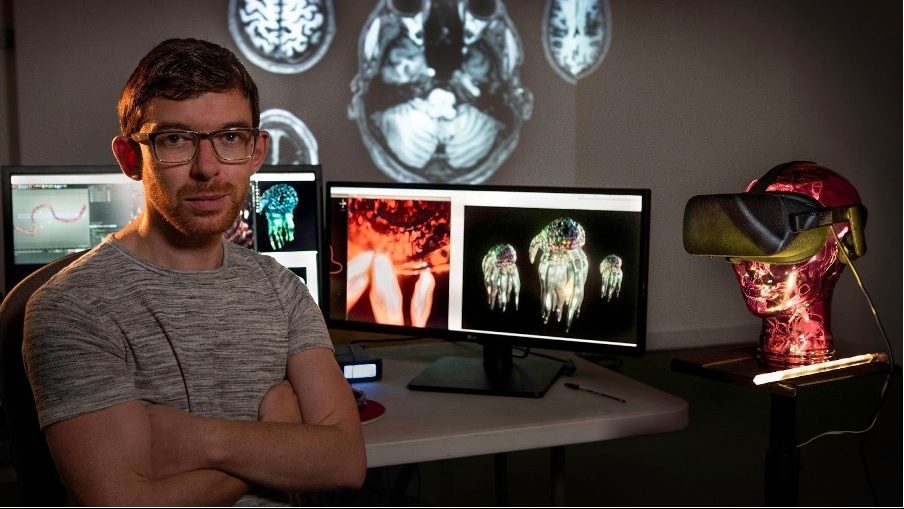
    Alan James Burns in his studio. Photo courtesy of Trevor Whelan

    Alan James Burns

    “I’ve had to move a lot of work online, which is quite interesting because it’s something that I never thought would be possible,” says Cavan-born visual artist Alan James Burns. “I usually create large events with up to 50 people attending, so that went completely out the window. Moving online has opened me up to be able to work from my bedroom, or work with international partners because you kind of break down the idea of having to be in the studio together.”

    Burns says he “can’t work now without putting in the context of the pandemic somehow.”

    “When I’m writing up my ideas and developing new works, it’s all with the context and background of this last year.

    “Everyone’s gone a lot more digital now, and the idea of the human machine – the digital world and our interconnectedness with that – has started feeding into a lot of new works I’m creating. I’m working with brain computer interfaces – looking at the idea of the human machine and what possible futures are like when we become more integrated with technology, which the pandemic has forced us all into.”

    Along with Sinead McCann, Burns is currently collaborating with users of intellectual disability services at St John of God Hospital in Dublin, as part of an artist in the community project. Participants are receiving training in audio recording and editing, and the piece they’ll create together will be exhibited on Culture Night in September.

    “That came about because of the pandemic. With everyone being at home, we decided to create a work, and the one medium we could think of that people would have access to tools, like a phone and stuff, was sound. So we’re all recording sounds and editing them together remotely online.”

    Tonally, Burns says his latest output has been “actually more hopeful than what it probably had been before the pandemic. The works that I’m creating have more joy within the production and also within what they’re trying to achieve for an audience when they do engage with it. So rather than looking negatively outward, they’re looking positively outward.”

    Burns says the Irish government’s Pandemic Unemployment Payment (PUP) has been a lifeline in compensating for cancelled projects.

    “Actually, I’m better off [than before the pandemic] thanks to the PUP. As an artist, you have no regular income, you live on minimal amounts of money, so the PUP was the first time many of us got a living wage that you could rely on.”

    Upcoming work: “Open Mind, Closed System”, Carlow Arts Festival, Co Carlow (June 2021)

    Ella Bertilsson

    Ella Bertilsson. Photo by Ella Bertilsson

    For Swedish multidisciplinary artist Ella Bertilsson, the initial lockdown last March was a case of life imitating art.

    “In the month before lockdown,” she tells The City, “I was working on a piece where I did a performance from inside a cardboard box, which was all about being trapped in a domestic space. That opening was I think two weeks before [the first] lockdown. So that was a super-odd coincidence.”

    In terms of concepts, Bertilsson feels the pandemic “will probably feed into my art at some point, but I think at the moment I find it hard to tell.”

    In terms of practice, however, her studio’s closure forced a rethink, as her workspace became “a tiny sewing machine table in a tiny room” at home.

    “I was like, ‘What do I do now?’ So, that was nice because it really brought me back into drawing a lot. I ended up illustrating a book cover and went back and sold a lot of prints, and I did a lot of photography. So the circumstances had an impact on my practice. It definitely had a creative impact. I’m now working with 35mm photographs I took around my neighbourhood every day for six months, and I’m turning them into digital collages with written text. That will be in my solo exhibition in Ballina next year.

    LOOPING SQUIRREL by Ella Bertilsson, music by Economusic

    “I hadn’t been doing drawings since my BA really,” continues Bertilsson, who’s been based in Ireland for the better part of two decades. “Now I’m drawing, and I’m printing and I’m doing things that I would have done a long time ago, so I think that’s kind of nice because I’ve done a bit of a circle and now it’s part of my practice again.”

    Bertilsson says she has “really enjoyed” the slower pace of the last year, in which she’s had “time to reflect on the work, and not have the pressure of exhibitions”.

    She counts herself fortunate to have been funded by the Arts Council for a number of projects in the lead up to and during the pandemic.

    “I think I was kind of lucky that I had that time to apply for awards,” she says, “and didn’t really have to use the PUP at all.”

    Upcoming works: Solo Exhibition, Ballina Art Centre, Co Mayo (2022),  Solo Exhibition, The Complex, Co Dublin (2022)

    Marcel Vidal

    Marcel Vidal. Photo by Marta Faye

    Sculptor and painter Marcel Vidal came into 2020 having picked up three prestigious awards in the previous year and landed a partnership with a commercial gallery.

    “I was in the midst of making work for a solo show,” Vidal says, “so that work had been established and the ideas were in place of how that might manifest itself. In a way, the work, as it’s developed, it’s changed in terms of what the overall show might have or potentially could have appeared like. It has a lighter tone. 

    “Some of my work would be large-scale cultural installations that are predominantly black, with paintings hung around the sculptural objects, whereas now the show is going to take on a lighter tone. The weight of [the work he is known for], its energy, is at this time unnecessary. So that all left my brain, and then it became about being in the studio [to focus on painting].

    “But it’s also maybe just that, as an artist,” continues the Wicklow native, “you find a way to manage the work. So for me, painting has been the easiest form to work in, in terms of just the practicalities of getting into the studio and being motivated. So in that way, [the pandemic] has influenced my art, in that I haven’t thought about sculpture, or that overall idea of making sculpture. But in conceptual or thematic elements, it wouldn’t play in that way. The type of art I make is never trying to speak on current or topical issues in that way.”

    The possibility of exhibiting Vidal’s show online was mooted, which he found “quite difficult, because it’s imagery that has a materiality, a physicality and a present. If it goes digital, the viewer is not having their own personal experience with it in a space. 

    “You come to a gallery or exhibition space with a set of criteria or a set of expectations as a viewer. And for me, the image and how it’s displayed and how you navigate that space – that brings out something else and that’s personal to that viewer. But if it goes into a digital format, you lose that context and it becomes something that could be viewed in distraction while doing something else. The subtlety of the work would be diminished and it could be misrepresented too.”