Tag: pandemic

  • Pandemic as muse? Artists on their art in a year of lockdowns

    Pandemic as muse? Artists on their art in a year of lockdowns

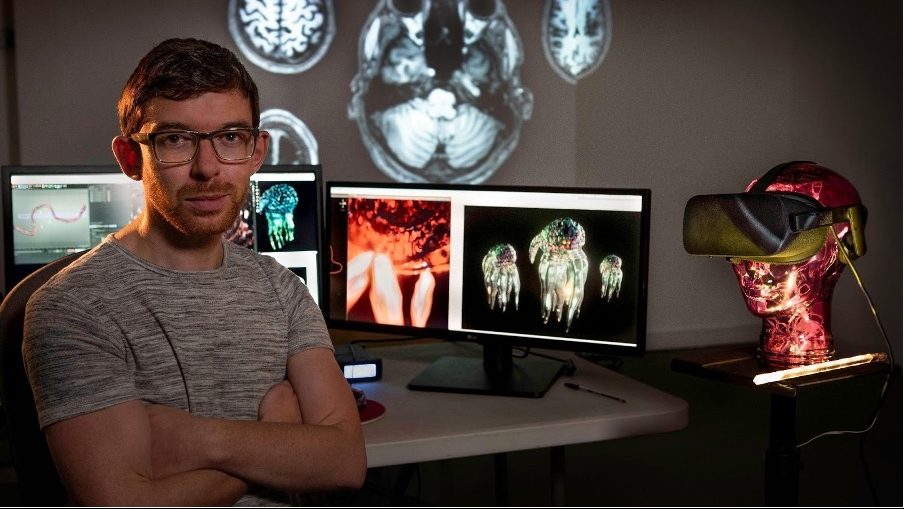
    Alan James Burns in his studio. Photo courtesy of Trevor Whelan

    Alan James Burns

    “I’ve had to move a lot of work online, which is quite interesting because it’s something that I never thought would be possible,” says Cavan-born visual artist Alan James Burns. “I usually create large events with up to 50 people attending, so that went completely out the window. Moving online has opened me up to be able to work from my bedroom, or work with international partners because you kind of break down the idea of having to be in the studio together.”

    Burns says he “can’t work now without putting in the context of the pandemic somehow.”

    “When I’m writing up my ideas and developing new works, it’s all with the context and background of this last year.

    “Everyone’s gone a lot more digital now, and the idea of the human machine – the digital world and our interconnectedness with that – has started feeding into a lot of new works I’m creating. I’m working with brain computer interfaces – looking at the idea of the human machine and what possible futures are like when we become more integrated with technology, which the pandemic has forced us all into.”

    Along with Sinead McCann, Burns is currently collaborating with users of intellectual disability services at St John of God Hospital in Dublin, as part of an artist in the community project. Participants are receiving training in audio recording and editing, and the piece they’ll create together will be exhibited on Culture Night in September.

    “That came about because of the pandemic. With everyone being at home, we decided to create a work, and the one medium we could think of that people would have access to tools, like a phone and stuff, was sound. So we’re all recording sounds and editing them together remotely online.”

    Tonally, Burns says his latest output has been “actually more hopeful than what it probably had been before the pandemic. The works that I’m creating have more joy within the production and also within what they’re trying to achieve for an audience when they do engage with it. So rather than looking negatively outward, they’re looking positively outward.”

    Burns says the Irish government’s Pandemic Unemployment Payment (PUP) has been a lifeline in compensating for cancelled projects.

    “Actually, I’m better off [than before the pandemic] thanks to the PUP. As an artist, you have no regular income, you live on minimal amounts of money, so the PUP was the first time many of us got a living wage that you could rely on.”

    Upcoming work: “Open Mind, Closed System”, Carlow Arts Festival, Co Carlow (June 2021)

    Ella Bertilsson

    Ella Bertilsson. Photo by Ella Bertilsson

    For Swedish multidisciplinary artist Ella Bertilsson, the initial lockdown last March was a case of life imitating art.

    “In the month before lockdown,” she tells The City, “I was working on a piece where I did a performance from inside a cardboard box, which was all about being trapped in a domestic space. That opening was I think two weeks before [the first] lockdown. So that was a super-odd coincidence.”

    In terms of concepts, Bertilsson feels the pandemic “will probably feed into my art at some point, but I think at the moment I find it hard to tell.”

    In terms of practice, however, her studio’s closure forced a rethink, as her workspace became “a tiny sewing machine table in a tiny room” at home.

    “I was like, ‘What do I do now?’ So, that was nice because it really brought me back into drawing a lot. I ended up illustrating a book cover and went back and sold a lot of prints, and I did a lot of photography. So the circumstances had an impact on my practice. It definitely had a creative impact. I’m now working with 35mm photographs I took around my neighbourhood every day for six months, and I’m turning them into digital collages with written text. That will be in my solo exhibition in Ballina next year.

    LOOPING SQUIRREL by Ella Bertilsson, music by Economusic

    “I hadn’t been doing drawings since my BA really,” continues Bertilsson, who’s been based in Ireland for the better part of two decades. “Now I’m drawing, and I’m printing and I’m doing things that I would have done a long time ago, so I think that’s kind of nice because I’ve done a bit of a circle and now it’s part of my practice again.”

    Bertilsson says she has “really enjoyed” the slower pace of the last year, in which she’s had “time to reflect on the work, and not have the pressure of exhibitions”.

    She counts herself fortunate to have been funded by the Arts Council for a number of projects in the lead up to and during the pandemic.

    “I think I was kind of lucky that I had that time to apply for awards,” she says, “and didn’t really have to use the PUP at all.”

    Upcoming works: Solo Exhibition, Ballina Art Centre, Co Mayo (2022),  Solo Exhibition, The Complex, Co Dublin (2022)

    Marcel Vidal

    Marcel Vidal. Photo by Marta Faye

    Sculptor and painter Marcel Vidal came into 2020 having picked up three prestigious awards in the previous year and landed a partnership with a commercial gallery.

    “I was in the midst of making work for a solo show,” Vidal says, “so that work had been established and the ideas were in place of how that might manifest itself. In a way, the work, as it’s developed, it’s changed in terms of what the overall show might have or potentially could have appeared like. It has a lighter tone. 

    “Some of my work would be large-scale cultural installations that are predominantly black, with paintings hung around the sculptural objects, whereas now the show is going to take on a lighter tone. The weight of [the work he is known for], its energy, is at this time unnecessary. So that all left my brain, and then it became about being in the studio [to focus on painting].

    “But it’s also maybe just that, as an artist,” continues the Wicklow native, “you find a way to manage the work. So for me, painting has been the easiest form to work in, in terms of just the practicalities of getting into the studio and being motivated. So in that way, [the pandemic] has influenced my art, in that I haven’t thought about sculpture, or that overall idea of making sculpture. But in conceptual or thematic elements, it wouldn’t play in that way. The type of art I make is never trying to speak on current or topical issues in that way.”

    The possibility of exhibiting Vidal’s show online was mooted, which he found “quite difficult, because it’s imagery that has a materiality, a physicality and a present. If it goes digital, the viewer is not having their own personal experience with it in a space. 

    “You come to a gallery or exhibition space with a set of criteria or a set of expectations as a viewer. And for me, the image and how it’s displayed and how you navigate that space – that brings out something else and that’s personal to that viewer. But if it goes into a digital format, you lose that context and it becomes something that could be viewed in distraction while doing something else. The subtlety of the work would be diminished and it could be misrepresented too.”
  • The drugs don’t work: Substance misuse during the pandemic

    The drugs don’t work: Substance misuse during the pandemic

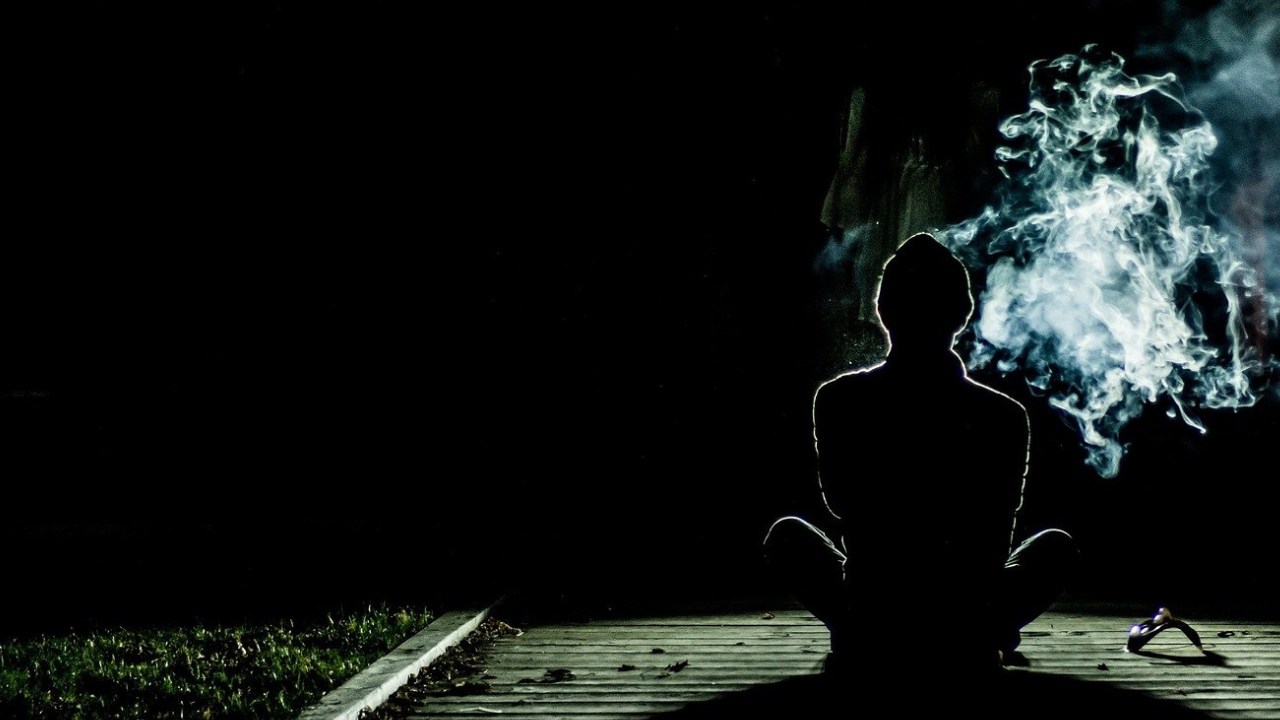
    Smoking in solitude. Image by Free-Photos from Pixabay

    Substance misuse has been at the forefront of the social issues in Ireland for decades and it is a problem that seems to continue to grow due to the widespread availability of both cheap alcohol and illicit drugs.

    Now, as we face the Covid-19 pandemic, people find themselves isolated at home with their own thoughts – a breeding ground for anxiety that can make it difficult to cope with drug and alcohol addiction. With counselling services stretch thin often these people are left without the help they need.

    A report released in January 2021 on behalf of the drugs policy and social inclusion unit found that 23% of respondents reported using more illicit drugs, and 15% reported using the same amount, citing anxiety and boredom as the driving factor behind their usage.

    pexels-photo-208512.jpeg
    Photo by Pixabay on Pexels.com

    The most commonly used substance was cannabis, followed by cocaine or crack cocaine and ecstasy (MDMA).

    However, cocaine or crack cocaine and ecstasy have seen a reduction in use since the pandemic with fewer opportunities to use and reduced availability of drugs cited as the main reasons for the reduction in their use.

    “We’ve had about a 100% increase of people seeking help”

    Elizabeth Sweeney 

    The report also found that support services were hit hard by Covid-19.

    Counselling sessions were forced to take place over the phone or through video calls, rather than face-to-face meetings.

    “We’ve had about a 100% increase [in 2020] of people seeking help, and the drugs would have been probably 70% of the increase and the alcohol would have been the rest,” says Elizabeth Sweeney, member of the Finglas Addiction Support Team (Fast).

    With regards to how the counselling takes place, Fast has had to adapt. 

    “The initial assessment is by phone,” Sweeney says, “we have to cut down on the footfall in the building, because we have to go by the HSE regulations.

    “And then when it comes to the one-to-one, we would have to schedule them for an hour, but it’s for 45 minutes with key workers allowed 15 minutes to tidy up.

    “We would have a reduced amount than we’d usually have,” she continues. “If we had eight in a day now, we could have had 14 or 15. That means we have a waiting list, and our books are full all the time and we’re constantly playing catch-up.”

    Image by Holger Detje from Pixabay

    With services for those seeking help stretched to their limits due to reduced time available and capacity, many people who struggle with substance misuse are battling their problems alone.

    “As the months went on, the amounts I smoke went up and I became more and more anxious”

    Anonymous

    “When Covid first hit last year I thought it would be for two or so weeks, but that has turned into over a year. At first nothing really changed, but as everything shut down and we were told to stay home I had nothing to do – boredom took over,” explains a man who wishes to remain anonymous.

    “First I started smoking more weed. When I couldn’t find that I’d turn to drink.

    “As the months went on,” he continues, “the amounts I [would] smoke went up and I became more and more anxious with no end of the lockdown in sight. The lack of routine, not seeing people and boredom, I’d say, are the main reasons for my change in habits. I suppose this isn’t the best for my mental health either.”

    When asked if he would seek counselling the man said, “I would but I don’t know where to look. Like, I feel when this eventually comes to an end and things start going back to normal, hopefully my habits will go back to normal.”

    With the end of lockdown in sight and the rollout of vaccines advancing, there are hopes that society will return to some sort of normality soon, allowing those who need help to get it and resume the lives they lived prior to the pandemic.

    If you or anyone you know is struggling with the issues mentioned in this article, text Mental Health Ireland’s drug line at 50808 or contact Alcoholics Anonymous Ireland.

  • Podcast: Covid-19 abroad – how Germany dealt with the pandemic

    Podcast: Covid-19 abroad – how Germany dealt with the pandemic

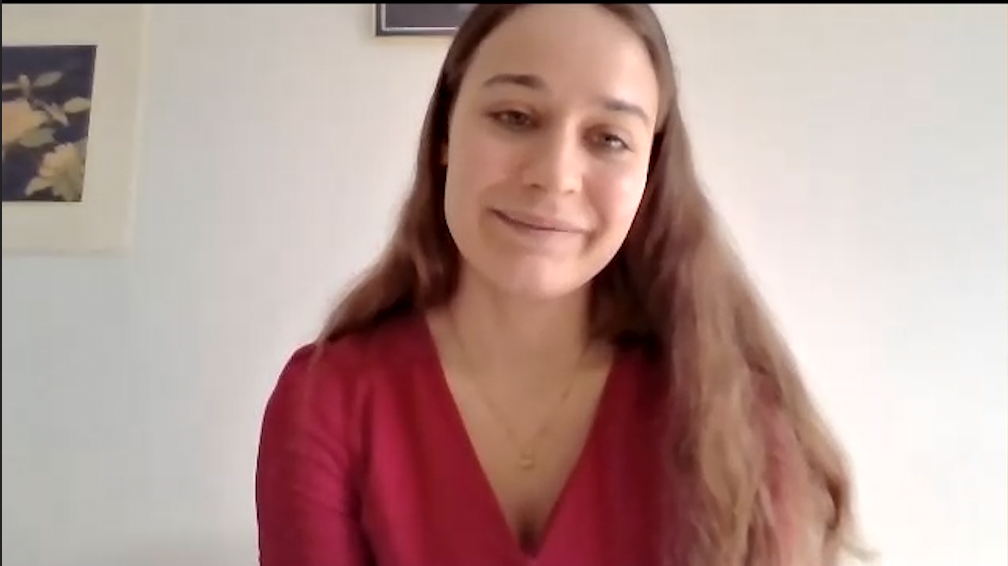
    Listen to Johannes Thom speak to James Molloy about how Germany handled the pandemic

    Germany had its first reported cases of Covid-19 in January of 2020 near Munich, and has been in and out of regional lockdowns ever since. The country is currently in its third wave of the virus.

    Varying levels of restrictions have been imposed on a region-to-region basis depending on the severity of the virus. Currently, Chancellor Angela Merkel is calling for unified Covid-19 restrictions nationwide, which would see an “emergency brake” in order to try and control the spread of the virus.

    Since we recorded this interview, 7.3% of Germany’s population of 83 million have been fully vaccinated with just under 26 million doses given in total. This is due to the accelerated rollout of vaccines. From next month, it is hoped that GPs will be able to administer their preferred vaccine, with the federal government providing family doctors with the choice of vaccines from BioNTech/Pfizer and AstraZeneca.

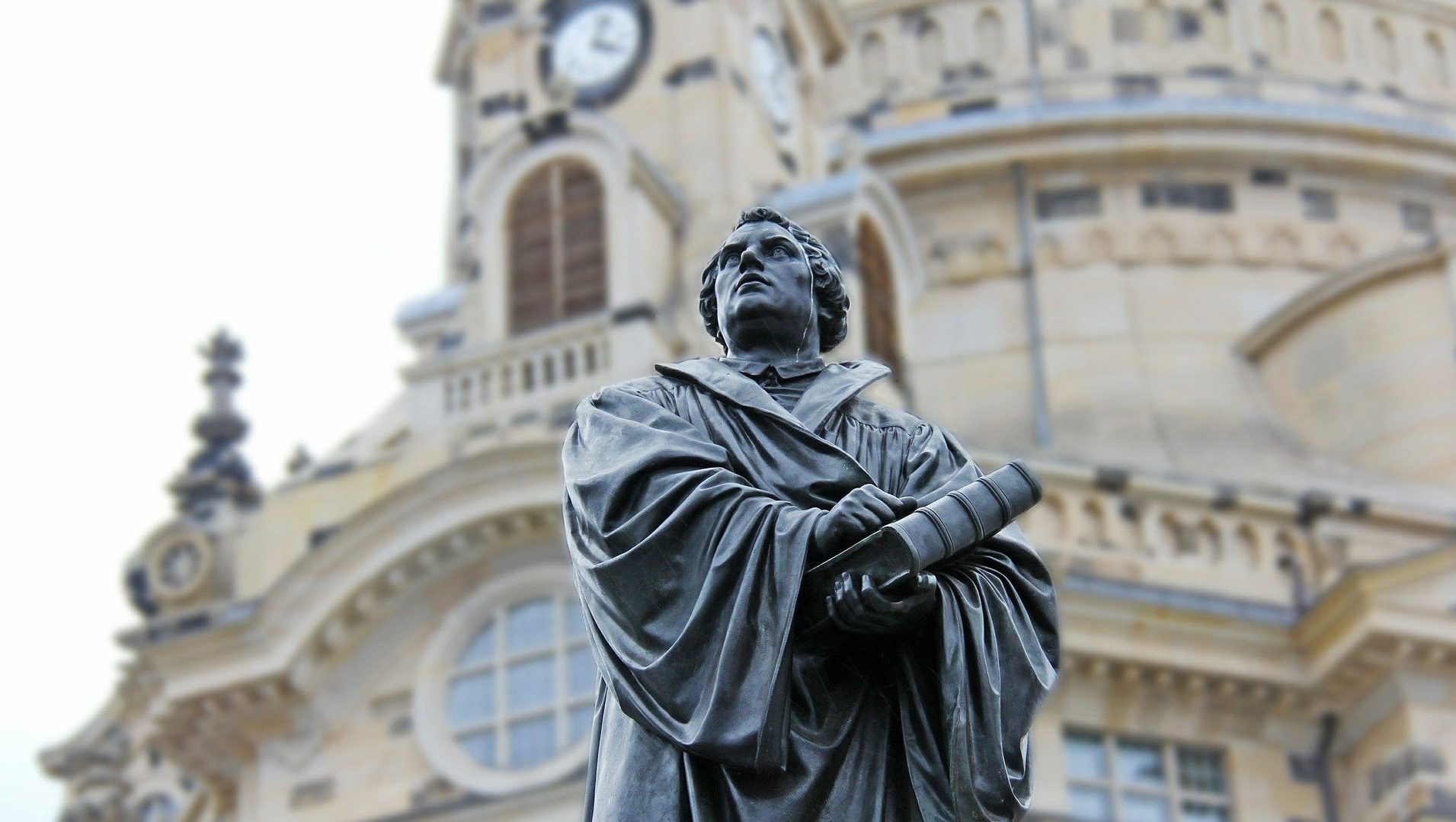
    Martin Luther’s statue at Dresden via Pixabay

    Europe has seen a rise in anti-lockdown protests from Paris to London and even closer to home, as Dublin saw violent protests in late February. Germany too has seen this rise in protests over Covid restrictions with regular demonstrations taking place across the country.

    The most recent protests planned for Dresden in Saxony were banned by the Saxony Higher Administrative Court.

    The banning of these protests is significant especially in the state of Saxony where the highest mortality numbers in Germany have been recorded. One of the main reasons for this is that the region has an ageing population and a large number of retirement homes that have been devastated throughout the pandemic.

    A snap of Dresden taken by James Molloy

    Another factor is its proximity to the Czech border, with many crossing it for work. The Czech Republic has been one of the worst hit countries worldwide. Saxony has been fighting an uphill battle from the start.

  • Covid-19 abroad: Public health vs economy in Switzerland

    Covid-19 abroad: Public health vs economy in Switzerland

    Watch Nina Suter and Izzy Rowley discuss the situation in Switzerland

    Switzerland has vaccinated 2,431,709 people and is on its way out of a national lockdown.

    It’s clear that the country was hit hard by the crisis. The Swiss government recently announced that, at a conservative estimate, a third of the country’s population has been infected by Covid-19.

    However, when the country was facing its second wave of the virus the government was slow to respond, and many businesses remained open, including bars and clubs, resulting in a superspreader event.

    “As is probably the case everywhere, but especially here, the economy is really prioritised over health,” says Nina Suter, a Swiss native who is currently living in Zurich.

    “It’s wild when you have the Swiss Finance Minister [Ueli Maurer] saying ‘oh, we can’t afford a second lockdown,’ which is wild, this is one of the richest countries globally,” adds Suter.

    Zurich’s streets are finally opening up after a long lockdown. Image courtesy of H. Emre via Pexels.com

    The country is only now emerging from restrictions that were put in place to avoid a third wave, with restaurants and pubs allowed to open their outdoor seating.

    The government has introduced a new strategy of rapid self-testing. Swiss people will be able to obtain five tests per month each. It’s hoped that this will allow for early detection of the virus and will help to contain any new variants. 

  • If you build it, they will come… Eventually

    If you build it, they will come… Eventually

    Lavanda (left) and V-Face (right) on Lower Grangegorman Road. Photo by Colm McGuirk

    “The fact that this unit was close to TU Dublin was a huge factor in the decision to go ahead with it.” Sarah Boland, owner of V-Face, is talking about her vegan fast-food restaurant’s proximity to the impressive new home of Technological University (TU) Dublin.

    The city campus of what used to be called DIT, built as the centrepiece of a major regeneration programme for Grangegorman in north Dublin city, is ready to welcome around 10,000 students plus staff – once Covid restrictions are no longer necessary. 

    Boland’s is among a number of independent businesses on the Lower Grangegorman Road that had factored those numbers into their plans. 

    “It’s going to be a huge campus, so obviously footfall will increase massively,” Boland says. 

    In the turbulent 10 months since it opened, V-Face has had to make some think-on-your-feet adjustments to compensate for lost bums on its 40 seats. Among them is the outdoor eating area installed on the opposite corner, in cooperation with Dublin City Council, and the window hatch through which Boland speaks to The City

    “Coffee and sandwiches were never in the business model,” Boland says, “but we said ‘let’s bring out a lunch offering.’ The burgers were doing really well, but were more for the evening offering. [The hatch and coffee counter] have been designed in a way that, once the pandemic is gone, you can also swing around and serve people that come in.”

    Dining tables installed by V-Face. Photo by Colm McGuirk

    While V-Face benefitted from a model partly geared towards takeaway from the off, former Mediterranean restaurant Lavanda on the opposite corner has had to reset completely in the last year. 

    “We tried to do takeaway Mediterranean food during the first wave,” says Croatian owner Robert Velic, “but it didn’t work very well.”

    Lavanda’s enforced rebirth was planned with the new TU Dublin campus in mind – it now sells toasties, slices of pizza and sweet treats.  

    “We’ll see when the students come back if we made the right choice”

    Robert Velic

    “The second wave came and then we completely changed. We were expecting those students. We adapted the prices to four or five euro,” Velic says.

    “When the lockdown ends,” he continues, “it’s going to be a proper takeaway and we can add a few more things to the menu when business picks up and the colleges are back. We’ll continue to target students and walk-ins. We’ll see when the students come back if we made the right choice.”

    A few doors up, Russia native Alexander Yegorov’s print and copy shop should be bustling. 

    His unit is next door to one of two new student apartment complexes on this stretch of road built in the controversial ‘co-living’ mould (and, in the ultimate symbol of the area’s gentrification, on the site of the former ‘Squat City’).

    “We opened our shop three months ago,” Yegorov tells us. “They move the lockdown every two months. I expected the students would be here from the new year. But now, it won’t be until summer time. 

    “But it’s OK,” Yegorov adds. “We can survive until summer.”

    “We knew it was a long game, but it’s been a lot longer than anticipated”

    Rebecca Feely

    On the next corner, Rebecca Feely of Kale+Coco tells The City that when she chose the location for her plant-based healthy food cafe in 2019, “it was under the assumption that there’d be lots of students.”

    “We knew it was a bit of a long game,” Feely says, “because they were moving students bit by bit. But it’s been a lot longer than anticipated.”

    While noting that her prices might be a little above the average student’s range, she tells us, “it’s always been in my head to focus more on marketing to students, but I haven’t had the chance yet because we haven’t had the students there yet.”

    Kale+Coco has leaned more towards retail of food products to help stay afloat in what has been a difficult year.

    Rebecca Feely in her cafe Kale+Coco. Photo by Colm McGuirk

    “We were never actually told to close, so you feel almost obligated to keep trading because you have bills to pay,” Feely says. 

    “You have rent due. If you’re not ordered by the government to close, you’re not covered by any insurance, your landlords aren’t going to give you a break,” she adds.

    While the eventual arrival of students should help jump-start these Lower Grangegorman businesses, it could well signal the end for Happy Days Coffee Van on the new campus a little further up the road. 

    The mobile cafe was set up by local resident Olivia O’Flanagan in response to the “inertia and isolation” her neighbours were faced with during the first lockdown last spring. 

    O’Flanagan, a former lecturer with no background in business, was given the green light to operate on TU Dublin’s campus for as long as its own catering services were closed. 

    “It’s a lockdown project to keep us all busy and connected and give some kind of focus for the local community,” she tells The City.

    Happy Days Coffee Van set up at the entrance of TU Dublin’s Grangegorman Campus. Photo by Colm McGuirk

    Hiring only locals helped her secure the temporary contract – staff can return to their own homes for the mandatory bathroom access.

    “For me, it’s not a business endeavour,” O’Flanagan says, “though it has made money and is paying eight people’s wages on 20 hours a week. They’re all delighted and their parents are saying they were all sitting in their bedrooms cracking up.”

  • Covid-19 abroad: The US and the impact of the pandemic from coast to coast

    Covid-19 abroad: The US and the impact of the pandemic from coast to coast

    Video by Liam Daly

    The first US Covid-19 fatality was reported in Seattle on the 28 February 2020 – one year later and the deaths have now risen to half a million.

    In that time the US has been a mainstay in worldwide news and media for a multitude of social and political issues ranging from the strange to the shocking.

    Throughout the last year, the American people have become increasingly polarised – the brutal killing of George Floyd and the resulting protests revealed systemic issues of racism in the US which were brought to the fore in worldwide media, on top of that, then-president Donald Trump’s approach to handling the pandemic was controversial, and did nothing to quell the tense atmosphere in the US.

    The US entered the pandemic with an already problematic healthcare system, which the Trump had inherited – a healthcare system which had been decreasing in funding every year since 2002.

    Trump’s devil-may-care attitude to the virus and his peddling of conspiracy theories did not help this fragile system, and the magnitude of lives lost is a sad reflection of this.

    Through this historic period, Cillian Dunne, 24, a recent college graduate, published author, and budding Hollywood screenwriter has lived on both the east and west coasts of the United States.

    First in Boston, where he has been living for the past five years while completing his college degree, then, upon graduating, he drove cross-country to settle in Santa Monica, where unfortunately he has been mostly confined to his apartment since October.

    “Since we got here we’ve been under the strictest lockdown in America”

    Cillian Dunne

    While things are starting to reopen as more than one million people in LA have been vaccinated, thousands of cases per day keep the locals wary.

    “ICU wards are getting within their threshold. I’m sure we’ll get put into another lockdown,” says Dunne.

    A quick vaccine rollout has lead to an increase in optimism. Some reputable sources are backing ‘herd immunity’ and speculate that a herd immunity threshold can be achieved as early as late-spring or at worst, the end of summer.

    This theory has its complications however, and arguments have been made against it. While a quick vaccine rollout seems the perfect solution that we all have been searching for, the danger of increasing variant strains of the coronavirus complicates the situation – we may vaccinate against the current strains but a new variant could come along tomorrow and make that work null and void.

    The only way to tackle this problem is to learn to live with Covid-19 while work on vaccines and studies of the virus improve – and in the US, the new president’s policies are putting this into action.

    President Biden’s approach to the pandemic has been significantly different to Trump’s.

    Biden has focused on personal protective equipment (PPE) and improving access to it. Increases have been made to testing capacity, travel restrictions, and mandates requiring Americans to wear masks have been introduced. There has also been a focus on returning to schools and workplaces safely.

    If the US can maintain their current vaccine trajectory, the country could reach herd immunity as early as July, however it is also projected that in that time an additional one million people could die – and that is without interference by new variants.

    The more important strategy could prove to be in the policies the new administration are implementing rather than in the questionable herd immunity plan.

    Sunset in Boston, Photo by Kristin Vogt via Pexels.com
  • A Covid tale of two cities

    A Covid tale of two cities

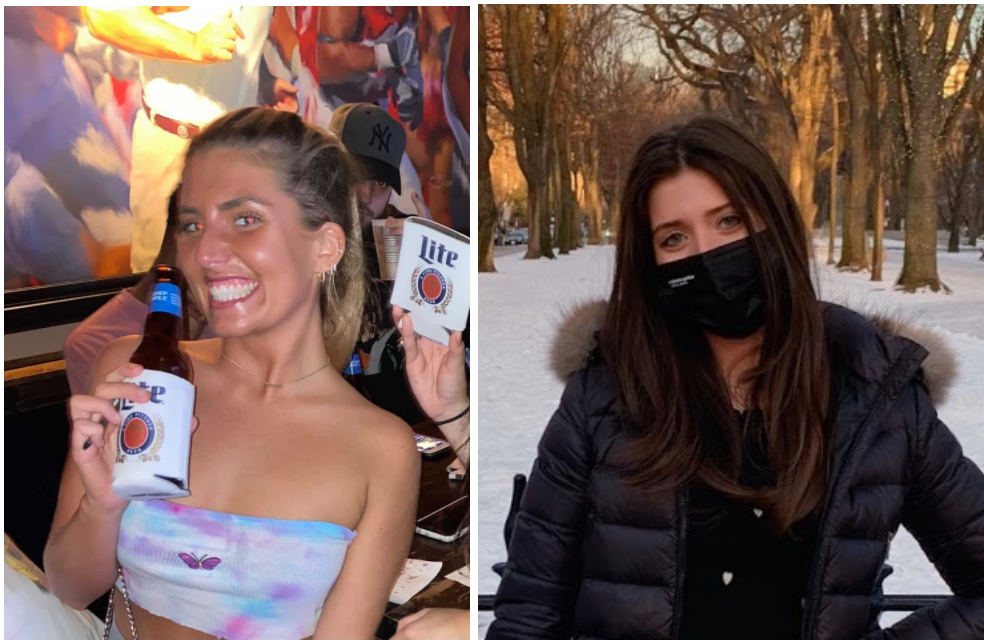
    Beaming Tara Wiekert (left) enjoys a brew indoors at a bar in Tuscaloosa, while Julia Hadley (right) is smiling through her state-mandated mask outdoors in Boston. Photos courtesy of Tara Wiekert and Julia Hadley

    In North America, each state decides on its own Covid-19 regulations. Different states can have radically different restrictions – changing the experience of the pandemic for their residents.

    A part of Biden’s 2020 presidential campaign was the requirement of masks to be worn throughout the US as he stated it could “save 100,000 lives” if masks were made mandatory to wear in every state.

    Less than a month into his inauguration, President Biden has already pushed nationwide mandates, requiring masks to be worn by all Federal employees and by those who use public travel throughout the US.

    However, social distancing regulations are very different depending on the state.

    Answering the same set of questions, two students who reside in different states share their lifestyle and opinions with Jessica Viola on the Covid-19 pandemic.

    Tara Wiekert lives in Tuscaloosa, Alabama, and studies advertising with a minor in German at the University of Alabama.

    Julia Hadley is a health science major at Boston University in Boston, Massachusetts. These responses are based on the student’s opinions as well as on their state’s individual regulations. 

    What is your opinion on Covid-19 now, in 2021? 

    Tara Wiekert: “I think it’s serious and something everyone needs to be made aware of. I know it affects older people more severely, which is why I think a lot of people at school don’t take it that seriously, since we are in a college town surrounded by people who are all mainly around the age of 20-25.”

    Julia Hadley: “My opinion on Covid-19 has remained the same over the past months. It is a very scary time for so many individuals and has affected far too many people. While the vaccination is bringing so much hope for the future, it’s still imperative people take precautions.”

    “While the vaccination is bringing so much hope for the future, it’s still imperative people take precautions”

    Julia Hadley

    What measures are being taken to prevent the spread of Covid-19 in your college?

    TW: “The school requires students to be tested for Covid-19 randomly. I try to wash my hands as often as possible, but since life here feels so normal, I do not take immense measures to prevent the spread of Covid-19. I still go out, eat out, and hang out with all my friends the same way as we did before.”

    JH: “At BU, students who attend classes on-campus or live on-campus must take a Covid-19 test every three days. When taking a class in-person, students must provide proof of their negative Covid-19 test. Throughout campus, students must wear masks at all times.”

    Are you taking college classes in person now and are other work spaces open?

    TW: “Alabama is probably one of the states with the least amount of Covid restrictions. We have some in-person classes and some online depending on what the professor prefers. Libraries and other study areas are open, however, you must wear a mask on campus at all times.”

    JH: “All students and faculty are required to get a Covid-19 test every 3 days, allowing students to take classes in person, if permitted. Libraries and study areas are open, but space is limited. Students must wear a mask at all times, while also having a negative Covid-19 test result, in order to enter the space.”

    “I still go out, eat out, and hang out with all my friends the same way as we did before”

    Tara Wiekert

    How has socialising been for you in 2021?

    TW: “In all honesty, life in Alabama has been rather normal. Bars have been open for a while now. They only shut down at the beginning of last semester for about two weeks.

    “All or most college organised events are happening here in Alabama. We just won the National Championship for (American) football.”

    JH: “Boston does have indoor dining and restaurants utilise glass shields and place diners a safe distance away from one another. The state’s mandates include setting limits on gatherings, also mask and face-coverings must be worn indoors and outdoors with a capacity limit and there’s a curfew for restaurants as well as businesses.

    “At this moment, no organized events are happening within my college campus and are highly discouraged within Massachusetts.”

    University of Alabama students celebrating their American football victory in January 2021. Video courtesy of Tara Wiekert

    What is your opinion on how your state is handling Covid-19 procedures now?

    TW: “In my hometown of New Jersey, my life has changed a lot, and I am able to do a lot less, yet both states seem to be doing ‘fine’. I do think wearing a mask in public should be required for the safety of others and the elderly. However, in Alabama, my life seems rather normal and I often forget Covid-19 is even a ‘thing’. I am doing everything that I used to do even before Covid-19 hit.” 

    JH: “Just as everyone around the world, my life has changed since COVID-19. I have limited traveling, restricted seeing people outside of my immediate circle, among many other things. While adapting to our new ‘normal’ has had its challenges, it is a sacrifice I am willing to contribute to keep myself, family, and friends safe during the pandemic and, I am extremely fortunate for their good health thus far.”

    “Adapting to the new ‘normal’ is a sacrifice I am willing to contribute to keep myself, family, and friends safe during the pandemic”

    Julia Hadley

    American universities have been a hot spot for the spread of Covid-19. Throughout the course of the pandemic, more than 85 colleges have had over 1,000 reported cases on campus. In a recent study, 70% of Covid-19 cases in the US have been spread by young aged 20-49 years old.

    Although Massachusetts has almost over 2 million more residents in it than Alabama, they comparatively have a little over 72,000 more confirmed Covid-19 cases than this southern state. As it stands now, Massachusetts has 546,800 confirmed cases and Alabama has had 474,666 coronavirus cases since the beginning of the pandemic.

    Masks, social distancing, and socialising remain hot-button issues – will Biden manage to unite his nation?

  • Bloody buses

    Bloody buses

    The 33A bus pulling into Lusk village. Photo by Izzy Rowley

    Public transport can change the shape of someone’s day entirely. For health care workers, it can add hours onto their already lengthy days, as they battle long wait times and social distancing issues. 

    “Transport, as stupid as it might sound to most people, makes such a difference if you can get home quicker because you are so tired,” says student nurse Sarah Reid who is currently working in St. James’s Hospital in Dublin.

    Reid lives in Swords, north county Dublin. To get to work, she has to take two buses or a bus and a Luas regularly.

    Her journey usually starts around 5:00am and ends at 6:30am, when she arrives into work an hour early for her shift. She could get a later bus, but according to Reid, it doesn’t leave her with enough time to get ready for her shift. 

    “Because of the pandemic, when we get to hospital, we have to change, and we have to PPE up before, because I’m on a Covid ward,” Reid explains.

    Getting home presents its own problems. After her 13 hour shift, she could often be waiting up to 35 minutes for a bus home.

    The 33 bus driving down Station Road in Lusk, north county Dublin. Photo by Izzy Rowley

    Dublin Bus services are currently running at a reduced capacity and regularity, operating on a Saturday schedule, leaving fewer buses with less room for passengers.

    In an email statement to The City, Dublin Bus said that the Saturday schedules are “augmented by additional services, especially in the early morning peak” and “the schedules reflect the current demand for services.”

    The reduction in both the frequency and the capacity of the buses can lead to issues with social distancing.

    “Especially in the level five situation, I know the service is reduced to a Saturday service, and that just doesn’t make sense to me. 

    “It would make more sense if the services still ran as normal – people would be given the opportunity to keep their distance more,” says a social care worker based in Fingal, who has chosen to remain anonymous to protect her privacy.

    The accessibility of transport is also an issue, this social care worker notes that recently, real time displays in train stations have often been broken: “If you’re an older person that doesn’t have a phone, or people with disabilities like the ones I work with, it makes it difficult.”

    “If the services still ran as normal, people would be given the opportunity to keep their distance more”

    Anonymous

    However, the health and safety of bus drivers can’t be ignored either.

    Dublin Bus said that these reductions are in place to protect the health and safety of passengers and staff, which is their “first priority”.

    “We’re just like everybody else, we don’t want to bring it home,” says Dublin Bus driver Joe O’Dwyer.

    O’Dwyer feels lucky to still be working during the pandemic and notes that “the company is supplying PPE stuff” including masks and hand sanitiser.

    “We’re just like everybody else, we don’t want to bring it home”

    Joe O’Dwyer

    “One of the things we’re trying to do with the Saturday timetable, it’s called an enhanced [timetable], so there’s an extra couple of buses that go out on certain routes that are busy – they’re trying to do their best with it,” O’Dwyer says.

    “It’s all about health and safety, isn’t it? Keeping the staff safe and the public safe,” O’Dwyer adds.

    Public transport has been an issue in Fingal before the pandemic, and the reduced services have worsened the situation.

    “With ongoing and increasing development in Lusk, Skerries, and Rush, it’s obviously putting more strain on the public transport system,” says Councillor Robert O’Donoghue, the Labour Party local area representative for Rush and Lusk in Fingal, who is working with a local action group to increase public transport in the area.

    The action group has asked Fingal County Council to assess public transport services in the area in relation to population and housing development. 

    “Any assessment that goes on, I can’t see the possibility of services being pulled back,” O’Donoghue says. “There’s just too much housing development going on in the north county.”

    “Fingal, I think, is being used almost as a relief valve for the housing crisis to some degree.

    “That can either be a good thing or a bad thing, depending on your way of looking at it. They’ll serve where the people are, and with more and more people moving out our way, I do believe the services will come,” he adds.

  • Increase in people feeling downhearted or depressed between April and November this year

    Increase in people feeling downhearted or depressed between April and November this year

    The Central Statistics Office has released findings of a survey in relation to ‘well being and lifestyle under level 5 restrictions’– a survey relative to the social impact of Covid-19 for the month of November 2020. Gavin Dalton examines the results of this survey.

    Image source: Pikist

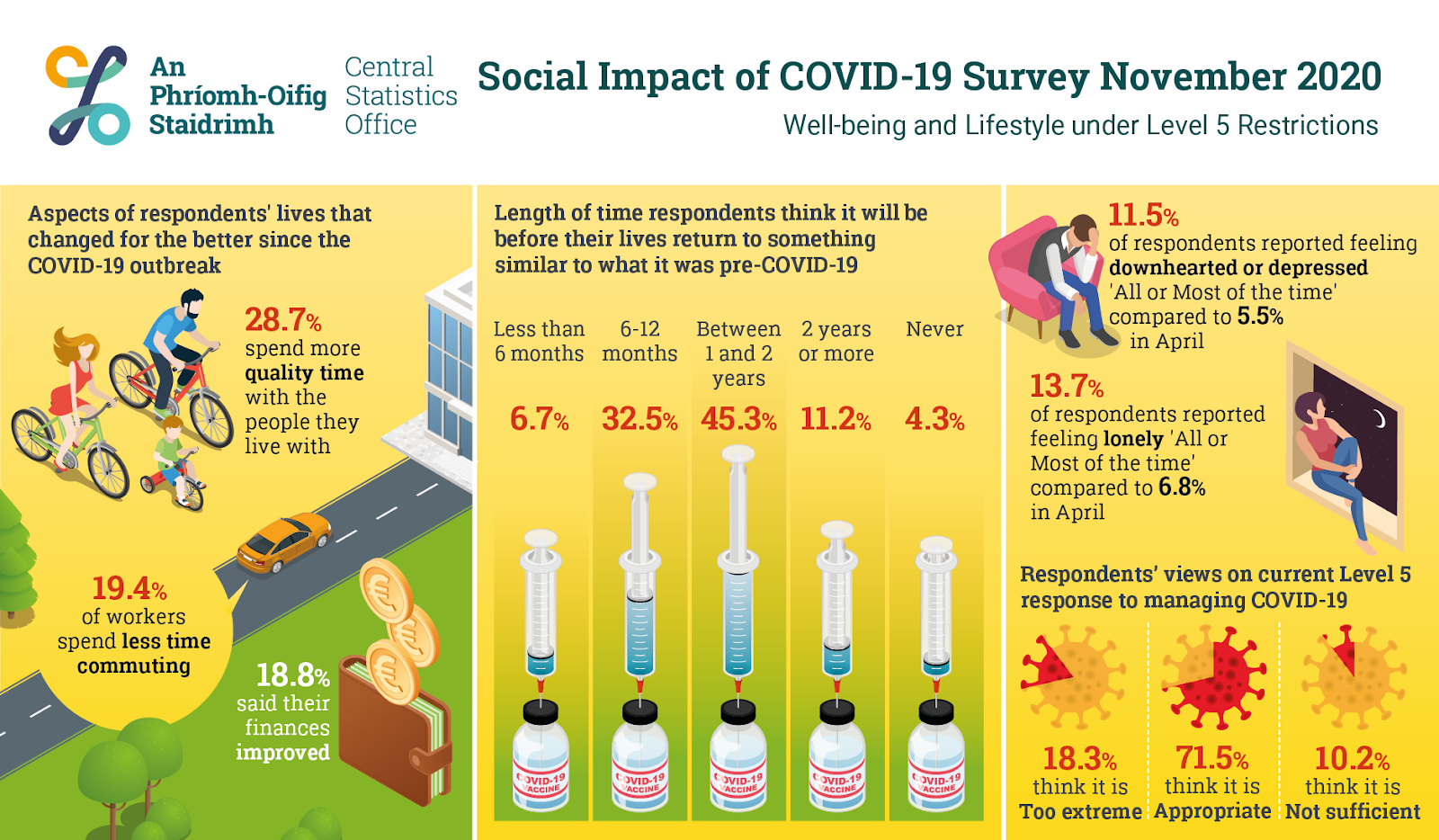
    Published on the morning of the 30th of November, the Central Statistics Office (CSO) well-being survey shows some eye catching findings. 19.4% of workers spend less time commuting, which was an aspect of repondants’ lives that have changed for the better during the pandemic, whereas in contrast 11.5% of respondants reported feeling downhearted or depressed ‘all or most of the time’. 

    The survey, which was carried out between Thursday November 12th and Wednesday November 18th, was based on a sample of 5,105 persons aged 18 and over. The survey availed of an online questionnaire to produce an achieved sample size of 1,585 individuals.

    There were some findings that arose in relation to the appropriateness of the implementation of Level 5 to Covid-19 risk, in which one could argue were rather expected results. Over 71% of those who responded to the survey indicated that the level 5 response was appropriate, 18.3% were of the impression it was Too extreme, with 10.2% feeling it was not sufficient. Analysing the findings by age shows the likelihood of a respondent feeling that the Level 5 response was Appropriate increased with age, with 63.2% of respondents aged 18-34 agreeing that the Level 5 response was appropriate rising to 88.2% for those 70 and over. 

    Some of the findings from the survey may raise cause for concern: The percentage of respondents that felt lonely All or Most of the time in the four-week period prior to interview doubled between April, when a similar survey was carried out and November 2020, from 6.8% to 13.7%, whilst the percentage of respondents that felt downhearted or depressed All or Most of the time in the four-week period prior to interview doubled between April and November 2020, from 5.5% to 11.5%.

    Speaking of these specific increases, councillor Mairin McGrath isn’t overly surprised but remains hopeful for the year to come. Speaking to The City, she said: “When we look at the first lockdown compared to the 6 week lockdown we’ve just come out of, there’s been a huge difference. There was probably a novelty to the first lockdown and although we were kind of facing into the unknown, it was genuinely a very scary time for the country, people being at home, having the long days and the good weather to do your few DIY jobs around the house and spend time like it was Christmas with family, was probably something a lot of people enjoyed.

    “And then when you compare the last 6 weeks we had in level 5 lockdown, it’s just been totally different. Much more grim in a sense. It wasn’t as much of a lockdown, life was still going on as normal for some people but I suppose the whole aspect of not being able to have that whole social outlet to look forward to, but I think people have grown more wary of the whole situation.

    “It has been very challenging. I’m not one bit surprised that the figures are as they are. As a young councillor, I for one can see it first hand through my job, I can feel the struggles myself. Working hard all week and then having nothing to look forward to at the weekend, no place to go, no plans to look forward to as we head into Christmas especially. So look it’s been a challenging year for all, it has been difficult.”

    Remaining positive for the approaching year, McGrath said: “The increase in figures doesn’t surprise me, but hopefully we can look forward to a better 2021 with lots of plans and get togethers with our friends.”

    CSO statistical publication, 30 November 2020, 11am. Taken from the CSO website.

  • A different challenge: how people with disabilities cope with the pandemic

    A different challenge: how people with disabilities cope with the pandemic

    People living with disabilities face challenges on a daily basis and with the current global pandemic they have been tested once more as we all adapt to a new way of living. Last Thursday marked International Day of Persons with Disabilities and Ciaron Noble spoke with Enable Ireland service users about some of the new ways the service has provided support to them.

    Picture from Pixabay.

    Enable Ireland is considered to be an essential service, but a lot of their day centre supports and activities have had to be moved online. These support systems are vital to the service users as they create a safe and happy environment for the users to take part in fun activities such as fun games, Yoga, Zumba and Bingo along with many other exciting and fun activities, all while socialising online with their friends.  Their routine wasn’t disrupted, as the new online service got up and running, proving to be a great success. 

    The virtual service has connected people from all the different Enable Ireland branches around the country from Dublin as far as Kerry and Cork. “Through the virtual service, we’re meeting people, we’ve never met before, making new friends and staying in contact with our other friends at the same time,” said Padhraic Dormer, an enthusiastic virtual participant.

    For many the virtual sessions have been really positive for what has been some very difficult times for everyone. By all accounts it seems like the online service has been a great success and a new way forward for the future. Jason O’Reilly and Sean Hall both work within the organisation, helping facilitate this online service, but they both wanted to emphasise the collective effort made by their staff and service users throughout the whole process. Sharon Byrne, who attends the virtual service, was given a special mention. “She’s been leading activities, creating activities and being our IT expert and helping people with some of their technical difficulties,” they said, highlighting the supportive network that has been created for all. 

    There’s often a stigma about people with disabilities about what they should and shouldn’t do, however for people with disabilities it’s more about the adaptations they need to make, to enable them in doing what they want. The Enable Ireland centres are there to provide a platform to help people do what they want, in a safe environment and to have a support system in place to help them achieve their goals, without making them feel any different. “You don’t feel like you have a disability when you’re with Enable, there’s no them and us, we’re all one,” emphasised Laura Dempsey, a service user and music lover.

    Dormer, Byrne and Dempsey have not let their disability stop them from following their passions. Pre-Covid, Dormer was jumping out of planes, living for adventure with his dare-devil nature. Byrne was central to her local boxing club, setting up the ropes, setting up the pads and helping run the whole show every Tuesday and Thursday night. Dempsey has been very proactive during lockdown, writing a book and focusing on her music with plans of getting her songs on Spotify in the near future. There’s no doubt that all three are very passionate and living life to the full is their complete intention.

    The trio are a confident bunch who have also become great ambassadors both for Enable Ireland and people with disabilities. This was evident throughout last week as they participated in many virtual events, promoting awareness for International Day of Persons with Disabilities, they spoke at a couple of conventions including one half way across the world in Qatar, in front of more than 150 people throughout the week. As a group this demonstrates one of their many talents as it’s a real skill to have the ability and confidence to present to that many people. “We’re used to doing it and it doesn’t faze us,” said Dormer.

    Dormer is always happy, outgoing and reliable, Byrne is hard-working and Dempsey has a love and talent for music, these are all human qualities that anybody can have. People with disabilities often don’t see themselves as different to anybody else, they just see their difficulties as different to the ones able-bodied people might face. Everybody goes through struggles throughout their life whether they’re big, small, physical or mental, our struggles and strengths are all different, but when Demspey was describing the relationship between the staff and the service users, she said: “there’s no such thing as them and us, we’re just one” and that’s something we should all think in life.