Tag: Public transport

  • “I’ll take the bus,”- increased taxi fares for Ireland 

    “I’ll take the bus,”- increased taxi fares for Ireland 

    By Amy Murphy

    The National Transport Authority (NTA) has approved a nine per cent increase in the National Maximum Taxi fare. This increase is due to take effect from the 1st of December.  

    This adjustment is to ensure that taxi fares reflect the rise in inflation and costs of operating a taxi service in Ireland.  

    “I’ll just take the bus, I have a 24-hour bus that I can get home after being out, but for people who don’t, it’s just going to break their banks,” said Niamh Linnane, a 22-year-old student.   

    “The cost of a taxi in Ireland is extortionate if you aren’t sharing with people,” said Linnane.  

    We will also see a change to the ‘Special Rate’, which a rate charged only for journeys taken between Christmas Eve, Stephen’s Day, New Year’s Eve and New Year’s Day during unsocial hours.  

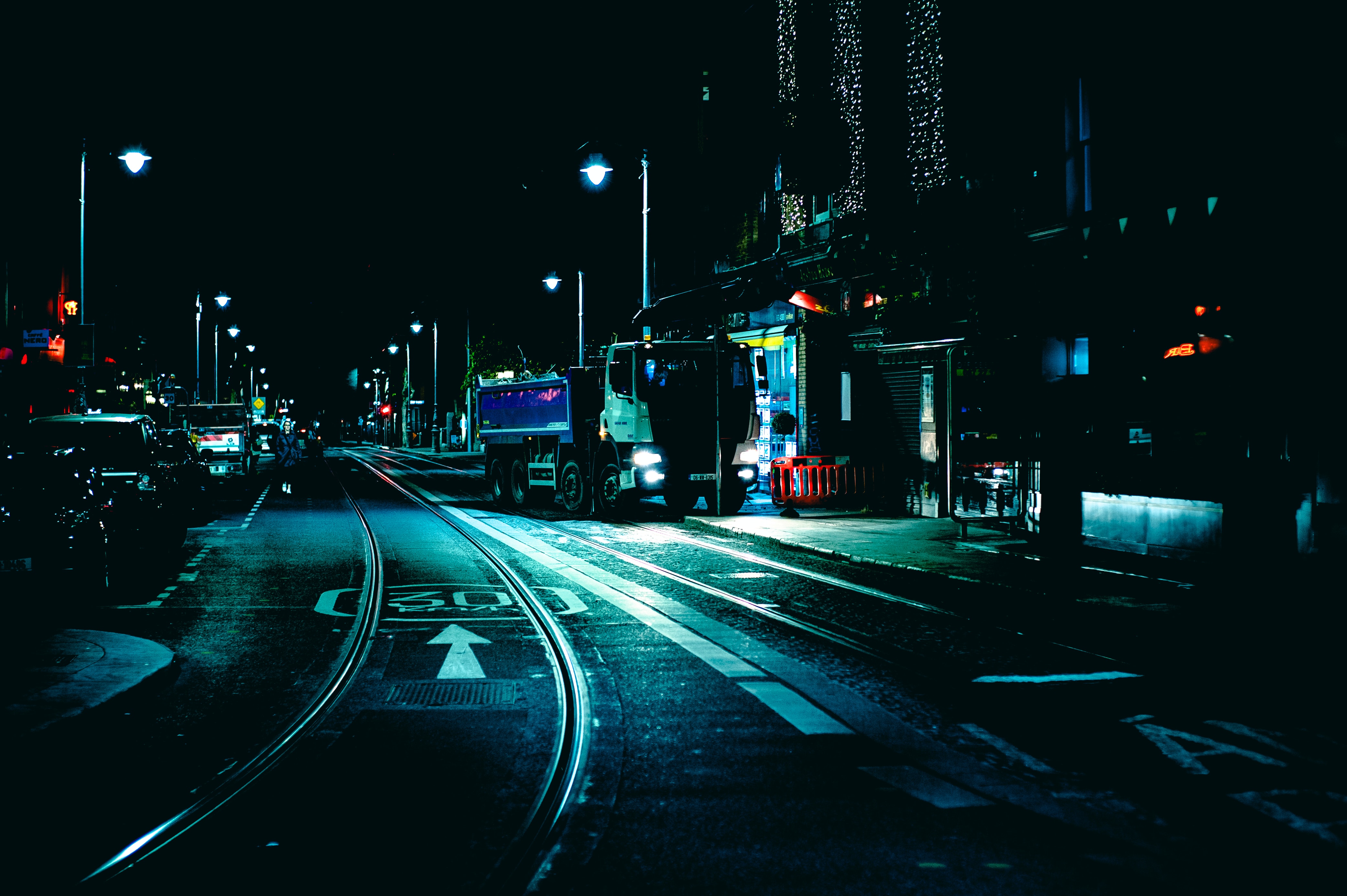
    The Special Rate will now cover the weekend peak hours from midnight to 4:00 AM on Friday night into Saturday morning and Saturday night into Sunday morning, year-round. The fare will be higher rate, and this change aims to encourage more drivers to support the nighttime economy.  

    There also will be an increase in pre-booking fees. During weekend peak times it will rise from €2 to €3.

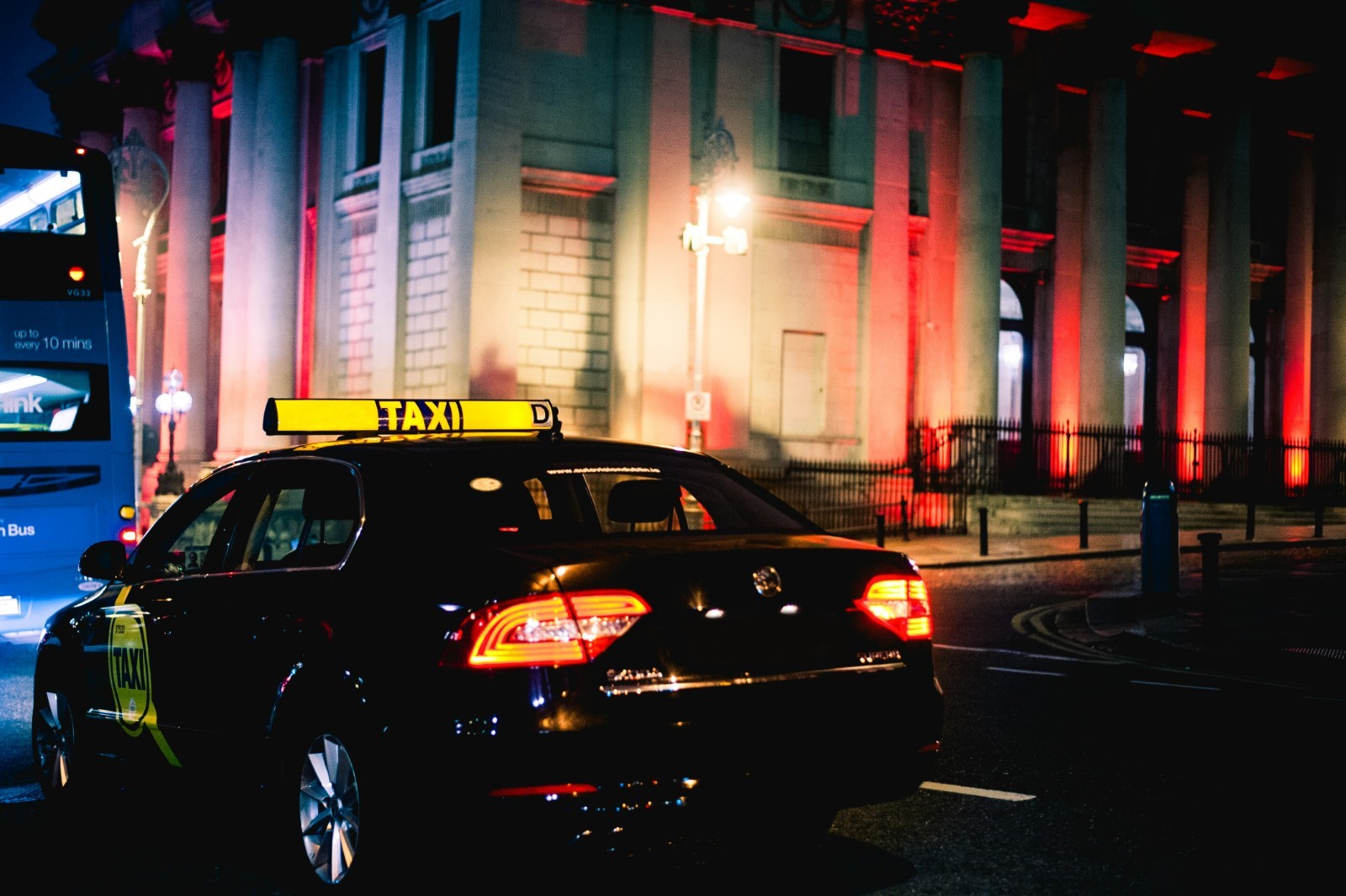
    Photo by Naseem Buras / Unsplash

    “With the cost of petrol, diesel and all that goes into owning a car, never mind a taxi, I am happy to see this fare increase,” said Paul Murphy, a taxi driver of nearly 20 years.  

    “I know it sounds bad to customers but with the cost-of-living crisis it’s just something that needs to happen,” said Paul Murphy. 

    This National Maximum Taxi Fare Review takes place every two years to ensure the fares match the costs of maintaining a good quality taxi service and the cost of living within Ireland.  

    The 2024 Review, published in July, revealed that taxi operating costs increased by approximately 9-11% between 2022 and 2024. Following public consultations regarding these rising costs for taxi drivers, the Taxi Regulation (Maximum Fares) Order 2024 implemented an average fare increase of nine per cent, adjusted across different time bands and distances. 

    ‘Numbeo’ has ranked countries in order of the highest fare of a taxi per kilometer. Switzerland was ranked 1st with the average fare per kilometer being €4.15. According to ‘My Swiss Company’ the average salary in Switzerland is relatively high, reflecting the country’s strong economy, with figures around CHF 78,000 per year as of 2024, which is equivalent to around €83,000.  

    Ireland placed 13th out of 97 countries with an average of €2 per kilometer. 

    Taxi fares should reflect the country’s cost of living. Given Ireland’s cost of living crisis and high inflation, this has led to the increase on the taxi fares.  

    However, with the inflation rate falling to 1.7% in the month of August, figures from the Central Statistics Office (CSO) have shown. This is the first time the inflation rate has lowered since June 2021.  

    Despite this, The Budget 2025 informed us that the rate will increase from €56 to €63.50 for petrol and diesel. This means an extra €1.20 per full tank for motorists. Potentially meaning this increase taxi fare will not be changed. 

    “This increase will be in place for the next two years, if inflation continues to decline, then it will be considered and there may be a decrease in taxi fares, but it must match the cost of living at that time,” said The NTA press office.  

    Photo: Amy Murphy

  • A tight squeeze: Public transport in Dublin severely congested at peak times and on popular routes 

    A tight squeeze: Public transport in Dublin severely congested at peak times and on popular routes 

    By Gary Petrov

    A display of photos from the point of view of a commuter using public transport in Dublin. Examples of overcrowding can be seen here on Dublin Bus, Luas and Irish Rail services in densely populated or heavily visited areas in Ireland’s capital – in which the photos below were taken during peak times of travel, on-board and at stops and stations. 

    Nevertheless, the photos pose the question: Do Dublin commuters need more frequent services of existing public transport, or do they need more modes of public transport? Or both

    Whether the answer is a swift underground metro system, or more frequency on existing services – or both, the population is growing and commuting access in and around Dublin is becoming more of an issue and needs urgent attention. 

    All photos present the same problem – Dublin’s public transport system is overwhelmed. 

    The photos also present how this overcrowding issue can prove difficult for accessibility on public transport for wheelchair users, mobility aid users and parents with children. Even in busy times, not everyone can just squeeze on and stand. People are inevitably being left behind – hoping that the next bus, train or tram will have room. 

    Commuters joining a lengthy queue for Blanchardstown Shopping Centre’s busiest bus route to Dublin City Centre, the 39a – hoping to get on as it fills very fast. 
    The standard sight at this shopping centre bus stop at peak morning and evening times, as commuters fight for a spot on the 39a service. 
    The 39a route journeys down the Navan Road, in which sections of the journey lack bus corridors in both directions, leaving passengers stuck in traffic at peak times. 
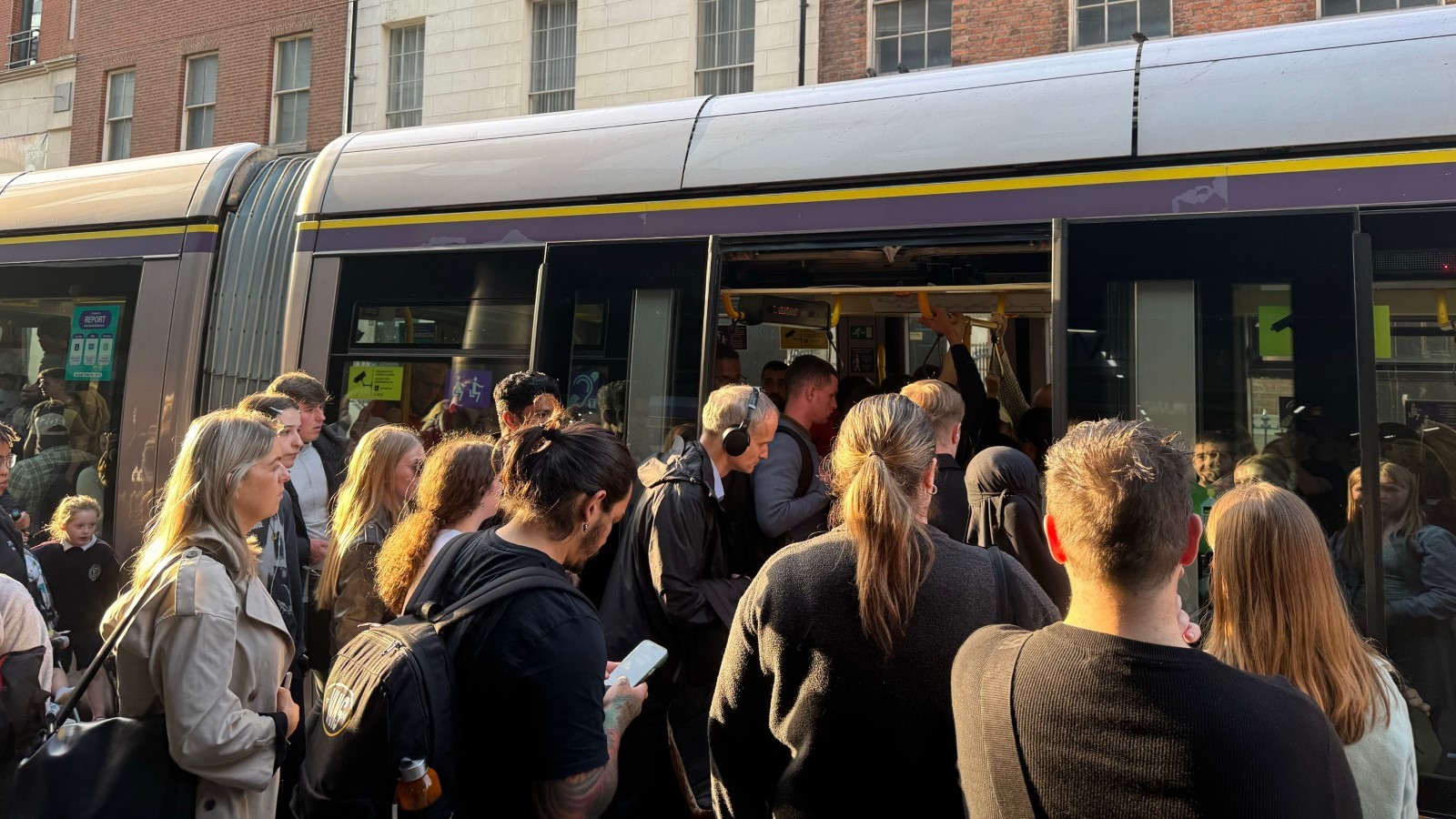
    Meanwhile at the Jervis Luas stop in Dublin City Centre, peak times result in commuters pushing themselves on-board to very packed carriages, with just about enough room to stand, for the few at the busy stop that manage to squeeze on. 
    Finished work and want to hop on the Luas Red Line home? You’re not the only one – and that’s not even including commuters already on-board. 
    A Luas has arrived, and the carriages are evidently full. With some commuters possibly disembarking, maybe there will be room for some intending to board. 
    “Oh my God, let us get off first,” said a young woman as commuters tried to get off while commuters on the platform scurry towards the doors for a spot on the mostly full Luas carriages. 
    “Oh, there’s another one coming in three minutes, maybe we’ll get on that one,” said one woman as disgruntled commuters accepted not being able to get on-board – but hopeful they remained, as another Luas was due in a few short minutes. 
    The next Luas has arrived at the Jervis Luas stop and like the previous one, it’s almost full and the next round of commuters on the platform attempt to get a spot on-board.  
    Three Luas trams later and the platform begins to clear as the Luas carriages begin to have more space than the previous trams – but was there space for commuters who have accessibility issues? How many trams must pass for there to be room for a person in a wheelchair or with a mobility aid, or a person with a baby pram to board comfortably and safely? 

    Getting on a train at peak times is no different. Commuters at Broombridge Station queue at every door, wondering if they will fit on-board as the train arrives full from the city centre – in which it will remain like that until it reaches the outskirts of Dublin. 

    If a commuter manages to squeeze on-board, there is only room to stand, and it gets quite uncomfortable. Like the Luas, accessibility issues are present here. 
    Dublin’s only service that has flow is Irish Rail, due to no road traffic, but commuters experience peak times with traffic by foot – if you stay on-board until disembarking in a Dublin suburb. 
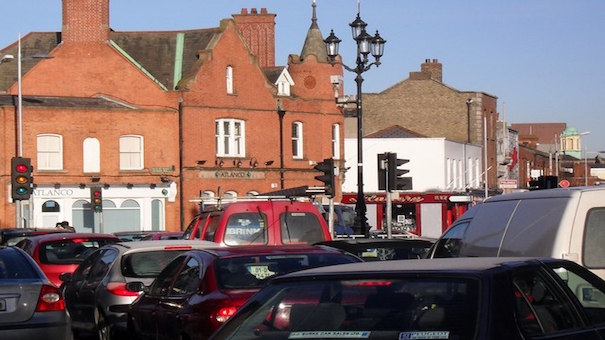
    Traffic standstill mayhem: The need for more efficient modes of public transport is hiding in plain sight here. Modes of transport that aren’t subjected to peak time road traffic. Commuters using an underground metro system around Dublin would go from A to B in an instant, in comparison to this.
    A bus stop and rain: Commuters already report it to be a struggle to get on-board popular routes, but adding bad weather to the equation does not make for a comfortable experience – when all a person wants to do is start their day commuting with ease or commute home swiftly, after a long day. 

    _____________________________________________________

    Everyone understands that peak times will always be busy for public transport users, that’s why it’s referred to as ‘peak times’ – but that doesn’t mean it’s acceptable for Ireland’s capital city and its surrounding areas’ public transport network to be severely overwhelmed, at a constant. 

    In a day and age where people are being encouraged to use public transport instead of private transport, as a means of reducing carbon emissions through minimising their individual carbon footprint – it’s worth noting that the correct infrastructure is vital for that to be sustainable, otherwise, people who can won’t use public transport, if it becomes more and more overcrowded, uncomfortable and unreliable. 

    A popular route having frequency in its service isn’t good enough, as it can be seen in the photos above that the demand is too high at peak times for ‘frequency’ to be enough. Ireland’s capital needs an expansion of public transport services across the board, not statements to brush the issues under the mat. 

    Dublin’s public transport congestion is clearly failing people with accessibility issues, despite the designated accessible areas on-board services – as abled people are filling up the designated areas at peak times. 

    Dublin needs more efficient public transport that facilitates everyone, and these photos are prime examples why improvement is needed – the only question now is, when will anything be done? 

  • TU Dublin feeling the rise in violence happening in Dublin. 

    TU Dublin feeling the rise in violence happening in Dublin. 

    By Mia Waterhouse

    In recent months the violence in Dublin City Centre has been top of the news agenda and it seems that violence has reached the university TU Dublin’s campus.  

    TU Dublin president, Professor David Fitzpatrick, wrote directly to the minister for justice Helen McEntee, appealing for more security around the campus for the safety of all students and staff.  

    In the letter earlier this year to then minister for justice Simon Harris, Fitzpatrick wrote to report about the anti-social behaviour and the lack of safety for students, “we have received reports that the response is slow and are also constrained by the fact that the University’s Estates and Security team cannot respond to off-campus incidents.” 

    The incidents have not been one-off attacks but have been regularly happening at the Broadstone Luas stop just outside campus.

    Luas tram in Dublin City Centre. Image: Louis Hansel/Unsplash.com

    “The Union has received increasing reports of anti-social behaviour in the Broadstone Plaza, right beside the Broadstone Luas stop, as well as the ‘main entrance’ to our Grangegorman Campus. Students do not feel safe entering and leaving the campus, particularly in the evening time,” said Brian Jordan, president of TU Dublin Students’ Union.

    The attacks have also appeared to not be random students from the college as there has been a racial element. While it appears that ‘nobody is safe’, there appears to be a distinct racial element to many of the incidents. It’s also very possible from what I’ve heard and seen that these students are targeted specifically because of their race and/or ethnicity. Several victims of attacks here have reported that racial slurs were thrown at them during the incidents for example,” Jordan added.

    With this still going on and no sign of any measures being taken by the college itself, the TU Dublin Students’ Union took matters into their own hands and held a demonstration at the Luas stop.

    TU Dublin Student Union members held a demonstration to send a message to the Government. Source: @tudublinsu

    The union said the reason they held the demonstration was to ‘show solidarity with the students who consistently feel let down by the government’ and the second reason was to apply more pressure on the government and McEntee to coordinate a far better response between the Gardaí, Transport for Ireland (TFI), and TU Dublin.’ 

    “There were several speakers, including myself on behalf of the SU, Nekesa who is our VP for Welfare & Equality, who also happened to be a mature and international student in TU Dublin, several local ‘opposition’ politicians, as well as current students within the University who felt more needs to be done. 

    We received very little communication from the University about steps being taken (an unfortunately common trend). However, after a particularly ‘viral’ incident last semester, media reported that the President of TU Dublin wrote to the then-Justice Minister requesting more policing in the area,” said Jordan.  

    The previous attacks saw some students getting pelted with eggs and racially abused and another getting her hair pulled. This all happened at busy times in the evening when students were waiting at the Luas stop. Witnesses described the offenders as all boys aged around 15 years.  

    When asked what the desired outcome Jordan said, “We want Justice Minister McEntee to provide adequate governmental support to improve the safety of the Broadstone Plaza. This means improving resourcing to policing in that area like more of a garda presence, as well as a collective response from TFI and TU Dublin. It should not be the role of the Union to constantly try to coordinate these stakeholders when we have an incredibly well-paid Government whose role that is.”

  • How has the Covid-19 pandemic changed cycling in Dublin City?

    How has the Covid-19 pandemic changed cycling in Dublin City?

    Since the start of the Coronavirus pandemic, people have looked for alternative methods of travelling to avoid busy public transport. Eibhin Kavanagh investigates how the pandemic is affecting cycling in the city.

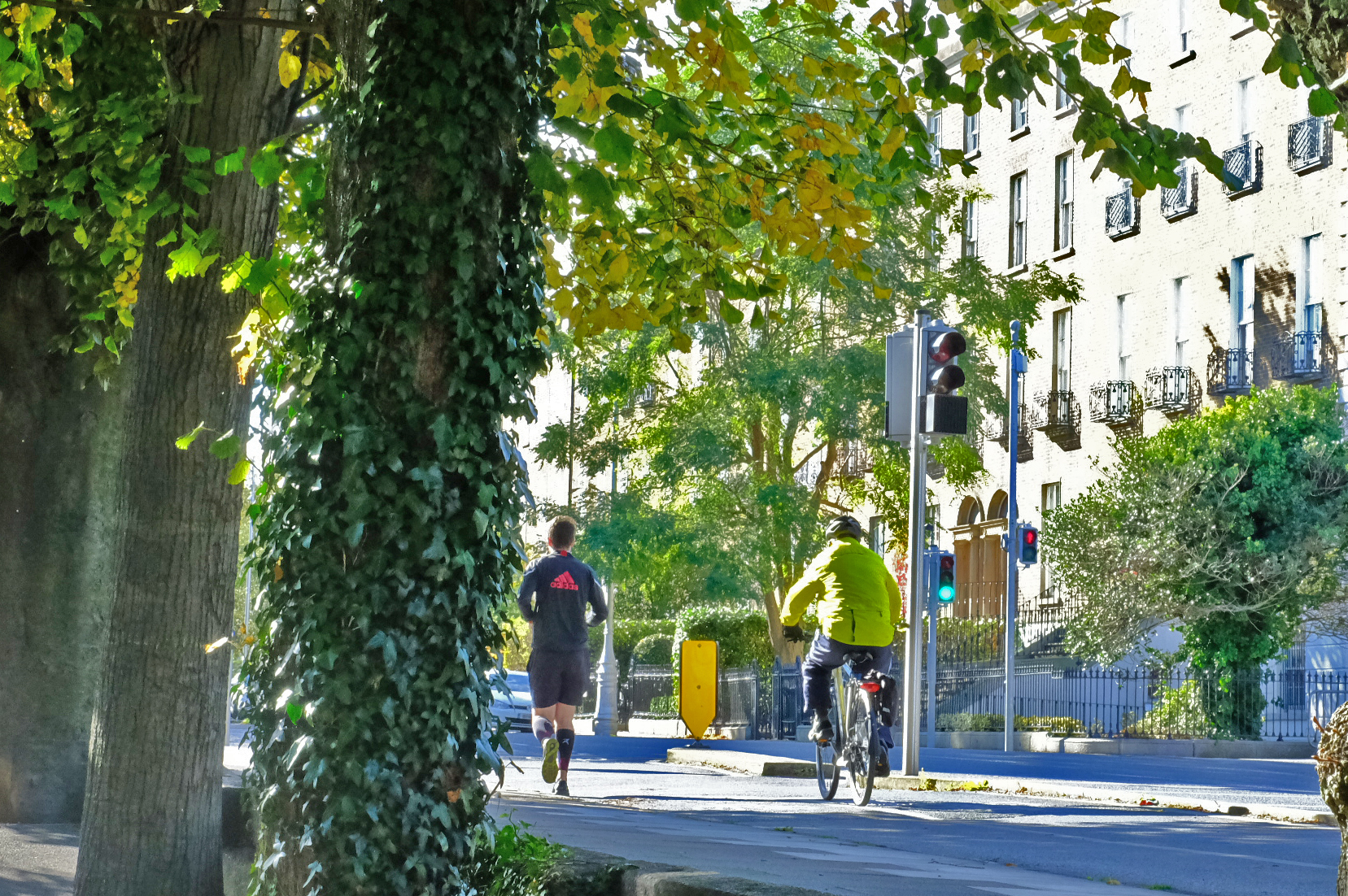
    Is cycling in Dublin City safe? Photo by Eibhin Kavanagh

    With our movements once again restricted, people in Ireland are limited to travelling within 5km of their homes. Walking and cycling have become a more popular means of exercising as a result of gyms closing and sporting events being cancelled.

    In the last ten years, Dublin has seen an increase in the number of people cycling. A number of bike share schemes have become well established. However, 2020 has seen an exponential increase in cyclists, which Dublin City has had to accommodate. This change, due to social distancing restrictions, means more space is required for both pedestrians and cyclists to make their way around the  city.  

    Councillor Michael Pidgeon talked to The City about the recent changes related to cycling in Dublin City.

    “In some ways I think the people are ahead of where the city is,” Pidgeon said. “We know that outside of peak hours there are now more people cycling than there were at this time of the year last year; there’s been a huge increase.”

    Dublin City Council projected  a 200% increase of cyclists in Dublin City from 2019 to 2020.This would be an increase from 13,131 to 39,000.

     2019 FiguresLikely Future ChangePotential Future Figures
    All Public Transport116,28780% Capacity Reduction30,000
    Car57,985Approx. 30% reduction41,000
    Taxi2,661Assume 30% reduction1,900
    Walk24,691Target 100% increase50,000
    Cycle13,131Target 200% increase39,000
    Goods983No change1,000
    Motorcycles1,485No change1,485
    Total (persons)217,223 164,385
    Source: Dublin City Council 

    Source: Dublin City Council 

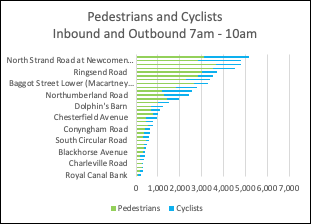
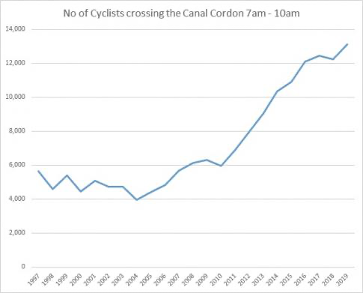
    The Canal Cordon Count was analysed by Dublin City Council to determine where the greatest demand for walking and cycling was recorded. The table below shows the number of people crossing the canal cordon (both directions) during the morning peak period from 7am to 10am in November 2019.

    Source: Dublin City Council 

    From 1997 to 2019, the number of cyclists crossing this cordon heading into the city centre between 7 am and 10 am increased by 133%, from 5,628 to 13,125.

    The number of cyclists remained between  4,000 and 6,000 between 1997 and 2010 before increasing by approximately 15% year on year until 2015 when the increase slowed up until 2017.  There was a small decrease in 2018,  but cycling numbers increased by 7.3% in 2018 and 2019. 

    Source: Dublin City Council 

    According to research conducted by the Road Safety Authority, 4 in 5 cyclists are injured on urban roads. More cyclists are  injured during morning and evening commutes. Of all collisions involving another vehicle – 4 in 5 cyclists are injured by cars. 1,056 cyclists were injured in collisions in 2018.

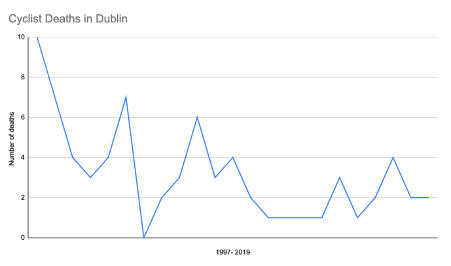
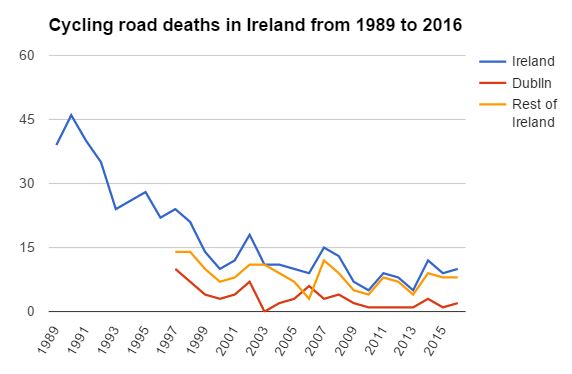
    In Dublin, the number of cyclist deaths since 1997 has remained relatively low with a slight increase in 2017, according to figures collected by the Road Safety Authority.

    Image Source- Irish Cycle.com

    Dublin has over 120 miles of cycle routes. While changes have been ongoing to improve cycling infrastructure in the city, especially since lockdown in the spring, the demand is high for safe and accessible cycling.

    “It felt like at the start of the pandemic there was a real understanding that we needed to take more space for cycling to encourage more people to do it, but it feels like that momentum has dropped a bit,” said Pidgeon. “So, I think that we need to get that going again.

    “In terms of infrastructure, I think the big changes we have seen are some of the temporary measures along the quays, particularly along the northside quays.”

    Some of the Cycle Safety interventions introduced since April include the installation of Nassau Street contra-flow cycle track from Clare Street to Dawson Street, the partial installation of key sections of the Interim Liffey Cycle route, removal of on-street car parking from Inns Quay and Ormond Quay, and a section of work from Church Street to Ha’penny Bridge, according to Dublin City Council.

    Dublin City Council also discussed other plans to ensure safe cycling in the city, including the reduction of the number of traffic lanes to accommodate protected cycling facilities on both sides of the road, while maintaining a balance for other required services. While there have been major changes made within Dublin City Centre to ensure safe cycling, other parts of the city have yet to see changes that will make cycling accessible and safe.

    “One of the things is to start looking at the urban villages, so instead of just focusing on the very core city centre, you would be looking at areas like Inchicore, Rialto, Stoneybatter, Phibsborough, Rathmines,” Pidgeon said in relation to making cycling consistent for everyone.

    “What we seen in the pandemic is that people are happy enough to stay within a few kilometers of where they live, so we shouldn’t just be designing a cycle lane with a view that will just take office workers from the suburbs to the city centre, because that’s not what the demand is right now. That’s important, we should definitely do that, but it will have to also be about making sure that local routes around your home are safe.

    “There’s still a lot to do, but equally I’d like to say that cycling in Dublin City is safe. There’s a perception of danger that I don’t think is entirely there. There’s a lot the city needs to do to feel a lot safer and be safer with segregated lanes, but if anyone’s considering it, I’d say just ask a friend who does cycle regularly and they can show you some good routes give you some tips and you’ll be up and running in no time.”

  • Get Ireland working again

    Get Ireland working again

    By Robert Geoghegan

    Is it time we give Fine Gael, and the rest of the government, a break and actually let them get on with running the country?

    There needs to be a recognition that Fine Gael didn’t create the financial crisis that crippled the country in 2008, they inherited it in 2011 and Got Ireland Working… to paraphrase their 2011 manifesto.

    Ireland got working and slowly, its economy was lifted out of recession due to austerity measures: the introduction of the Universal Social Charge (USC), the rollback on goods and services and the attempt to introduce “water charges”. Consequently, voters were not entirely happy with Fine Gael and the “water charges,” which became a point of contention in 2014.

    Enough was enough.

    Even though the implementation of charges were rolled back, we saw that in the 2016 election the message was sent loud, perhaps not clear, that people wanted change, voting in a rainbow coalition made up of independents and the confidence and supplydeal with Fianna Fail. Leaving the fractious left to whimper and fight amongst themselves in the corner of their own choosing.

    Distrust lingered and was felt by the sting of rising rents, hospital queues and a homeless crisis that has only exacerbated since the collapse of the country’s economy.

    It almost seems like Ireland is bursting at the seams as the population grows. There always seems to be a push back on anything the government wants to implement: from Bus Connect, to National Broadband, to the children’s hospital.

    “As the population grows, so does the need to commute to work. Workers commuting has risen by 11%, with those who commute by car up by 8% and those using public transport up 21%”

    Of course, it is understandable that people have reservations when the Government trys to implement anything, people saw the damage that can be inflicted when those pulling the purse strings are not fiscally prudent.

    Malthusian theory of growth

    Malthusian’s theory dealt with exponential growth and its effect on food supply. In a more contemporary setting, it could be applied to population growth and commuting. The population of Ireland rose by 64,500 in the past year, with 4.92 million people now living in the country according to the latest figures from the Central Statistics Office (CSO). With an estimated 1.4 million people now living in Dublin – accounting for 28.4% of the total population – Ireland’s population is forecast to increase by almost one million people to 5.75 million by 2040.

    And therein lies a problem.

    As the population grows, so does the need to commute to work. Workers commuting has risen by 11%, with those who commute by car up by 8% and those using public transport up 21%, according to the CSO. With that increase there needs to be a recognition that something radical needs to be done about Ireland’s infrastructure.

    Throughout 2015, Ireland’s road network saw a steady rise in general traffic volumes which saw a return of severe traffic congestion at peak times. Ireland has a radial motorway network extending out of Dublin that is on a par with those in Europe. Investment in roads has been targeted at upgrading roads where there is the highest demand and this has resulted in Ireland’s motorways being able to meet demand, apart from the M50, which is currently carrying 29% more traffic since its upgrade in 2010.

    Does change begin with Bus Connect?

    In 2018, the CEO of the National Transport Authority (NTA), Anne Graham, said that the city will slowly “grind to a halt”. Ms Graham was talking about the need for a radical NTA move to shorten bus times and to introduce Bus Connects. This would be done by a compulsory purchase order of gardens, the removal of parking spots, and the removal of trees, a fair point of contention for the implementation of new bus corridors.

    If you stand at a bus stop on College Green long enough, you begin to see that the current system is not working. Buses are at a standstill, which in turn causes traffic and delays in services.

    Those who say there needs to be a Dutch-style implementation of public transport, to make sure it is pedestrian and cyclist friendly, need to look at the current infrastructure and recognise that such a system is currently infeasible in Ireland. The argument for a cyclist-friendly city is moot, when there is a point of contention with the necessity to widen roads.

    “People must accept that there is a need for new infrastructure to be put in place”

    Speaking to Labour Party Councillor Marie Sherlock on the Cairn development in Glasnevin, one area that has garnered an outcry about the possibility of trees being felled, Cllr. Sherlock spoke about what she describes as a: “city wide issue of not putting in traffic plans when it comes to any of the major construction projects.”

    If Bus Connects works, this could lead to a change in cycling throughout Dublin City, and hopefully it will lead to an upgrade to meet the demands of the growing population on Irish Rail too.

    Cllr. Sherlock said, in regards to Bus Connect, that they [Bus Connect] will go ahead with: “one of their proposed original proposals… keep the trees but close the road to cars for a period of time…allowing pedestrians and cars to get out of the city faster.”

    At Dublin Airport, there was a push back against another runway with people not recognising that new runways will help to increase tourist numbers coming into Ireland, something that is good for the economy of Ireland. An argument perhaps, of the needs of the many outweigh the needs of the few?

    People must accept that there is a need for new infrastructure to be put in place. Infrastructure, right now, seems like it does more harm than good. However, in the long run there will come a time when the airport needs a new runway, the roads need to be widened, faster internet connection is required and hospitals need to be built. So why not now?

    Infrastructure is the cornerstone of modern society and this dependence will continue to increase in the coming decades.

    What seems like the greatest harm now might reduce the greatest harm later.


  • More public transport journeys despite 2016 strikes

    More public transport journeys despite 2016 strikes

    Most Dubliners chose to travel on Dublin Bus in 2016 according to new figures released by the Central Statistics Office (CSO).

    Over 125 million bus journeys were taken over the course of the twelve months. The number of bus journeys taken in 2016 jumped 2.7 percent from 2015.

    DB
    Source: CSO

    November was the most popular month for Dublin Bus, with 11,318,902 journeys taken. A sharp decrease in Dublin Bus journeys was seen in September 2016. That coincided with the bus strikes which plagued the capital across five days in September.

    DB monthly
    Source: CSO

    Rail journeys in 2016 increased to just shy of 43 million, up from just over 39.5 million the previous year. This gave a total increase of 7.96 percent.

    RAIL
    Source: CSO

    While the total number of journeys taken across all Irish Rail services (including DART and commuter services) took a hit in 2013, the total number of journeys have increased by an average of 5.2 percent per year since.

    DART
    Source: CSO

    Overall, 44.3 percent of all rail journeys taken in 2016 were on the DART. DART journeys increased to nearly 19 million in 2016, an increase of 10.7 percent from 2015. DART journeys also increased dramatically in 2015, up 7.5 percent from the previous year.

    The only form of public transport in Dublin that did not see an increase in 2016 was the Luas. There was a decrease of over 500,000 journeys.

    LUAS
    Source: CSO

    This decrease of 1.65 percent was uncharacteristic for the Luas as journeys had increased year on year from 2012 to 2015.

    The Red Line proved to be more popular with commuters, with 22.4 percent more journeys taken on the Red Line than the Green Line in 2016.

    Luas lines
    Source: CSO

    Like Dublin Bus, the Luas was also hit by twelve days of industrial action in 2016. This can be seen in the sharp decrease in the amount of journeys taken on the Red Line between April and June. The strike did not, however, seem to have as dramatic an effect on the Green Line, with journeys increasing between May and June despite several strike days.

    These figures, announced last week as part of the CSO’s annual travel omnibus, are released as further transport strikes threaten to leave commuters stranded. Iarnród Éireann strikes are set to affect more than 150,000 daily commuters amid rows over pay. Rail workers are looking for 11 percent pay increases over the next three years.

    The first strike took place on Wednesday 1st November, with further strikes planned for the 7th, 14th and 23rd of November, as well as the 8th of December.

    Reports in Irish newspapers recently suggested that workers may also strike on Christmas Eve.

    By Louise Burne

  • Passengers stalled as train strike takes hold

    There are delays expected on DART and Iarnród Éireann services as this morning’s train strike came into effect earlier.

    The most significant news from this morning’s strike is that there will be no services for the Docklands with a bus service operating from M3 Parkway and Clonsilla.

    The strike took place between 6 and 9 am this morning after a dispute between Irish Rail and the two major unions for train drivers, SIPTU and the National Bus and Railworkers’ Union (NBRU), over bonuses for previous years went unresolved.

    The parties were still in discussions late last night to avert strike action. This is not the first expected strike as one is also being scheduled for two weeks time on November 6th.

    Inline images 1
  • In praise of the Luas


    Luas map 2015
    Luas map 2012

    By Aoife Lawless

    The Luas Cross City is the name given to the new extensions planned for the Luas by the year 2017. The plans include extending the Luas line across the city from Stephens Green to Broomfield and are proposed to include the much anticipated ‘missing link’ between the red line and the green line.

    In 2014, the Luas had been in operation for ten years. This June marks it’s eleventh year as a main feature of Dublin’s transport services. The Luas was first proposed in April 1994 and would not launch for a further ten years.

    Construction began on the Luas in October 2000. Ten years on the Luas continues to expand across the city and has already added numerous new stops either side of it’s two lines, the Green Line and the Red Line. In 2008 the red line extended as far as the Point depot on Dublin’s northside.

    In October 2010 The Green line extended by 11km with 9 new Stops to Brides Glen.In july 2011 The Red Line was extended by 4.5km with 5 new stops taking passengers as far as Saggart.

    Future extensions plan to bridge the gap between the two current lines and join them both. The new lines are planned to extend from St Stephen’s green as far as Broomfield and boast a mere “21 minutes to travel the 5.6Km from St. Stephen’s Green to Broombridge”.

    https://www.luascrosscity.ie/about/

  • Public Transport Fare Hike

    Public Transport Fare Hike

    Irish commuters will be digging deeper into their pockets with price hikes announced for public transport fares.

    The National Transport Authority (NTA) announced at the end of October that prices will soar on Dublin Bus, Bus Éireann, Iarnród Éireann, and Dublin’s Luas service, with changes expected to be implemented as soon as December 2014.

    According to the NTA, “Leap card fares continue to offer customers best value compared to cash”, with the company aiming to “increase Leap card use to simplify fare payments.”

    According to Gerry Murphy, CEO of the NTA, the Leap card has proved popular with “over 750,000 Leap cards now in circulation and almost €2 million per week used in travel credit.”

    From December 1, 2015 changes to cash fares, Leap card fares, monthly and prepaid tickets will come into force with the most radical changes affecting the adult 30 day rambler ticket.

    Commuters and public transport users will be expected to fork out an extra €10 as the fare will alter from €137.50 to €147.50 in the lead up to the Christmas season.

    Student tickets will also be hit with a damaging leap to €107.50 from €100 for the 30 day student rambler ticket, with less of an increase on the student 5 day rambler ticket, which is more expensive by €1.50, bringing the total cost to €21.50.

    This has not been the first time public transport users have been dealt a blow leading up to the Christmas period, with the NTA previously increasing fares during the months of November and December in 2013, with the same reasoning of ‘protecting service delivery.’

    The much relied on Nitelink service by Dublin Bus will now be €6.50 as opposed to €5, with the city centre fare also increasing to €7.50

    Dublin Bus will also enhance the €1.80 trip to €1.95, €2.35 to €2.55, €2.60 to €2.80 and €3.05 to €3.30.

    Bus Éireann is raising selected fares by as much as nine per cent.

    According to the NTA, “fare increases are necessary in order that a sufficient level of service can continue to be provided.”

    The NTA also added that “public transport fare increases have been deemed to be necessary in recent years as the operators have sought to compensate for reduced PSO payments.”

    The NTA have approved the increases after they received numerous submissions by each of the publicly owned companies, with the NTA commenting that “Dublin Bus has written to the Authority requesting fares increases that will yield extra revenue of €4.9m in 2015.”

    The NTA entered into Public Service Contracts with Dublin Bus, Bus Éireann and Iarnród Éireann in December 2009.

    Weekly commuter and apprentice Michael Doyle is unimpressed with the recent changes:, “There’s no incentive to use public transport as at times it’s pretty much cheaper to drive.”

    He also added that “it’s a pretty bad service to be paying through the teeth for. It’s late, and nine out of ten times it flies by packed. We should take a leaf out of Barcelona’s book and protest.”

  • OPINION: Is Dublin Bus a reliable service?

    OPINION: Is Dublin Bus a reliable service?

    According to the National Transport Authority’s (NTA) quarterly figures, less than 5% of Dublin Bus services have been more than five minutes late for scheduled departure times between January 2012 and May 2013.

    On its website the NTA, which publishes performance reports on all public sector transport under its remit, officially states that “Dublin Bus are required to report quarterly on their performance” to the authority. When asked by TheCity.ie how exactly these figures are collated and whether or not the process is self-regulatory, as is indicated in the aforementioned statement, the NTA refused to comment.

    So, we want to know what service users from across the capital think.

    Do you believe the figures? Take part in our online interactive poll below and watch the reactions of the Dublin’s commuters as we ask them whether Dublin Bus can be relied upon to get them from A to B.