Ireland is often accused of being a boring place for young people. It’s often wet and rainy, and the outdoor activities lacklustre. Here is a list of 10 activities that might keep you occupied this Winter season.
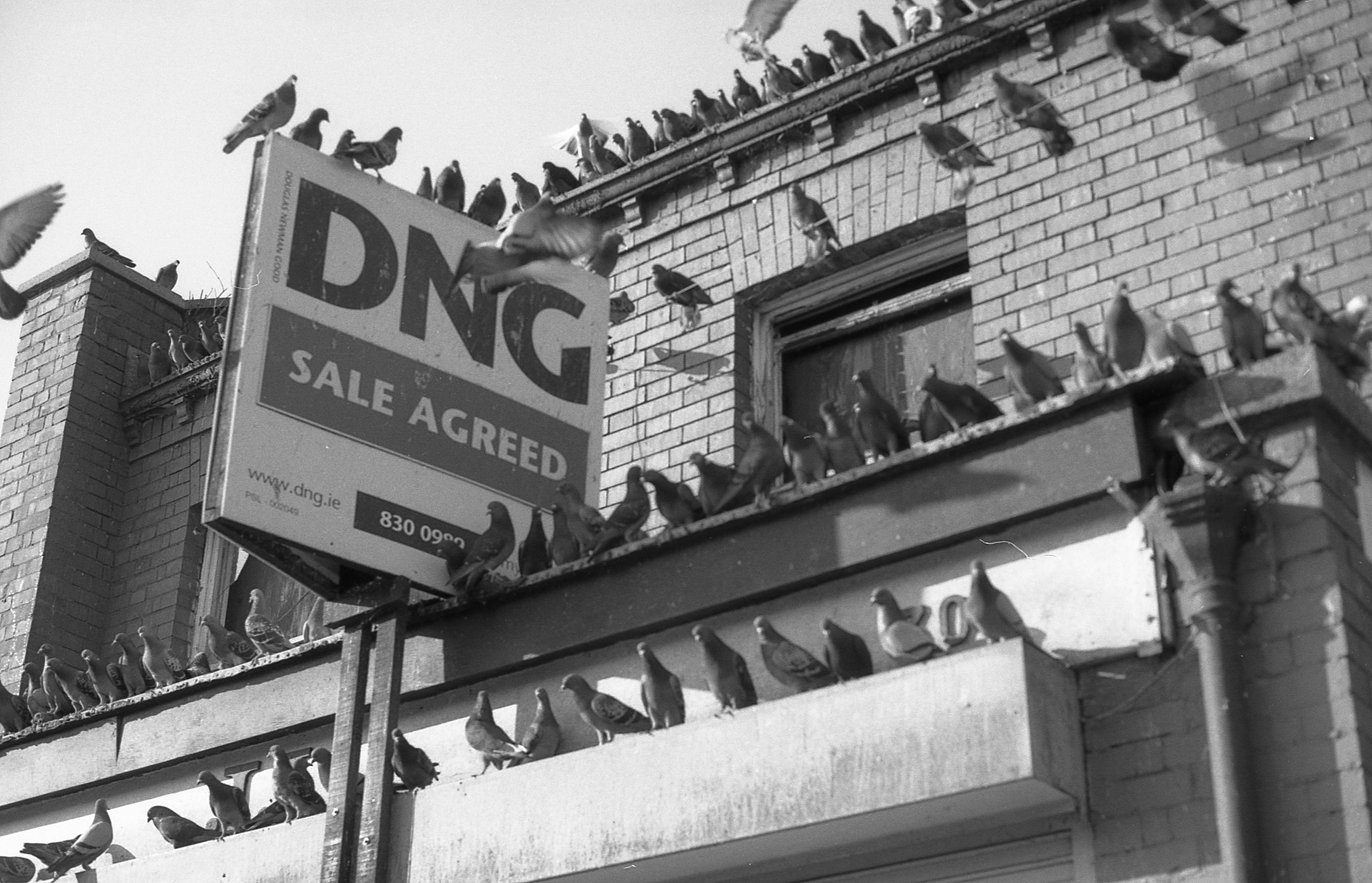
Visit the Gingerman pub. You may not think it from this stunning display, but this is actually a pub. This could be a great stop off for any 12 pub-partakers.
Visit the Guiness Storehouse. You’d be surprised how many Irish natives haven’t seen it yet.
Here’s one for the non-drinkers. Kilmainham Gaol is a great daytime activity for the history nerds.
Go to a sauna. They’re everywhere nowadays!
Find your new favourite restaurant. This is Mama Yo on Camden St.
Try a new bakery. There’s one on every corner, you’d be kept busy for a while.
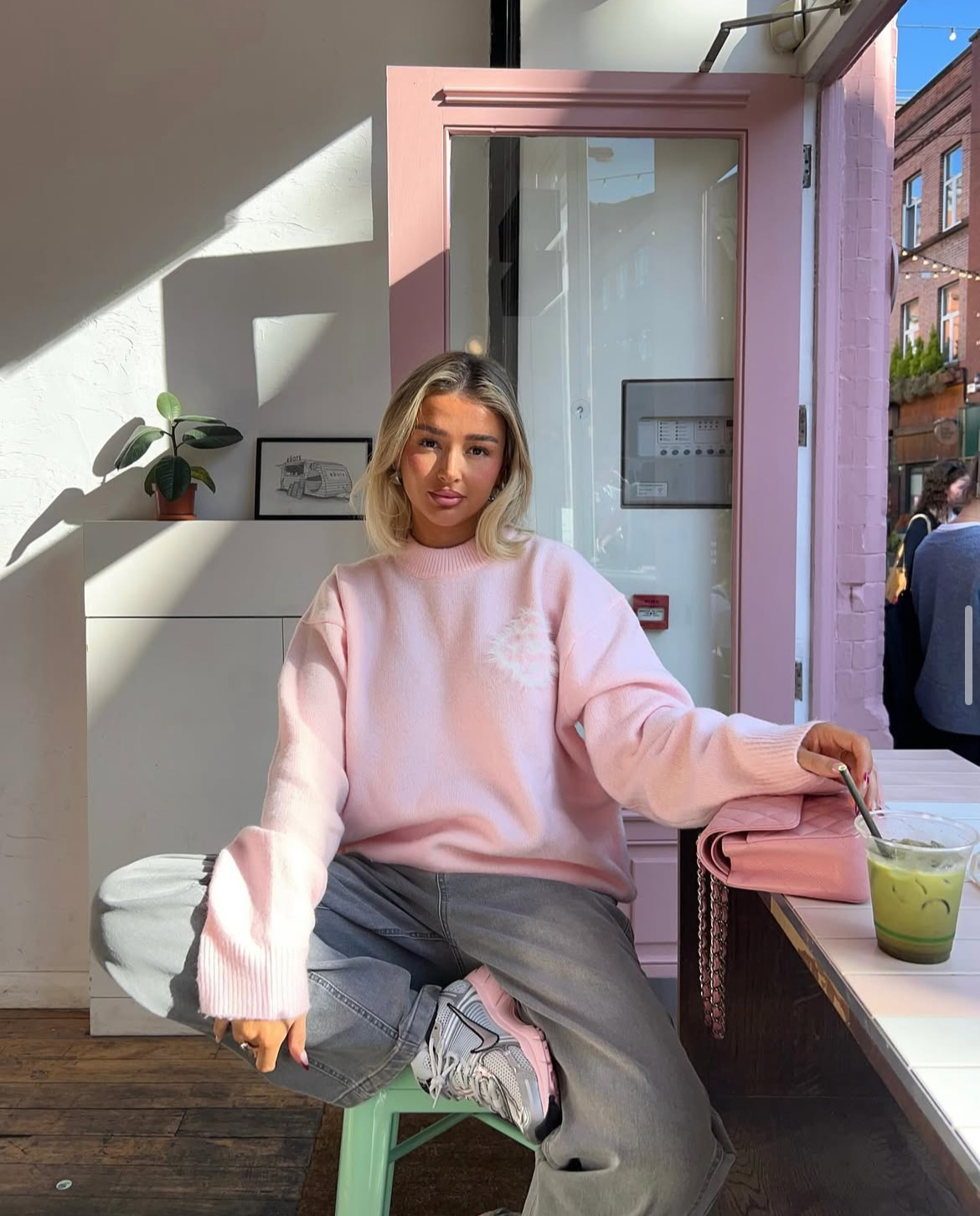
Matcha is the new craze at the moment and Dublin is quite good at keeping up with the trends.
Find your new go-to bar. “The usual, please.’
George’s Arcade, Grafton St, Henry St. There’s so much fun jewellery to look at everywhere.
10: Go to the Howth Cliff Walk. Ideally save this one for one of the less rainy days.
An assessment released this week by the Department of Finance shows increasing concerns for Ireland’s future economy and society, with an emphasis on the housing market.
Minister for Finance, Paschal Donohue, launched “Future Forty: A Fiscal and Economic Outlook to 2065”, which models over 2,000 scenarios for Ireland’s future over the next forty years. The models are based on national and international trends.
‘Future Forty’ includes a fiscal analysis of how the age demographic will impact Ireland over the next four decades. The assessment shows that the old age dependency ratio has increased, and fertility rates have declined over the past 38 years. The assessment states, “A rising old-age dependency ratio increases pressure on public finances, by raising costs for age-related expenditure. Over the long term, a smaller workforce relative to the total population will pose fiscal challenges and potentially constrain economic growth.”
Demographic trends show that migration will have both positive and negative impacts on the issue. Inward migration can help to alleviate the challenges of our ageing population by filling skill gaps and reducing labour shortages. However, an influx of migrants will pose challenges to the government through the increased demand for infrastructure and public services. ‘Future Forty’ states that this may cause delays in family formation which, in turn, lower birth rates.
Source: assets.gov.ie
The above graph shows population projections from 1996-2022 and includes estimates up to 2057.
The assessment includes a report on housing, which states that it is expected that demand for housing will peak in the early 2030s and will not ease until the 2040s.
Rachel Dunne, a 32-year-old special needs assistant told The City, “I’d be more inclined to emigrate than to wait another 20 years until I can purchase my own home.” Ms. Dunne and her partner have been renting in Dublin for the past 6 years. “We’re lucky to be in the position to afford rent in Dublin, but I just want to paint my own walls without having to ask someone,” she said.
Depending on immigration and fertility rates, it is projected that the population will reach between 5.9M and 7.9M by 2065. Notably, the report states that the current government plans to build 300,000 more houses by 2030.
The main scenario in the ‘Future Forty’ document is referred to as the ‘Central Scenario’. The ‘Central Scenario’ is a model that anticipates a change in household size preference due to changes in demographics over the coming years. Suppliers are predicted to shift from providing family-friendly housing units to units more suitable for single occupants.
Source: assets.gov.ie
The above graph is a representation of projected future housing expenditure and its relative GNI. The ‘Central Scenario’ takes social housing, HAP, and RAS into consideration.
Housing expectations in this scenario are entirely dependent on the 2030 supply target being met.
Charleen Murphy, 27, is an Irish influencer and podcast co-host of “Hold My Drink” alongside fellow influencer and best friend, Ellie Kelly.
Charleen Murphy (left) and Ellie Kelly (right) at one of their Vicar St. live shows in October 2023. Photo: Alison Gussago
Charleen’s career started back in her secondary school days when Suzanne Jackson,
The owner of the beauty brand ‘SOSU by Suzanne Jackson’ hosted a talk at her school which Charleen attended and was immediately inspired.
However, Charleen did not immediately begin her career as an influencer. She studied Childcare at DIT, which she eventually dropped out of as she realised it wasn’t the right path for her. Charleen then started taking social media more seriously, however, she didn’t expect to gain such a large following as she has today and said, “I did it out of the love of fashion and beauty.”
Charleen’s influencing career went on to grow enough to start receiving brand deals. For example, she has recently worked with Coca Cola, PrettyLittleThing, and even Garnier. However, Charleen’s first-ever brand deal was with ‘SOSU by Suzanne Jackson’. Due to the fact that this brand was her inspiration to start this career, it was expected that Charleen would reach out to SOSU herself, however, it was SOSU that reached out to Charleen. This really kickstarted her career as an Irish influencer.
Though being an influencer does come with great benefits such as brands deals, brands trips, and receiving PR, Charleen reveals that social media isn’t all what it seems. Though Charleen is currently in a relationship with Dano Mandroiu, she says that single life as a public figure is hard as “If I were single now, I would be worried people would be looking to be in a relationship with me for a certain thing; just to say they’re richer or something.” She also says that she’s grateful that her boyfriend, Dano, is in the public eye as a footballer, meaning he relates to her feelings on this more. However, Charleen doesn’t express the same concerns with friendships “My friends now are people I’ve known from before, there’s a couple I know from now, but I know that they’re real.” Charleen expressed that she hasn’t had any bad experiences with other Irish influencers, as they are quite a tight-knit community in comparison to the USA for example.
Though sharing details of your life is part of being an influencer, Charleen finds it hard to believe that so many people are interested in her personal life. “You feel like you’re always proving yourself to people.” Charleen spoke about the struggles of social media and how you can never keep everyone happy., “People want something to hate you over.” Charleen reveals that she had to delete Twitter due to the amount of hate she was receiving on the platform. Being so open on social media also allows people to form opinions and assumptions about you., Charleen says that she has had strange rumours made up about her by people she doesn’t even know. “There was a rumour I smashed a glass over someone’s head.” Charleen says that she didn’t expect “people being so nosy” about what goes on in her personal life and that she must be cautious of who she trusts with personal information.
Charleen has also been open on social media about having cosmetic procedures done, however, she is cautious about it as she has a young, impressionable audience. “When you make big decisions, you have to think about that yourself and how you’re going to announce it online.” Charleen does not keep it a secret that she has had a breast augmentation and rhinoplasty, however, she is careful about how much she shares about her experiences with them, as her audience consists mostly of teenage girls. “I’d be wary about it. I don’t post loads about it. I don’t want it to look like I just go around getting loads of stuff done,” she said.
However, despite these negatives of social media, Charleen does love her job and acknowledges that the hate she gets could be worse., “I’m really lucky the hate that I do get is never really about my appearance.” Charleen saidys that despite the challenges that social media brings, for example, thinking of new content, she wouldn’t have it any other way. She enjoys the “freedom and flexibility of it” and the opportunities that being an influencer brings. Charleen co-hosts a podcast with fellow influencer Ellie Kelly called “Hold My Drink”, which started in 2021 and recently had 2 sold-out live shows at Vicar St. She has done campaigns with BooHoo, NastyGal and KASH Beauty, and expresses that they are all “brands I actually love”. In April 2023, she also went on a brand trip to London with Netflix for the show ‘Bridgerton. She expresses how grateful she is that she has these opportunities as part of her career, “things like that are just mad, they’re like little ‘pinch me’ moments.”
A record number of 60,946 students have been given exemptions from studying Irish in secondary school as of September 2025, .according to TG4’s current affairs programme ‘As Láthair’,
There is speculation that the main reason for this unprecedently high figure comes as a result of an influx of young people immigrating into Ireland in recent years.
Leaving cert student Anna Caldwell tells The City, “I personally didn’t have the option to get an exemption since I’m born and raised in Ireland with no learning disabilities, but I would if I could. The language is taught terribly.” Caldwell says the way in which the language is taught is difficult and uninteresting for students.
Exemptions are typically granted to individuals who have special education needs or have come from abroad.
The Department of Education and Youth has said that the current number of exemptions equates to 1 in 7 children having permission to be excused from studying Irish. The current figure of 60,946 is up by more than 5,000 in comparison to the previous 2023/2024 school term.
The Department of Education and Youth has expressed concerns for the pressure that is put on schools, especially principals, when an exemption is not granted.
Conradh na Gaeilge, an online forum for the Irish speaking community, says the exemptions are “being granted too easily.” According to the forum, the current system is failing due to the overuse of exemptions and the disadvantages for those with learning disabilities.
Conradh na Gaeilge are advocating for a reformed curriculum which would allow for tailored learning in an effort to include late arrivals to the Irish education system, and to help students with literacy and comprehensive challenges.
“The system is definitely outdated, and I can see students’ lack of interest in it. It’s very grammar based. It could be more enticing if it involved more visual learning such as Irish films or even some more story books involved,” said Sinéad Byrne, and Irish and P.E. secondary school teacher.
The rate of exemptions has increased yearly and has almost doubled in the past 6 years, with 33,476 students recorded to have been exempt in 2019.
Reporters Shay Galon, Leigha O’Reilly Hughes and Jane Byrne all take to the streets of Dublin to ask people about their Christmas wishes and the best spots to be in at this festive time of year!
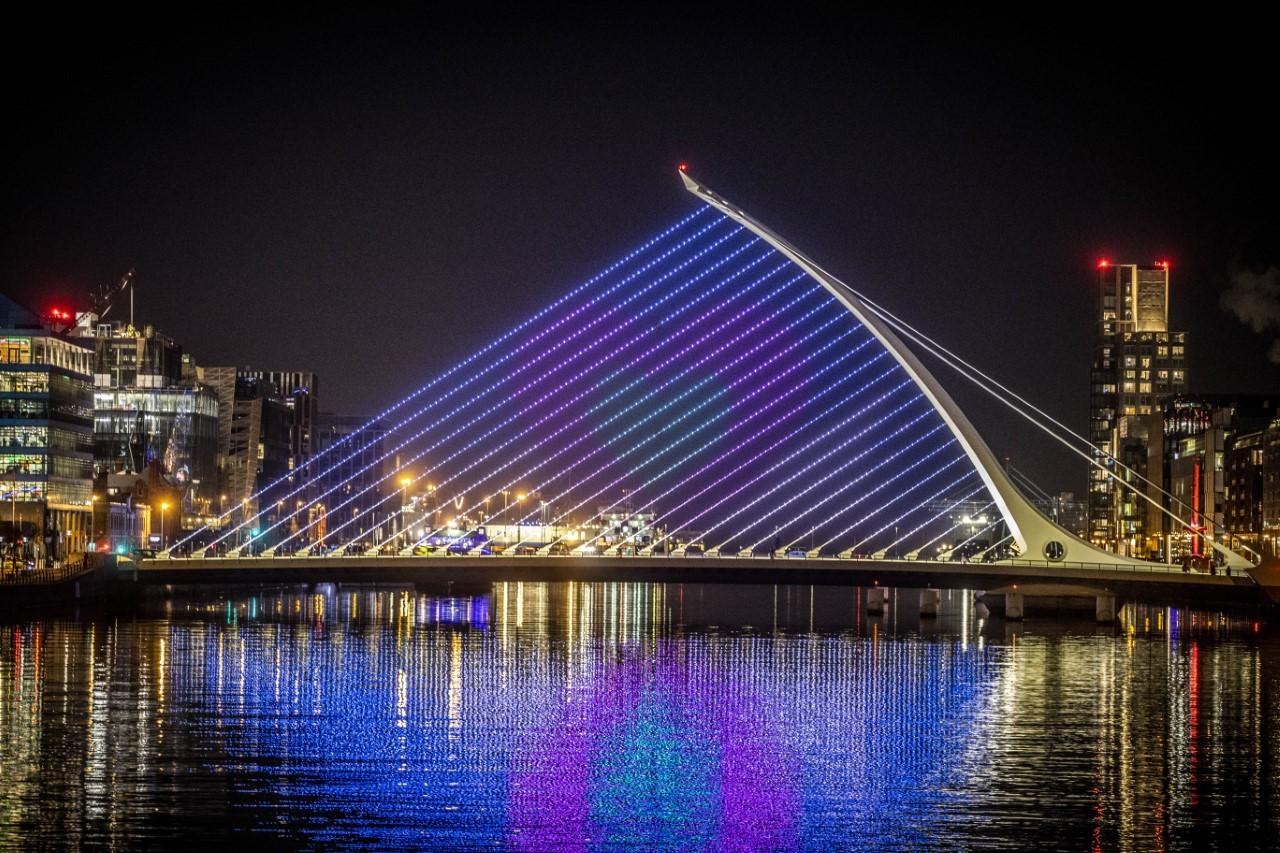
Samuel Beckett Bridge, photo credit: Conor McCabe
After a long year and the beginning of a cold winter, Dublin lights up to get everyone in the Christmas mood.
Dublin City Council returns with their very popular ‘Dublin winter lights.’ The lights were first switched on, on November 15th and will stay on until January 1st. Twenty one locations, which is an increase of five from last year have been transformed with colourful projections and light displays. Two locations, one on the Southside and the other on the Northside are walking trails that bring the public across Dublin in the most Christmassy way. A team of over sixty people work hard every year to deliver the winter lights.
The Lord Mayor of Dublin, Alison Gilliand welcomes the Christmas lights back. “I’ve been a huge fan of ‘Dublin Winter Lights’ ever since it began in 2018. The contrast between the bright lights and the dark evenings makes for a stunning backdrop to the city.”
Custom House – Photo credit: Conor McCabe
In an effort to cut down on CO2 emissions Dublin City Council announced that no diesel generators were used this year. Instead, where main power was not accessible, they used Hydrotreated Vegetable Oil which is made from 100% renewable waste materials and results in an up to 90% reduction in CO2 emissions. Furthermore, they recycle all materials and branding from year to year and store all lighting in wooden crates instead of single use plastics.
A new location that was added this year and is proving very popular is the light installations at Merrion Square park. So much so that six new dates have been added allowing the light show to run every day up until December 22nd.
The park has been transformed into a magical winter walk with light installations, a 15m high Christmas tree in the heart of the park projected with magical images, a virtual snowstorm and dancing penguins and polar bears. At the end, children are seen begging their parents for a nutella crèpe whilst adults can enjoy a mulled wine under the lights. Although tickets are free, due to limited numbers you are asked to book your free ticket online before attending.
Other locations garnering spectacular sights include, Trinity College, Grafton Street, City Hall, Millennium Bridge and the Samuel Beckett Bridge among others.
Btec GPO, photo credit: Conor McCabe
New restrictions on nightclubs, the hospitality sector and vaccine requirements mean that we will be looking at a Covid Christmas for the second year in a row. However, a free walk around the Christmas lights in Dublin City is sure to lift the spirits. In the video attached, we talked to the people of Dublin and gave you a look around the winter lights to get you in the Christmas mood.
Smoking in solitude. Image by Free-Photos from Pixabay
Substance misuse has been at the forefront of the social issues in Ireland for decades and it is a problem that seems to continue to grow due to the widespread availability of both cheap alcohol and illicit drugs.
Now, as we face the Covid-19 pandemic, people find themselves isolated at home with their own thoughts – a breeding ground for anxiety that can make it difficult to cope with drug and alcohol addiction. With counselling services stretch thin often these people are left without the help they need.
A report released in January 2021 on behalf of the drugs policy and social inclusion unit found that 23% of respondents reported using more illicit drugs, and 15% reported using the same amount, citing anxiety and boredom as the driving factor behind their usage.
Photo by Pixabay on Pexels.com
The most commonly used substance was cannabis, followed by cocaine or crack cocaine and ecstasy (MDMA).
However, cocaine or crack cocaine and ecstasy have seen a reduction in use since the pandemic with fewer opportunities to use and reduced availability of drugs cited as the main reasons for the reduction in their use.
“We’ve had about a 100% increase of people seeking help”
Elizabeth Sweeney
The report also found that support services were hit hard by Covid-19.
Counselling sessions were forced to take place over the phone or through video calls, rather than face-to-face meetings.
“We’ve had about a 100% increase [in 2020] of people seeking help, and the drugs would have been probably 70% of the increase and the alcohol would have been the rest,” says Elizabeth Sweeney, member of the Finglas Addiction Support Team (Fast).
With regards to how the counselling takes place, Fast has had to adapt.
“The initial assessment is by phone,” Sweeney says, “we have to cut down on the footfall in the building, because we have to go by the HSE regulations.
“And then when it comes to the one-to-one, we would have to schedule them for an hour, but it’s for 45 minutes with key workers allowed 15 minutes to tidy up.
“We would have a reduced amount than we’d usually have,” she continues. “If we had eight in a day now, we could have had 14 or 15. That means we have a waiting list, and our books are full all the time and we’re constantly playing catch-up.”
Image by Holger Detje from Pixabay
With services for those seeking help stretched to their limits due to reduced time available and capacity, many people who struggle with substance misuse are battling their problems alone.
“As the months went on, the amounts I smoke went up and I became more and more anxious”
Anonymous
“When Covid first hit last year I thought it would be for two or so weeks, but that has turned into over a year. At first nothing really changed, but as everything shut down and we were told to stay home I had nothing to do – boredom took over,” explains a man who wishes to remain anonymous.
“First I started smoking more weed. When I couldn’t find that I’d turn to drink.
“As the months went on,” he continues, “the amounts I [would] smoke went up and I became more and more anxious with no end of the lockdown in sight. The lack of routine, not seeing people and boredom, I’d say, are the main reasons for my change in habits. I suppose this isn’t the best for my mental health either.”
When asked if he would seek counselling the man said, “I would but I don’t know where to look. Like, I feel when this eventually comes to an end and things start going back to normal, hopefully my habits will go back to normal.”
With the end of lockdown in sight and the rollout of vaccines advancing, there are hopes that society will return to some sort of normality soon, allowing those who need help to get it and resume the lives they lived prior to the pandemic.
If you or anyone you know is struggling with the issues mentioned in this article, text Mental Health Ireland’s drug line at 50808 or contact Alcoholics Anonymous Ireland.
Irish Olympian Nicholas Quinn took time out of his hectic training schedule to sit down with The City. The 27-year-old athlete, who’s currently based in Scotland, hasn’t been home in over a year due to the intervallic travel restrictions.
Quinn’s first time competing at the Olympics was in the Rio Games in 2016, where he took part in the men’s 100m breaststroke as well as the 200m race. Despite the pandemic, Quinn has been able to keep up with his training as well as his postgraduate work and will be arriving soon to compete in a series of trials to earn his place in this year’s Olympics.
Believe it or not, there was a time when Quinn thought the 2016 Rio Games would be out of his reach. It’s hard to imagine that someone who has amassed such success so early in life could lacking certainty about their own talents, but it just goes to show that underneath it all, even renowned athletes have insecurities.
“I’ve tried to use the time since Black Lives Matter was trending last year to educate myself and learn more about systematic racism in our society”
Nicholas Quinn
A Photo of the five Olympic rings. Taken by Kyle Diaz from Unsplash
During our conversation, I asked Quinn about the Black Lives Matter card in his social media bio.
“I’ve tried to use the time since BLM was trending last year,” he says, “to educate myself and learn more about systematic racism in our society and what we can do to help end it.”
#Deletebanreport is a scheme by the Olympic Federation Ireland calling for a zero tolerance approach to online hate speech by pushing the public – as well as sporting stakeholders – to take action when they see online abuse and discrimination, by deleting comments, banning the offenders and reporting them to the approriate platform.
Japan will be expecting over 10,000 competing athletes to arrive and once they do, they’ll be confined to the Olympic village. As of this moment, Japan has over 508,350 cases of Covid-19 and over 775,000 citizens have received a dose of the Covid vaccine.
The Tokyo 2020 Olympic Games will commence on Friday 23rd July 2021.
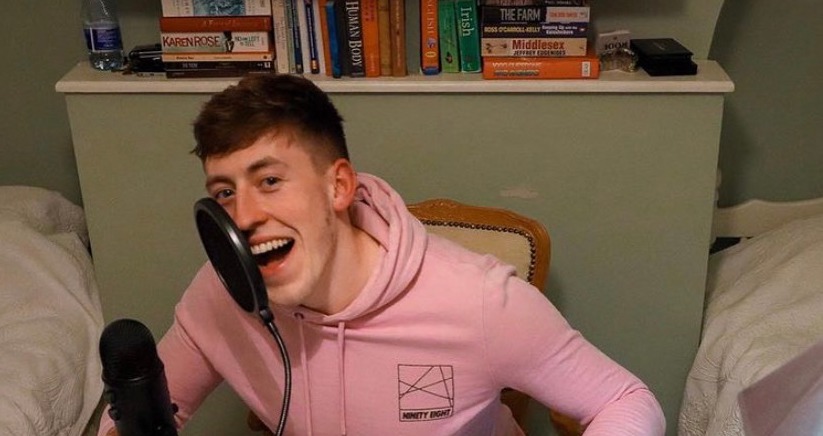
Podge Henry, the host of the Podgecast. Image courtesy of Podge Henry
Like many people bored in lockdown, I discovered Podge Henry through one of his many viral videos on TikTok. At the moment, Henry has over 1.7 million likes on his page which has allowed him to have a career on various media platforms, firmly securing his status as an Irish influencer.
Henry’s main project at the moment is The Podgecast, a podcast where he interviews a different guest every episode and has open and honest conversations with them.
“From doing the podcast, I’ve realised that I enjoy mediating conversation or hosting people and letting them be the centre of attention.
“I much prefer when I’m talking to someone else and interviewing them. I just find that so much more enjoyable and just having a conversation. As someone else described it, the podcast is an earwig into a conversation with me and someone else,” Henry reflects.
Starting a podcast has become a popular pandemic pastime – is oversaturation a worry for Henry?
“I don’t think it’s oversaturated because people are putting the work in and there’s so much variety.
“It’s great as well because I can ask people for a hand or for advice and there’s so many people in Ireland who are creating such great podcasts.
“Come back to me in a couple of months and I’ll be like ‘get them off’,” he jokingly adds.
“I always feel kind of guilty because the pandemic has benefited me in a few ways, because people are consuming more content but also for me, it’s what got me doing the podcast regularly. I said ‘listen, I have to start going weekly and get guests’, and that’s when I really noticed the podcast growing.”
“The podcast is an earwig into a conversation with me and someone else”
Podge Henry
However, he also acknowledges the hardships that the last year has brought him too.
“You know, like everyone, there’s moments during the last couple of months where I have had times where I didn’t feel up for it or maybe wasn’t feeling myself, as everyone has, by trying to adapt and it’s been very tough.
“I know for myself that I often find it kind of hard to maybe open up or if I’m down, it’s sort of that Irish ‘oh I’m fine’ way of thinking,” Henry continues. “I think it’s about surrounding yourself with people who are able to talk. That’s one of the things that I’m lucky, very lucky to have, is people around me who understand me enough to know when I’m down. It’s definitely something that I don’t take for granted.”
The podcaster also shares his goals to promote topics related to mental health more on his show.
“It’s something that I’d like to do more on,” he says, “like more specific episodes with that focus. I had Rosanna Purcell on the podcast and we talked about body confidence and I definitely try to link it in the episodes and I try to do it as naturally as possible.
“I’d love to do live events where I can donate the money to a charity of some sort. Something that I’d love to be more able to do when the lockdown lifts is to give back a bit more,” he says.
Podge Henry cradling his Podgecast merch. Photo courtesy of Podge Henry
Henry has also been involved in a number of different sponsorships and campaigns. More notably, he participated in the AntiViral campaign at the end of 2020.
“I enjoyed getting behind it because they promoted the good of the people between the age bracket of 18 and 24, where people were following the guidelines,” he tells me.
“At the time, the media were giving a lot of bad press to the young people of Ireland and this is to promote the good that they were doing. It was also an incredible experience to interview Deputy Chief Medical Officer Dr Ronan Glynn.”
Additionally, the internet personality also discusses his opinion on internet culture in 2021.
“Cancel culture is a funny one because it’s so broad,” he states. “I don’t really think it’s a blanket term. I think that you see it more now that it’s happening every day.
“In terms of being redeemed, it’s really down to the individual and is a case by case basis. It shouldn’t be focused on ending someone’s career, it should be focused on educating that person and other people as well.”
“Cancel culture shouldn’t be focused on ending someone’s career, it should be focused on educating that person and other people as well”
Podge Henry
Podge and I finish up our conversation by discussing the successes that the internet has brought him, such as “the podcast reaching 12,000 downloads in November, which of course in comparison to other people’s podcasts might not be that much at all. But for me, when I compared it to the year before, I had just over 1,000 so that was cool. It’s just those little goals where you kind of realise what you’ve achieved afterwards that I enjoy.”
Henry optimistically looks to the future. “A lot of opportunities that I got last year weren’t really ones that I saw happening, but I’m so happy that they did. So, I hope to keep the podcast up and hopefully more opportunities will present themselves.”
Aishling Moloney and Sarah Rowe celebrate winning the 2018 O’Connor Cup. Photo courtesy of Eóin Noonan/Sportsfile
Let’s not kid ourselves here; the cancellation of camogie, football and hurling competitions for higher education students measures fairly low on the adversity scale in the current scheme of things.
Parking perspective for a moment though, to compete and succeed in these tournaments is often a huge honour for young players, and an important formative experience on and away from the pitch. It’s another experience the class of 2020/21 will have to do without.
Tipperary star and Ladies Gaelic Football Association ambassador Aishling Moloney has, at 22, a mantlepiece for a veteran to envy — two intermediate football All-Ireland medals, two national league titles, and a Player of the Year award, not to speak of club honours. Representing her university, DCU, has brought more glory.
“I was honoured to be captain of the O’Connor Cup winning team in 2018, and to live that all over again would be a dream,” she says. “It’s sad to see that it won’t be going ahead this year but, given the circumstances, it is the appropriate call.”
“I’ve made best friends for life playing with DCU, and will always cherish the wonderful memories”
Aisling Moloney
Sporting accomplishment is one thing; forging friendships that can long outlast a student’s playing days is at least as valuable for many players. Moloney describes her time playing for DCU as “a very special part of my experience as a student. It’s different from any other competition; your social life mixed with playing football. It’s a roller-coaster. I’ve made best friends for life and will always cherish the wonderful memories.”
Dozens of competitions across four codes give students of all levels the chance to compete, and the upper tiers feature much of the best young talent around.
“Getting the opportunity to play among and against some of the best players in the country is a real privilege,” Moloney says.
Aishling Moloney receives the Player of the Match award for the 2018 O’Connor Cup final. Photo courtesy of Eóin Noonan/Sportsfile
Monaghan footballer Conor Boyle agrees. Now a regular starter with his county, he was on the fringes when he won a Sigerson Cup with DCU in 2015.
“It’s a very high standard and it’s a great opportunity to get onto your county squad. If you start on a UCD team, for example, you’re not going to be far off getting on your county panel, even for the top counties.
“The DIT team of 2013 was ridiculous! I remember their full-forward line was Darren O’Sullivan, Aiden O’Shea and Jason Doherty. You’re looking at those three walking on and thinking, ‘What have I signed up for here?’”
He remembers, too, the confidence he gained from excelling among such company.
“I found after a while it made you see that you’re at a similar level to a lot of these players you’d play against on the inter-county scene. The year before we won it we were playing with the likes of Johnny Cooper, James McCarthy, Dean Rock, and when you were playing with Monaghan you’d nearly look at these boys like they’re at a different level. But playing with them on the college team can open your eyes that there’s no big gap between players in a lot of these top teams, and those from smaller counties.
“I trained with Dean Rock for a full year and I can’t say that he’s any better than [Boyle’s club-mate] Conor McManus. It’s a good leveller because you put a lot of these boys from more successful counties on pedestals sometimes.”
While undergrads missing out this year may at least get another bite at the cherry, there may be, in the words of Kildare hurler Martin Fitzgerald, “no tomorrow” for postgraduate students.
“Most of what I learned in hurling, I learned playing Fitzgibbon Cup”
Martin Fitzgerald
Fitzgerald captained Limerick Institute of Technology in hurling’s coveted Fitzgibbon Cup while studying for a Master’s in 2013, before going on to win two Christy Ring Cups with his county.
He sees that year in Munster — under the management of Davy Fitzgerald — as crucial to his development.
“Most of what I learned in hurling, I learned playing Fitzgibbon Cup. That was the best year I had of my playing career, and if I hadn’t had it, I probably wouldn’t have experienced that level of hurling ever.”
Martin Fitzgerald in action for his club Ardclough
He notes the value of training and preparing alongside county players from the country’s top sides.
“I found it really interesting when I went in there to see what the Laois hurlers, the Clare hurlers, the Limerick hurlers were doing. Everybody brought something different that you might not be exposed to at club and county level. So you got insights into how the rest of the country was preparing.
“You pick up things that you can implement at home, that I could have implemented with Kildare and my own club Ardclough as well.”
Fitzgerald says the self-discipline and focus required to lead his LIT team fed into his studies too.
“Playing Fitzgibbon cup put a huge amount of structure on my college life,” he tells The City, “because it’s the highest level of hurling there is really at that age group.”
Camogie player Sinead Murphy has represented Dublin at intermediate level and should have been playing in the Ashbourne Cup for UCD this year.
“I think it’s great for player development,” she says. “Especially for players like myself that don’t play senior inter-county. It allows you to play at a higher level and train with and play against some of the best camogie players in the country.”
Murphy is next in line to stress the value of these tournaments for their off-field perks.
“From a social side, I think, especially in first year, it’s a great way to get to know people and to have a few more familiar faces around campus. I think what’s great about college sport is the mix of people you meet that you wouldn’t have met otherwise. You’re playing with girls doing a wide range of courses from different counties.”
Darragh Biddlecombe, GAA Development Officer at TU Dublin, feels sorry “for this year’s freshers cohort especially, who have missed out on their camogie, ladies football and GAA experience. It can be so important for making friends and settling into university life.
“In light of public health and the safety of everyone, [cancelling the tournaments] was the right thing to do. If it’s safe to return, hopefully a dedicated second year championship can be run next year for this group.”
Ciaran D’Arcy has a bone to pick. Read on as he outlines 10 ways to ‘endear’ yourself at your local bar.
1. Remember to order your drinks one at a time, they love running backwards and forwards as it keeps them fit.
2. When ordering a round, please make sure you don’t know what you want; barmen love to stand and wait while you shout across the room to find out.
3. Once you receive two drinks please take them back to your table and stay for a quick chat, your barman isn’t going anywhere and truly appreciates the rest.
4. Irish coffees are a perennial favourite, and please remember to order your Guinness last as there’s nothing quite like being reminded to top it up by a disgruntled customer to keep you on top of your game.
Photo by Marco83 on Flickr
5. Don’t put money in their hands as they love to pick it out of puddles of beer on the bar. As for membership cards, remember to top them up in small increments so they’re short on every round and have to be topped up, there’s no rush!
6. Don’t bother with unnecessary niceties such as please and thank you, and tipping is positively discouraged.
7. Translating confusing hand signals for drinks is infinitely preferable to actually being informed of a round at the bar. Revert to smoke signals first if necessary.
8. Lip reading is a particular joy, and if you’ve picked up the barman’s name five minutes into your first visit don’t hesitate to parrot it again and again as they have notoriously poor hearing, especially when busy.
9. Always wait until you’ve been told how much your round is before asking for crisps, peanuts etc. When cheese and onion crisps are desired, ask for the full range of flavours before invariably going for the most obvious option, it helps them remember the stock.
Photo by Jen & Elwood on Flickr
10. If you’ve been waiting at the bar for two minutes, remind them that you’ve been waiting there for ‘half an hour’ as they have no concept of time whatsoever.
If all of these tried and trusted techniques fail to secure your status as a well-known and loved regular, then there’s always the six-pack of Linden Village in Dunnes Stores.





















You must be logged in to post a comment.