It’s exam time in most colleges, and in UCD the thoughts of repeat exams may cause students a slight panic. This is because UCD have the highest repeat fees in the country.
The City reporter, Ronan Smyth, investigated repeat fees in colleges earlier this year. Check out his report here.
We headed out to UCD to see some the reaction of students there.
UCD students pay up to €230 to re-sit supplemental exams – higher than any other college in the country.
Most of the universities listed above operate a capping system, whereby students are limited in how much they will have to pay.
NUI Galway, even though they are the second most expensive, charge a flat fee so students will only have to pay €195 to repeat, regardless of the number of exams they need to take.
University of Limerick caps their charge at the cost of four re-sits. NUI Maynooth, DCU and UCC all cap their charges at €280, €277 and €245 respectively, and Trinity do not charge for the first set of supplemental exams.
UCD however has no upward cap, so students will be liable for a charge of €230 per module repeat.
According to Danii Curtis, the education officer for UCD, the fee is calculated on average across the whole college. “It’s because we have a lot of practical courses so UCD averages the cost across the university and across the students,” she said.
“The practical subjects such as veterinary would be the most expensive, all the equipment and lab time means they would be on the higher end of what each repeat would cost,” she explained.
She added: “I think if you work it [out] on a per program basis you’ll have more students who can’t afford to repeat, the €230 is a fair average across the campus.”
How repeat and re-sits are conducted in UCD depends on the individual school, but UCD does allow students to carry onto the next year of their degree with 50 credits instead of the full 60 credits. However, they will need to make up those missing credits somewhere down the line.
As it stands, students who fail a module in UCD will be expected to re-sit an exam or project over the winter or summer exam periods, with no supplemental exam period set aside in the autumn unlike the majority of other colleges in Ireland.
“I would be in favour of a summer repeat period so students do not have to carry on subjects [into the next semester],” said Ms Curtis. “I’ve also started looking into a cap, and I would be in favour of a cap on three to four subjects per student.”
UCD allows students that owe the college money to repay it over the course of the semester, with students owing less than €600 allowed to receive their provisional results. However, students over that amount cannot.
In comparison to the universities, costs for taking supplemental re-sits are simplified at the Irish Institutes of Technology.
Most of the Institutes of Technology operate on a flat fee basis, so regardless of the number of repeat exams a student needs to take; they will only need to pay a set amount.
As the chart above shows, Tralee IT is the most expensive with a flat fee of €120. All the other institutes, with the exception of Dún Laoghaire Institute of Art, Design and Technology (IADT) charge €50 to €100.
Cork IT offers repeats during the December or May exam periods at a cost of €50. However, if a student needs to repeat in the autumn the cost rises to €100.
IADT is the only IT to charge on a per subject or project basis at a cost of €25. They also do not offer a cap on the amount to pay, so for a student who has to repeat multiple classes, IADT could add up to be the most expensive IT to repeat in.
To see more from Ronan, visit his Twitter at @RowSmyth.
Bressie has launched a new website which focuses on mental and emotional health, while he continues his series of talks on mental health in Dublin and around the country.
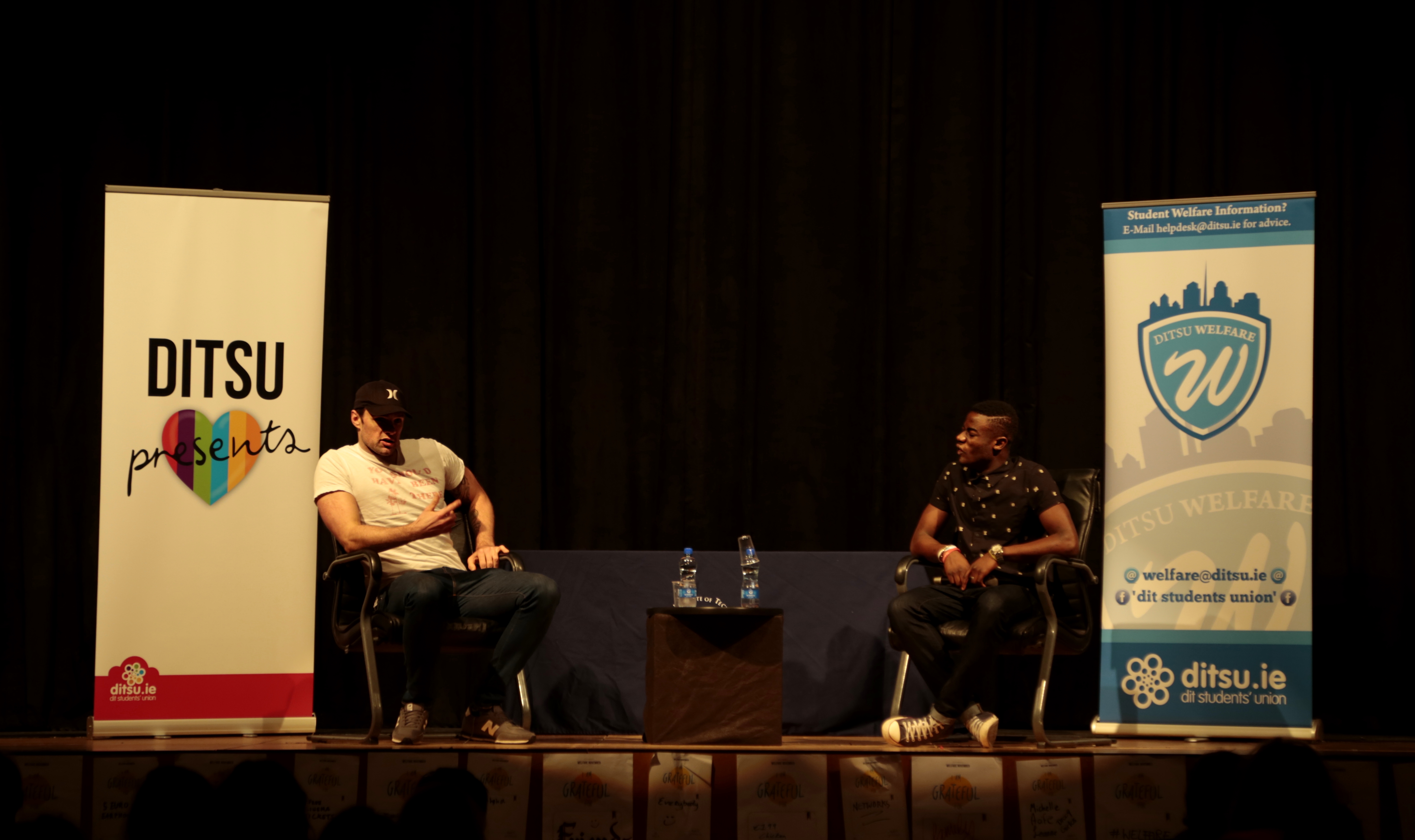
The Dublin-based singer, best known for being the front-man for the Irish band The Blizzards and a judge on The Voice, has spoken at a number of Dublin-based colleges, including his old college UCD in October, DIT in November, and Trinity College this December.
Photo by Cormac Dunne
Just last month in November he launched a new website called my1000hours, which focuses on the importance of mental health as well as physical health, and will also act as an ‘online support blog’. The website explains,
“So many of us put so much emphasis on physical fitness but seem to ignore the importance of our mental or emotional fitness. The evidence surrounding the correlation between positive mental and physical health has never been more profound”
The concept of 1000 hours is to encourage people to improve their mental health by challenging themselves to achieve things such as learning a new skill or running a marathon. This will all be with assistance from the 1000 team “who will help with both the physical training programmes, diets etc…and also the mental processes required to achieve these challenges.“
The website is also due to add a section on musical therapy and how it could help to manage depression.
Bressie suffers from Generalized Anxiety Disorder, and since first speaking out about his struggles a year ago in 2013 he has become an advocate for mental health in Ireland. As well as speaking at schools and colleges around the country he has also spoken on a number of television and radio programmes on the issue.
Thanks to DITSU I got to talk to Bressie last month, after his talk on mental health in DIT as part of their Welfare November campaign:
For more information on 1000Hours follow the links below.
As another year of Irish league football comes to an end, the time for reflection for managers, players and fans has arrived. Whether your club has won the league, embarked on a memorable cup run, exceeded expectations or spectacularly failed to live up to them, little will change the love we feel for the club we support. Here’s a round-up of all the Dublin-based Premier Division clubs for the 2014 season.
Bohemians
Dalymount Park will welcome back First Division football next season. Photo: Jack Pollock
After retaining their SSE Airtricity Premier Division status in 2013 with a 10th place finish, the Gypsies pushed on in the 2014 season to surprise everyone at Dalymount Park and finish in a commendable 7th place.
Having only secured safety in the final weeks of the 2013 season, this campaign was a far more productive effort under now departed boss, Owen Heary. The 38 year-old, who spent seven years with the Phibsborough based club as a player and manager, guided his team to the latter stages of all three domestic cups. Bohs reached the semi-final stages of the EA Sports Cup, only to lose out to Shamrock Rovers 0-2. The FAI Cup brought more heartache, as the side were narrowly defeated by St Patrick’s Athletic despite threatening a late comeback in their quarter-final tie. The lesser acclaimed Leinster Senior Cup also saw the club excel, before being convincingly beaten by rivals Shamrock Rovers once again at the quarter-final stage.
Dinny Corcoran ended the season as the Gypsies’ top scorer, as he bagged 13 league goals to ensure relegation was never at the forefront of his teammates’ thoughts. Summer signing Jason Byrne also provided the goals for Heary’s men, but at 36 years of age, time is running out for the Dublin-born striker to break the League of Ireland’s all time scoring record of 235 goals, currently held by Brendan Bradley. Byrne still needs just over 20 goals to match Bradley’s feat.
Shamrock Rovers
Shamrock Rovers narrowly missed out on European qualification for next season. Photo: Shamrock Rovers FC
Having previously secured a domestic cup treble in the 2013 campaign, Rovers were expected to improve on their 5th place finish and to challenge for the league title. However, the Hoops were to end another season without qualifying for Europe.
Midway through the season, manager Trevor Croly left the club by mutual consent as the club decided he was no longer the man to take the club forward. Pat Fenlon, the former Hibernian boss, took over the reins as the club desperately tried to secure European football for the first time in four years. With their league form proving indifferent, the cups took on more importance as the club searched for an alternative route into Europe.
The Hoops surrendered their EA Sports Cup to Dundalk, who claimed a 3-2 victory in a pulsating final. The club also lost its grip on their two remaining trophies, as they exited both the Leinster Senior Cup and the Setanta Sports Cup at the semi-final stages. Most painfully, Pat Fenlon’s side saw their last opportunity to qualify for Europe pass them by, as they lost to Derry City in their FAI Cup semi-final replay. The FAI Cup was high on the list of priorities for boss Fenlon, with the club having gone 27 years without claiming the trophy.
Gary McCabe ended the season as the club’s top scorer with seven goals, as the Tallaght-based club struggled to find a prolific scorer. Goalkeeper Barry Murphy was named as the club’s Player of the Year.
St Patrick’s Athletic
Fans of St Pat’s can look forward to some Europa League action in July 2015. Photo: Fionnsci
In claiming the SSE Airtricity Premier Division title in 2013, St Pat’s finally shook off their tag of ‘nearly men’. However, Liam Buckley’s side failed to recapture their title-winning form in 2014, as arguably the best squad in the league vastly underperformed to seal only a 3rd place finish.
In light of their league triumph, the Inchicore club’s struggles in the cup competitions were largely overlooked last season. This campaign, in contrast, will be remembered for their exploits in both European and the domestic cups. Having gained a remarkable 1-1 draw in their Champions League second-round qualifier first-leg against Legia Warsaw, those at Richmond Park began to dream of a fairytale meeting with Scottish giants, Celtic. Unfortunately, those visions would remain imaginary, as the Polish champions thrashed St Pat’s in the second-leg, to end their chances of progressing.
Liam Buckley and his players did claim the Leinster Senior Cup after beating First Division side Longford Town in the final. With Europa League qualification secured through their final league position, St Pat’s head into the FAI Cup Final on November 2 with little to fear, as they go in search of more silverware.
Christy Fagan marked a memorable personal campaign with 20 league goals; Conan Byrne and Chris Forrester also reached double figures. Keith Fahey also enjoyed a fine campaign as he made his eagerly anticipated return to the League of Ireland.
UCD
UCD’s future in the Premier Division remains in their own hands. Photo: Ed Scannell
The perennial target for the Students is to remain in the SSE Airtricity Premier Division and they still have a chance of extending their five-year stay. In 2013, UCD sealed their safety after finishing in 9th place and in doing so, avoided the uncertainty of a relegation play-off. However, Aaron Callaghan’s side were not so fortunate this time around, as they will have to wait until Halloween night before their Premier Division status is decided.
With the club’s target of survival the only real aspiration for management and players, cup competitions always prove to be a thankless task at the UCD Bowl. The Students exited all domestic cup competitions in the early rounds, as they lived up to their low expectations. Striker Cillian Morrison left the club in July to join Cork City, in what has become a familiar scenario for UCD as they continue to lose their best players on an all-too regular basis. The likes of Michael Leahy, Craig Walsh, Dinny Corcoran and David McMillan have all left the side in the past 12 months. However, management encourage the club’s best players to move on, in order to further their careers at more ambitious sides throughout the division.
Time will tell if UCD are to prepare for life in the Premier Division once more, or whether they will finally endure relegation to Irish football’s second-tier.
Students of University College Dublin recently voted in a UCDSU referendum to ban smoking on campus. Although the ban is not in place yet, it looks likely to come into force in the coming years. Could this be the start of a trend among Irish colleges?
If Health Minister James Riley’s new ‘Tobacco Free Ireland’ document is anything to go by, the answer could be yes.
The document includes recommendations to encourage a ban on smoking on the grounds of primary schools, secondary schools, child care facilities, health care facilities and third level campuses.
The City asks students how they would feel is smoking was banned on their campus:
The University College Cork graduate believes that “We need to redefine the role of ITs. They should not be quasi-universities. ITs should be about apprenticeships and internships.”
With the impending amalgamation of Dublin Institute of Technology, IT Blanchardstown and IT Tallaght to form Dublin Technological University on the city’s northside, the question arises; “Are degrees from universities more valuable than those earned through an institute of technology?”
“In practical application, no, I don’t think there is a difference in the value of a degree, but in terms of actually getting a job, maybe. Maybe nowadays employers look more positively on names such as Trinity and UCD than those ending with IT”- Philip Greene, Economics and Politics, Trinity College.
“I’m sure law courses in other schools cover the same ground as we do, but I do think firms look for students from the likes of Trinity, mainly because they more than likely achieved better academically to get into their respective colleges. As well as that, there is a lot to be said for the esteem in which employers hold colleges and universities such as Trinity and UCD.”- Ellen Gaffney, Law, Trinity College.
Dr. Paul Horan, the head of Campus Planning at Dublin Institute of Technology believes the move to Grangegorman will be a massive benefit to the college. “For DIT the project delivers a range of wins; improved facilities, potential to respond to changing pedagogy, potential to deliver facilities we currently don’t have e.g. student accommodation, synergies and savings in more efficient operation, and a strengthened sense of identity.”
“I’d have the same skill set as a graduate from a similar degree in UCD or Trinity i.e I don’t think there would be much difference in the content. I’m not sure though about getting a job. I’d imagine employers would have a preference for universities.” Daniel Condon, Economics and Finance, D.I.T.
“I think in practice, A degree from an I.T is every bit as valuable and useful as one from a university but in reality, a university degree would give an individual more opportunities as far as employment is concerned.” Daniel Murphy, Media, BCFE.
“I think degrees from an IT carry the exact same value as ones from a university. My course is a four year degree course; just because it’s in an IT and not a university does that make it less of a degree? ITs are improving year on year and are quickly catching up to the level of universities.” Neal Harrison, Exercise and Health Studies, W.I.T.
From talking to these students, it is clear that the general consensus is that a University degree carries with it a higher value to employers, but those who do IT degrees feel they are catching up.






You must be logged in to post a comment.