
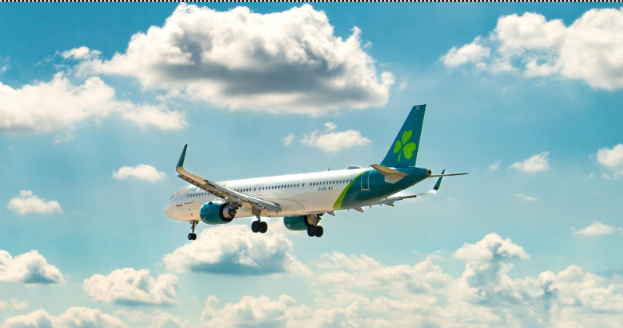
Being a pilot is an occupation that the majority of us would imagine to be of high importance and extremely pressurised. Now, imagine being in that position as young as 23-years-old. While that would sound daunting to most, that is the reality for Dáire Murphy, a young man from Lucan, Dublin, who will complete his training to become fully-fledged pilot.
Murphy started honing his craft at the National Flight Centre (NFC) where he completed all his necessary training as a student pilot and got a commercial flying license. This allowed him to continue his training and get inside the cockpit.
“I’m with Emerald Airlines now, so I’ve done my initial training with them, health and safety, fire training, all that sort of stuff,” said Murphy. “I’m doing a two-week course doing flight simulations, then I do what’s called line training, where I fly with a specialised captain until they deem me fit enough to not need anyone there and I can be a fully unrestricted commercial pilot flying passengers.”
It is a job that is heavily sought after, but extremely tough to get into, due to the harsh nature of flying and the long process of the training and exams, which many people who think they want to go into aviation simply cannot complete.
“The exams are designed to filter out people who aren’t suitable for the job, they don’t want people who just like the idea of being in uniform and sitting up the front. You can’t just pick someone off the street and teach them how to fly an airplane. You do have to put the work in,” said Murphy.

An obvious factor which may turn a lot of people off aviation is the cost. Like many other things, the cost of training would instantly discourage many young hopeful pilots, with Murphy himself further showing how much commitment he had to this course:
“By the time you’re walking into an airline, you could have shelled out around €100,000 or €120,000, which is a huge amount of money. I was working in retail before and 50%, sometimes more, of what I was earning was put aside into a different account for my training. If I was earning around €3,000 a month I wasn’t actually seeing much of it.”
Like any other sort of course, there are always people who will drop out. Dropout rates are usually correlated with the difficulty level of a course with “4 out of 13 dropped out of [Murphy’s] full time course during the exams, so only 9 will graduate from the class, which is sad because you make friends with these people, but you have to want it.”
While it could be assumed that a line of work such as this would require intense studying and training, the short time frame given to complete these hours may come as a surprise to some.
“It is a legal requirement to complete 13 exams and 750 hours in the classroom, which is about 6 or 7 months. It’s the equivalent of a 4-year masters condensed into these 7 months or so,” he said.
The common narrative is that people go into this line of work because they got the idea from a family member, but not Murphy. He explains how flying has been the only thing he was talking about “since [he] could talk”.
He said, “maybe it’s rare that someone with no aviation background wants to do it, but I’ve never questioned it, I never thought that it wasn’t for me and I wouldn’t change any decisions I’ve made along the way.”
In a world in which there are so many different lines of work to go into, it is rare that somebody sticks to what they are doing from, in Murphy’s case, as young as 17 years old.
“There were times when I was sat there doubting myself, thinking I’d never be able to get through it, or I’d never see the end of it.”
This line of work really is a one step at a time type of work, with even Murphy himself evidently feeling that it is almost never ending at times. However, he can see the light at the end of the tunnel now.
“I still have a few more weeks in the classroom, making sure we know everything, then a few more flight simulations which will be done by December. Then I have to fly the aircraft and do what’s called a circuit, which is basically just flying the aircraft around, practicing takeoffs and landings, then I’m ready to have passengers on board. I’ll still be observed at that point because safety is the priority,” he explained.
Emerald airlines are unofficially known as a stepping stone towards being an Aer Lingus pilot, which Murphy hopes will get him one foot in the door in order to achieve his ultimate goal.
“When Aer Lingus go hiring and recruiting pilots, they do take a lot of young pilots from Emerald. They’re starting a new course in January, and they’re talking 10% of Emerald’s pilots, which is a huge number. Aer Lingus would definitely be my end goal, like a lot of other Irish pilots would say.”
While it’s been established how this business is not suitable for everyone, Murphy would encourage people who are considering aviation to “not overthink it and just go for it”.
“The more you think about it, the more reasons you’ll come up with not to do it. Definitely do your research and don’t dwell on it too much. You’ll start coming up with reasons not to do it if you just start thinking negatively.”
You must be logged in to post a comment.