As we head into June, the primaries in the US Presidential Election are drawing to a close. It’s been a long road and it looks like it’s going to get bumpy as Donald Trump becomes the expected nominee for the Republican party and Bernie Sanders continues to try with all his might to pip Hillary Clinton to the post for the Democrats.
TheCity.ie is concluding our Following the Primaries series by jumping ahead to what to look out for on 8 November as the political landscape of the US – and the world – is set to change once again.
‘Leave the light on’ – the latest single by Wicklow-based singer songwriter Kolumbus – succeeds where many songs about heartbreak fail. From the opening guitar riff and gentle weaving lyrics the listener is pulled into the song. “I remember the night. You hit the switch. Turned out the light and said that was it.” A story of broken promises emerges as the acoustic-filled ballad builds up to a powerful chorus. Kolumbus’ breathtaking vocals bring the listener on a journey of his anguish. The bridge unveils his reluctant acceptance that lovers must move on yet still pleads for a chance to make it all right again. The simple production by the talented Gavin Glass captures the theme of the song perfectly. Expect to wipe the tears from your eyes before the final strum.
Check out our short interview and acoustic performance of ‘Leave the light on’ with Kolumbus from earlier in the year.
The single will be officially released on 29 April and is available to download for free from kolumbus.ie. Keep up to date with all Kolumbus’ endeavours on Facebook, Twitter and Soundcloud.
Keith Burke’s sophomore album came together with the help of his band, The Little Black Book featuring a group of veteran Irish musicians including the talented songwriter and fiddle player Sinead Madden from the Moya Brennan Band. With Gavin Glass on production duties, the outcome is a professionally constructed album featuring nine solid tracks with a few stand out gems.
The opening track ‘Brother Hear Me Out’ begins with a monotone melody similar to Talking Head’s ‘Psycho Killer’ but quickly builds to a cracker chorus hook.
The first few strums of ‘Crazy Babe’ bring me back to 1995 and Deep Blue Something’s smash hit, ‘Breakfast at Tiffanys’. However, that moment is fleeting and what develops is a simple country waltz. Sinead Madden’s fiddle brings this song to life weaving Irish roots throughout the Jackson Browne-esque melody.
The catchy melody of ‘Cut Our Teeth’ along with the finely ingrained Hammond organ and tenor sax make me imagine Burke and The Little Black Book transforming into Bruce Springsteen and the E Street Band and delivering an energetic, sweat-filled stadium rocker.
The fourth track, an easy going piano ballad ‘Come on Now Be Real’, could be a re-write of Marc Cohn’s ‘Walking in Memphis’. However, lyrics such as “I’m just an honest cheater trying to make a deal. It’s just me and St Peter and the court of appeal”, highlight Burke’s often-clever lyrical skills.
The standout track on this album is ‘Sounds Like Something John Might Play’. Jackson Browne’s influence appears again with Burke’s heartfelt vocals finding a comfortable level. The inclusion of the tenor sax accompanying Anja Kuncic’s gentle piano gives the song a classy, romantic feel while also raising a hat to John Earle, the late saxophonist who inspired this beautiful track.
‘The Making of a Saint’, opens with a slow guitar lick accompanied by the dark use of the piano’s bass notes. The song brightens slightly in the first verse before becoming larger than life towards the end. This track has the makings of a slow burning anthem like Chris De Burgh’s ‘Spanish Train’ but Burke’s sweet vocals fail to encapsulate the darkness of the song.
On the closing track, ‘These Boys’, Sinead Madden’s fiddle skills shine through again as the lyrics plead, “War. We’ve got no time for war. . . I’m asking nicely.”
Overall, These Boys is a well crafted and appealing album. Burke’s remarkable talent shines on the simpler songs. However, his gentle vocals struggle to convey the rougher edge of the more complicated numbers. If these songs fell into the right hands I have no doubt that they could become masterpieces.
Find out more about Keith Burke and The Little Black Book on:
In our second episode of Music from the Alley we met Dublin-based indie band Tabloid TV.
Mark, Ultan, Senan, Moninne and Ian joined us in the alley for a quick interview (with a few awkward laughs) and live performance of their song Runaways.
Back in June 2015 the entire world joined together in a belly laugh as Donald Trump declared the words, “I am officially running for President of the United States.” Since then he has insulted and attacked large sectors of society – not only in his native USA but all over the world – yet his popularity has steadily increased and the belly laughs are now turning into nervous giggles.
Dr. Jack Thompson – lecturer at the Clinton Institute for American Studies in UCD – shone some light on why this may be happening. “Trump is giving a voice to a massive percentage of the population – angry people that the elites in both parties tend to ignore.”
“In many ways, Trump and Sanders are different sides of the same coin,” said Dr. Thompson. “US politicians are proud that unemployment now sits at around five per cent and the economy is steadily growing. The reality is that most of this growth goes to the people at the top of the spectrum. Working class people haven’t seen a rise in their wages and they’re angry about that.”
To make a comparison between Trump and Sanders may seem laughable, but hear me out.
Sanders’ campaign is strongly focused on extinguishing the corruption in politics. He has refused to take donations from Super PACs as he does not want to be beholden to them. At the first Democratic debate in December he said, “Our campaign finance system is corrupt and is undermining American democracy. Millionaires and billionaires are pouring unbelievable sums of money into the political process in order to fund super PACs and to elect candidates who represent their interests, not the interests of people.”
Donald Trump likes to remind people pretty regularly that he is “extremely rich” and is self-funding his campaign (although questions have been raised about this recently) and he therefore, like Sanders, has no special interests or lobbyists asking him for favours. After admitting to making donations to political interests in the past, he called campaign financing a “broken political system”.
That being said, the differences vastly outweigh the similarities between Sanders and Trump.
Trump’s campaign strategy centres around highlighting people’s fears in an often aggressive and manipulating manner. You often hear Trump supporters say things like, “he speaks the truth”. And the truth is that there are a large number of Americans who truly think that Mexicans are “rapists”, immigrants are dangerous and that the way to solve the problems in Syria is to “bomb the shit” out of ISIS.
Because of these “truths”, the Republican party is worried.
Stacy Hilliard of Republicans Abroad told RTÉ’s Morning Ireland on Wednesday, “A candidate should truly represent the Republican values and be someone of decency who doesn’t bully other candidates.”
Dr. Thompson explained saying, “Scholars have talked about seeing the Republican party broken.” Recent developments within the Republican establishment suggest tactics to “sabotage Trump and reassert the party’s control”.
This split is evident when you consider the statements made by the two most recent Republican candidates for president. Mitt Romney called Trump a “fraud” and “a phony”. Senator John McCain agreed with Mr. Romney, adding “uninformed” and “dangerous” to their list of words to describe Trump. Mr. Romney continued by encouraging voters to back the candidates most likely to deny Trump a victory in the remaining states yet to hold their primaries and caucuses.
At the same time, former Republican presidential candidate Gov. Chris Christie has rushed to Trump’s side along with Gov. Paul LaPage of Maine and five members of congress.
Although Trump has won in the majority of states where primaries have been held so far, the race is far from over. Tuesday 15 March is a critical day in this unpredictable battle as 367 delegates are up for grabs. 226 of these are in winner-take-all states which includes Florida – Senator Marco Rubio’s home state.
“The Republicans have some soul-searching to do,” said Dr. Thompson. “If Trump wins the Florida primary, it’s game over.”
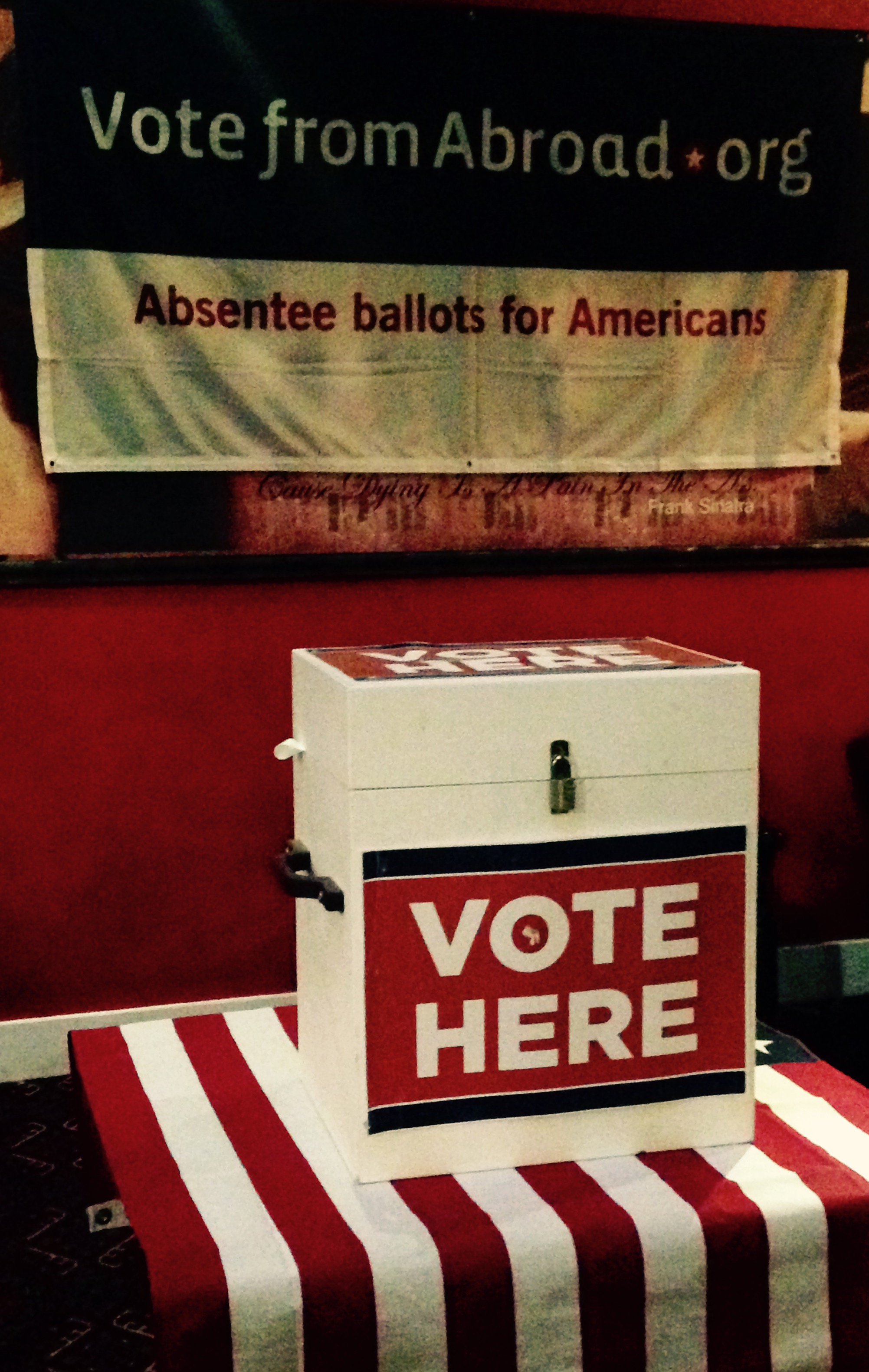
Democrats Abroad Ireland hosted almost 140 US citizens in the Arlington Hotel in Dublin yesterday who were able to vote as part of the presidential primary elections.
Rea, who is originally from Texas and has been living in Ireland for four-and-a-half years, proudly cast her vote for Bernie Sanders. “I am delighted that I get a chance to have my say”, she said. “I was unaware that I could even vote until a friend told me today”.
Roisin and Cillean O’Gara, born in New Jersey and now living in Drogheda, cast their votes. Photo: Aoife Gallagher
Kelly Mahoney is the Vice Chair of Democrats Abroad Ireland. She spoke to TheCity about this year’s campaign. “We have over 1,300 members here in Ireland and we are hoping for a 60 per cent turnout in voters”, she said. She also stated that membership of Democrats abroad had increased by over 200 people in the past month and said that Bernie Sanders’ campaign has a lot to do with this sudden increase.
“Sanders appeals to people who are frustrated with establishment and stalemate politics and want to see a change”, she said.
As eleven states in the US raised their hands and cast their votes yesterday for ‘Super Tuesday’ – the biggest date in the primary campaign – American citizens abroad have a chance to have their say over the week of 1-8 March.
However, it is only those wishing to vote Democrat who have this opportunity. The Republican party does not give their party affiliates living overseas a chance to vote.
Democrats Abroad are given state-recognition during the primaries and are assigned 17 delegate votes – 13 pledged delegates and 4 superdelegates.,
Voters must register with Democrats Abroad before casting their ballot and can do so in person at the polling station or online. Registered voters are then able to vote via email, post, fax or drop their votes into the ballot box at their local polling station.
Ms. Mahoney told TheCity that one of the biggest issues for many voters living overseas concern the laws that are currently in place to prevent tax evasion through hiding money in foreign bank accounts. These regulations pose an unwanted burden on legitimate ex-pats.
US citizens living abroad must file yearly tax returns to the IRS on their non-US financial accounts. The law also allows the IRS to search through a bank’s customer database to identify possible tax evaders.
“In certain countries, banks are not letting US citizens open accounts due to the increased administration involved”, Ms Mahoney explained. “This can prevent people from securing jobs in foreign countries. Pensioners who have retired abroad also feel the inequality of these laws.”
Both Clinton and Sanders are aware of the impact of these laws and have promised to work with Democrats Abroad on reforming these regulations.
As voting finished at 8pm, TJ Mulloy – chairperson of Democrats Abroad Ireland – announced that Sanders had won with 98 votes to Clinton’s 37. US citizens in the west of the country will have their chance to vote on Saturday in Monroe’s Tavern in Galway.
As the somewhat unpredictable campaign trail makes its way across the US, it is of some comfort to those who voted from overseas to know that they have been able – to some extent – to have their voice heard.
In the first episode of our new feature – Music from the Alley – we caught up with Kolumbus. Hailing from Co. Wicklow, he performed his first solo show in Whelans last week to great success.
Watch the interview below to hear how he beat Justin Bieber to the number one spot and see an amazing performance of Leave The Light On.
The results of the New Hampshire primaries last Monday saw Donald Trump and Bernie Sanders come out on top for their respective parties. Trump’s win has made him the leader on the Republican side with 17 delegates followed by Ted Cruz’s 11.
Sanders tops the table for the Democrats after winning 15 delegates in New Hampshire. He now leads in a 36-31 delegate count over Hillary Clinton.
However, a quick Google of, “how many delegates does Clinton have?”, gives you this result.
394? How has Clinton won all these extra delegates? The answer lies in the phenomenon known as “superdelegates”. I have briefly explained the role these delegates play in previous articles but my curiosity has driven me to investigate their role further.
The Democratic national convention will be attended by 4,763 delegates on 25 July in Philadelphia. The aim of the primary elections is for each candidate to win the majority vote of these delegates to continue to the national election in November. However, of these 4,763 delegates, 712 (or 15 per cent) are unpledged superdelegates. They can vote for whichever candidate they choose and are not tied to the popular vote from the primaries and caucuses. Therefore, it is plausible that a candidate could lose the popular vote but still become the nominated candidate for the Democratic party from winning superdelegate votes.
Seems quite undemocratic right?
So, who are these people and what makes them super?
The 712 superdelegates are made up of the most important people in the Democratic party including current and former presidents, party leaders, governors, senators, members of the House of Representatives, and members of the Democratic National Committee (DNC).
In the 1972 presidential election, George McGovern lost to Richard Nixon in 49 states. This loss was a massive blow to the Democratic party who decided that they needed to implement an emergency system to avoid nominating inexperienced or radical candidates for election. In other words – they didn’t trust the public’s decision.
In 1982, the Hunt Commission (chaired by then-governor of North Carolina Jim Hunt) recommended that the DNC set aside a number of unpledged delegate seats for member of congress and other state party officials. These became known as superdelegates.
Will superdelegates make a difference in this year’s election?
The question about whether superdelegates will ultimately decide who continues in the presidential election in November cannot be answered at this moment. Although over 300 superdelegates have said that they will vote for Clinton, they are free to change their mind at any point before the national convention in July. Therefore, the collective results from the Google search and various news publications, who show Clinton with a distinct delegate advantage, are once again based on predictions.
This is similar to what happened in 2008. Clinton began her primary campaign leading Barack Obama with 154 superdelegate votes to 50. By the end of the primary season, Obama had overtaken Clinton’s superdelegate support by almost 2:1, with a number of these delegates switching their support from Clinton to Obama.
This year however, Clinton has began with a much larger margin. This means the battle will be tough for Sanders. To start with, Sanders only declared himself a Democrat in 2015. As Clinton is a long-standing member of the Democratic party it is only natural that she would have the support of party officials. Sanders is also a self-proclaimed socialist and his campaign prominently revolves around reforming corruption in politics – a thought which may scare the old fashioned Democrats.
Nobody likes statistics
Instead of boring you with loads of statistics and percentages, let me conclude by saying that for Sanders to be absolutely sure of winning the Democratic nomination – without any support from superdelegates – he must win over 58.8 per cent of the pledged delegate votes. If the results are closer than that – for example 52 per cent to 48 per cent in favour of Sanders – the support of two-thirds of superdelegates in favour of Clinton would mean that she would win the nomination. For a more detailed breakdown see Nate Silver’s excellent article.
If the superdelegates are presented with a chance to overrule the popular vote, the results for American democracy would be catastrophic and Bernie Sanders will be vindicated in his certainty that campaign politics are corrupt.
A marine conservationist in Australia is eight days into a hunger strike in a fight to see shark nets and drum lines removed from along coastal waters.
Nicole McLachlan, 25, is calling on the Queensland government to invest in non-lethal methods of shark control. The current program – which has been in place since 1962 – is putting the lives of many vulnerable sea creatures in danger.
Theshark net and drum lines are in place along the coast to mitigate shark-human interactions at popular beaches. McLachlan is calling on theses “outdated practices” to be replaced by the non-lethal alternatives that are now available.
As an underwater photographer, Ms McLachlan has witnessed the destruction caused by these practices first hand.
In an interview prior to the hunger strike, Ms McLachlan stated, “I think if the public see what the shark nets and drum lines do, there would be more of a tourism downfall because of their existence along our coastlines.”
In 2014, the Western Australian Government removed the 72 baited drum lines off their coast after tens of thousands of people protested against them. Ms McLachlan is calling for a similar response in Queensland.
“I am simply asking for the government to commit to funding, to match the same amount of funding the New South Wales government has put forward, into non-lethal programs and shark-spotting programs as well as a commitment to phase out shark nets and drum lines over coming years,” said Ms McLachlan.
The US primaries are now in full swing with both Iowa and New Hampshire already having their say, and the Nevada Democratic caucus scheduled for next Saturday week. In last week’s article I explained how caucuses and primary elections differ but how they both elect delegates who pledge to vote for their chosen candidate at the party’s national convention. This winning candidate then goes on to run in the presidential election in November.
This week, I will take a closer look inside the perplexing caucus system by focusing on Iowa’s Democratic caucus results.
Grab a coffee and sit down. This could get messy.
To begin, I will give a brief description of how the Democratic caucuses were run in Iowa – this process differs from party to party and from state to state.
Registered Democrats gathered in a public space and votes were counted by people dividing into groups in support of their chosen candidate. In each caucus, if a candidate didn’t receive at least 15% of the total vote on the first count they were considered inviable and their voters were free to cross the room to support one of the other candidates. (This is somewhat similar to Ireland’s single transferable voting system.) County delegates were then allocated to each remaining candidate on a proportional basis. For example, if 100 voters came to a caucus and of them, 14 or fewer voted for O’Malley, then O’Malley would win zero delegates out of that precinct and his 14 supporters could then choose to support either Clinton or Sanders (they could also go home uncounted). The county delegates are then divided among Clinton and Sanders based on their share of votes.
Sounds simple enough right? Let’s dive deeper.
Iowa is divided into 99 counties and subsequently into 1,683 precincts. A caucus took place in each of these precincts.
Throughout these precincts there are a total of 11,065 Democratic county delegates that were allocated to the candidates. However, you may have noticed that the results of the overall state caucus that have been reported by the media give the results in ‘state delegate equivalents’ (SDEs) and national delegates. These are actually predicted results that will not be officially awarded until after the county, congressional, and state conventions – which take place throughout March and April – and filter the 11,065 county delegates down to 44 national convention delegates. Are you still with me?
Source: The Washington Post
For example, this image from The Washington Post, shows that Clinton has been awarded 701 SDEs which has been calculated through ratios of county to state delegates. This state delegate number then predicts that she will win 23 delegates in the national convention. The media are ultimately publishing results from conventions that have not yet happened.
To make matters more complicated there are also eight unpledged delegates known as ‘superdelegates’ who go straight to the national convention from Iowa and can vote for whichever candidate they choose. Politico have allocatd six of these superdelegates to Hillary Clinton and left two uncommitted, while The New York Timesshow only two uncommitted delegates, leaving six unaccounted for. Surely if they are unpledged delegates they should not be awarded to either candidate?
It was reported in many news outlets that in a number of Iowa precincts, delegate allocations were awarded using coin tosses. This was apparently due to inconsistencies in voter numbers. Some media publications, including The Guardian, reported that Clinton won six out of six coin tosses (a probability of 1.56 per cent). However, others such as CNN reported that Sanders won five and Clinton won one. CNN also reported that there are no official records of how many coin tosses occurred and that many of them rely on anecdotal information.
In saying all this, most media reports have concluded that these coin tosses would not affect the overall state results, as one county delegate – after the county, congressional and state conventions occur – will equal 0.009 national delegates. But if there are no records of how many actually occurred, is it accurate to conclude that they don’t make a difference?
After conducting my research for this article, a number of questions occurred to me. Why are there no official, detailed reports by the Democratic party from the individual caucuses? Afterall, this is part of a system that is used to elect one of the most powerful people in the world. Why waste time, money, resources and manpower holding three layers of conventions when the reported results have already predicted their outcomes? And why do these parties insist on still using the middle-age caucus system in some states and a simple ballot election in others?
Hopefully in the coming weeks and months I can find the answers to these questions. I’m in too deep to stop now. Watch this space.











You must be logged in to post a comment.