Author: Mark Mircescu

  • One Step Forward Several Steps Backwards – A Messy Budget For Next Year

    One Step Forward Several Steps Backwards – A Messy Budget For Next Year

    The Budget 2027 has passed and a disgruntled general public have voiced their concerns over the new changes that are to be implemented next year, the major being parents with childcare.

    “Overall this Budget could have been the one to make life affordable. Instead, it is the second FF-FG Budget that leaves most workers worse off,” Said Denise Mitchell TD for Sinn Féin.

    In terms of childcare, Jack Chambers, Minister for Public Expenditure, announced a reduction from €735 to €550 per month, a decrease of 25%.

    According to TheJournal.ie, this comes with the caveat that it is based on a 45-hour week, so families paying for childcare from 8am to 6pm are paying more and will have to continue paying more than €550 when the new regulations start next year.


    “We in Sinn Féin have long argued that childcare fees should be capped at €200 per-month for full-time childcare, and this Government is only moving towards €550 per-month,” said Mitchell.  

    Campaigners have been saying that the new cost of disability payment has fallen short of their expectations.

    “The Government have decided to leave them waiting yet again as the permanent Cost of Disability Payment is not actually scheduled to come on track until 2028,” Denise added.

    The Budget promises a €500 payment in January, which the government has said could help more than 238,000 people with disabilities.

    According to the Disability Federation of Ireland (DFI), this will only cover a fraction of what the extra costs will be for those who have disabilities.

    “They have promised a lump sum in January – which should have been available immediately which is well short of what is required,” said Mitchell.

    Denise continued “It is worth noting that the lump sum in January is only being made available to those dependent on long term social welfare.”

    Last Thursday, up to 3,000 college students attended the protest in regards to college fees being too high with several students unions from each university attending as well.

    In relation to the Budget 2027, the government agreed to reduce the fees by only €150 which brings it down to €2,350 from January onwards.

    The reduction of €150 is effective immediately, if the students have already paid for their fees in the current year.

    “Despite all their promises to students, the Government have left them paying €350 more in fees today than they were when the promise to abolish fees was first made.”  Mitchell said.

    It was also announced that there would be an increase in the SUSI grant for families with more than one child in university from €500 to €750, an increase of 4.5%.

    This will also include an increase of 4.5% to maintenance grants across every band according to the budget itself.

    With all these new changes, this still leaves Ireland being one of the most expensive countries for education across the European Union.

    “At the rate Fianna Fáil and Fine Gael are going, it will take nearly 16 years to abolish student fees in full.” Mitchell said.

    “That means children not born today will be preparing for the Leaving Cert before we get to free fees, we in Sinn Féin called for student fees to be halved in this Budget.”


    ACADEMIC INTERGRITY

    In terms of the individuals I tried to contact, those being the TDs in the Dublin Bay North area which includes Tom Brabazon, Barry Heneghan, Denise Mitchell, Naoise Ó Muirí, and Cian O’Callaghan with only Denise Mitchell responsing to the email.

    Source: Denise Mitchell (Sinn Féin)

    Interviewed: Denise Mitchell
     

  • The Unexplored Side of Peace in Technology Through an Artistic Lens

    The Unexplored Side of Peace in Technology Through an Artistic Lens

    Throughout the course of history, violence has been prodominantly showned to divide people, this exhibits demonstrates through conflict, can birth peace and harmony among cultures into becoming a better society.

    “It’s an important exhibition for people to come because it speaks directly to the world we’re living in today and the Irish experience,” Mary Cremin, Head of Programming, said.

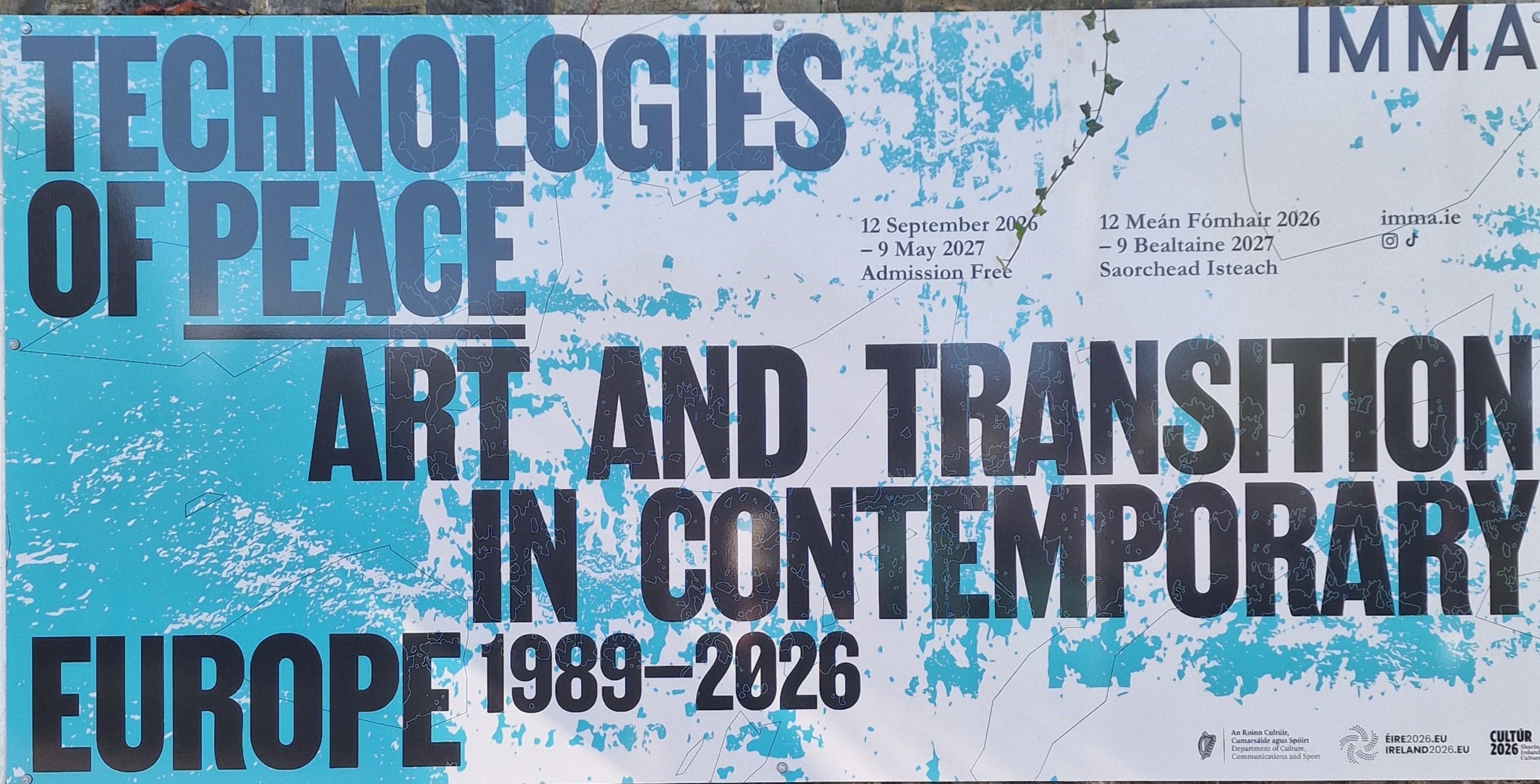
    Technologies of Peace: Art and Transition in Contemporary Europe began showing in the Irish Modern Museum of Art on the 12th September.

    IMMA Front Entrance Photo: Mark Mircescu

    The exhibit explores the concept of peace through an artistic lens, along with the tools used to achieve it.

    Thematically, Technologies of Peace considers how artistic practices can support healing, foster critical thinking, and contribute to the ongoing work of peacebuilding.

    It focuses on the period between 1989 – 2026, connecting Ireland’s history of complex politics with other European countries that have faced a similar path, transforming from a place of conflict to peace and stability.

    The project reflects on the changes that marked the significant political and social shifts in Ireland, specifically in Northern Ireland.

    “The Good Friday Agreement of 1998 offers a powerful example of a landmark manifestation of peace,” Cremin said.

    It’s divided into multiple rooms and two corridors, that exhibit the different cultural aspects and historical events that each country experienced, such as the Eastern European Bloc or the Middle East.

    The Northern Ireland exhibit explores the years 1968-2026,with pieces on Bloody Sunday or the Northern Ireland Assembly Act of 1973, to demonstrate the growth and change that each nation has experienced.

    “What it highlights is that peace is an ongoing process; one that continues to require care, compromise, and vigilance,” Cremin said.

    The International section shows significant political and social events from around the world, such as the 9/11 attacks in New York that birthed a new age of surveillance and warfare, or the creation of the World Wide Web in 1991 that changed the way we distribute information and communicate forever.

    Technologies of Peace explore the mechanisms that allow societies to move from the destructive nature of violence using dialogue, listening, cultural memory, education, which allows individuals to live together despite their differences.

    ‘I don’t know what Union I want to belong to’ (2003) by Vlad Nanca was created to contrast eastern and western ideals and societies. The piece itself represents the tension between the communist past of the USSR and the future of Europe under a new economic community, reflecting on the uncertainty of transition.

    ‘I don’t know what Union I want to belong to’ (2003) by Vlad Nanca Photo: Mark Mircescu

    Language and Translation highlights the most powerful technologies that change society as they shape identity, convey memories, and determines how histories can be remembered or forgotten.

    Mother Tongues and Father Throats (2012), by Payam Sharifi and Kasia Korczak, uses a huge black and white drawing of an open mouth, showing the parts of the mouth and throat used to produce certain sounds in Arabic and Hebrew. The diagram points to these areas demonstrating the shared spaces for communication and social exchange between different cultures.

    Mother Tongues and Father Throats (2012) by Payam Sharifi and Kasia Korczak Photo: Mark Mircescu

    “I think visitors will come away thinking differently about peace, about the role that art and culture can play in bringing people together, and perhaps about their own role in creating a more inclusive and peaceful society,” Cremin said.

    The exhibition will continue into the summer of 2027, officially ending on May 9th.