
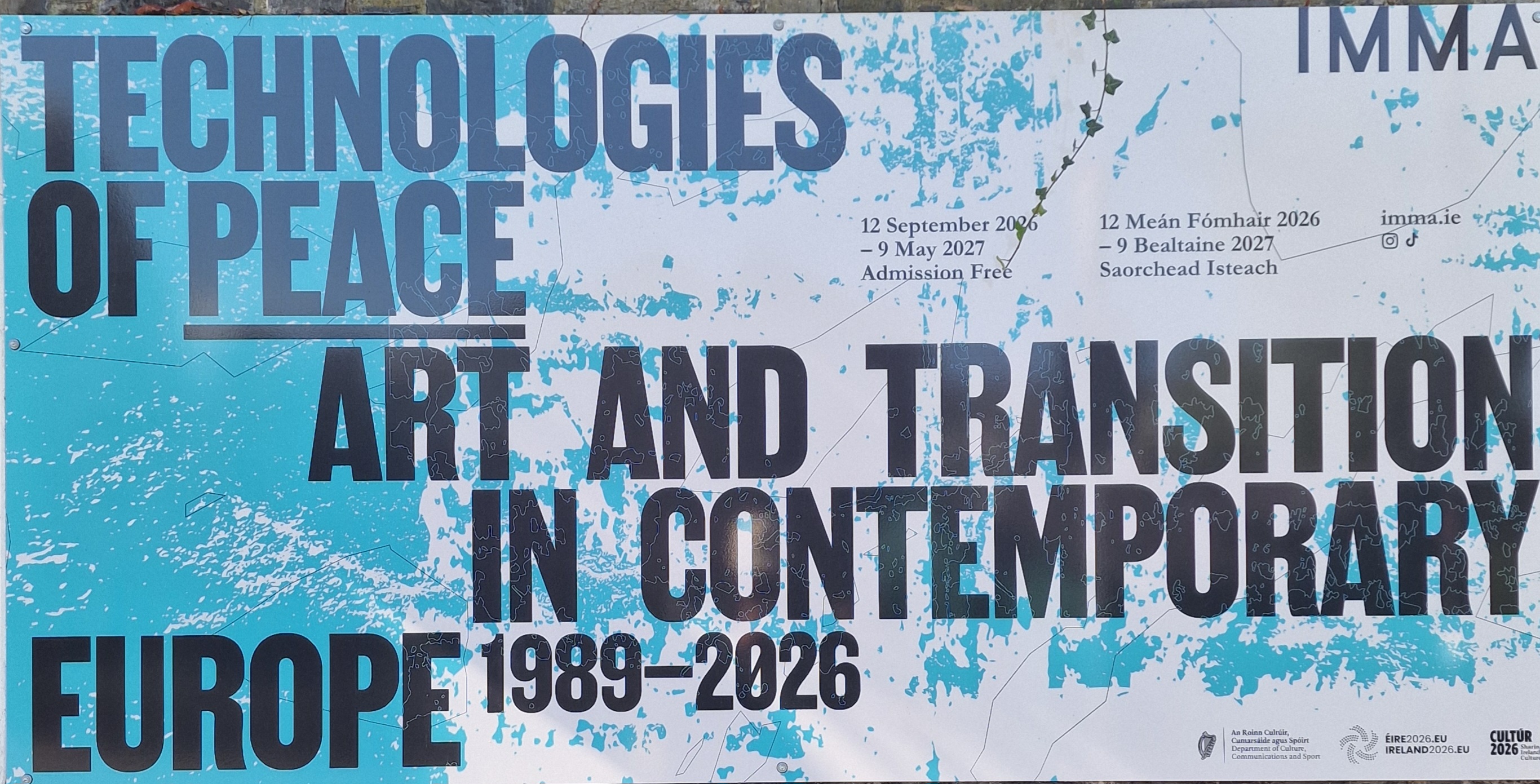
Throughout the course of history, violence has been prodominantly showned to divide people, this exhibits demonstrates through conflict, can birth peace and harmony among cultures into becoming a better society.
“It’s an important exhibition for people to come because it speaks directly to the world we’re living in today and the Irish experience,” Mary Cremin, Head of Programming, said.
Technologies of Peace: Art and Transition in Contemporary Europe began showing in the Irish Modern Museum of Art on the 12th September.

IMMA Front Entrance Photo: Mark Mircescu
The exhibit explores the concept of peace through an artistic lens, along with the tools used to achieve it.
Thematically, Technologies of Peace considers how artistic practices can support healing, foster critical thinking, and contribute to the ongoing work of peacebuilding.
It focuses on the period between 1989 – 2026, connecting Ireland’s history of complex politics with other European countries that have faced a similar path, transforming from a place of conflict to peace and stability.
The project reflects on the changes that marked the significant political and social shifts in Ireland, specifically in Northern Ireland.
“The Good Friday Agreement of 1998 offers a powerful example of a landmark manifestation of peace,” Cremin said.
It’s divided into multiple rooms and two corridors, that exhibit the different cultural aspects and historical events that each country experienced, such as the Eastern European Bloc or the Middle East.
The Northern Ireland exhibit explores the years 1968-2026,with pieces on Bloody Sunday or the Northern Ireland Assembly Act of 1973, to demonstrate the growth and change that each nation has experienced.
“What it highlights is that peace is an ongoing process; one that continues to require care, compromise, and vigilance,” Cremin said.
The International section shows significant political and social events from around the world, such as the 9/11 attacks in New York that birthed a new age of surveillance and warfare, or the creation of the World Wide Web in 1991 that changed the way we distribute information and communicate forever.
Technologies of Peace explore the mechanisms that allow societies to move from the destructive nature of violence using dialogue, listening, cultural memory, education, which allows individuals to live together despite their differences.
‘I don’t know what Union I want to belong to’ (2003) by Vlad Nanca was created to contrast eastern and western ideals and societies. The piece itself represents the tension between the communist past of the USSR and the future of Europe under a new economic community, reflecting on the uncertainty of transition.

‘I don’t know what Union I want to belong to’ (2003) by Vlad Nanca Photo: Mark Mircescu
Language and Translation highlights the most powerful technologies that change society as they shape identity, convey memories, and determines how histories can be remembered or forgotten.
Mother Tongues and Father Throats (2012), by Payam Sharifi and Kasia Korczak, uses a huge black and white drawing of an open mouth, showing the parts of the mouth and throat used to produce certain sounds in Arabic and Hebrew. The diagram points to these areas demonstrating the shared spaces for communication and social exchange between different cultures.

Mother Tongues and Father Throats (2012) by Payam Sharifi and Kasia Korczak Photo: Mark Mircescu
“I think visitors will come away thinking differently about peace, about the role that art and culture can play in bringing people together, and perhaps about their own role in creating a more inclusive and peaceful society,” Cremin said.
The exhibition will continue into the summer of 2027, officially ending on May 9th.
You must be logged in to post a comment.