Tag: Black History Month

  • A Way to Celebrate Black History Month in Ireland

    A Way to Celebrate Black History Month in Ireland

    By Mene Agbofodoh

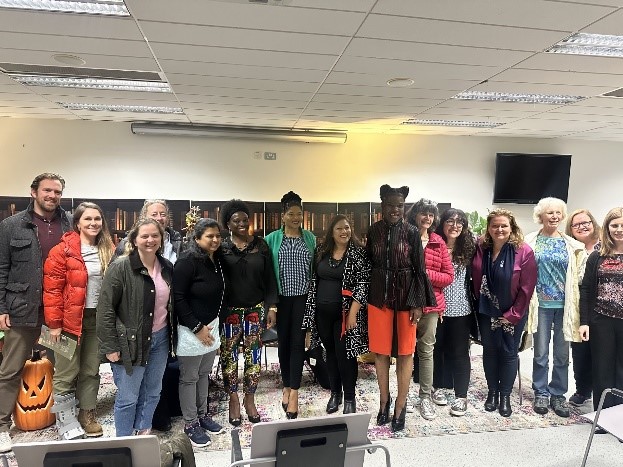
    The Red Line Book Festival held a book conference for influential Black Women in Ireland to celebrate Black History Month. 

    The Red Line Book Festival is a cultural event that happens once every year. 

    It is held to appreciate and celebrate literature, storytelling, and creativity.  

    It aims to bring people together from across Dublin and Ireland, spark conversations, and inspire the next generation of writers and readers. 

    The Red Line Festival is normally held throughout an entire week with multiple events happening throughout the week. and one of the events was ‘Stories of Black Women in Ireland’. 

    Luas Red Line in Tallaght. Photo: Mene Agbofodoh 

    Dr. Ebun Joesph, a special rapporteur for racial equality and racism Ireland and founder of Anti-Ireland and Black Studies was also in attendance for the talk. 

    Melissa Bosch, (Head of Diversity, Equity, and Inclusion at where?, Eya Lawani, a Special Needs assistant who has a background in assisting charities for Black Irish children, and Carline Thompson, a nurse, researcher, entrepreneur, and activist, also attended to talk about their new book, ‘Equity in the Workplace Stories of Black Irish Women in Ireland’. 

    Left to Right- Eya Lawani, Carline Thompson, Melissa Bosch, and Dr. Ebun Joesph speaking at their Red Line Book Conference.
    Photo: Mene Agbofodoh 

    The purpose of the book was to amplify the voices of black Irish women and examine their experiences within the Irish labour market.  

    It aims to uncover the challenges they face and their perceptions of achieving equity in the workplace.  

    Despite progress in gender parity, disparities still exist, with women being underrepresented in leadership roles and facing lower pay, poor working conditions, and instances of bullying and harassment. 

    Dr. Ebun Joesph spoke about the importance of women finding their voices within the workplace. 

    “I think it is important that us women find our voice especially us black women, so that our stories can be heard, to be told and not told from a perspective that doesn’t truly represent us,” she said 

    Melissa Bosch talked about understanding the power your voice has. 

    “When you see something that is wrong along the lines of racism and discrimination, your voice is so powerful and when speak out against these things, it can drive change,” she said. 

    “If we do not speak about things like this and if we don’t open our minds, our hearts to create those spaces for this kind of level of dialogue, we are not going to change anything. Ireland won’t be able to move forward”. 

    Melissa Bosch’s chapter in the book revolved around trying to help people see their place in the world and what they can do to help marginalized people. 

    “Whatever ethnic background you come from, whatever demographic background you come from, you have the power to make that change, it’s about understanding your privilege and position in this world.”. 

    Carline Thompson spoke about the challenges of writing her chapter in the book. 

    “One of the challenges I had when writing my chapter wasn’t the 2,500-word count even though I only had a week to do it, it was how do I write so much about this topic without exceeding the limit?” 

    “People think racism only happens in the workplace however, it’s everywhere around you. It’s in the supermarket where you feel you’re being watched by security whilst you’re shopping, it’s in the library, it’s in the restaurant when you’re going out to eat with family and you get stares throughout the night”. 

    Eya Lawani also spoke on her challenges when she was writing her chapter. 

    “My problem or challenge about writing my chapter was I didn’t know how I was going to convey the message that systematic racism is the problem in our society without blaming white people as a whole.” 

    “It was a very difficult topic to write because I had to relive certain moments in my life that made me feel belittled, moments when applications were rejected despite having my bachelor’s degree from Nigeria but because it wasn’t an Irish degree it wasn’t good enough”. 

    “I struggled with the fact people in society were willing to accept I could be discriminated against because I was a woman but If I said I felt discriminated against because I’m black suddenly it couldn’t possibly be because I’m black and having to convey that in my chapter was very challenging.” 

    Black History Month is observed in Ireland from the 1st of October until the 31st

  • Five Black businesses that are making serious money moves

    Five Black businesses that are making serious money moves

    A package delivered by Nogora. Photo by Dolapo Agunbiade

    One of the most impactful ways to celebrate Black History Month is by putting your money where your mouth is. By supporting Black businesses, you are spreading wealth around the Black community and closing the racial wealth gap.

    Over the past few years in Ireland, there has been a steady rise in Black businesses and although I cannot name them all, here are five affordable ones to follow this lockdown.

    An array of credit cards popping out of a jean’s pocket. Photo by Dolapo Agunbiade

    “It’s not for profit. It’s meant to take a stand”

    Funto Joye

    1 Nogora Beauty

    On 28 January 2021, Nogora Beauty became Ireland’s first Black-owned e-commerce hair care and beauty supply store. The site features a wide range of products, from silk bonnets and wave sponges to lashes and lip gloss. Nogora Beauty was created as a response to the shortage in supply of Afro-hair products displayed in Irish stores. 

    The creator – Funto Joye – in an interview with The City said, “I want it to be for our community.” He continued, “It’s not for profit. It’s meant to take a stand.” 

    Nogora Beauty stocks popular Black-used brands like Aunt Jackie’s, Eco Styler gel and Cantu, while also featuring products from Black Irish businesses: byO and Melt Effect (more on that later).

    2 Awe-some Creations

    Felicia Awe’s company, Awe-some Creations,  is not one that we’ll be saying bye to anytime soon. Her business can satisfy all your delicacy needs and more. They do it all: savoury dishes, chocolate fountains and flavourful drinks. 

    The business started 10 years ago at church programme Summerfest, where Awe was asked to bring drinks. From there, at the tender age of 19,  her career in mixology began. Awe-some Creations can cater for any occasion: business events, birthdays and bridal showers on small and larger scales. 

    “I feel it’s very important to support and promote black businesses but if we don’t support ourselves how can we expect others to do so?” Awe told The City.

    The brand even runs masterclasses showing you how to make some of their refreshing cocktails. Their site is currently under construction. However, you can still order through email, Instagram, Facebook or directly over the phone. 

    3 Bees of Honey

    Mimmie Malaba’s vegan self-care brand Bees of Honey is the wellness brand you wish you’d known about at the start of lockdown number one. Since 12 February 2020, Bees of Honey has been bringing customers the daily essentials to start their self-help journey. 

    Their 100% organic products promote stability, peace and comfort. Their whipped body butter, healing candles and sage sticks soothe the spirit while relaxing auras around you. 

    “Supporting a small black owned business is like supporting any other small business. It impacts you as a buyer because we look after you as a person and not just another statistic,” said Malaba.

    Bees of Honey may be fairly young but the company has already had an enormous amount of success. The one-woman brand has been featured in Image Magazine and is certainly one to watch. 

    4 Melt Effect

    Founder Mariam Oshundairo launched Melt Effect in June 2020. She is committed to giving her clients the best foundations to put their best foot forward. 

    For Black women, getting your hair done can be seen as a gruelling task that goes on for hours on end. This is one of the reasons why this brand specialises in providing quality hair products that will keep your edges laid and make your wig stay put. Oshundairo has developed an adhesive formula that’ll leave people asking, “What lace?” 

    Melt Effect items can be found on their site, as well as on the previously mentioned Nogora Beauty. 

    “We invite the world to join in this celebration of African excellence by supporting, while spicing up their wardrobes”

    Umoja Linn

    5 Umoja Linn

    Umoja Linn was created by Liswa McDonald and China Soribe in 2017 during their college days at National University of Ireland Galway. Their Afrocentric fashion brand is a collaboration of African and Irish talent as the two work closely with numerous African designers, photographers and other creatives. 

    The company has had many achievements thus far, and have featured in Country Magazine and Irish Tatler. Umoja Linn’s success goes even further, as their clothes starred in Pharrell Williams and Jay Z’s music video Entrepreneur

    In our discussion about Black History Month, the creators said, “we invite the world to join in this celebration of African excellence by supporting us, while spicing up their wardrobes!”

    Even with their mass successes, every brand I spoke to disclosed the desire for their items to be sold in shops around Ireland. Some even expressed the possibility of opening up their own stores, depending on future restrictions. 

    This is the end of this Black History Month series. However, celebrating and supporting Black accomplishments shouldn’t be limited to once or twice a year. To truly make a difference, Black efforts should be recognised at the same volume as White ones. This is the only way we’ll ever have a harmonious society.

  • Podcast: Black and Irish on ‘Embracing the dynamics of a modern, diverse Ireland’

    Podcast: Black and Irish on ‘Embracing the dynamics of a modern, diverse Ireland’

    Black and Irish logo

    Black and Irish is an organisation that looks to celebrate and share the stories of black and mixed raced people living in Ireland. In light of Black History month, I wanted to chat with Eric Ehigie, the political coordinator of Black and Irish, to hear about their organisation’s mission as well as his opinions on racism, representation and identity as an Irish black man in 2021. I recorded this audio piece so that Ehigie could share in his own words his experience and views on these important issues freely.

    Eric Ehigie, the political coordinator of Black and Irish. Photo courtesy of Eric Ehigie

    To find out more about this organisation, follow @black_andirsh on instagram or visit their website.

  • Black history month and how to celebrate it in a pandemic

    Black history month and how to celebrate it in a pandemic

    ‘Ma kpa mi lekun ooo’ painting by Shade Mawoyeka, image used with her permission

    In these uncertain times, we have all been given the burden of figuring out how to navigate festive occasions. One that has recently come upon us is Black History Month. February is the US’s month of choice and the most mainstream – unlike Ireland’s festivities that takes place in October. However, that doesn’t mean that celebrations can’t extend to the rest of the world. 

    People may ask, ‘What is the point?’ or ‘Why are they allowed to have designated times of the year?’ Black History month – also known as African History Month – is a time where we set aside Eurocentric teachings to learn about significant Black events and characters in history. Contrary to widespread belief, the month was not prescribed to victimise Black people but to take time out of the year to commend their efforts and contributions to society. 

    Here are some ways you can mark the occasion from the comfort of your home.

    Conversations

    One major way you can join in this month is simply by talking. Topics that are deemed as taboo, such as race, should be discussed thoroughly throughout the month. Using social media platforms such as Instagram, Facebook or Twitter is a great way to spread awareness of racial bias and keeping these conversations alive. As American political activist Angela Davis once said, “In a racist society, it is not enough to be non-racist. We must be anti-racist.” 

    Photo by Jopwell on Pexels.com

    It should also be noted that these discussions should not be used as an opportunity to alleviate white guilt. Usually when race is brought up, numerous media outlets solely focus on negative aspects and as important as it is to talk about colourism and micro-aggressions, it is just as important to explore the brighter side of Black people’s experiences. 

    Podcasts

    Photo by Tommy Lopez on Pexels.com

    Another way to commemorate the month is by listening to podcasts. If you do not know how to instigate a conversation on racial injustice or inequality, then listening is key. By listening to Black experiences, you can deduct information from their stories and then share what you learnt with others. Apple and Spotify are awash with podcasts that delve into a myriad of topics and race is no exception. 

    By listening to informative voices, you can get a better insight into what it means to be a minority from all corners of the globe. GirlTrek’s Black History Bootcamp and Black History Year are aptly named African American podcasts that reflect on Black heroes, the past and how far American society has progressed racially.

    Some may claim that there is a disconnect between the racial climate in the United States and Ireland. However, podcasts such as Black and Irish, Where’s Your Head At? and Oh Man Podcast unveil the curtain of race related conflict that lies within the country.  

    Literature

    You can also celebrate the month by reading books and watching films that feature Black protagonists. By showing your support to Black endeavours, the demand for artistic works created by minorities increases. 

    Thanks to technology, there is a wide scope of Black literature to admire across various platforms. The book Don’t Touch My Hair by Emma Dabiri – based on Emma’s perception of growing up in Ireland as a mixed-race child while tackling the complexities of Black hair – can be found on iBooks, Amazon and other notable websites. 

    As for films, this year Virgin Media’s Dublin International Film Festival will be held virtually. The line-up showcases a variety of Black talent, the most noteworthy being Lia Campbell’s short film To All My Darlings, a story of love, loss and community. 

    Photo by Suzy Hazelwod on Pexels.com

    These are just a few ways you can educate yourself and assist others this Black History Month. Nevertheless, the conversations don’t have to stop and start twice a year. In an online post about the month, Amanda Adè of the Black and Irish podcast stated, “being culturally responsive means acknowledging [Black] culture outside of dedicated holidays.” 

    Check in with us again next week for more ways to support the Black community.